Eleven markets · every rate published · free

Find out what your number is.From the Sanskrit निवृत्ति — freedom from obligation. The state financial independence is actually meant to be.

Most plans do not fail because markets crash. They fail quietly, over thirty years, because inflation and healthcare were underpriced on day one — and because compounding rewards starting early far more than it rewards saving harder later. Eight figures is enough to find out which kind yours is.

Start your planSee how it works

निवृत्तिni-VRIT-tee

3.24×

what the same month of spending costs after thirty years at 4% a year — the rate India’s central bank targets. Nothing about the life changed

6 years

for a medical bill to double at India’s 12% trend. A grocery bill takes eighteen. Most plans price both at one rate

30 years

of spending with no salary behind it, if you stop at 60 and live to 90. That is the bill all of this is about

+33%

more corpus after thirty years from one extra point of return — 7% against 6%. Both assumptions are shown, and both are yours to change

New · the Freedom Ladder

Knowing your number is half of it. Knowing where it should sit is the other half.

A corpus is not one pot. Survival is what you can reach today, for a shock that will not wait. Sustenance is the runway that stops you selling investments at a loss to eat. Sufficiency is the number itself. Surplus is whatever sits beyond independence.

They are cumulative, not four buckets: every rupee you hold counts toward the rung it reaches and toward every rung above it, so the top of the ladder is simply your FI number. Each rung says how much is enough, what it should be held in, and how far along you are — worked out from your own figures, with the arithmetic shown.

How the Freedom Ladder works →

The problem

Inflation is quoted yearly. It decides things over decades.

At 4% a year prices roughly double in eighteen years, and they never give the ground back. Medicine and education have outrun the general rate in almost every economy — three times over in India, on the figures this product projects with.

A plan that prices a hospital stay or a degree at the headline rate understates the two lines that grow fastest, and the gap is invisible until the decade it falls due. Nivritee inflates every category at its own rate, because that is the only version that is true.

Why this compounds →

A quick gut check

Three ways a plan quietly goes wrong.

Not hypotheticals. These are among the things Nivritee reads your plan for, and the reason a first draft usually looks fine and is not.

Healthcare

Priced at the general rate, or not at all

Medical costs compound faster than everything else in almost every economy. A plan that uses one inflation rate for everything understates the single line that grows fastest, and nothing about the chart looks wrong while it does.
The 4% rule

Borrowed from one market and one era

It was derived for a particular country, currency and period. Run it somewhere else, at a different withdrawal rate, and it can hold for years before it does not — which is exactly the failure a year-by-year projection shows and a rule of thumb hides.

One number

"Monthly spending", typed once

One figure standing in for groceries, utilities, transport, insurance and the rest is a guess wearing a decimal point. It is also the input the whole projection leans on hardest, which is why you are asked to break it down rather than quietly trusted.

What you get

One screen, and every figure on it computed.

A verdict in one word and the sentence reconciling it with the number underneath. Four headline readings. A freedom index out of 100 and where you sit among households in your own country. The burn-down across your whole life, with any of eight historical stress tests drawn onto it.

And a plan-confidence meter saying how much of it rests on your figures rather than our assumptions — because a projection built from defaults is a projection about nobody, and it should say so.

Every reading, and where it comes from →

Living here, settling there

Earning in one country and retiring to another is a different plan, not a conversion.

Tell us where you live now and where you will settle. The second fixes the currency, the six rates and the statutory schemes your plan is built from. The first is what your spending today is judged against, because a grocery bill in Singapore is not evidence about Mumbai.

Every holding, salary, loan and goal can be held in its own currency. They are converted once, before anything is computed — and a row we have no rate for stays in its own units and says the totals are short, rather than quietly counting as zero.

How a two-country plan works →

The difference

A number is only meaningful somewhere.

The same savings buy very different lives in Mumbai, Singapore or Manchester. Inflation, returns, medical trend and education costs are not the same in any two of them, and the statutory schemes people are already paying into are not either.

Every rate is published on the page it is used on, with its source, and every one of them is yours to override. Where a figure is an assumption rather than a measurement, the app says which.

Where the numbers come from →

The cost of waiting

Compounding rewards starting early far more than it rewards saving harder later.

₹10,000 a month at 7% a year, to age 65. Same contribution, same rate, same finish line — the only variable is when it began. Illustrative and rounded; your own plan uses your figures and your market’s rates.

Start at 25

40 years of growth

₹2.6 Cr

Start at 30

35 years of growth

₹1.8 Cr

Start at 35

30 years of growth

₹1.2 Cr

Start at 40

25 years of growth

₹81 L

How it works

Eight figures to an answer. The detail whenever you want it.

No linking accounts, no bank logins, no statement upload. You type what you know, and change it whenever it changes.

01

Where you will live

Where you are now and where you will settle. That fixes the currency, six rates and the statutory schemes the plan is built from.

02

What you have and owe

Savings, investments, property and loans — each row in whichever currency it is actually held in, converted only where a total needs it.

03

What comes in and goes out

Income today and what your life costs. The projection prices that same life forward at each category’s own inflation rate, never one blended one.

04

Your answer

A year-by-year ledger to the end of the plan, eight stress tests, and one word for whether it holds — with the reasoning underneath it.

What to do about it

Then it names the parts of your plan that are still guesses.

Everyone types one number for “monthly spending” and it is always too low. Nivritee reads your plan for the specific things that are missing — a home with no upkeep in it, no healthcare anywhere, a loan with no end date — and says what each one would cost you.

Every flag quotes a reference point rather than an opinion, and they are ordered by what is most obviously true rather than by what moves the number most. Under-stating a cost is flagged sooner than over-stating one, because an optimistic plan is the failure this product exists to prevent.

How action items work →

How am I doing?

A score out of 100, and an honest answer to “compared with whom?”

The Financial Freedom Index is three things rather than one: how far along you are (half of it), the age the projection actually reaches independence at, and how much shock you could absorb — emergency cover and the debt you carry.

Beside it, where you sit among households in your own country, against that country’s own survey, aged forward from the year it was collected. Where no survey exists, you are told that instead of being given a number somebody invented.

What the index is made of →

What it means

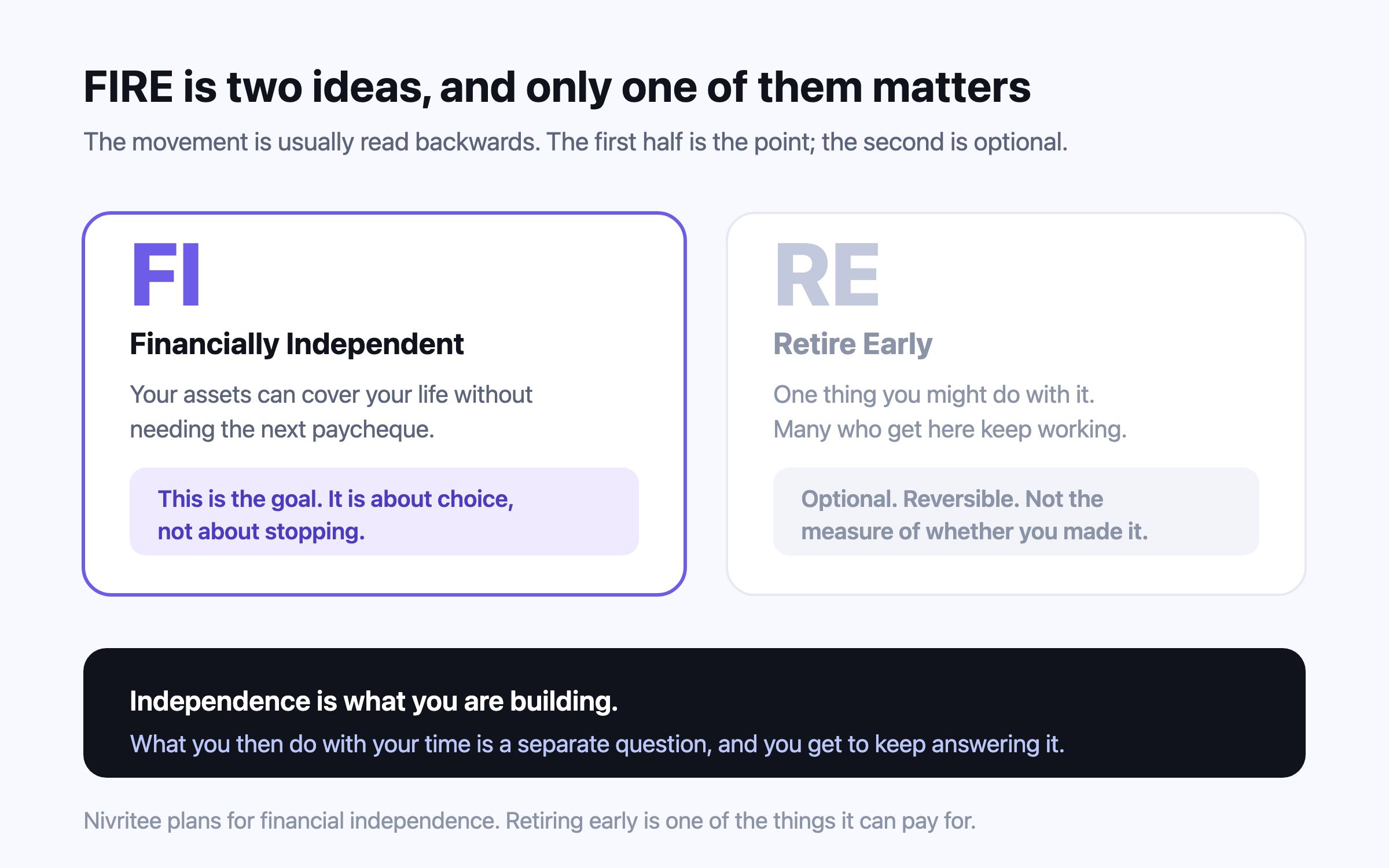
Independence first. Retiring early is optional.

FIRE is usually remembered for its second half. The first half is the achievement: reaching the point where your assets can carry your life without the next paycheque.

What that buys is not an empty calendar. It is a year off that does not derail the next thirty, a venture where failing costs time rather than the house, work you would choose at a salary you would not have, and being there when someone needs you.

Why independence, not early retirement →
FIRE split into two halves. FI, Financially Independent, is highlighted: your assets can cover your life without needing the next paycheque — the goal, about choice rather than stopping. RE, Retire Early, is greyed out: one thing you might do with it, optional and reversible, and not the measure of whether you made it.

The planner

A seasoned adviser who never guesses a figure.

Niv spent her career in banking and public finance. She can see your numbers, and when you ask “what if I stopped at 55” she re-runs the projection rather than estimating — the same engine that drew your chart, returning the base and the variant so she can tell you which is larger without doing arithmetic of her own.

She explains figures; she never invents them. If she proposes a change to your plan, nothing happens until you press the button.

What Niv can and cannot do →

The promise

Nobody reads your finances. Not even us.

There is no internal tool that displays what you enter, because we did not build one. That is an architectural decision rather than a policy, which is why it holds: the administrative panel shows usage counts and cannot show a figure.

No email we send carries an amount, a rate or a verdict. Encrypted in transit and at rest, never sold, never pooled, and hard-deleted — not flagged — when you say so.

How we handle your data →

What is next

One thing we are building, and are not pretending to have.

It is marked Coming soon inside the product too, with a way to register interest and nothing else behind it.

Coming soon

Tax Planner

What the drawdown costs you in tax, and the order to draw in. Every figure in Nivritee today is pre-tax, and the app says so wherever it matters rather than leaving you to find out.

Already here

Everything else on this page

The projection, the stress tests, the index, the percentile, the action items, the two-country plan and the Freedom Ladder are all built and running. Nothing on this page is a mock-up of something we intend to write.

Find out what your number is.

About two minutes to a first answer, and you can change every assumption we use. If the answer is uncomfortable, it is better to know now — that is the whole point of projecting it.

Start your plan