For global families

Earn in one country. Settle in another. One plan.

Salary in dirhams, a flat in Pune, school fees in Dubai, an index fund in dollars and a move you have pencilled in for 55. Each row keeps its own country, dates and currency, every cost rises at its own country’s prices, and the whole household projects in the currency you will actually spend.

Your Location

Where you earn and spend todayUnited Arab EmiratesNew rows start here · today’s spending is read against it
Where you will be livingIndiaFixes the plan’s currency, rates and schemes

When will you move to India?When I stop workingat 55

RowWhereStartsEndsAs enteredIn INR
SalaryUAETodayAt 55AED 42,000 / mo≈ ₹9.53L / mo
Rent from the Pune flatIndiaTodayAt the moveINR 30,000 / mo₹30,000 / mo
Rent in DubaiUAETodayAt the moveAED 9,000 / mo≈ ₹2.04L / mo
School feesUAETodayAt the moveAED 4,000 / mo≈ ₹90,800 / mo
Living in DubaiUAETodayAt the moveAED 7,000 / mo≈ ₹1.59L / mo
Living in PuneIndiaAt the moveINR 1,25,000 / mo₹1.25L / mo
Home loanIndiaTodayPaid off 2039INR 48,00,000₹48L
S&P 500 ETFNYSEUSD 37,400≈ ₹31.19L
Each row inflates at its own country’s rates and converts once, at today’s rate, before anything is computed. A row with no rate stays in its own units and says so.

47%

how far the rupee’s buying power drifts against the Singapore dollar over twenty years, at the two central banks’ targets of 4% and 2%. A conversion done once and frozen misses all of it

how much faster medical costs rise than prices generally in India — 12% against 4%. Settling there changes which rates your later life is priced at

2.2×

what a year of education in India costs ten years from now at its 8% trend. Where the children study is a figure, not a detail

15%

the fall in what money abroad buys, applied the day you stop working, in the stress test modelled on the pound after 2016

Earn here, settle there

Say where you earn today, where you will live, and when you move.

Two questions, answered separately. Where do you earn and spend today? sets where new rows start and what your current spending is compared against. Where will you be living when you stop working? fixes the plan’s currency, its rates and its statutory schemes.

Then when will you move — when you stop working, at an age you choose, or you already live there. Rows that stop at the move stop; rows that start there start. Nothing you have typed is rewritten by any of it.

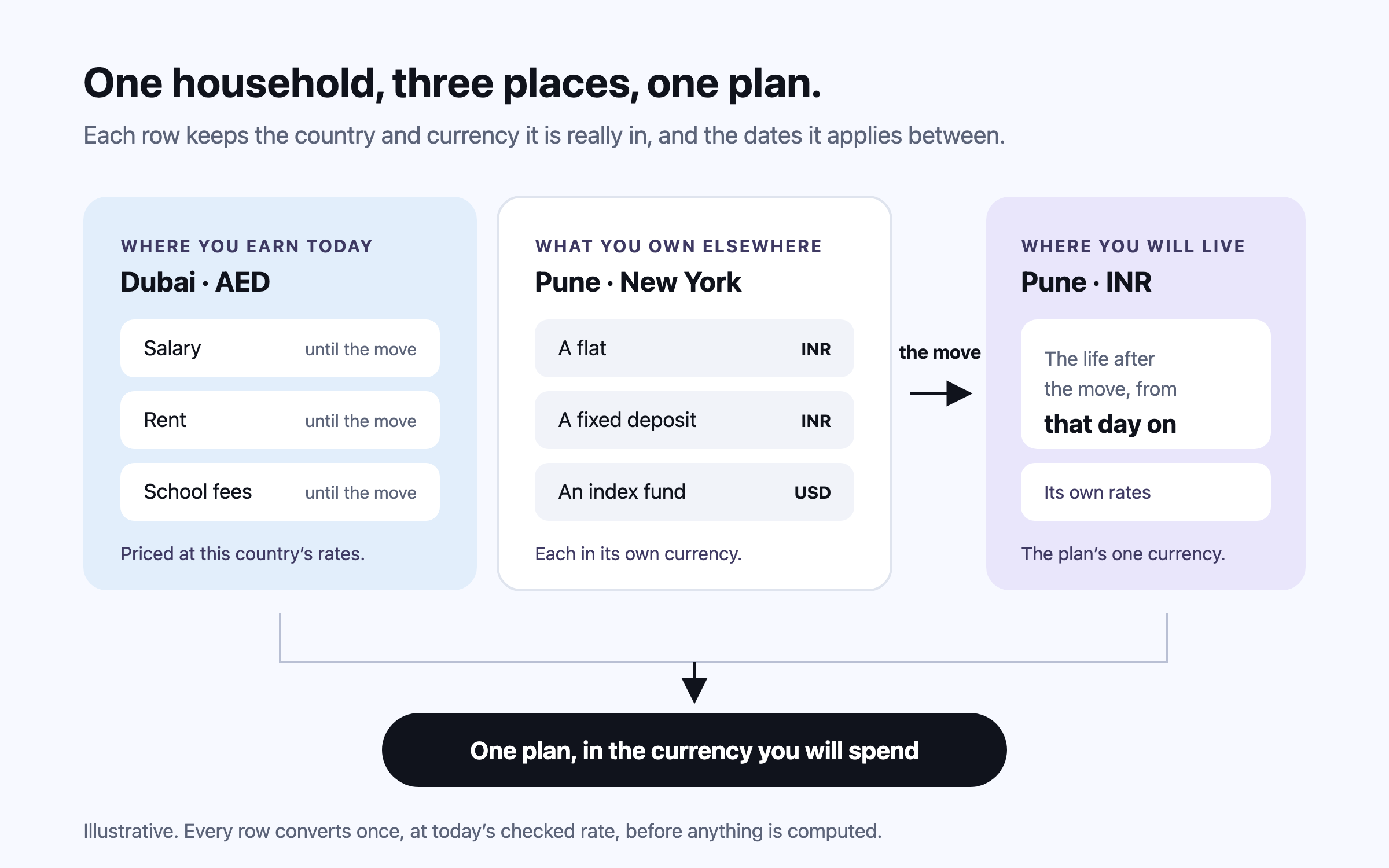
One household drawn across three places on a timeline. Today, in the country where they earn: a salary, rent and school fees, each in that country's currency. Beside it, what they already own elsewhere: a flat and a fixed deposit in the home country, and an index fund listed in the United States. An arrow marked the move runs to the country where they will live when they stop working, where the life after the move is priced in its own currency and at its own rates. Beneath the timeline, every row feeds one plan in the currency they will spend.

One set of totals

Salary in dirhams, rent in rupees, one household.

What you earn, what you spend and what you owe, each a year in your plan’s currency with the exact figure under the rounded one. The savings rate and the share of income going on living are read from the rows themselves, whichever country they are in.

Every one of 142 currencies is offered on every money row, shown as a code and a caret. Changing the currency of a figure you already typed always asks whether to convert it or keep the number — it never decides for you.

Prices where they are paid

A cost abroad rises at that country’s prices.

Rent in Dubai inflates at UAE rates until the day it ends; the life you live in Pune afterwards inflates at India’s, with medical costs at 12% and education at 8%. Between the two, the plan allows for the drift in what one currency buys of the other.

Eleven countries to settle in, each with every rate shown and its source, and each rate copied into your own plan to change. Today’s spending is judged against where you live now, never against where you will live later.

What you own, wherever it is

Deposits in two countries, a flat in a third city, one corpus.

A savings account in AED and a fixed deposit in rupees, each named by the country it is banked in. EPF and NPS from the years in India. Gold jewellery. A flat that becomes home after the move — counted for net worth, and never as money to draw down.

Money you set aside as the emergency fund leaves the corpus and sits on the Freedom Ladder’s first rung, so the same rupee is never counted twice.

When the rate moves

Stress-test the currency, not just the market.

Your money abroad buys 15% less applies a fall, on the day you stop working, to everything you hold, earn, pay or expect in another currency — modelled on the pound after 2016. Tick it beside a 2008-style crash and the two compose into one line.

Here that takes a plan that lasts to 90 and runs it out at 82. The Retirement Tracker says so in a word, a figure and a year — and the ledger shows every row it came from.

Investments across exchanges

Holdings in Mumbai, New York and London, valued in rupees.

NSE, BSE and Indian mutual funds beside NASDAQ, NYSE, the London Stock Exchange and US and European funds. Each holding keeps its market’s currency and converts once, so the portfolio and the plan are always the same money.

Investment Performance then asks whether it is earning what your plan assumes — and one of its six readings is how much of it is already in the currency you will be spending.

How Investment Performance works →

Questions families ask

Planning from one country for a life in another.

I earn in the Gulf and will settle in India. Can one plan hold both?

Yes. You say where you earn and spend today, where you will be living when you stop working, and when you move. Salary, rent, school fees and loans keep their own country, dates and currency; the plan reports in the currency of the country you will live in, and each row converts once at today’s checked rate.

Does a cost abroad inflate at Indian rates?

No. A row that names a country rises at that country’s rates until it ends. The life after the move is priced where you will live it — its own inflation, medical and education trends — and your spending today is compared against benchmarks for where you live now.

What if the exchange rate moves against me?

There is a stress test for it. “Your money abroad buys 15% less” applies a 15% fall, on the day you stop working, to everything you hold, earn, pay or expect in another currency — modelled on two recorded moves — and draws the result beside your plan.

Can I hold deposits and investments in several countries?

Yes. Bank deposits in any of 47 countries in their own currency, statutory schemes from your years in India, and stocks, ETFs and funds on NSE, BSE, NASDAQ, NYSE and London — all counted in one corpus.

Put both countries in one plan.

Free, with no bank or broker login. About two minutes to a first answer in the currency you will spend, then add each row in the country and currency it is really in.

Start your plan