Investment Performance

Is your portfolio doing enough — for your plan?

Stocks, ETFs and mutual funds across India, the US and London, priced every weekday and converted into the currency you will spend. The return is an XIRR set against the rate your own financial independence plan assumes — so the question it answers is whether what you hold is carrying your plan.

Investment Performance

Return on what you hold, against your own plan

12.4%a year · your plan assumes 11.0%

+1.4 against the rate your plan projects with

Everything you hold₹1.86Cr₹1,86,00,36052% of it priced daily
  • Priced holdings₹96L5 of 5 listed
  • Gain on what you put in+₹22.5L · +30.6%
  • Today+₹41,300 · +0.43%
  • Held for4 yr 3 mosince June 2022

You put in ₹73.5L Markets added ₹22.5L

Prices as of 11 September 2026 · exchange rates as of 11 September 2026

An illustrative household: Two adults, 38 and 36, two children, earning in Dubai and settling in Pune. Returns are XIRR on priced holdings; typed figures are counted but carry no return.

−17%

less corpus after twenty years if what you hold returns 10% while your plan assumes India’s 11%. One point, quietly, is the gap this page exists to catch

₹77 L

what ₹1,20,000 a year becomes over twenty years at India’s 11% assumption — if the return actually arrives. A SIP is only as good as the rate behind it

100×

the error in reading a London price quoted in pence as pounds. Each holding carries its own quote scale, so a FTSE tracker is not valued at a hundred times itself

15%

fewer dollars a pound bought between May and October 2016. Money held abroad carries an exchange rate as well as a market, and the stress test prices that move

Every holding

Typed once. Priced every weekday. No broker login.

Search by name, ticker, scheme code or ISIN, pick what kind of investment it is, and enter the units and the price you paid. Buys, sells, bonuses, splits and transfers go in a ledger under each holding; a SIP becomes a dated purchase on the day the mandate actually settled.

Every row shows its value, its gain, its own XIRR and thirty days of closes, in your plan’s currency with its own beside it. A holding the feed has not priced yet is valued at what you paid, and the row says so rather than guessing.

Eight markets

India, the US and London, in one currency.

NSE and BSE from the exchanges’ own daily files, Indian mutual funds by scheme code, NASDAQ, NYSE, the London Stock Exchange, US mutual funds, and UK and European funds by ISIN — stocks, ETFs, index funds, ELSS, REITs, bonds, gold ETFs and Sovereign Gold Bonds.

Each holding keeps the currency its market quotes it in and converts once, at a rate checked against a second source before it is used. Every page says which day the prices and the rates are from.

How the money is arranged

Six readings, judged against your circumstances.

Return against your plan, concentration, how much is priced daily, spread across asset classes, markets and currencies, and regular contributions — combined into one score out of 100, each band stated in words as well as colour.

Three of the six are measured against you: the return your plan assumes, the years you have left, and the currency you will be spending. So a 28-year-old holding equities is not marked down for it, and every row says what it was measured against.

What would move this

A ranked list, and your plan re-run at the return you actually got.

The pointers are ordered by how much money each one is about: what is still typed as a single figure, a position carrying too much, contributions that have stopped. Niv reads the same list — she adds no number of her own and names no security to buy or sell.

Once three years and half of what you hold are priced, the page re-runs your whole plan at your actual return and shows what it does to the corpus and the age you reach independence — projected, not promised.

Two figures, never blended

What a market prices, and what you typed, are kept apart.

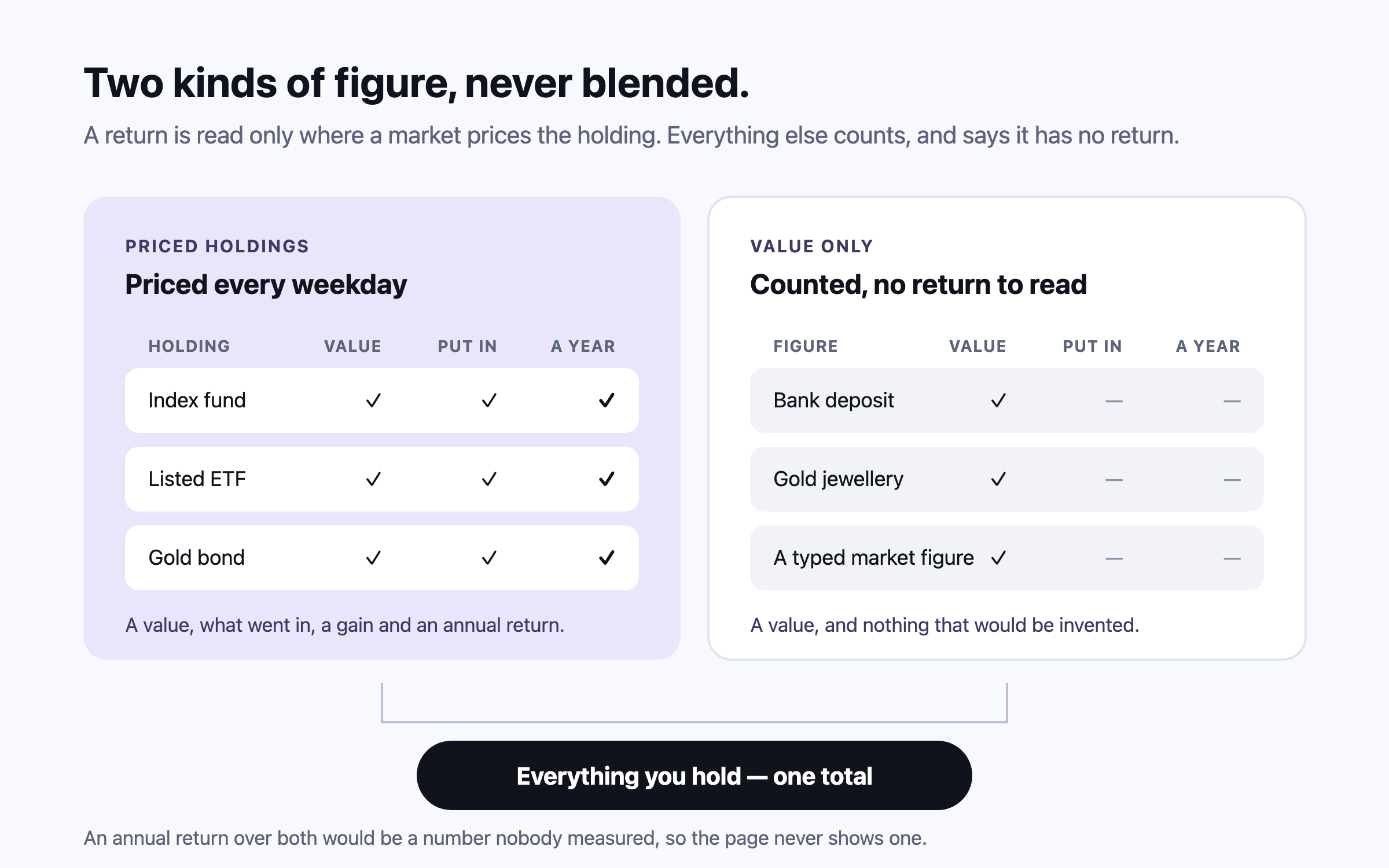
A holding with a ledger and a daily close has a real return. A deposit or a figure you typed has a value and nothing else — so the page shows both totals side by side, and never an XIRR “over everything” that would be a number nobody measured.

The return is shown from the first day, and its colour waits: a two-month return annualised can read +300%, and painting that green would be telling you that you are doing well on four weeks of noise.

Everything a household holds split into two groups. On the left, priced holdings — listed stocks, ETFs and funds — each with a value, what was put in, a gain and an annual return, marked as priced every weekday. On the right, value-only figures — bank deposits, gold jewellery, a typed market figure — each with a value and nothing else, marked as counted in the plan with no return to read. Beneath both, one total labelled everything you hold, and a note that the return is read only from the left-hand group.

Everything else you hold

Deposits, gold, property and schemes sit beside it.

Savings accounts and fixed deposits in any of 47 countries, EPF, PPF, NPS and the schemes of every market, gold jewellery, and property — with the home you live in counted for net worth and never as something to draw down.

All of it feeds the same plan: the Retirement Tracker’s corpus, the Freedom Ladder’s rungs and the Financial Freedom Index. A holding you add changes every one of them, because there is only one set of figures.

Questions people ask

Before you add the first holding.

Do I have to connect my broker or bank?

No. There is no broker login, no account linking and no statement upload. You search for a holding, enter the units and the price you paid — or a SIP — once, and Nivritee prices it from the exchange’s own daily close every weekday after that.

Which markets can I track?

NSE and BSE in India, Indian mutual funds by scheme code, NASDAQ and NYSE, the London Stock Exchange, US mutual funds and UK and European funds. Stocks, ETFs, index funds, equity and debt mutual funds, ELSS, REITs, bonds, gold ETFs and Sovereign Gold Bonds.

What is the return measured against?

The return your own plan projects with. The headline is an XIRR on everything priced daily, set beside the pre-independence return in your plan’s assumptions — so it answers whether what you hold is earning what your plan needs, not whether it beat an index somebody else chose.

See whether what you hold is carrying your plan.

Free, with no broker login. About two minutes to a first plan, then add holdings whenever you like — every reading updates from the same figures.

Start your plan