4%
General inflation
How fast everyday prices rise each year in the plan — the central bank’s published target.
FIRE Planner · FIRE calculator for India
Nivritee’s FIRE Planner projects the corpus your household needs and when you could stop working, in rupees, with Indian inflation, separate education and medical rates, and your EPF, PPF, VPF, NPS and gratuity pre-filled as rows. It is free: eight answers after sign-up, about two minutes.
Your Location
| Country | Currency | Inflation | Medical |
|---|---|---|---|
| India | INR | 4.0% | 12.0% |
| United Kingdom | GBP | 2.0% | 8.2% |
| Singapore | SGD | 2.0% | 11.0% |
| United States | USD | 2.0% | 9.2% |
Eleven countries. Every rate shown, every rate yours to change.
FIRE Planner · your FI number in INR
Your FI number is a year of the life you plan after you stop working, divided by the 3.5% withdrawal rate the planner uses for India, with tax on withdrawals allowed for, your goals added and income that keeps paying netted off. It is projected in INR (₹), with a Financial Freedom Index out of 100 beside it.
Your peer percentile compares your household’s net worth with households of your age in the All India Debt and Investment Survey (NSS 77th round), aged forward from its survey year.
How the FIRE Planner works →Financial freedom index
An illustrative household. Your own score is computed from your plan and stored, not estimated.
India · the rates your plan starts from
A plan for India starts from these, in INR. Each one is shown on your plan and yours to change, and changing one changes nobody else’s.
4%
How fast everyday prices rise each year in the plan — the central bank’s published target.
8%
School and university fees, which rise faster than everyday prices.
12%
Healthcare costs, which rise faster than everyday prices in almost every market.
11%
An assumption, not a forecast — shown so you can change it.
7%
Lower, because money being drawn on is usually held more cautiously.
3.5%
What your FI number assumes you draw from your savings in a year.
Portfolio Tracker · India schemes in one plan
Each is a row in your plan, under its own name, beside your stocks, funds and deposits in any other country — all converted into one currency in the Portfolio Tracker.
How the Portfolio Tracker works →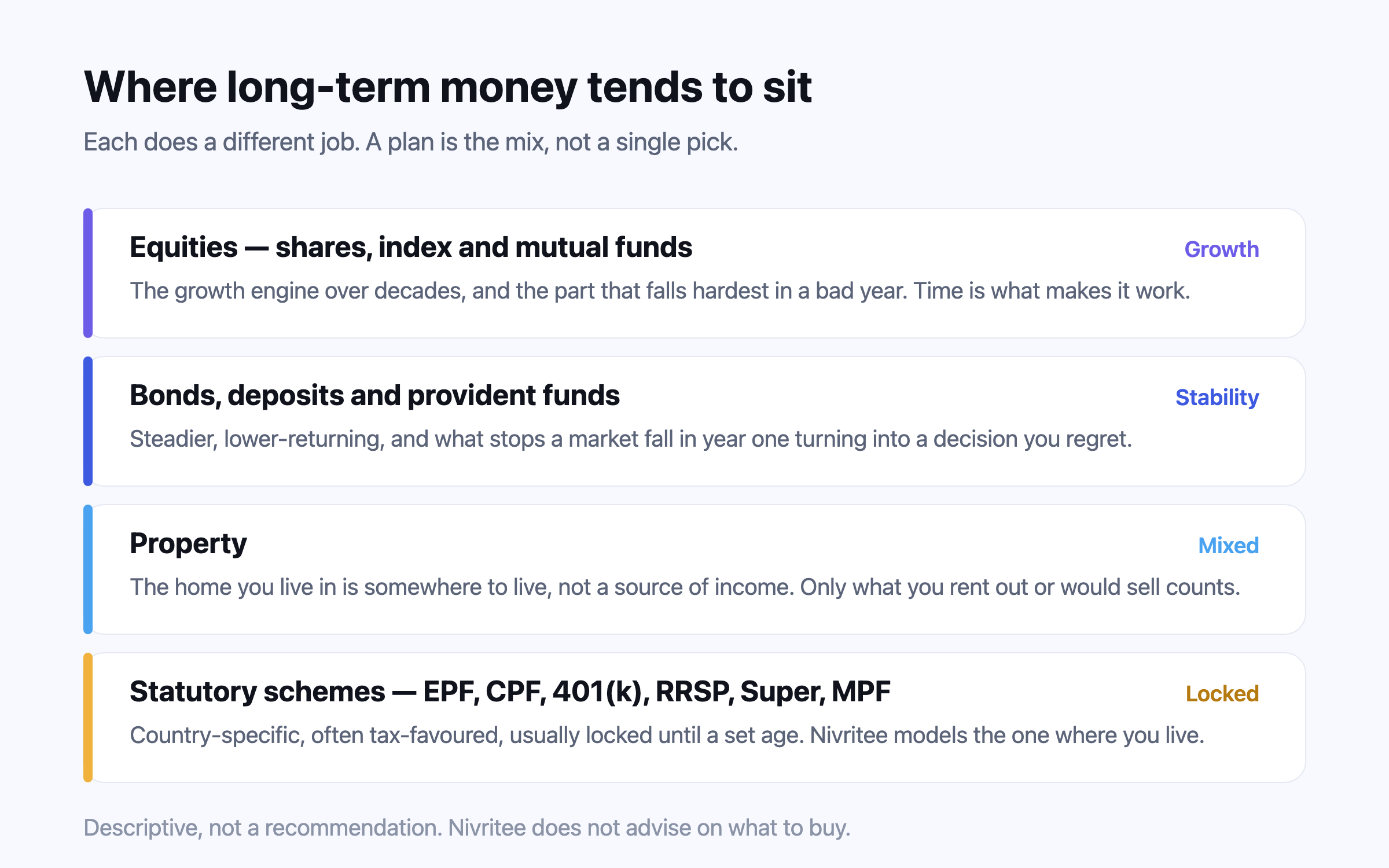
India · when the money can be reached
The ages that decide how a FIRE plan bridges the years after the salary stops.
EPF can be withdrawn in full on retirement after age 55.
A PPF account matures after 15 complete financial years; partial withdrawals are allowed once a year from the seventh.
At NPS normal exit for non-government subscribers, up to 80% of a corpus above ₹12 lakh can be taken as a lump sum and at least 20% buys an annuity.
FIRE Planner · India
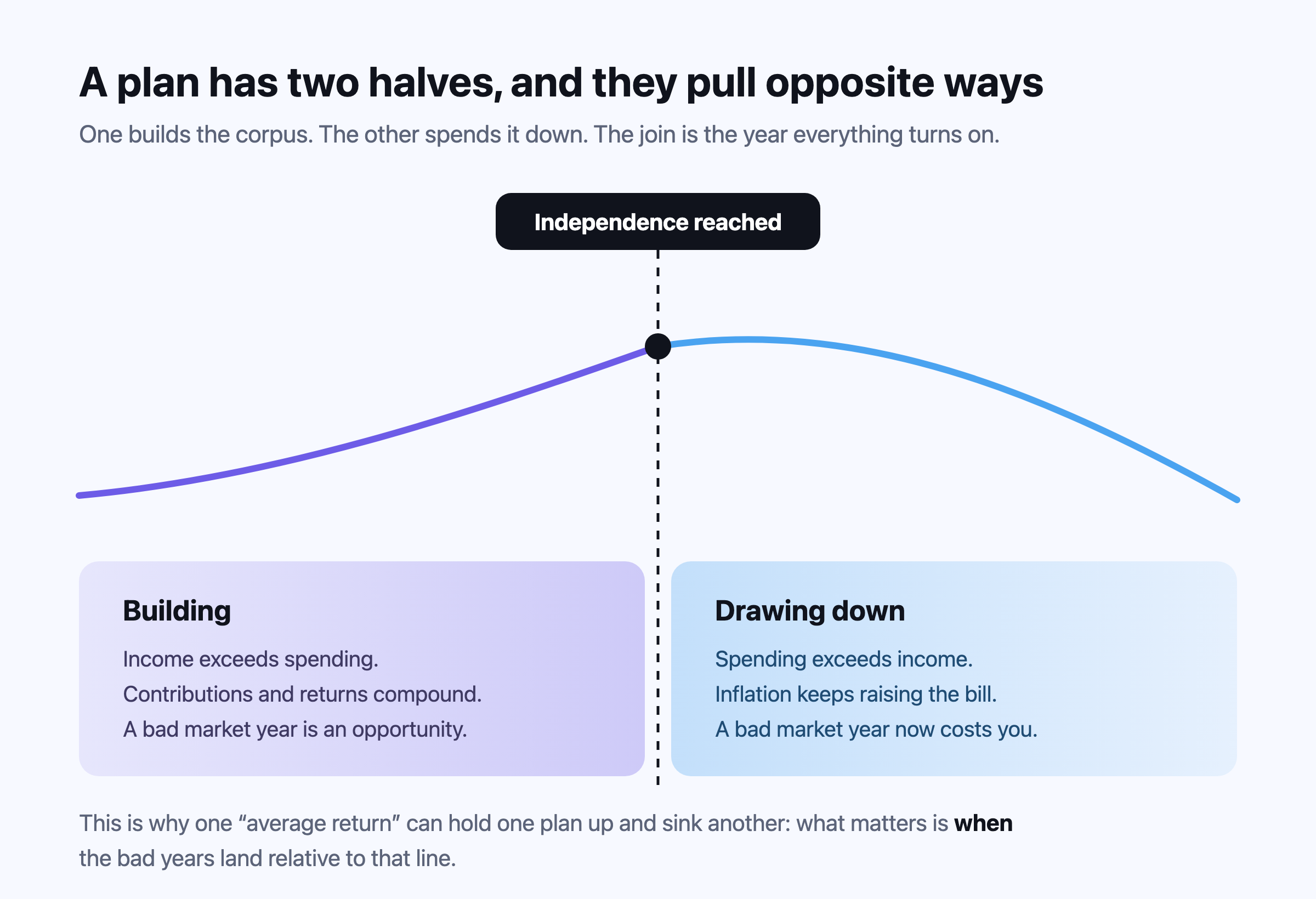
Indian FIRE plans are usually stated as a corpus and drawn down with an SWP. Nivritee’s FI number is that corpus: your yearly need, after any rent or pension still coming in and allowing for tax, divided by a 3.5% withdrawal rate, with your goals added on top.
Education and medical costs outrun headline inflation, so Nivritee grows each at its own rate. Insurers in WTW’s survey project a 14% Asia Pacific medical cost trend for 2026, the highest of any region.
Each scheme opens on its own clock: EPF on retirement after 55, PPF at 15 years, NPS at 60 with at least 20% of a larger corpus going to an annuity. Nivritee’s ledger shows the years in between.
Working abroad and planning to settle in India? An NRI cannot open a new PPF account, and one opened while resident can be continued only until maturity. Nivritee holds a Gulf deposit, US shares and Indian mutual funds in one rupee plan.
Your peer percentile compares your household’s assets with Indian households of your age in the National Statistical Office’s All India Debt and Investment Survey, aged forward from its survey year.
Why Nivritee for India
Your India plan reads the same figures as the other five pillars — what you hold, earn, spend and owe, in whichever countries they are in.
Portfolio Tracker
Stocks, funds and deposits from every country you invest in, valued daily in one home currency, with your real return (XIRR).
Portfolio Tracker →Money Manager
What you earn, spend and owe, benchmarked against your country, your city and each kind of inflation.
Money Manager →Family Finance
Plan as a couple with your own logins, choose what each of you sees, and give your CA or lawyer read-only access.
Family Finance →Niv
Analyses your portfolio, spending, buckets and plan, runs what-ifs on the real projection, and explains. You decide.
Niv →Freedom Ladder
Survival, Sustenance, Sufficiency, Surplus: how much belongs in each bucket, and whether it is in something that bucket can use.
Freedom Ladder →What only Nivritee does
FIRE calculators start from a figure you type. The FIRE Planner starts from everything your household holds, in every country, in one currency — and plans for both of you.
Indian mutual funds, US stocks, a UK fund and a Gulf deposit in one household figure, converted daily into your home currency.
What you hold today feeds the projection of when you could stop. Portfolio trackers do not plan; FIRE calculators do not track.
Two people, one plan, each choosing what the other sees — and your CA or lawyer sees exactly what you share, read-only.
Eleven markets’ inflation, schemes and household surveys, so your spending and your percentile are measured where you live.
Ask Niv a what-if and she runs it on your own projection and reports both figures — she never guesses at arithmetic.
No fee, no commissions, no products. Nobody at Nivritee can open your plan.
FIRE calculator India · questions
The common rule of thumb is 25 times a year’s spending: a 4% first-year withdrawal, raised with inflation, lasted at least 30 years through US market history in William Bengen’s 1994 study. Nivritee’s FI number for India uses a more cautious 3.5% withdrawal rate — about 29 times a year’s need — allows for tax on withdrawals, adds goals such as a child’s education and nets off rent or a pension that keeps paying. Your own corpus depends on what you spend and when you stop.
EPF in full on retirement after 55. PPF at maturity after 15 complete financial years, with partial withdrawals from the seventh. NPS at normal exit: non-government subscribers can take up to 80% of a corpus above ₹12 lakh as a lump sum, with at least 20% buying an annuity.
Yes. Nivritee keeps deposits in 142 currencies, US and UK shares and Indian mutual funds in one plan converted to rupees, and projects a move home with costs inflating at Indian rates. Note that an NRI cannot open a new PPF account and can continue an existing one only until maturity.
Yes. Nivritee’s FIRE Planner is free, with no paid tier. Once you have an account it asks eight questions — about two minutes — and projects your plan year by year in rupees with Indian inflation, education and medical rates, and your EPF, PPF and NPS. You get the corpus you need, a 0–100 Financial Freedom Index, eight stress tests and how you compare with Indian households of your age.
About two minutes to a first answer from eight figures, then add your holdings, your partner and the detail at your own pace. Free, no bank login, and nobody at Nivritee can open your plan.
Start free