Every country, one currency
Indian mutual funds, US stocks, a UK fund and a Gulf deposit in one household figure, converted daily into your home currency.
Money Manager · personal finance app
Nivritee’s Money Manager is personal finance for income, spending, loans and goals: every figure in its own country, currency and dates, compared with the typical range for your country and city, and grown at the rate that kind of cost actually rises. Free.
Overview
Money Manager · income in any currency
A salary in dirhams, rent from a flat in rupees, a pension that starts later: each income row keeps its own country, currency and start and stop dates — any of 142 currencies — and is converted once into the currency you will spend. Income is entered before tax, and the plan does not model tax.
The What you earn card then shows the year, the month, how much of it would survive a job loss and what is left over after spending and loans — 17% for the illustrative household above.
Entering money in another currency →Your Location
When will you move to India?When I stop workingat 55
| Row | Where | Starts | Ends | As entered | In INR |
|---|---|---|---|---|---|
| Salary | UAE | Today | At 55 | AED▾ 30,000 / mo | ≈ ₹6.81L / mo |
| Rent from the Pune flat | India | Today | At the move | INR▾ 25,000 / mo | ₹25,000 / mo |
| Rent in Dubai | UAE | Today | At the move | AED▾ 10,000 / mo | ≈ ₹2.27L / mo |
| School fees | UAE | Today | At 52 | AED▾ 5,000 / mo | ≈ ₹1.14L / mo |
| Living in Dubai | UAE | Today | At the move | AED▾ 9,000 / mo | ≈ ₹2.04L / mo |
| Living in Pune | India | At the move | — | INR▾ 1,25,000 / mo | ₹1.25L / mo |
| Home loan | India | Today | Paid off 2037 | INR▾ 35,00,000 | ₹35L |
| S&P 500 ETF | NYSE | — | — | USD▾ 27,000 | ≈ ₹22.52L |
Money Manager · household budget, benchmarked
Start with one spending figure, or split it into ten categories — housing, groceries, utilities, transport, health, schooling, personal care, travel, dining out and everything else — and break any of them into its own lines. Each line opens empty, with a Use typical button beneath it and the typical range for your country and city tier beside it.
Those ranges are derived, not surveyed, and the product says so. The What you spend card reads your spending as a share of your income — measured against your own money, not anybody else’s.
How spending is benchmarked →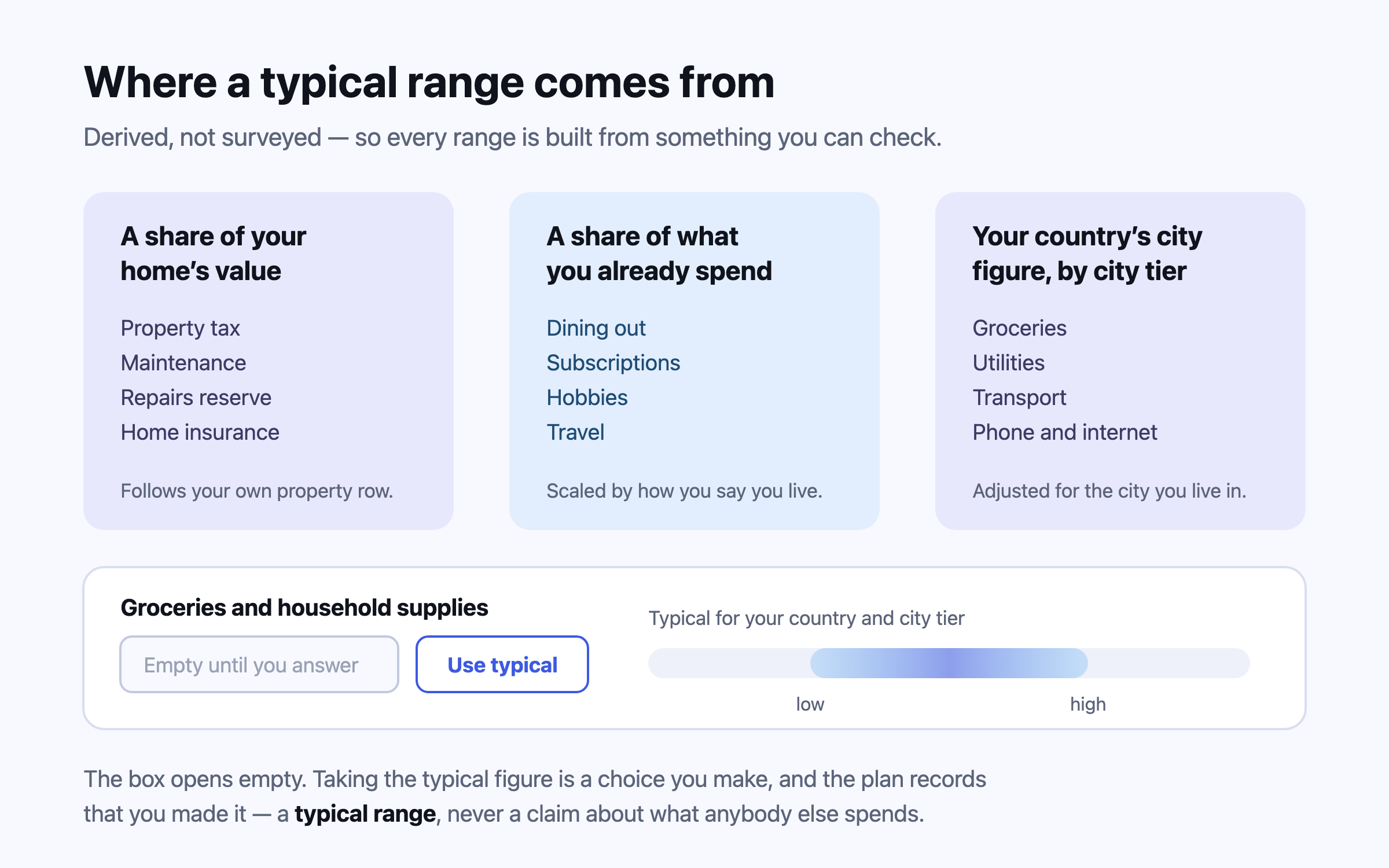
Money Manager · inflation by kind of cost
Every cost carries one of three inflation classes — general, education or medical — at the rate for your country: each central bank’s published target for general prices, and faster rates for schooling and medical care. Eleven countries, every rate shown and every rate yours to change.
A cost in another country grows at that country’s rates until it ends, so rent you still pay abroad and the life you will live after a move are each priced where they happen.
The six assumptions, and when to change them →Why it matters
The same money today, 25 years apart — India’s default rates
Money Manager · loans and life goals
Give a loan what is outstanding, the payment and the years left, and the What you owe card shows the rate those repayments imply — worked out from your own schedule, never a country average.
Life goals — university, school fees, a wedding, a home, care for a parent — each have a year and a cost in today’s money. Give your children’s ages and a higher-education goal is offered in the year each one turns 18; the cost is yours to fill in, and nothing is added until you press the button.
Adding a life goal →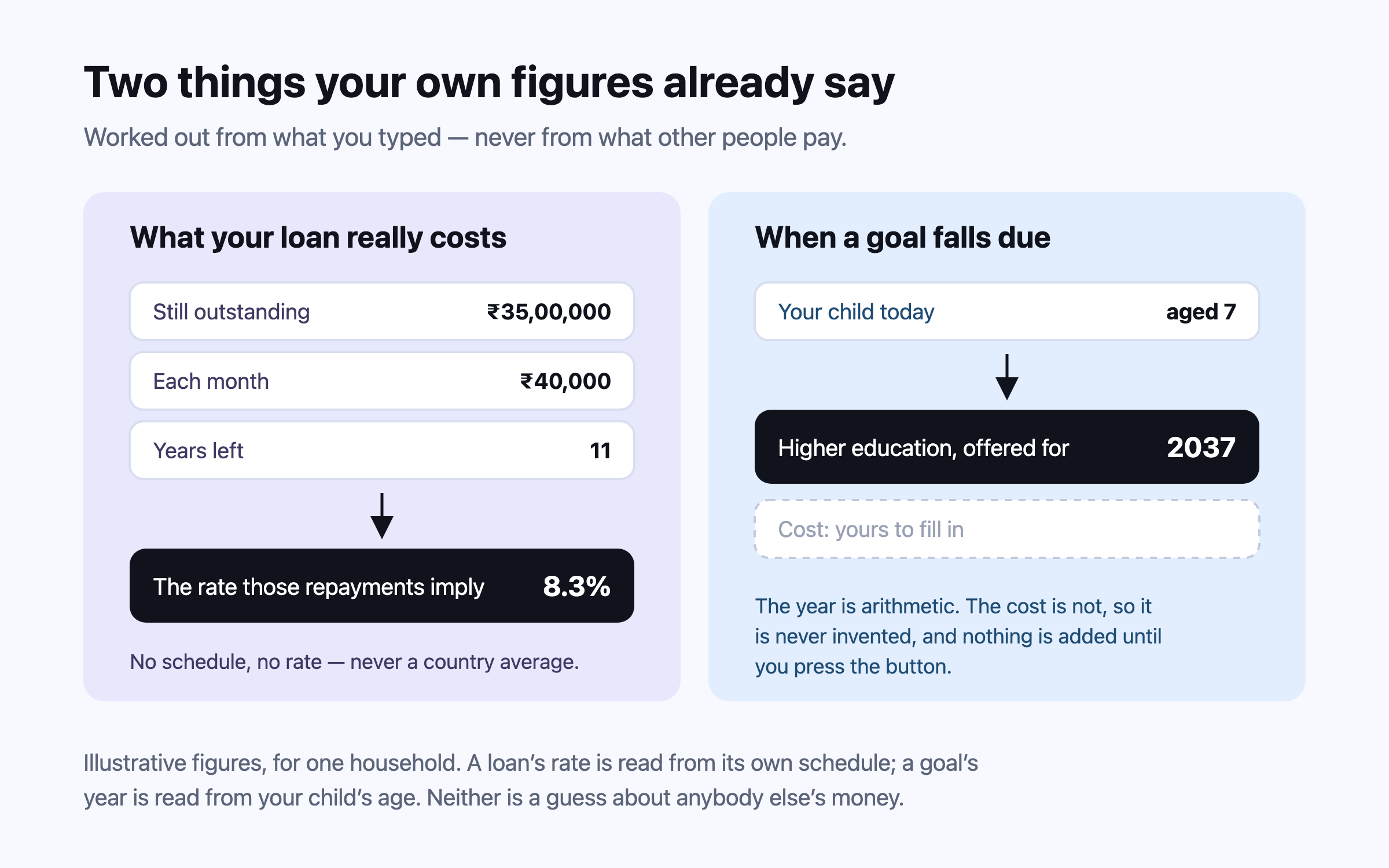
Action Items · what is still a guess
A home with no upkeep priced in, no healthcare anywhere, one figure standing in for a whole life’s spending: Action Items names each one with the reference point it was measured against. A rule that cannot quote one does not fire.
The list is ranked by what is most obviously true, and plan health sums up what is still open. Fix an item, commit to it or dismiss it — nothing changes your plan until you press something.
What Action Items are →Your plan
What needs your attention
Plan healthAt riskRanked by what is most obviously true, not by what moves the number most.
Plan confidence · how much is your own
Plan confidence measures inputs, not outcomes: how much of the projection rests on figures you gave rather than on a country default. It is not a probability — the outcome word on the Overview answers that.
Its unanswered items are the list of what would sharpen the plan, and a debt-free household or one with no goals is never marked down for it.
What plan confidence counts →Your plan
How complete this plan is
70% Taking shapeNot a probability — that is what the outcome word answers. This is how much of the projection rests on figures you gave us rather than on a country default.
The unanswered ones are the list of what would sharpen it.
What only Nivritee does
Budgeting apps stop at this month and FIRE calculators ask for one spending figure. The Money Manager feeds every income, cost, loan and goal straight into your FIRE Planner and your Freedom Ladder.
Indian mutual funds, US stocks, a UK fund and a Gulf deposit in one household figure, converted daily into your home currency.
What you hold today feeds the projection of when you could stop. Portfolio trackers do not plan; FIRE calculators do not track.
Two people, one plan, each choosing what the other sees — and your CA or lawyer sees exactly what you share, read-only.
Eleven markets’ inflation, schemes and household surveys, so your spending and your percentile are measured where you live.
Ask Niv a what-if and she runs it on your own projection and reports both figures — she never guesses at arithmetic.
No fee, no commissions, no products. Nobody at Nivritee can open your plan.
| Kind of app | Portfolio Tracker | FIRE Planner | Money Manager | Family Finance | Niv | Freedom Ladder |
|---|---|---|---|---|---|---|
| Portfolio trackers | Yes | No | No | Partly | Partly | No |
| FIRE calculators | No | Yes | Partly | Partly | No | No |
| Budgeting apps | Partly | Partly | Yes | Partly | Partly | No |
| Document vaults | No | No | No | Partly | No | No |
| Nivritee | Yes | Yes | Yes | Yes | Yes | Yes |
Questions
Neither, deliberately. It does not import transactions, connect to a bank or set a budget per category each month. You enter what you earn, spend and owe as monthly or yearly figures, and it measures them against your country, your city and inflation — and feeds them straight into your FIRE plan.
Each spending line is compared with a typical range for your country and city tier. The ranges are derived rather than surveyed — a share of your own home’s value for upkeep, a share of what you already spend for discretionary lines, and your country’s city figure adjusted for your tier for the rest — and each range is labelled as typical, never as your target.
Each category carries a class — general, education or medical — and grows at your country’s rate for that class, so school fees and healthcare rise faster than groceries. A row in another country grows at that country’s rates. Every rate is shown and every rate is yours to change.
From the three figures you give it: what is still outstanding, the regular payment and the years left. The rate those repayments imply is shown on the loan. Where the schedule cannot say, no rate is shown — it never substitutes a country average and presents it as yours.
Yes. Life goals cover higher education, school fees, a wedding, a home, a car, travel, care for a parent, a health buffer and starting a business, each with a year and a cost in today’s money. Where you give your children’s ages, a higher-education goal is offered in the right year with the cost left for you to fill in.
Yes. Free, no paid tier, and nothing to sell. It needs a free account: eight answers give you a first plan in about two minutes, and you add the detail at your own pace.
About two minutes to a first answer from eight figures, then break your spending down at your own pace. Free, no bank login, and nobody at Nivritee can open your plan.
Start free