Evensky’s cash reserve
A reserve of cash for near-term spending beside a long-term portfolio of shares and bonds, so a market fall never forces a sale to pay the bills.
Freedom Ladder · a four-bucket strategy
The Freedom Ladder is Nivritee’s four-bucket version of the retirement bucket strategy, the idea developed by Harold Evensky and popularised by Morningstar’s Christine Benz: Survival, Sustenance, Sufficiency and Surplus, each sized from your own spending, each saying how much is enough and whether the money is in something it can use.
Freedom Ladder
₹1.14Cr₹1,14,33,800
Cumulative, not four separate pots: everything you hold counts toward the rung it reaches and toward every rung above it, so the top of the ladder is simply your FI number. Illustrative figures.
Freedom Ladder · four buckets
Survival is months of essential spending you can reach the same day — the settled convention is three to six months, and you choose. Sustenance is years of the life you will live, held as a runway with no growth assets, so a bad year never forces a sale. Sufficiency is the corpus itself, with one decision: how much sits in growth assets. Surplus is whatever lies beyond independence, with no target by definition.
Every target comes from your own plan: what is essential and what the full life costs are read from your spending once you stop working, not from a rule of thumb.
What the Freedom Ladder is →The four rungs
| Rung | Protects against | Held as |
|---|---|---|
| Survival | A shock that will not wait | Cash you can reach the same day |
| Sustenance | Income stopping | A laddered runway, no growth assets |
| Sufficiency | The number itself | One equity-to-debt decision |
| Surplus | What comes after | Whatever you choose it to be |
Each rung has its own purpose, its own target formula and its own instrument mix. They are not four versions of one allocation model.
Freedom Ladder · cumulative rungs
Everything you hold counts toward the rung it reaches and every rung above it. Survival ends at your months of essentials, Sustenance where your runway ends, and Sufficiency at your FI number — the same figure the FIRE Planner works toward, so the ladder and your plan cannot disagree about the target.
For the illustrative household, Survival holds ₹5.4L of ₹5.4L, Sustenance ₹30L of ₹30L, and Sufficiency is 17% of the way to an FI number of ₹5.12Cr.
Why the rungs are cumulative →Freedom Ladder
Cumulative, not four separate pots: everything you hold counts toward the rung it reaches and toward every rung above it. Illustrative figures, for one household.
Freedom Ladder · instrument fit
Two readings, kept apart. Coverage asks whether there is enough money for the rung. Instrument fit asks whether it is in something that rung can use — cash for Survival, no growth assets in the runway. Fit can make a rung’s reading worse by one step, never better, and the sentence says when it has.
That is the illustrative household’s runway: all the money is there, but 90.3% of it is in something a runway can use, so Sustenance reads Building rather than Funded — and Action Items names it.
What instrument fit means →Your plan
What needs your attention
Plan healthAt riskRanked by what is most obviously true, not by what moves the number most.
Freedom Ladder · sliders and projection
Three sliders — months of essentials, years of runway and the share of Sufficiency in growth assets — each say what they cost before you touch them and what they moved after. A longer runway holds more safely and leaves less in the growth rung above it, because the rungs are cumulative.
The projection then gives the age at which each rung is projected to be reached, against the age you are aiming for. Sufficiency’s status — On track, Slightly behind, At risk or Red flag — is judged against what the rung needs today, net of what you will still put in, so a balance sheet reads the same on a new plan as on an old one. Niv writes a short reading of the whole ladder beside it.
How the sliders work →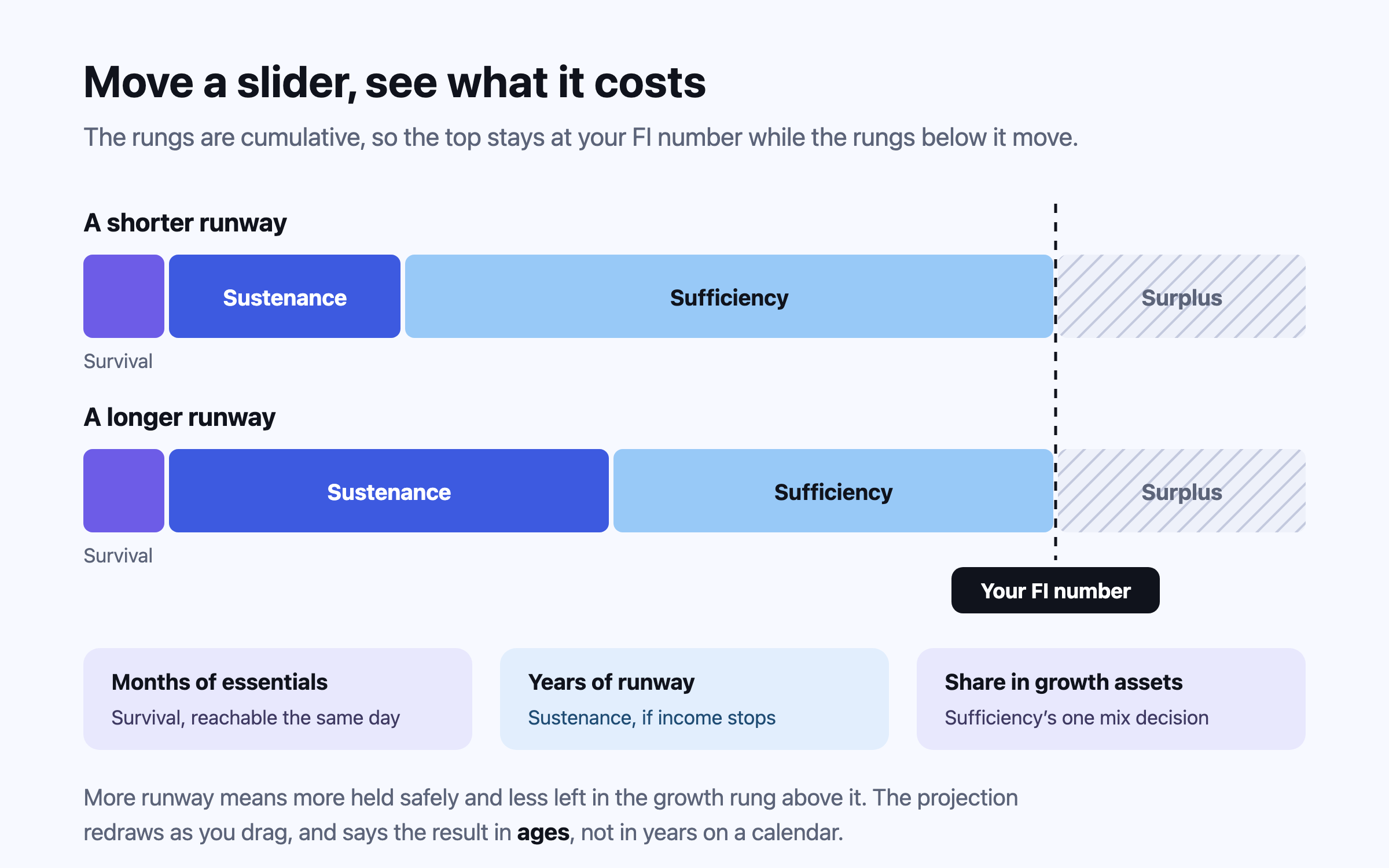
Bucket strategy · three buckets or four
The bucket strategy divides savings by when they will be spent. The Freedom Ladder keeps that idea and adds what a household needs to act on it: targets from your own spending, a top rung that is your FI number, and a reading of whether each rung’s money fits its job.
A reserve of cash for near-term spending beside a long-term portfolio of shares and bonds, so a market fall never forces a sale to pay the bills.
Christine Benz’s model portfolios at Morningstar: cash for the next years, mainly bonds for the middle years, mainly shares for the rest, with the cash refilled from income and rebalancing rather than spent through in order.
The same idea, sized from your plan: Survival for a shock, Sustenance as the runway, Sufficiency up to your FI number and Surplus beyond it — cumulative, and each rung read for whether its money can do its job.
The research behind the bucket strategy →What only Nivritee does
A bucket calculator asks you for a balance and a spending figure. The Freedom Ladder reads both from your plan — every holding in your Portfolio Tracker, in every country, in one currency — and its top rung is the number your FIRE Planner works toward.
Indian mutual funds, US stocks, a UK fund and a Gulf deposit in one household figure, converted daily into your home currency.
What you hold today feeds the projection of when you could stop. Portfolio trackers do not plan; FIRE calculators do not track.
Two people, one plan, each choosing what the other sees — and your CA or lawyer sees exactly what you share, read-only.
Eleven markets’ inflation, schemes and household surveys, so your spending and your percentile are measured where you live.
Ask Niv a what-if and she runs it on your own projection and reports both figures — she never guesses at arithmetic.
No fee, no commissions, no products. Nobody at Nivritee can open your plan.
| Kind of app | Portfolio Tracker | FIRE Planner | Money Manager | Family Finance | Niv | Freedom Ladder |
|---|---|---|---|---|---|---|
| Portfolio trackers | Yes | No | No | Partly | Partly | No |
| FIRE calculators | No | Yes | Partly | Partly | No | No |
| Budgeting apps | Partly | Partly | Yes | Partly | Partly | No |
| Document vaults | No | No | No | Partly | No | No |
| Nivritee | Yes | Yes | Yes | Yes | Yes | Yes |
Questions
A way of dividing savings by when they will be spent: near-term spending in cash, the middle years in steadier assets and the long term in shares, so a bad year in markets never forces a sale. It was developed by the US financial planner Harold Evensky and popularised by Christine Benz at Morningstar.
It is a four-bucket one. Survival, Sustenance and Sufficiency play the parts of the classic three buckets — reachable cash, a runway, long-term growth — and Surplus holds whatever lies beyond your FI number. The rungs are cumulative, so the top of Sufficiency is your FI number.
There is no settled answer, and the ladder does not pretend there is. It suggests a runway from how stable your income is, shows what each extra year takes from the growth rung above it, and lets you set your own with a slider.
Yes, and for all eleven countries Nivritee covers. The ladder works in your plan’s own currency and reads everything you hold — Indian mutual funds and shares, deposits, provident funds and anything abroad — converted into one figure first.
Yes. It opens once you have generated a plan, and the quick start’s eight answers are enough. Its targets come from that plan, which is why its top rung and your FIRE Planner agree about the number.
No. It shows where your money sits against targets from your own plan and whether each rung’s money is in something that rung can use. It never names a fund or a security, and it is general information, not advice.
About two minutes to a first plan from eight figures, and the Freedom Ladder opens the moment it is generated. Free, no bank login, and nobody at Nivritee can open your plan.
Start free