Buckets rarely beat a rebalanced portfolio on paper. Their value is that people stick with them.
The bucket strategy keeps the next year or two of spending in cash, the following several years in bonds and the rest in shares, so a market fall never forces a sale. Studies find it does no better than a simple rebalanced portfolio on the numbers; its real value is behavioural, and it only works if the buckets are refilled with discipline.
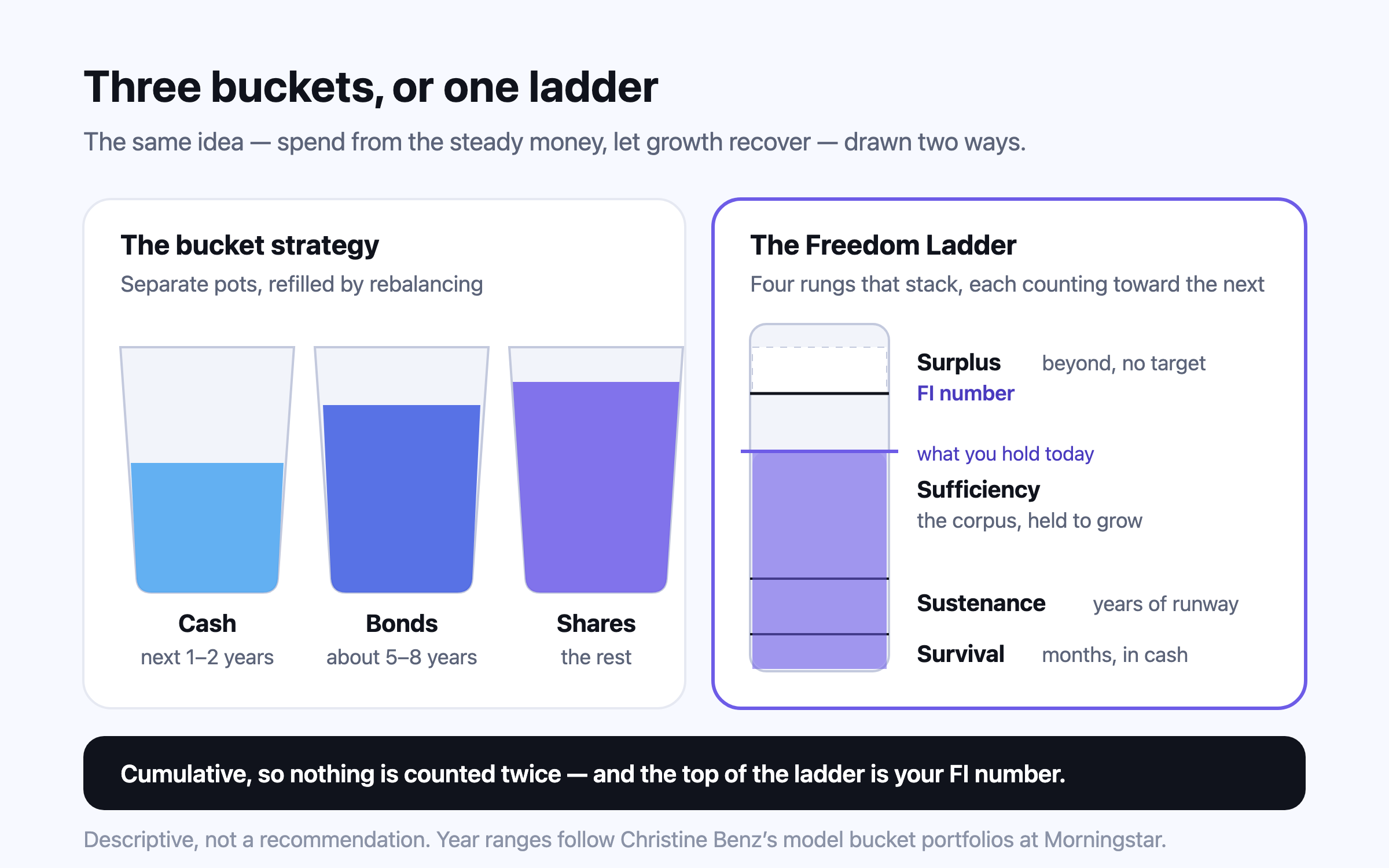
The bucket strategy divides savings by when they will be spent. The next year or two of spending sits in cash; the years after that sit in bonds; everything meant for the distant future sits in shares. When markets fall, you live on the cash and leave the shares alone to recover. The idea was developed by the US financial planner Harold Evensky and popularised by Christine Benz at Morningstar1. It is one of the most widely used ways to turn a portfolio into an income — and one of the most argued about.
Where the idea came from: Evensky’s cash flow reserve
Evensky’s version is the simplest: a cash flow reserve beside a long-term portfolio of shares and bonds. The reserve holds enough for one or two years of living costs, and its job is to stop a retiree being forced to sell long-term holdings at depressed prices1. In Benz’s account, Evensky does not spend the cash as a matter of routine: he meets living costs by rebalancing the long-term portfolio and taps the reserve only in years when both its shares and its bonds are down1.
Evensky later tested it with Shaun Pfeiffer and John Salter. Their one-year reserve was refilled only when at least one asset class had a positive return the year before. Once taxes and transaction costs were included, the reserve showed a survival advantage of 4.4 to 6.0 percentage points over simply selling from the portfolio to meet each withdrawal, and about 88% lower transaction costs by year 302. Part of the case, they noted, is behavioural: a reserve may make people more willing to tolerate volatility in the rest of the portfolio2.
Christine Benz’s three buckets
Benz’s model bucket portfolios at Morningstar give the idea its familiar three-part shape3:
- Bucket 1 — cash. At least a year of the living costs that a pension or other certain income will not cover, held for stability rather than return. It can also hold an emergency fund3.
- Bucket 2 — bonds. Roughly five to eight years of living costs in high-quality bonds and similar steady holdings, aiming for income and stability3.
- Bucket 3 — growth. Everything else, mostly shares. It is the part most likely to grow and the part most likely to fall, and Buckets 1 and 2 exist so that it is never sold in a slump3.
The detail most people miss is the refilling. Benz does not recommend spending through the buckets in order — cash, then bonds, then shares — because that leaves a household with an all-share portfolio late in life. Nor does she shuffle money down the chain every month. Bucket 1 is spent each year and topped up from dividends, interest and rebalancing: in a good year for shares the top-up comes from shares that have risen, and in a bad year from bonds1.
The critiques: buckets and a static mix are the same thing
The sharpest challenge came from Javier Estrada of IESE Business School. Using 115 years of data from 21 countries, he compared three bucket strategies with eleven static mixes rebalanced each year. The simple static strategies clearly outperformed the buckets on four different measures of performance4. His title asked whether the bucket approach is a suboptimal behavioural trick.
Michael Kitces reached a gentler conclusion. A bucket system that is refilled by rebalancing produces exactly the same results as a total-return portfolio rebalanced to the same mix, because the overall allocation is identical; what goes wrong is when the buckets are managed as separate pots and the overall allocation is allowed to drift away from what was intended5. He also noted the appeal of buckets to mental accounting, the habit of treating money differently depending on which mental box it sits in, and concluded that if buckets help people stay invested, so much the better5.
Both critiques land on the same place. Buckets do not create returns. What protects a household from a bad first few years is holding enough in steady assets — Morningstar found bond holdings acted as a shock absorber, and that portfolios which got through the first five years with gains rarely failed later6. Buckets are a way of seeing that protection, and of keeping a nervous household from selling at the bottom. That is a real benefit, not a trick, as long as nobody mistakes it for extra return.
Simple static strategies, which by definition involve periodic rebalancing, clearly outperform bucket strategies.
How many years should each bucket hold?
There is no settled answer, because each extra year in cash buys calm at the price of growth. Estrada describes the most popular choices as two or three buckets with one to five years of withdrawals parked in cash — fewer years in cash when there are three buckets, because the middle bucket shares the load4.
| Framework | Cash | Steady middle | Long-term |
|---|---|---|---|
| Evensky’s cash flow reserve | One to two years of living costs | None as a separate bucket | A diversified portfolio of shares and bonds |
| Benz’s model bucket portfolios | A year or more | Five to eight years, mainly bonds | The rest, mainly shares |
| An example in Morningstar’s 2025 study | — | Three years of spending in a ladder of inflation-linked bonds | The rest, in a balanced portfolio |
| Nivritee’s Freedom Ladder | Survival: 1 to 12 months of essential spending, 3 by default | Sustenance: 1 to 5 years of full spending | Sufficiency: up to your FI number; Surplus beyond |
Three questions decide where you sit in that range. How steady is the income you will still have — a pension, rent, a partner’s salary? How much of your spending is essential rather than discretionary, and could be cut in a bad year? And how would you actually feel watching your shares fall by a third? A household with secure income and flexible spending needs less cash; one living entirely off the portfolio, with little room to cut, needs more.
The Freedom Ladder: a four-bucket version
Nivritee’s Freedom Ladder — a four-bucket strategy — takes the bucket idea and fixes the two weaknesses the critics found. Its rungs are named for what each protects against: Survival (a shock that will not wait), Sustenance (income stopping), Sufficiency (the corpus itself) and Surplus (what sits beyond independence)7.
- The rungs are cumulative, not separate pots. Your emergency money is the first part of your savings, not money set aside from them, so nothing is counted twice. The top of Sufficiency is your FI number, so the ladder and your plan always agree on the target7.
- Each rung is judged twice. Once on whether there is enough money, and once on whether it is held in something that rung can use — shares cannot fund Survival, however many you own7.
- The sizes are yours. Survival defaults to three months of essential spending; Sustenance suggests a runway from how stable your income is. Sliders show what changing either does to the rungs above, because a longer runway leaves less in growth7.
- Surplus has no target. It is what you choose to do once the plan is funded.
Questions people ask
What is the 3-bucket strategy for retirement?
It splits savings into cash for the next year or two of spending, bonds for roughly the following five to eight years, and shares for the long term, refilling the cash from income and rebalancing3.
How many years of cash should I keep in retirement?
The most popular choices range from one to five years of withdrawals, with fewer years when a separate bond bucket sits behind the cash4. More secure income and more flexible spending justify less.
Is the bucket strategy better than a total return approach?
Not on the numbers. A study across 21 countries found simple rebalanced mixes outperformed bucket strategies4, and buckets refilled by rebalancing behave the same as the equivalent static mix5. Their value is helping people hold their nerve.
How do you refill the buckets?
From dividends, interest and rebalancing — selling whatever has risen — rather than by spending through cash, then bonds, then shares in order1.
Does the bucket strategy work in India?
The logic is the same anywhere: hold near-term spending in deposits or short-term debt, and growth money in equity. The Freedom Ladder applies it to any of the eleven markets Nivritee supports, in your own currency7.
Sources
- Retirement Bucket Basics: A Q&A With Morningstar’s Christine Benz — Morningstar (Matthew Coffina), 2016-05.
- The Benefits of a Cash Reserve Strategy in Retirement Distribution Planning (Journal of Financial Planning, September 2013) — Shaun Pfeiffer, John Salter and Harold Evensky / Financial Planning Association, 2013-09.
- The Bucket Approach to Building a Retirement Portfolio — Morningstar (Christine Benz), 2025-03.
- The Bucket Approach for Retirement: A Suboptimal Behavioral Trick? (Journal of Investing, 2019) — Javier Estrada, IESE Business School, 2018-12.
- Managing Sequence of Return Risk With Bucket Strategies vs a Total Return Rebalancing Approach — Michael Kitces, Kitces.com, 2014-11.
- The State of Retirement Income: 2025 — Morningstar, 2025-12.
- Where should my money sit: emergency fund, runway, long-term investments or surplus? — Nivritee Help Centre, 2026-10.
This is general information, not financial, tax or legal advice for your circumstances. Rules and figures change; check the official source for your country, and consult a licensed professional before making financial decisions. Projections are estimates, not predictions.