Once you are drawing on your savings, the order of returns can matter more than their average.
While you are saving, the order of good and bad years barely matters. Once you are withdrawing, a fall in the first few years forces you to sell low, and the money sold never recovers — so two people with the same average return can end decades apart. A cash runway, flexible spending and a modest starting withdrawal rate are the main defences.
Sequence of returns risk is the danger that poor returns arrive early, just as you begin living on your savings. A saver who meets a crash buys more cheaply and has years to recover. Somebody drawing down must sell holdings at low prices to pay for the year, and those holdings are not there when prices come back. Michael Kitces showed the effect in US history: an American who stopped work in 1966 earned 9.56% a year on a balanced portfolio over the next 30 years, yet could only sustain a starting withdrawal of barely over 4% — because the bad years came first1.
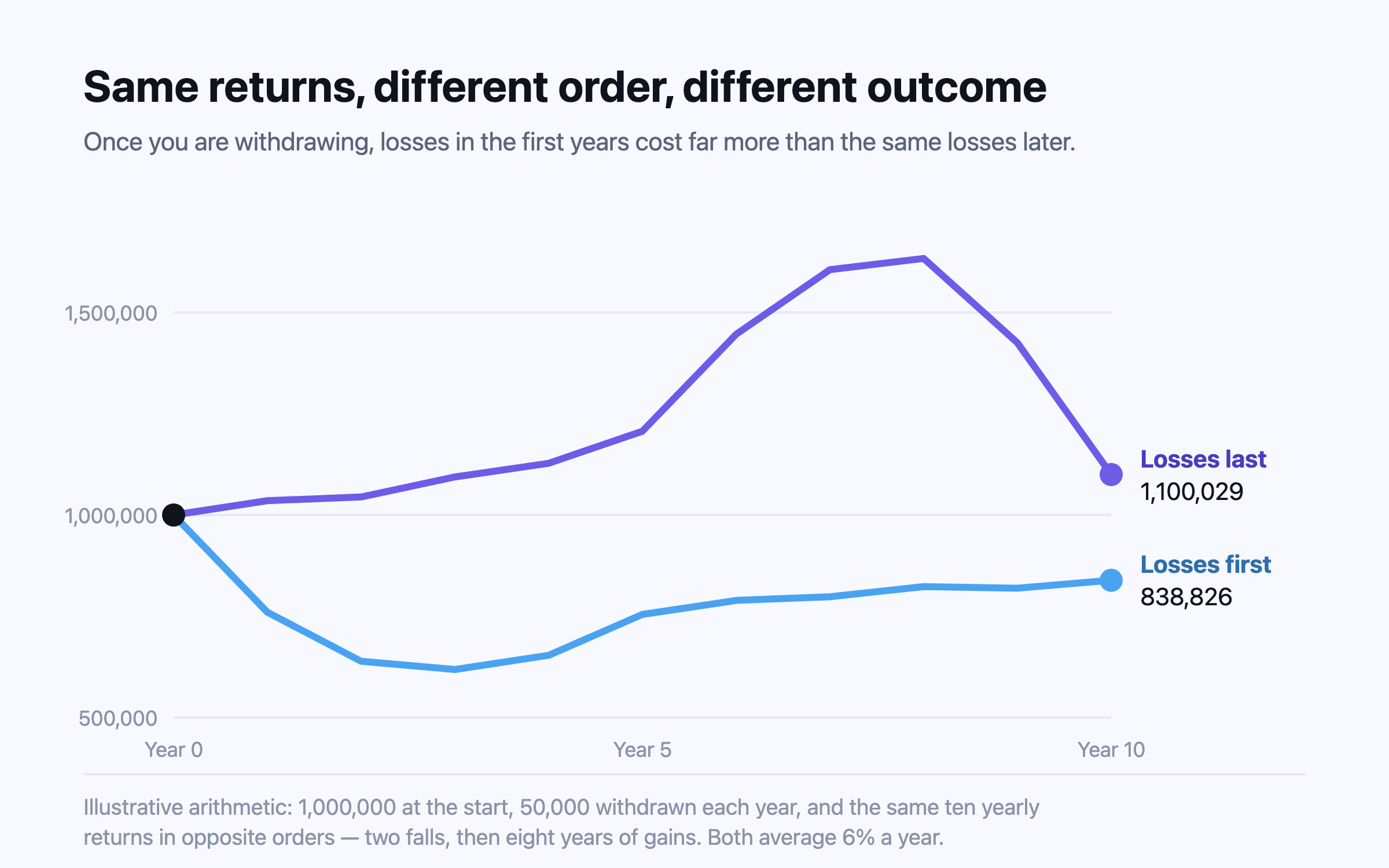
Same returns, different order
With nothing going in or out, order makes no difference: multiplying the same yearly returns in any order gives the same result. Add a withdrawal every year and that stops being true. The table below takes one illustrative set of ten yearly returns — two bad years, then recovery — and runs it forwards and backwards.
| Starting with 1,000,000 | Bad years first: −20%, −10%, +5%, +15%, +25%, +12%, +8%, +10%, +6%, +9% | Same returns, bad years last |
|---|---|---|
| Nothing in or out | 1,670,692 | 1,670,692 |
| Taking 50,000 at the start of each year | 838,826 | 1,100,029 |
With no withdrawals the two orders finish level. With the same withdrawal every year, the household that met the losses first ends roughly 261,000 behind — over a quarter of what it started with — despite earning exactly the same returns. Early losses shrink the base that every later good year compounds on, and each withdrawal taken from a fallen portfolio sells more of it.
The danger window is the first five to ten years
Morningstar’s 2025 retirement income research looked at the simulated cases in which an all-share portfolio ran out within 30 years, and found that nearly 70% of them had already lost value by the end of year five2. Turned the other way round, portfolios that came through the first five years with a gain had only about a 4% chance of running out later, and even one year of gains at the start cut the risk of failure in half2.
Bengen saw the same thing in history in 1994. The 1973–74 slump, which combined falling markets with high inflation, shortened the life of portfolios whose withdrawals had begun as much as 20 or more years earlier3. His warning to recent retirees was not to raise withdrawals just because the first years went well: early gains may be needed later3.
What history shows: 1966, 1982 and Japan
- 1966. The worst year in the last century to start drawing on a US balanced portfolio. After ten years its compound return was negative after inflation, and the portfolio had gone backwards before withdrawals were counted4. Over 30 years it still averaged 9.56% a year — the order, not the average, set the safe withdrawal rate1.
- 1912. The mirror image: a 30-year return of only 5.50% a year, yet the sequence allowed a higher starting withdrawal of 4.6%1.
- 1982. A retiree who started at the beginning of a long bull market could have raised spending every three years throughout the following decades under a rule that allowed raises only when the portfolio grew well beyond its starting value5.
- Japan, 1990. The Nikkei 225 peaked at 38,915.87 on 29 December 1989 and did not close above that level again until February 2024 — more than 34 years later6. In Pfau’s 17-country study, Japan also produced the single worst 30-year start: a retiree in 1940 could have sustained only 0.47% a year7.
Bengen’s paper also carries a cautionary tale about the lucky ones. A client who stopped in 1958 enjoyed a decade of strong markets, raised her withdrawals as her balance passed double its starting value, and then met the 1973–74 slump — by which point she was drawing 8% a year from a portfolio that had lost more than half its purchasing power3. A good sequence is only good if it is not spent as though it will last.
What reduces sequence risk
- A modest starting withdrawal rate. The lower the first-year draw, the more a bad start can be absorbed. Morningstar’s 2025 estimate for 30 years is 3.9%, falling for longer horizons (the 4% rule by country)2.
- A runway of steady money. Holding the next few years of spending in cash and bonds means nothing has to be sold in a downturn. Morningstar found bond holdings acted as a shock absorber, with portfolios holding 50% to 70% in bonds supporting the highest starting rates in its study2. This is the logic of the bucket strategy.
- Spending rules decided in advance. Jonathan Guyton and William Klinger’s “guardrails” cut spending after markets fall and raise it after they rise. With those rules, they found initial withdrawal rates of 5.2% to 5.6% sustainable at a 99% confidence level over at least 40 years for portfolios holding at least 65% in shares8. In Morningstar’s version, spending is cut by 10% when the withdrawal rate climbs 20% above where it started2.
- Some income in the early years. Part-time work, a partner still earning, rent or a pension that starts early all reduce what has to be sold while prices are low.
- Flexibility about the date. Stopping a year or two later after a crash, while markets recover, can be worth more than any portfolio change.
Testing your own plan against a bad start
No one can predict when a fall will come. What you can know is what one would do to you. Nivritee’s stress tests place market falls after you stop working, when there is no salary to ride them out: A dot-com style slump applies a 25% fall one year after you stop, and A 2008-style crash a 35% fall five years after — each milder than the episode it is named after10. Tick several and they are drawn as one combined line against your plan, with what changes listed beneath.
Questions people ask
What is sequence of returns risk?
The risk that poor investment returns arrive early in the years you are withdrawing, forcing you to sell at low prices. Two people with the same average return can end very differently depending on the order of good and bad years.
How do you protect against sequence of returns risk?
Start with a modest withdrawal rate, hold a runway of cash and bonds for the next few years of spending, agree spending cuts in advance for bad years, and keep some income early on if you can. Rules like Guyton-Klinger guardrails formalise the spending cuts8.
Is sequence risk worse for early retirees?
Yes. A longer horizon gives a bad start more time to compound, and early retirees often wait years for any pension. Morningstar’s safe starting rate falls from 3.9% for 30 years to 2.9% for 509.
What happened to people who retired in 1966?
A US retiree starting in 1966 with a balanced portfolio faced a decade of poor markets and high inflation. Despite averaging 9.56% a year over 30 years, the safe starting withdrawal was barely over 4%1.
Sources
- The Extraordinary Upside Potential of Sequence of Return Risk in Retirement — Michael Kitces, Kitces.com, 2019-02.
- The State of Retirement Income: 2025 — Morningstar, 2025-12.
- Determining Withdrawal Rates Using Historical Data (Journal of Financial Planning, October 1994; FPA reprint) — William P. Bengen / Financial Planning Association, 1994-10.
- Does Monte Carlo Analysis Actually Overstate Tail Risk in Retirement Projections? — Michael Kitces, Kitces.com, 2017-07.
- Ratcheting the Safe Withdrawal Rate: A More Dominant Version of the 4% Rule? — Michael Kitces, Kitces.com, 2015-06.
- Japan’s Nikkei 225 surpasses all-time high reached in 1989 — CNN Business, 2024-02.
- An International Perspective on Safe Withdrawal Rates: The Demise of the 4 Percent Rule? (Journal of Financial Planning, December 2010) — Wade D. Pfau, via SSRN, 2010-12.
- Decision Rules and Maximum Initial Withdrawal Rates (Journal of Financial Planning, March 2006) — Jonathan T. Guyton and William J. Klinger / Financial Planning Association, 2006-03.
- How Much Can You Safely Withdraw If You Retire Early? — Morningstar (Amy C. Arnott), 2026-09.
- What does each stress test assume? — Nivritee Help Centre, 2026-10.
This is general information, not financial, tax or legal advice for your circumstances. Rules and figures change; check the official source for your country, and consult a licensed professional before making financial decisions. Projections are estimates, not predictions.