Most investors over-own their home market — and a family that earns in one currency and will spend in another carries a second risk on top
Investors everywhere hold far more of their own country’s shares than its weight in world markets, which concentrates risk. For a family earning in dirhams or dollars and planning to live on rupees or pounds, the bigger question is currency: measure every holding in the currency your future bills will be paid in, then diversify across markets from there.
What home bias is
Home bias is the habit of holding far more of your own country’s shares than that country’s share of the world market. Economists Kenneth French and James Poterba documented it in 1991: American investors kept about 94% of their equity portfolios at home, Japanese investors about 98% and British investors about 82%1.
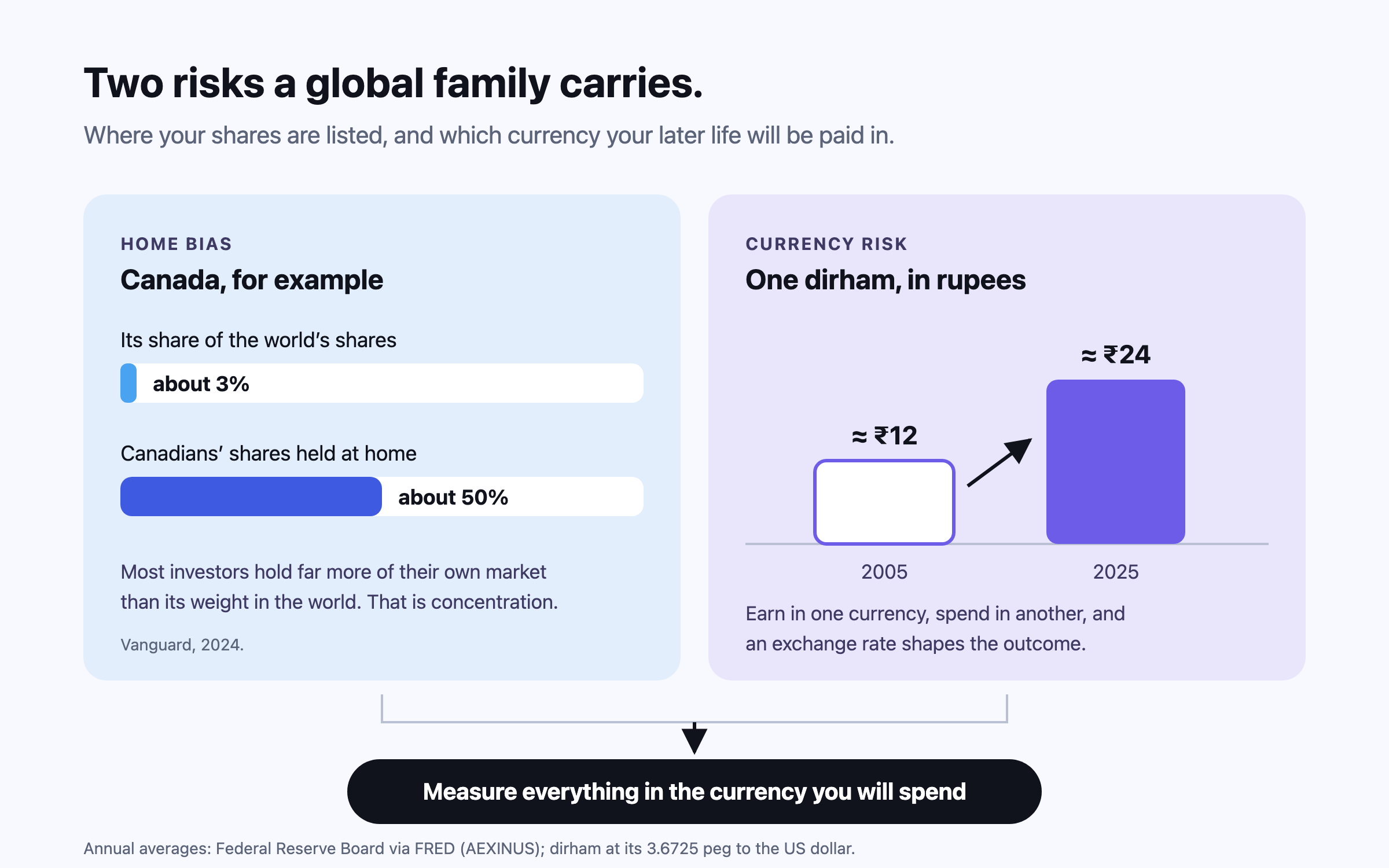
Three decades later the pattern has softened but not gone. Vanguard’s 2021 review found that US investors held about 1.4 times the US weight in the global market, and UK investors about 4.9 times the UK weight2. Canadians held about half their equities at home in 2024, against a Canadian share of world markets near 2.7%3.
The scale of the gap is clearest against a global index. In the MSCI ACWI, which covers large and mid-sized companies across developed and emerging markets, the United States was 64.21% of the index at the end of September 2026, Japan 5.2%, the United Kingdom 3% and Canada 2.9%4. Every other country, India included, shares the remaining quarter or so. A portfolio held entirely in any one of those markets is a bet on a small slice of the world’s listed companies.
Why it persists
Some of the reasons are practical. Vanguard lists regulation, taxes, transaction costs and limits on moving income across borders as real barriers that can justify holding less abroad than a pure market-weight portfolio would2. A provident fund, a pension or a tax-advantaged account usually invests at home by design.
Some of it is preference. French and Poterba found that investors in each country expected their own market to beat the others by several hundred basis points a year — an expectation that cannot hold for everyone at once, and that they argued explained the pattern better than costs did1. Familiarity feels like knowledge: the brands you shop at and the companies in your newspaper seem safer than ones you have never seen.
What it costs
The cost is concentration. A single country’s market is exposed to one economy, one set of policies and usually a few dominant sectors. Over 1970–2020, Vanguard measured individual country indexes at between 15% and 100% more volatile than the global index; the United States, the largest and broadest market, came closest to it2.
Adding other markets helps up to a point. In each developed market Vanguard examined, portfolio volatility fell most with between 35% and 55% of equities held abroad, after which it began to rise again2. Its conclusion was not a single right number but a starting point: the global market weight, adjusted for costs, taxes and an investor’s own circumstances.
The second risk: earning in one currency, spending in another
Home bias asks where your shares are listed. For a family that works in one country and plans to settle in another, a larger question sits underneath it: in which currency will the bills be paid? A salary in dirhams, a 401(k) in dollars and a flat in Pune are three currencies, and only one of them pays for groceries in later life.
The dirham shows why this matters. The Central Bank of the UAE holds it at about 3.6725 to the US dollar, standing ready to buy and sell dirhams at 3.673 and 3.6725. The rupee floats. Its annual average against the dollar moved from 44.00 rupees in 2005 to 87.15 in 2025, roughly 3.5% a year6. Through the peg, a dirham that bought about ₹12.0 in 2005 bought about ₹23.7 in 202556.
- Earning in a stronger currency and settling in a weaker one has, over the last two decades, flattered savings: every dirham or dollar saved turned into more rupees over time6. That is a past pattern, not a promise — currencies also move sharply the other way for years at a time.
- Earning in rupees and paying for something in dollars — a child’s degree abroad, say — has worked against families: the same tuition bill nearly doubled in rupee terms from the exchange rate alone between 2005 and 20256.
- Holding assets in one currency and expenses in another means a plan’s outcome depends on an exchange rate nobody can forecast. Short sharp moves are common: in 2007 a dollar bought about 11% fewer rupees in November than in January7.
Measure everything in the currency you will spend
Vanguard notes that a currency on its own has no expected return; for an investor, exposure to it mainly adds or removes volatility2. That framing matters most when it is measured from the right place. The volatility that counts for a family is the volatility of its wealth in the currency of its future spending, not in the currency of today’s payslip.
An Indian family settling in India that holds Indian funds has assets and future bills in the same currency, so a concentrated-looking portfolio carries no exchange-rate risk at all. The same portfolio held by a family settling in the UK is currency risk on nearly everything it owns. The holdings are identical; the risk is not. That is why a single reporting currency — the one you will live on — is the honest way to read a global portfolio.
- Decide where you expect to live once you stop working. That fixes the currency your plan should be measured in.
- Value every holding in its own currency, then convert it once, at a checked daily rate, into that one currency.
- Read concentration twice: by market (how much rides on one economy) and by currency (how much rides on an exchange rate against your future bills).
- Test the plan with your foreign money buying less than today, and see whether the outcome still holds.
Diversifying across markets without losing the match
Home bias and currency matching pull in different directions, and the useful work is in holding both questions at once. Spreading shares across markets reduces the risk that one economy disappoints; keeping a meaningful part of your wealth in the currency you will spend reduces the risk that an exchange rate decides your outcome. Money needed in the next few years arguably belongs in that spending currency; money with decades ahead of it has more room to travel. How much of each is a personal judgement — this article is information, not investment advice.
Questions people ask
What is home bias in investing?
It is holding much more of your own country’s shares than its weight in world markets. French and Poterba found US investors held about 94% at home in 1991, and Vanguard still found UK investors at about 4.9 times their market weight in 202112.
Is home bias always bad?
No. Costs, taxes, regulation and the currency you will spend in can all justify some tilt toward home. The risk is a tilt nobody chose, concentrating a family’s wealth in one economy by habit.
How does currency risk affect NRIs?
If you earn in one currency and will spend in another, your outcome depends on the exchange rate between them. The rupee went from about 44 to about 87 per dollar between 2005 and 2025, which helped savers abroad and hurt anyone paying dollar bills from rupees6.
Which currency should I track my portfolio in?
The one you expect to spend once you stop working. Measuring in that currency shows the risk that actually matters to your plan, rather than the risk as seen from today’s payslip.
Sources
- Investor Diversification and International Equity Markets (NBER Working Paper 3609; American Economic Review 81(2)) — Kenneth R. French and James M. Poterba, National Bureau of Economic Research, 1991.
- Global equity investing: The benefits of diversification and sizing your allocation — Vanguard Research, 2021-04.
- Oh Canada! Canadian investors still have high levels of home bias in their portfolios, but are increasing global diversification — Vanguard Investments Canada (news release), 2024-06.
- MSCI ACWI Index (USD) factsheet — MSCI, 2026-09.
- Monetary policy framework: maintaining the dirham peg to the US dollar — Central Bank of the UAE, 2026.
- Indian Rupees to U.S. Dollar Spot Exchange Rate, annual averages (AEXINUS) — Board of Governors of the Federal Reserve System, via FRED, 2025.
- Stress test definitions: Your money abroad buys 15% less (calibrated on FRED series EXINUS and EXUSUK) — Nivritee Help Centre, 2026-10.
- How are my holdings converted to my home currency? — Nivritee Help Centre, 2026-10.
This is general information, not financial, tax or legal advice for your circumstances. Rules and figures change; check the official source for your country, and consult a licensed professional before making financial decisions. Projections are estimates, not predictions.