Returning to India changes your tax status, your bank accounts and your investments on different clocks — plan the order before you book the flight
Coming home is several changes on different timetables. Your tax status follows day counts under the Income-tax Act, your bank accounts follow RBI rules under FEMA, and your investments, insurance and living costs each need their own step. This checklist explains each one in plain terms, with official sources — confirm the tax parts with a chartered accountant.
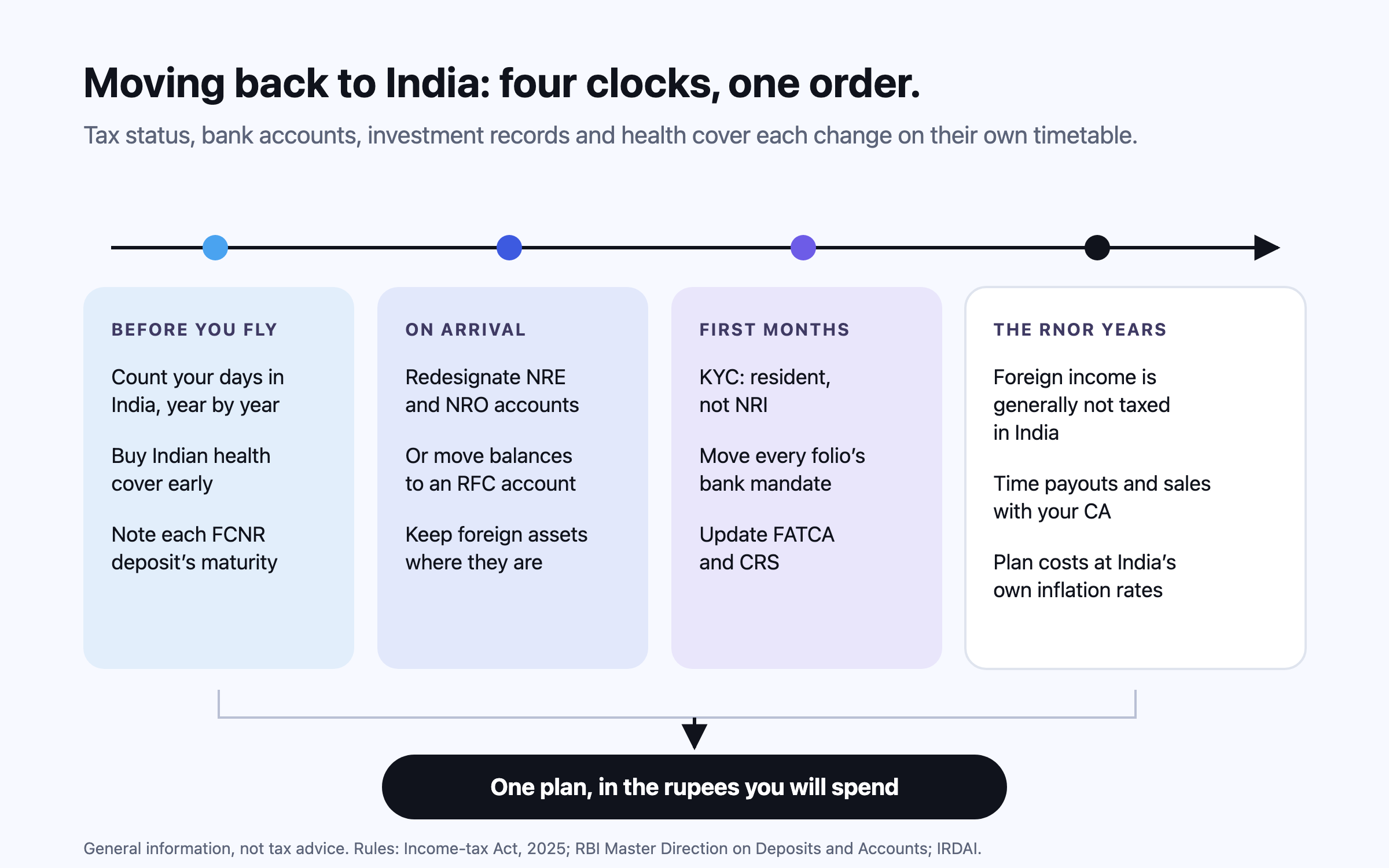
Returning to India after years abroad is a family decision first and a paperwork exercise second — but the paperwork has an order, and getting it wrong can cost tax, interest or insurance cover. This guide walks through each item with the rule behind it. It is general information, not tax or legal advice: rules change, and a chartered accountant who knows your history should confirm how they apply to you.
Your residential status for tax
India taxes you according to your residential status for each tax year (April to March), and the test is a day count, not your passport or your intention. Since 1 April 2026 the Income-tax Act, 2025 has replaced the 1961 Act; residence is in its section 6, and the tests carried over largely unchanged1. In broad terms, you are resident in a tax year if you are in India for 182 days or more, or for 60 days or more in that year together with 365 days or more in the four years before it2.
Many returning NRIs are first resident but not ordinarily resident (RNOR). You are not ordinarily resident in a year if you were non-resident in nine of the ten preceding years, or spent 729 days or less in India in the preceding seven years2. While you are RNOR, income that arises outside India is generally not taxed in India unless it comes from a business controlled in, or a profession set up in, India1. That window can matter for the year you sell foreign assets or receive a foreign payout.
NRE, NRO and FCNR accounts
Bank accounts follow the Foreign Exchange Management Act, not the Income-tax Act, so the trigger is different: your return to India to stay. The RBI’s master direction on deposits sets out what happens to each account3.
- NRE accounts should be redesignated as resident accounts, or their balances moved to a Resident Foreign Currency (RFC) account, immediately on your return to take up employment or on a change in residential status3.
- NRO accounts may be redesignated as resident accounts once you return with the intention of staying for an uncertain period3.
- FCNR(B) deposits may run to maturity at their contracted rate, but are treated as resident deposits from the date you return; at maturity they convert to a resident rupee account or an RFC account3.
- RFC accounts let a returning resident keep money in foreign currency — including NRE and FCNR(B) balances and pension or superannuation benefits from an overseas employer4.
Tell each bank in writing, and keep the acknowledgement. Interest on an NRE account is treated differently from a resident account’s, so a late redesignation is not just an administrative slip.
Foreign accounts, pensions and payouts
You do not have to bring everything home. Under section 6(4) of FEMA, a person resident in India may keep, transfer or invest foreign currency, foreign securities and property abroad that were acquired while non-resident, or inherited from someone who was5. A brokerage account, a foreign home or a pension built up abroad can therefore stay where it is.
- 401(k), IRA, UK pensions and RRSPs. These usually defer tax until withdrawal abroad, while India might tax growth as it accrues. The 1961 Act added a relief for accounts in notified countries — the US, the UK and Canada — so that the income is taxed in India when it is withdrawn, matching the foreign timing6. Ask your CA how that relief applies under the 2025 Act to your accounts.
- Gulf end-of-service gratuity. A gratuity is usually paid as one sum when you leave. Our guide to Gulf gratuity and pensions explains how it is calculated and how to plan around it.
- Foreign bank balances can stay in place or move to an RFC account; either way, record them in the currency they are really in.
Mutual funds, shares and KYC
Your investment records still say you are an NRI until you change them. The common KYC form used across Indian mutual funds records residential status — resident individual, non-resident Indian, foreign national or person of Indian origin — so update it through your KYC registration agency or fund house once you return7.
- Update your residential status and Indian address on your KYC record.
- Change the bank mandate on every folio from the NRE or NRO account to the redesignated resident account.
- Refresh your FATCA and CRS declarations, which record your tax residence.
- Ask your broker to convert NRI trading and demat accounts to resident ones, which may mean opening new accounts and transferring holdings.
Health insurance before the move
Employer cover abroad usually ends with the job, and Indian health policies apply waiting periods to pre-existing conditions, so a policy bought early starts those clocks early. The IRDAI requires insurers to offer products for all ages, lets you carry waiting-period credits across when you port a policy, and bars an insurer from contesting a claim on non-disclosure, except for established fraud, after 60 months of continuous cover8. For many families that is the strongest argument for buying an Indian policy months before the move rather than after it.
Timing the move
- Tax year. India’s runs April to March. Arriving late in a tax year can keep you under the day-count thresholds for that year — but your history in earlier years decides as much as the arrival date2.
- Payouts and sales. If you expect a large foreign payout or plan to sell foreign assets, discuss with your CA whether it falls before you become resident, during an RNOR year, or after.
- Deposits. Note the maturity date of each FCNR(B) deposit, since it keeps its rate only until then3.
- School years. Children’s admissions often fix the month more firmly than anything financial; plan the rest around them.
Planning living costs in India
Converting today’s spending at today’s exchange rate is the most common planning mistake. Rent, schooling and healthcare cost different amounts in Pune than in Dubai, and they rise at different speeds once you are there. Nivritee’s India defaults project general prices at 4.0% a year — the RBI’s target — education at 8.0% and medical costs at 12.0%9. Over fifteen years, at those rates, a cost of ₹1,00,000 today grows to about ₹1.80 lakh, ₹3.17 lakh and ₹5.47 lakh respectively9. Our data report, Inflation is not one number, sets out the figures for all eleven markets.
Write down what each line will cost after the move rather than converting what it costs now: rent that stops, school fees that change board, insurance you will now pay yourself, and the help and travel that a family home in India often brings.
Questions people ask
Do NRIs lose NRE status when they return to India?
Yes. Under the RBI’s rules an NRE account should be redesignated as a resident account, or its balance moved to an RFC account, immediately on your return to take up employment or on a change in residential status3.
What is RNOR status and how long does it last?
Resident but not ordinarily resident applies if you were non-resident in nine of the previous ten years or spent 729 days or less in India in the previous seven2. How long it lasts depends on your own day counts, so work it out year by year with a CA.
Can I keep my FCNR deposit after returning to India?
Yes, until it matures, at the contracted rate; from your return it is treated as a resident deposit, and at maturity it converts to a resident rupee or RFC account3.
What happens to my 401(k) when I move back to India?
You can keep it: FEMA lets a resident hold foreign assets acquired while non-resident5. How withdrawals are taxed in India depends on the relief for notified countries and your treaty position, so confirm it with a CA6.
Do I need to update mutual fund KYC after returning to India?
Yes. The KYC form records residential status, so change it from non-resident to resident and move each folio’s bank mandate to your resident account7.
Sources
- Income-tax Act, 2025 (as amended by the Finance Act, 2026) — Income Tax Department, Government of India, 2026.
- Non-resident FAQs — Income Tax Department, e-Filing portal, 2026.
- Master Direction – Deposits and Accounts — Reserve Bank of India, 2026-09.
- FAQs: Foreign Currency Accounts by Resident Individuals — Reserve Bank of India, 2025-01.
- FAQs: Miscellaneous forex facilities — Reserve Bank of India, 2025-11.
- Section 89A, Income-tax Act, 1961: relief from taxation in income from retirement benefit account maintained in a notified country — Indian Kanoon (text of the Act), 2021.
- CKYC & KRA KYC form for individuals — Association of Mutual Funds in India, 2026.
- Master Circular on Health Insurance Business (IRDAI/HLT/CIR/PRO/84/5/2024) — Insurance Regulatory and Development Authority of India, 2024-05.
- Should I change the six assumptions? (Nivritee’s default rates by country) — Nivritee Help Centre, 2026-10.
This is general information, not financial, tax or legal advice for your circumstances. Rules and figures change; check the official source for your country, and consult a licensed professional before making financial decisions. Projections are estimates, not predictions.