In the Gulf, an expatriate’s end-of-service gratuity is a lump sum, not a pension — so the corpus you build has to carry every year after you leave
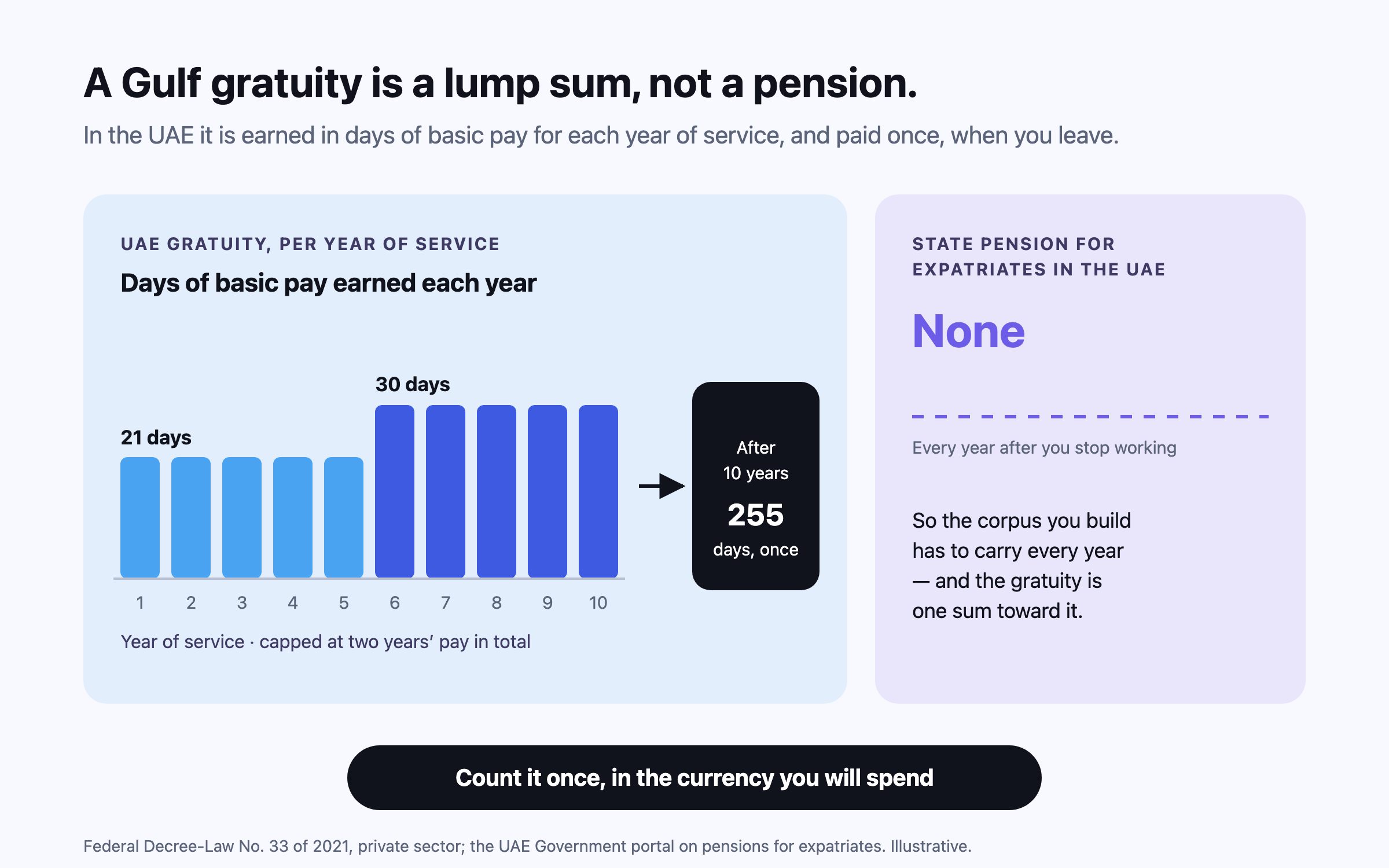
Expatriates in the UAE earn an end-of-service gratuity of 21 days’ basic pay a year for the first five years and 30 days after that, capped at two years’ pay — and no state pension. That makes the gratuity a useful one-off sum and nothing more: everything after you stop working has to come from savings you build yourself.
For most expatriates working in the Gulf, the end of a job comes with a cheque rather than a pension. Understanding exactly what that cheque is — and what it is not — is one of the most useful things a family planning to settle elsewhere can do. This article explains the rules in plain terms; it is information, not legal or tax advice, and your contract and the relevant ministry have the final word.
How UAE gratuity is calculated
In the UAE private sector, Federal Decree-Law No. 33 of 2021 on the regulation of labour relations sets the end-of-service gratuity for a full-time employee who has completed at least one year of continuous service. It is 21 days’ basic wage for each of the first five years and 30 days’ basic wage for each year after that, and the total may not exceed two years’ wage1.
- Basic, not total. The calculation uses your last basic wage, not housing, transport or other allowances, which often make up a large part of a Gulf package1.
- Part years count in proportion to the time worked, once the first year is complete1.
- Resignation. Under the 2021 law, a gratuity earned after a year of service is not cut for resigning in the way the old law allowed; amounts you owe your employer can be deducted1.
- Payment is due with your final dues within 14 days of the contract ending1.
DEWS and the UAE Savings Scheme
Two newer arrangements turn the lump sum into a fund that is invested while you work. In the Dubai International Financial Centre, employers have since 1 February 2020 had to enrol eligible employees in the DIFC Employee Workplace Savings (DEWS) plan or a qualifying alternative, which replaced the statutory gratuity there. Employers pay 5.83% of monthly basic wage for the first five years of service and 8.33% for each year after2.
Those two rates are the gratuity rule restated monthly: 21 days out of a 360-day year is 5.83%, and 30 days is 8.33%12. The federal Savings Scheme under Cabinet Resolution No. 96 of 2023 uses the same rates for private-sector employers who choose to join, and lets employees add their own contributions of up to 25% of salary3. The difference that matters is that the money sits in a fund in your name, so it is invested — and exposed to markets — before you leave.
Saudi Arabia and Qatar, briefly
- Saudi Arabia. The Labor Law sets an end-of-service award of half a month’s wage for each of the first five years and a month’s wage for each year after, on the last wage, with part years counted pro rata; resigning can reduce it4. Non-Saudi employees are covered by social insurance for occupational hazards, for which the employer pays 2% of wages, rather than by the pension branch5.
- Qatar. The Labour Law requires a gratuity for anyone with a year or more of service, agreed between employer and employee but not less than three weeks’ basic wage for each year, with part years counted pro rata6.
- Elsewhere in the GCC the details differ by country and by sector — government, free zone and private employers can follow different rules — so check the law that governs your own contract.
No state pension follows you
There are no pension schemes for expatriate workers in the UAE.
The UAE’s own portal says it plainly, and explains that expatriates receive an end-of-service gratuity instead; GCC citizens working in the UAE are the exception, covered through their home countries’ social security7. For a family from India, Pakistan, the Philippines, the UK or anywhere else, years in the Gulf therefore usually add nothing to a state pension at home, unless contributions were paid there separately.
That changes the arithmetic of financial independence. A household that will live for thirty years or more after it stops working cannot treat eight or ten months of basic pay as a pension. In the example above, AED 170,000 is a welcome lump sum1 — but every year after it is spent has to be paid for by the corpus the family builds, plus any rent or other income it keeps.
Planning a corpus somewhere else
- Estimate the gratuity honestly. Use basic pay, not the package, and the years you expect to complete before you leave.
- Count it once. Treat it either as money arriving on the day you leave, or — if it already sits in a funded scheme such as DEWS — as a balance you hold today. Not both.
- Put it in the currency you will spend. A dirham sum converts into rupees, pounds or ringgit on the day it lands; plan in the currency of the country you will live in.
- Do not let it stand in for a pension. Ask what the corpus has to pay every year from the day you stop working to the end of the plan, and what the gratuity changes about that answer.
- Check the tax where you settle. Your next country may tax the payout, depending on when it arrives and where you are resident that year. For India, see our money checklist for moving back.
Questions people ask
How is UAE gratuity calculated?
For private-sector employees with a year or more of service, it is 21 days’ basic wage for each of the first five years and 30 days’ basic wage for each year after, capped at two years’ wage1.
Do expats get a pension in the UAE?
No. The UAE Government portal states that there are no pension schemes for expatriate workers; they receive an end-of-service gratuity instead, while GCC citizens are covered through their own countries’ systems7.
Is gratuity paid if I resign in the UAE?
Under the 2021 labour law, an employee with at least one year of continuous service is entitled to the gratuity when the contract ends, including by resignation, less any amounts owed to the employer1. Check your contract and MOHRE for your case.
What is DIFC DEWS?
The DIFC Employee Workplace Savings plan, which replaced the statutory gratuity in the DIFC from February 2020. Employers contribute 5.83% of basic wage a month for the first five years and 8.33% after, invested in your name2.
Should I count my gratuity in my FIRE number?
Count it as a one-off sum arriving when you leave, not as income for life. Your FI number still has to cover every year after you stop working; the gratuity only reduces how much you need to have saved by then.
Sources
- Federal Decree-Law No. 33 of 2021 on the Regulation of Labour Relations — UAE Legislation (Government of the UAE), 2021.
- Frequently asked questions: DIFC Employment Law — DIFC Courts Pro Bono Programme, 2024.
- UAE introduces voluntary alternative end-of-service benefits scheme (Cabinet Resolution No. 96 of 2023) — EY Global Tax Alert, 2023-10.
- Labor Law, Royal Decree No. M/51 (Articles 84–85, end-of-service award) — Ministry of Human Resources and Social Development, Saudi Arabia, 2023-02.
- Occupational Hazards branch — General Organization for Social Insurance, Saudi Arabia, 2026.
- Law No. 14 of 2004 on the promulgation of the Labour Law (Article 54) — Al Meezan, Qatar Legal Portal, 2004.
- Pension schemes for expatriate workers in private and government sectors — The UAE Government portal (u.ae), 2024-12.
This is general information, not financial, tax or legal advice for your circumstances. Rules and figures change; check the official source for your country, and consult a licensed professional before making financial decisions. Projections are estimates, not predictions.