Pay off debt or invest? Compare the loan’s rate with a return you cannot be sure of
Repaying a loan earns its interest rate with certainty; investing earns an uncertain return, after tax. So costly debt goes first, a low-rate mortgage can sit beside investing, and an emergency fund and the right insurance come before both.
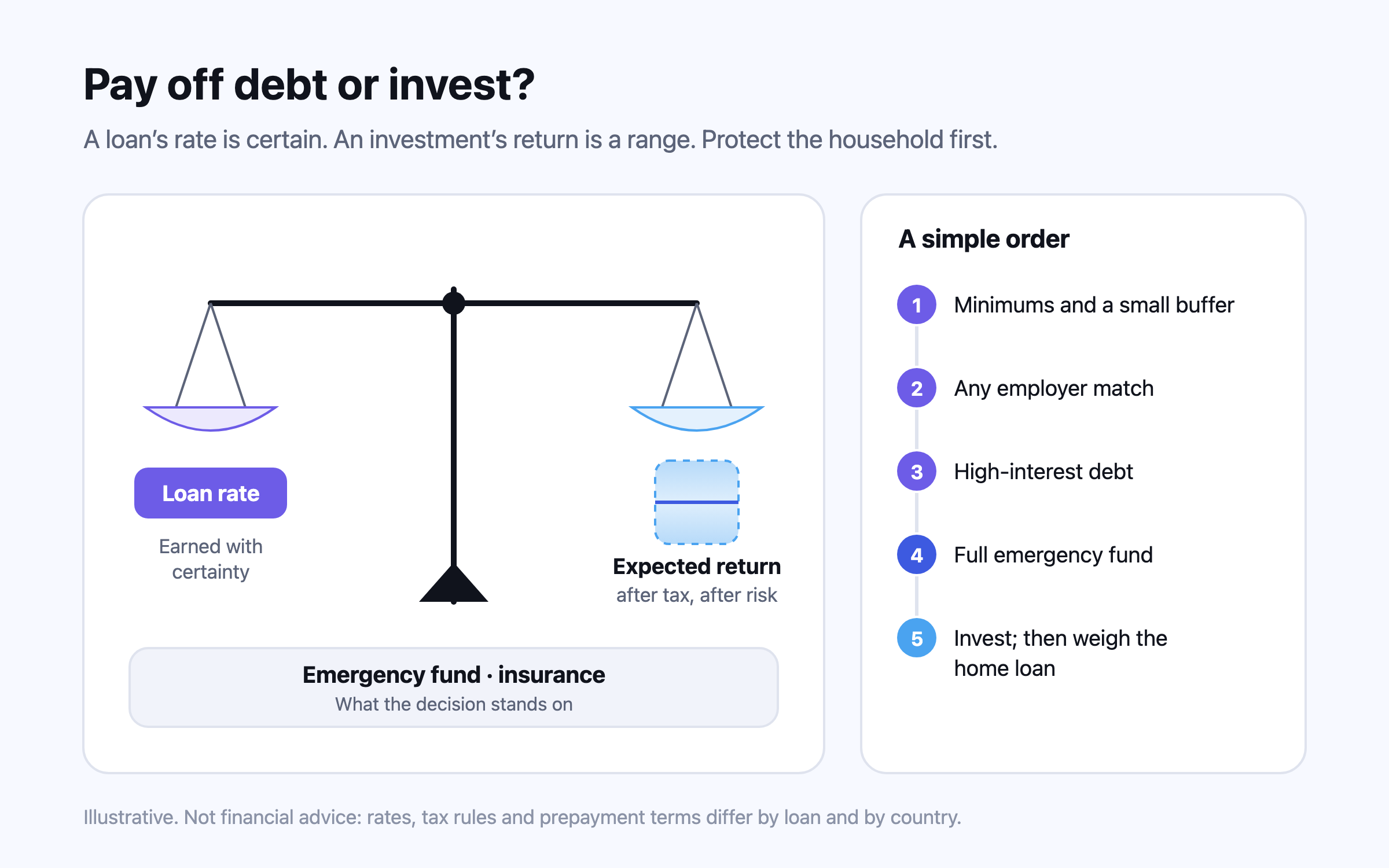
The short answer: every unit of debt you repay earns exactly that loan’s interest rate, with no market risk and no tax to pay on it. Investing might earn more, or less. So the decision comes down to one comparison — the loan’s rate against what investing could reasonably earn after tax and after allowing for risk — made only once the household is protected against a shock. The US Securities and Exchange Commission puts the first half bluntly: credit cards can charge 18 percent or more, and almost no investment beats clearing them1.
Few investment strategies pay off as well as, or with less risk than, merely paying off all high interest debt you may have.
The one comparison that decides it
Put the two options side by side and three differences matter more than the headline rates.
- Certain against uncertain. Repaying a loan saves its interest every year it would have run. An investment’s return is an estimate that can be negative for years at a time, so a fair comparison discounts the expected return for that risk rather than taking it at face value.
- After tax on both sides. If the loan’s interest is tax-deductible, its real cost is lower than the rate on the statement; if the investment sits in a taxable account, its real return is lower too. Inside a tax-sheltered account such as a UK ISA, gains and interest are tax-free, which tilts the comparison towards investing2.
- Liquidity. Money invested can usually be sold within days. Money used to prepay a home loan is locked inside the house until you sell or borrow again. That is the strongest argument for keeping a cash buffer before prepaying anything.
The result is a rough sorting rule rather than a formula. Debt that costs far more than a balanced portfolio might reasonably return — credit cards above all, at 18 percent or more in the SEC’s words — goes first, because no plausible investment beats it1. A low-rate, possibly tax-deductible home loan is genuinely close, and reasonable people choose differently. Everything in between depends on the rate, the tax treatment and how secure your income is.
Before either: an emergency fund
An emergency fund is what stops the next car repair or a lost job going onto a credit card — which would undo the very debt repayment you were working on. Vanguard frames it as two separate shocks: for unexpected bills, at least $2,000 or two to four weeks of expenses; for losing your income, at least three to six months of living expenses3. The SEC notes that some savers keep up to six months of income in savings once high-interest debt is gone1.
Dave Ramsey’s widely followed Baby Steps put the same idea in a different order: a $1,000 starter emergency fund, then all debt except the home, then the full fund of three to six months of expenses4. The common thread across all three sources is a small buffer before attacking debt and a full one before investing for the long term. Keep it in cash or deposits you can reach within days, not in shares that may be down exactly when you need them.
Insurance before investing
Insurance protects the plan from the events that savings cannot absorb. If anybody depends on your income, term life insurance is the usual tool: Canada’s Financial Consumer Agency explains that it covers a fixed period, such as 10 or 20 years, and that its premiums are generally lower than permanent insurance when first bought5. Its purpose is to replace your income so your family can keep its standard of living5. Health cover belongs in the same place in the queue wherever a hospital bill is not mostly publicly funded: one uninsured illness can cost far more than an emergency fund holds. Buy protection for the risks that would break the plan; insurance sold as an investment is a separate decision.
A simple order of operations
Most careful guides converge on roughly the same sequence. Each step compares a certain return with an uncertain one, and moves on only when the certain one runs out.
- Pay every minimum and keep essential bills current. Missed payments add fees and damage your credit record.
- Build a starter buffer — a few weeks of expenses, so a surprise bill does not become new debt3.
- Take any employer match in full. The SEC calls an employer matching your retirement contribution “free money”: an instant return no other step can beat1.
- Clear high-interest debt, credit cards first, which can charge 18 percent or more1.
- Finish the emergency fund, three to six months of living expenses3, and put term life and health cover in place if anybody depends on you.
- Invest for the long term, tax-sheltered accounts first where your country offers them.
- Then decide about the mortgage: prepay, invest, or split the difference. This is the one step where the answer genuinely varies.
Snowball or avalanche?
Once you are clearing debts, there are two famous orders. The avalanche pays the highest interest rate first; it costs the least, and the Consumer Financial Protection Bureau describes it as focusing on the debts with the highest interest rate, while the snowball focuses on the smallest debt and may cost more overall6. The debt snowball, Dave Ramsey’s method, pays the smallest balance first regardless of the rate, rolling each cleared payment into the next4. On paper the avalanche always wins.
In practice the evidence is more interesting. Kellogg School researchers David Gal and Blakeley McShane studied about 6,000 consumers in a debt-settlement programme and found that closing out individual accounts — independent of the balances closed — predicted who went on to eliminate their debt entirely7. Small wins kept people going. The fair reading is that the avalanche is cheaper and the snowball is easier to finish, so the better method is the one you will actually complete. If the rates on your debts are close, the snowball costs little; if one debt is far more expensive than the rest, that is the one to clear first.
The home loan: prepay or invest?
A home loan is usually the cheapest debt a household carries, often tax-advantaged and very long — which is why prepaying it is a real choice rather than an obvious one. Prepaying earns the loan rate with certainty and removes a fixed cost before your income stops. Investing keeps the money liquid and may earn more over decades. Many households split the difference: invest steadily, and use bonuses or windfalls to prepay. Two practical checks come first. In the United States some mortgages carry a prepayment penalty, usually only for paying off the whole balance within the first three or five years, and normally not for small extra payments8. In India the Reserve Bank does not allow banks to charge foreclosure or prepayment penalties on floating-rate term loans to individual borrowers9.
Country notes
- India. Under the old tax regime, interest on a home loan for a self-occupied house can be deducted up to ₹2,00,000 a year; the new regime — now the default — does not allow that deduction, so the loan’s after-tax cost depends on which regime you file under10. Prepaying a floating-rate home loan carries no bank penalty9.
- United Kingdom. You can save up to £20,000 a year across ISAs in the 2026 to 2027 tax year, with interest and gains free of tax2. That shelter raises the after-tax return on investing, which matters when the comparison is against a modest mortgage rate.
- United States. Take the full employer match in a 401(k) before anything except the minimums and a small buffer — the SEC’s “free money”1 — and treat credit-card balances, at 18 percent or more, as an emergency1.
- Everywhere. Contribution limits, deductions and prepayment rules change, and so does the order of the tax-sheltered step. Check the current rules for your country before acting.
How Nivritee helps you weigh it
This article explains general principles. It is not financial or tax advice; tax rules and prepayment terms vary, so check them for your own loans and country.
Questions people ask
Should I pay off my home loan or invest?
Compare the loan’s rate after any tax deduction with what investing might earn after tax and risk. A low-rate home loan is a close call that many households split, investing steadily and prepaying with windfalls, once the emergency fund is in place.
Should I pay off credit card debt before investing?
Almost always. Credit cards can charge 18 percent or more, and the SEC says few investments pay off as well as, or with less risk than, clearing high-interest debt1.
Should I build an emergency fund or pay off debt first?
Usually a small buffer first, then high-interest debt, then the full fund. Vanguard suggests at least $2,000 or two to four weeks of expenses for surprise bills and three to six months for losing your income3.
Is the debt snowball or the debt avalanche better?
The avalanche (highest rate first) costs less; the snowball (smallest balance first) is easier to stick with. A Kellogg study of about 6,000 consumers found that closing individual accounts predicted paying off debt entirely7.
Is there a penalty for prepaying a home loan in India?
Not on a floating-rate home loan to an individual: the Reserve Bank of India does not allow banks to charge foreclosure or prepayment penalties on those9. Fixed-rate loans can carry charges, so check your agreement.
Sources
- Saving and Investing: A Roadmap to Your Financial Security Through Saving and Investing — U.S. Securities and Exchange Commission (Investor.gov), 2019.
- Individual Savings Accounts (ISAs) — GOV.UK, 2026-10.
- What’s the right emergency savings amount? — Vanguard, 2026-10.
- How the Debt Snowball Method Works — Ramsey Solutions, 2026-10.
- Life insurance — Financial Consumer Agency of Canada, 2026-10.
- How to reduce your debt — U.S. Consumer Financial Protection Bureau, 2019-07.
- The ‘snowball approach’ to debt (on Gal and McShane, Journal of Marketing Research, August 2012) — Kellogg School of Management, Northwestern University, 2012-08.
- What is a prepayment penalty? — U.S. Consumer Financial Protection Bureau, 2026-10.
- Levy of foreclosure charges/pre-payment penalty on floating rate term loans (7 May 2014) — Reserve Bank of India, 2014-05.
- FAQs on New Tax vs Old Tax Regime — Income Tax Department, Government of India, 2026-10.
- What is the Survival rung? — Nivritee Help Centre, 2026-10.
This is general information, not financial, tax or legal advice for your circumstances. Rules and figures change; check the official source for your country, and consult a licensed professional before making financial decisions. Projections are estimates, not predictions.