Investing a lump sum at once has beaten spreading it out about two times in three — but a monthly SIP from your salary is a different choice, and its real strength is that it keeps you investing
With money already in hand, investing it at once has beaten feeding it in over a few months roughly two-thirds of the time, by about 2% after a year for an all-equity portfolio, because markets rise more often than they fall. A SIP from each month’s salary is not that choice: it invests money as soon as it exists. Its real advantage is behavioural: automatic, regular investing takes the stop-start timing decisions out of investors’ hands.
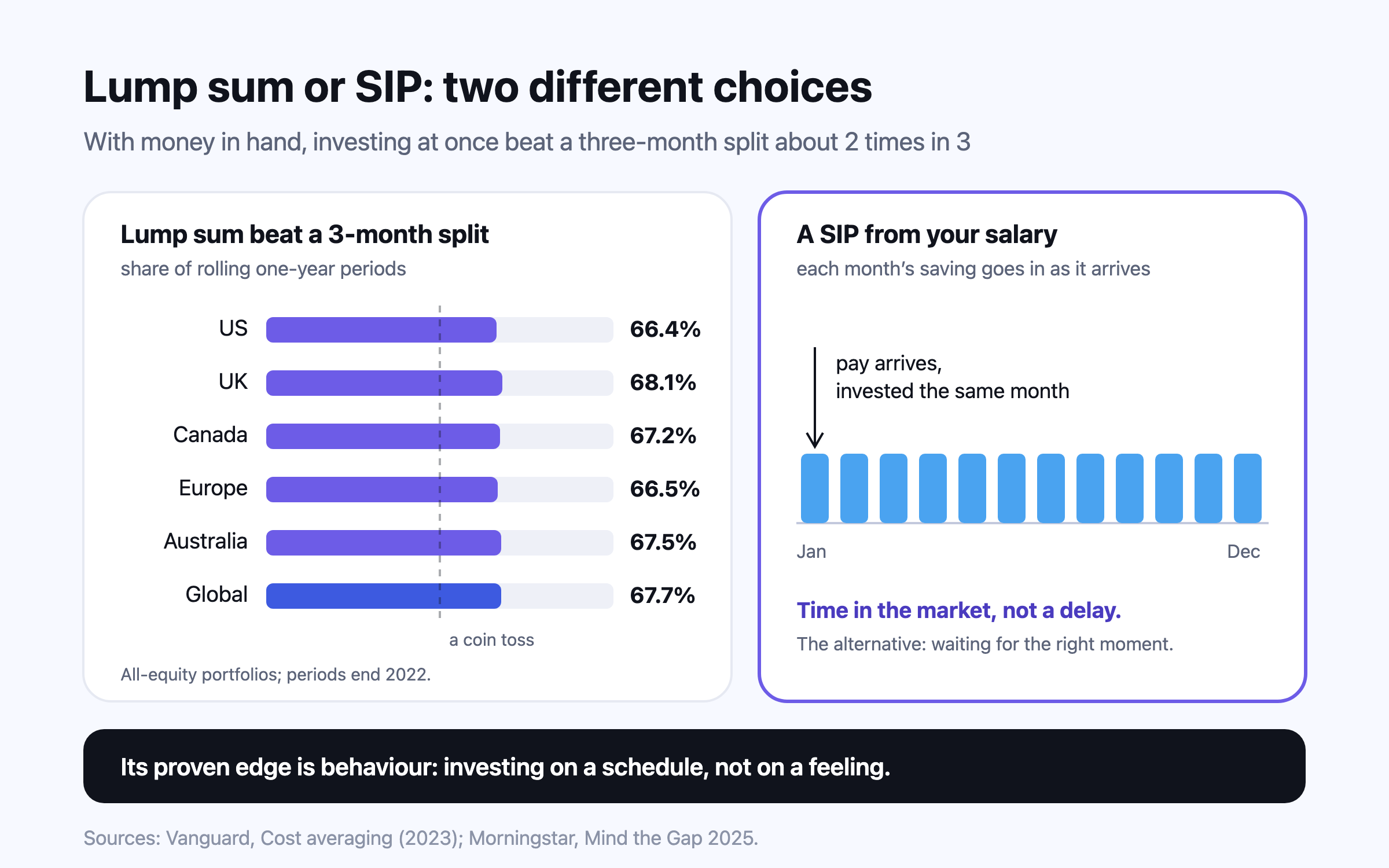
“Lump sum or SIP?” is really two questions, and most advice blurs them. The first applies when you already have a sum to invest — a bonus, an inheritance, a matured deposit, the proceeds of a flat — and must decide whether to put it in at once or feed it in over months. The second is how to invest money you have not earned yet: a fixed amount from each month’s pay, which is what a systematic investment plan (SIP) usually is. The evidence answers the two very differently.
68%1
of rolling one-year periods in which a lump sum beat a three-month split (MSCI World, 1976–2022)
2.2%1
more wealth after a year at the median, all-equity portfolio, from investing at once
69%1
of periods in which spreading it out still beat leaving the money in cash
1.2 points2
a year between what US funds returned and what the average dollar invested in them earned, ten years to 2024
With a sum in hand: investing at once usually wins
Vanguard compared the two approaches in 2023 using global shares from 1976 to 2022. Investing a lump sum immediately beat splitting it into three monthly parts in 68% of rolling one-year periods. Splitting it still beat leaving everything in cash 69% of the time, and investing at once beat cash 70% of the time1. The reason is plain: over 1976–2022, US shares beat cash in 76% of periods and US bonds in 68%, so every month money waits is usually a month of return given up1.
| Market (index, period) | Lump sum beat a 3-month split | Lump sum beat a 6-month split |
|---|---|---|
| United States (Russell 3000, 1979–2022) | 66.4% | 73.7% |
| United Kingdom (FTSE All-Share, 1986–2022) | 68.1% | 69.5% |
| Canada (S&P/TSX Composite, 1985–2022) | 67.2% | 69.7% |
| Europe (MSCI Europe, 1998–2022) | 66.5% | 65.4% |
| Australia (S&P/ASX 300, 1992–2022) | 67.5% | 72.5% |
| Emerging markets (MSCI EM, 1988–2022) | 61.6% | 61.8% |
| Global (MSCI World in US dollars, 1976–2022) | 67.7% | 72.6% |
The longer the money is drip-fed, the more often investing at once wins: in the US the hit rate rises from 66.4% with a three-month split to 73.7% with a six-month split1. Paying interest on the cash while it waits narrows the gap but does not close it — the lump sum still won 65% of the time for an all-equity portfolio1. This is consistent with Vanguard’s own earlier work and with a long academic literature reaching the same conclusion1.
By how much — and the third of the time it loses
The typical advantage is modest. Starting from $100,000, the median all-equity portfolio was worth $111,940 a year later if invested at once and $109,580 if spread over three months — about 2.2% more. In a 60/40 mix of shares and bonds it was 1.8% more, and in a 40/60 mix 1.2% more1. The more of the portfolio is in shares, the more there is to gain from getting it working sooner.
The other third of the time matters too, and it is the third people remember. At the 5th percentile — roughly the worst year in twenty — the all-equity lump sum ended at $82,947 against $85,906 for the three-month split1. Investing at once means accepting a wider range of outcomes: more often ahead, occasionally further behind. A deep fall straight after investing a life-changing sum is not hypothetical — US shares lost 38% in real terms in 1931 alone3 — and the regret of that experience is what makes many people hesitate.
Those last two per cent are Vanguard’s own median figures, about 2% for an all-equity portfolio after a year1. In India, the usual way to spread a lump sum is a systematic transfer plan (STP) from a liquid or debt fund into an equity fund, which at least earns something on the waiting money. The same arithmetic applies: the longer the transfer runs, the more return is given up on average.
A SIP from your salary is a different decision
Vanguard is careful to separate the two meanings of cost averaging: its study is about money already available, not about investing a fixed amount from each paycheque1. That distinction is the heart of the SIP question. If your savings arrive monthly, a monthly SIP is not holding money back; it is investing each instalment as soon as it exists. In the study’s terms, a salary SIP is much closer to the lump-sum strategy: money invested as soon as it is available, twelve times a year.
So the real alternative to a salary SIP is not a lump sum. It is saving the money up in a bank account and investing it later, whenever the market looks right — and that is where the evidence turns against investors.
What “rupee-cost averaging” does and does not do
A fixed amount buys more units when prices are low and fewer when they are high. Invest 1,000 a month at unit prices of 100, then 50, then 100: you buy 10, 20 and 10 units — 40 units for 3,000, an average cost of 75 a unit, below the average price of about 83. That is real arithmetic, and it is why a falling market is less frightening to someone with a running SIP. In a market that dips and recovers, like this one, the monthly buyer ends ahead: 40 units worth 4,000, against 30 units worth 3,000 for someone who put the whole 3,000 in at the start. In a market that only rises, the order reverses — and because markets have risen more often than they have fallen, the earlier money has usually done better. Averaging is a way of buying, not a reliable source of extra return.
Timing the market: the gap investors pay
Morningstar’s annual Mind the Gap study compares the return funds earned with the return the average dollar invested in them actually got, which depends on when investors bought and sold. Over the ten years to December 2024, the average dollar invested in US funds earned 7.0% a year against the funds’ own 8.2% — a gap of about 1.2 percentage points, or around 15% of the funds’ return, which Morningstar attributes to the timing and size of investors’ purchases and sales2. Investors in allocation funds — all-in-one funds such as target-date funds, often held through retirement-plan menus — captured nearly 97%: a 6.3% a year dollar-weighted return against 6.5% for the funds2. The measure has critics: a 2026 study in the Financial Analysts Journal, using the same 2015–2024 sample, put the cost of poor timing at only about 0.1 percentage points a year4. Both agree on the direction; they disagree on the size.
The long record shows why waiting for the right moment is so costly. After the 1929 crash, US shares took until February 1945 to recover; after the dot-com peak in March 2000 the fall and recovery took seven and a half years; after the 2008 crisis, four years5. Nobody announced those bottoms in advance, and an investor waiting on the side for a clearer signal usually missed the early part of each recovery.
The behavioural case for a SIP
The strongest evidence for automatic investing comes from behavioural economics rather than from market returns. When a large US employer switched its 401(k) plan to automatic enrolment, participation rose sharply even though nothing about the plan’s economics changed — people stayed with whatever happened by default6. Inertia, usually a problem, worked for them.
Richard Thaler and Shlomo Benartzi’s Save More Tomorrow programme used the same force deliberately: employees committed in advance to save part of future pay rises. In the first company to adopt it, 78% of those offered the plan joined, 80% were still in it after the fourth pay rise, and their average saving rate rose from 3.5% to 13.6% over 40 months7.
A SIP is the household version of the same design. It turns the decision to invest into the default and makes stopping the act that requires effort. It also removes the monthly temptation to judge the market — the stop-start buying and selling that Mind the Gap links to a wider gap between a fund’s return and its investors’. The trade-off is that a SIP keeps buying through a fall — the point of it, but uncomfortable — and that a SIP amount set years ago and never raised quietly falls behind a growing salary.
Putting it together
- Money you already have and will not need for years: the evidence favours investing it at once, in the mix of assets you would hold anyway.
- If a fall straight afterwards would make you abandon the plan, spread it over a few months — through an STP in India — and accept that this usually costs a little.
- Money you will earn: invest it as it arrives, with a SIP or a standing instruction, and raise the amount when your pay rises.
- Money needed within a few years is exposed to a fall whichever way it goes in — which is why short-term money is usually kept out of shares altogether.
This is information about what the research found, not financial or tax advice; the right choice for a particular sum depends on your plan, your other savings and how you would react to a fall. For why the order of returns matters most just before and after you stop working, see sequence of returns risk.
Questions people ask
Is SIP better than lump sum?
For money you already have, investing at once has usually done better: it beat a three-month split in about 68% of periods in Vanguard’s global data1. For money you earn each month, a SIP is how you invest it as soon as it exists, so the two are not really competitors.
Should I invest a large amount at once or spread it out?
The evidence favours investing at once, by about 2.2% at the median after a year for an all-equity portfolio1. Spreading it over a few months is reasonable if a fall straight afterwards would make you give up — it still beat holding cash 69% of the time1.
Does rupee-cost averaging increase returns?
No. Buying a fixed amount lowers your average cost per unit compared with the average price, but it does not beat investing the same money earlier in a rising market. Its value is behavioural: it keeps you investing through falls.
Is it better to wait for a market correction before investing?
Historically, rarely. Over 1976–2022, US shares beat cash in 76% of periods1, so money waiting on the side has usually given up return. How much investors lose to timing is debated: Morningstar puts the gap at about 1.2 percentage points a year over the decade to 2024, while a 2026 study using the same data put the cost of poor timing at about 0.1 points24.
What is the difference between a SIP and an STP?
A SIP invests a fixed amount from your income on a schedule. An STP moves an existing lump sum from a liquid or debt fund into an equity fund in instalments — a way of spreading a sum you already have, with the cost that implies.
Sources
- Cost averaging: Invest now or temporarily hold your cash? (Megan Finlay and Josef Zorn) — Vanguard Research, 2023-02.
- Mind the Gap 2025: The More Investors Traded, the Less They Made (Jeffrey Ptak) — Morningstar, 2025-08.
- The Worldwide Equity Premium: A Smaller Puzzle (Table 2: worst one-year real returns) — Elroy Dimson, Paul Marsh and Mike Staunton, London Business School (SSRN 891620), 2006-04.
- Bad Timing Does Not Cost Investors 15% of Their Funds’ Returns: An Examination of Morningstar’s “Mind the Gap” Study (Financial Analysts Journal 82(3)) — Jon A. Fulkerson, Bradford Jordan, Timothy Brandon Riley and Qing Yan, CFA Institute, 2026-05.
- UBS Global Investment Returns Yearbook 2025: public summary edition (post-crash recoveries) — Elroy Dimson, Paul Marsh and Mike Staunton, UBS, 2025-03.
- The Power of Suggestion: Inertia in 401(k) Participation and Savings Behavior (NBER Working Paper 7682) — Brigitte C. Madrian and Dennis F. Shea, National Bureau of Economic Research, 2000-05.
- Save More Tomorrow: Using Behavioral Economics to Increase Employee Saving (Journal of Political Economy 112(S1)) — Richard H. Thaler and Shlomo Benartzi, 2004.
- How do I add a monthly SIP or regular investment? — Nivritee Help Centre, 2026-10.
This is general information, not financial, tax or legal advice for your circumstances. Rules and figures change; check the official source for your country, and consult a licensed professional before making financial decisions. Projections are estimates, not predictions.