In England and Australia a student loan behaves like a graduate tax; in the US and India it is a debt you must clear
Student debt comes in two shapes. Income-contingent systems — England, Australia, New Zealand — take a share of income above a threshold and, in England, write off what is left after 30 or 40 years. Loans in the US, Canada and India have a schedule, with income-based relief in the first two and a fixed EMI in the third. The shape decides what the debt does to a household’s saving far more than the balance does.
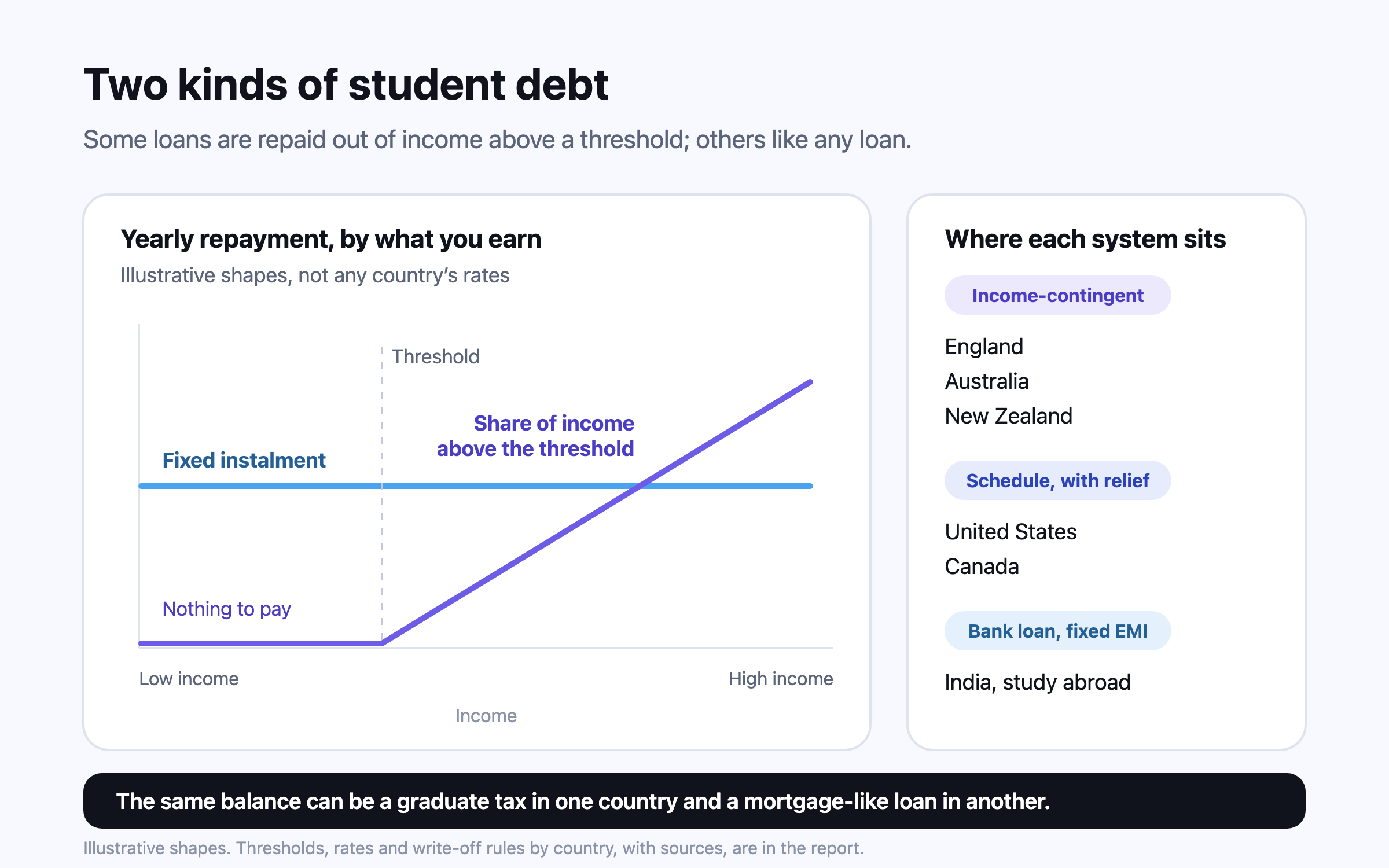
The short answer: the same balance means different things in different countries. A graduate in England on a Plan 5 loan repays 9% of income above £25,000 and has whatever is left written off after 40 years12; a graduate in Australia repays 15% of income between $67,000 and $125,0003. A family in India financing a degree abroad pays a fixed monthly instalment whatever the graduate earns, at a floating rate — 9.40% a year on SBI’s secured study-abroad loan4. The first kind behaves like a tax on graduate earnings; the second like a mortgage. Planning for one as if it were the other is the commonest mistake.
$1.65tn5
US student debt outstanding, all lenders, Q2 2026
£294.6bn6
Outstanding English higher-education student loans, March 2026
55%7
Plan 5 starters in 2025/26 expected to repay in full
9.40%4
SBI Global Ed-Vantage rate, with collateral, from June 2026
The systems side by side
| System | What you repay | Interest | What happens to the rest |
|---|---|---|---|
| United States, federal Direct Loans | A schedule, or under the new Repayment Assistance Plan 1% to 10% of income, minimum $10 a month | 6.52% for new undergraduate loans, 2026-27 | Forgiven after 360 qualifying monthly payments under the Repayment Assistance Plan |
| England, Plan 5 (courses from 2023) | 9% of income above £25,000 | RPI only | Written off 40 years after repayment starts |
| England, Plan 2 (courses started 2012 to July 2023) | 9% of income above £29,385 (2026/27) | RPI up to RPI plus 3 points, capped at 6% for 2026/27 | Written off 30 years after repayment starts |
| Australia, HELP | 15% of income between $67,000 and $125,000, plus 17% above it, at most 10% of income (from 2025-26) | Indexed each year rather than charged interest | Accumulated debts cut by 20% in 2025 |
| New Zealand | 12% of income above NZ$24,128 (2026 tax year) | None while living in New Zealand; 5.6% if based overseas (2027 tax year) | Repaid through the tax system |
| Canada, Canada Student Loans | A schedule after a six-month grace period; no payment below $3,866 a month for a household of one under the Repayment Assistance Plan | None on the federal portion since April 2023 | Repayment Assistance Plan relief while income is low |
| India, bank education loan | A fixed EMI after the course | 9.90% unsecured up to ₹7.5 lakh; 9.40% secured for study abroad (SBI) | Owed in full |
United States: a debt with a new safety net
Americans owed $1.65 trillion in student loans at the end of June 2026, and 10.6% of balances were 90 or more days past due5. The 2025 reconciliation law rewrote federal lending for anyone borrowing from July 2026: no new Graduate PLUS loans, graduate borrowing capped at $20,500 a year and $100,000 in total, professional students at $50,000 a year and $200,000, and Parent PLUS at $20,000 a year and $65,0008. The income-contingent plans, including PAYE and SAVE, close after July 20288.
Its replacement, the Repayment Assistance Plan, charges between 1% and 10% of adjusted gross income, less $50 a month per dependant, never below $10 a month; unpaid interest is not added to the balance, and what remains is forgiven after 360 qualifying monthly payments98. New undergraduate loans carry 6.52% for 2026-27, graduate unsubsidised loans 8.07% and PLUS loans 9.07%10. The safety net is real, but thirty years is most of a working life, and the Federal Reserve’s household survey found 41% of borrowers required to pay had recently struggled to17.
England, Australia and New Zealand: a share of income
In an income-contingent system the balance decides how long you pay, not how much each month. The repayment is a fixed share of income above a threshold, collected through payroll or the tax return. Three graduates, each on the rules above, show how small the monthly effect can be:
| Graduate | Income | Rule | Repayment a year |
|---|---|---|---|
| England, Plan 5 | £35,000 | 9% above £25,000 | £900 |
| England, Plan 2 (2026/27) | £35,000 | 9% above £29,385 | about £505 |
| Australia, HELP (2025-26) | $80,000 | 15% above $67,000 | $1,950 |
| New Zealand (2026 tax year) | NZ$50,000 | 12% above NZ$24,128 | about NZ$3,105 |
England’s scheme is the clearest case of debt that is not really debt. The average English borrower entering repayment in 2026 owed £47,730 (a provisional figure), and the outstanding total reached £294.6 billion in March 20266. The Department for Education expects 55% of Plan 5 starters in 2025/26 to repay in full, against 32% of the 2022/23 Plan 2 cohort7. For everyone else the repayment is, in effect, 9% extra tax on income above the threshold for 30 or 40 years, and paying the balance down early only helps those likely to clear it anyway.
The rules move. The Plan 2 threshold will be held at its 2026-27 level for three years from April 2027, which raises repayments in real terms18, while Plan 2 interest was capped at 6% for 2026/27, from September 202611. Australia cut accumulated HELP debts by 20% in 2025 and switched to a marginal system in which repayment rises only on income above $67,0003. New Zealand charges no interest at all to borrowers who live there, and 5.6% to those who move abroad13 — a rule worth knowing for a family whose graduate plans to work in Australia or the Gulf.
Canada: interest-free, with income-based relief
Canada removed interest permanently from the federal portion of Canada Student Loans from 1 April 2023, including loans already in repayment14. Repayment starts after a six-month non-repayment period16, and under the Repayment Assistance Plan a borrower in a household of one with gross income below $3,866 a month makes no payment at all15. Provincial loans sit alongside and may follow different rules15.
The international student who borrows at home
A student going abroad cannot usually use the destination’s government loans, so the family borrows at home. In India that means a bank loan with a fixed monthly instalment. SBI’s published rates from June 2026 were 9.90% for an unsecured student loan of up to ₹7.5 lakh, and 9.40% for its Global Ed-Vantage study-abroad loan with collateral, for amounts from ₹7.5 lakh to ₹3 crore; rates float with the bank’s benchmark, and girl students get 0.50% off4.
At 9.40% a year, a ₹40 lakh loan repaid over ten years costs an EMI of about ₹51,540 a month — about ₹61.85 lakh in all, of which about ₹21.85 lakh is interest4. Unlike an English or Australian loan, that EMI is due whether the graduate finds a well-paid job abroad, comes home to a lower salary or does not work at all, and the parents who co-signed or pledged property carry it if the student cannot.
For study in India, the government’s PM-Vidyalaxmi scheme offers collateral-free, guarantor-free loans to students admitted to the top 860 institutions by NIRF ranking, a 75% credit guarantee on loans up to ₹7.5 lakh, and 3% interest subvention on loans up to ₹10 lakh where family income is up to ₹8 lakh19. Families earning up to ₹4.5 lakh a year receive full interest subvention under the central subsidy scheme20.
What student debt does to household finances
The best-known study is by Federal Reserve economists Alvaro Mezza, Daniel Ringo, Shane Sherlund and Kamila Sommer, who followed a nationally representative cohort, aged 23 to 31 in 2004, through credit-bureau records from 1997 to 201021. They estimated that a 10% increase in student debt causes a 1 to 2 percentage point drop in the home-ownership rate of borrowers in the first five years after leaving education21. The mechanism is ordinary: a monthly repayment reduces what a lender will advance and what a household can save toward a deposit.
- It is common. Sixteen percent of all US adults had outstanding student loans in 202517.
- Payment difficulty is widespread where repayment is fixed. In the same survey, 41% of those required to make payments had recently had difficulty doing so17.
- Income-contingent debt bites differently. It rarely causes arrears, because it falls when income falls, but it acts as a long-running deduction from take-home pay — about £900 a year at £35,000 on Plan 51 — that a household should count in its saving rate.
- Parental loans move the debt to the parents. A Parent PLUS loan, capped at $65,000 for new borrowing from July 20268, or an Indian EMI co-signed by parents, competes directly with the parents’ own saving for independence.
Whether to clear a student loan early or invest instead turns on the same question as any other debt — its real interest rate against what the money would earn — with one twist: a loan likely to be written off should usually not be overpaid. The general case is set out in pay off debt or invest.
Questions people ask
What is the student loan repayment threshold in 2026?
In England it is £29,385 for Plan 2 in 2026/27 and £25,000 for Plan 5, with 9% repaid above it1. In Australia repayment starts at $67,000 from 2025-263, and in New Zealand at NZ$24,128 for the 2026 tax year12.
What is the difference between Plan 2 and Plan 5 student loans?
Plan 5, for courses from 2023, repays 9% above £25,000, charges RPI only and is written off after 40 years12. Plan 2 repays 9% above £29,385, charges up to RPI plus 3 points, capped at 6% for 2026/27, and is written off after 30 years112.
Are Canada student loans interest-free?
The federal portion of Canada Student Loans has carried no interest since 1 April 2023, including loans already being repaid14. Provincial loans may differ.
What is the interest rate on an education loan for studying abroad in India?
Rates float with each bank’s benchmark. From June 2026 SBI charged 9.40% on its Global Ed-Vantage study-abroad loan with collateral, and 9.90% on an unsecured student loan of up to ₹7.5 lakh4.
What is the new Repayment Assistance Plan for US student loans?
It charges 1% to 10% of adjusted gross income, less $50 a month per dependant, with a $10 monthly minimum, and forgives what remains after 360 qualifying payments98. Applications opened on 1 July 20269.
Does student debt stop people buying a home?
It delays it. Federal Reserve economists estimated that a 10% increase in student debt lowers borrowers’ home-ownership rate by 1 to 2 percentage points in the first five years after leaving education21.
Sources
- Repaying your student loan: what you pay — GOV.UK, 2026.
- Repaying your student loan: when your student loan gets written off or cancelled — GOV.UK, 2026.
- Universities Accord (Cutting Student Debt by 20 Per Cent) Act 2025 — Federal Register of Legislation, Australian Government, 2025-08.
- Education loan schemes: interest rates (w.e.f. 09.06.2026) — State Bank of India, 2026-07.
- Quarterly Report on Household Debt and Credit, 2026 Q2 — Federal Reserve Bank of New York, 2026-08.
- Student loans in England: financial year 2025-26 — Student Loans Company, 2026-07.
- Student loan forecasts for England — Department for Education, 2026-07.
- Reimagining and Improving Student Education: Federal Student Loan Program final regulations — US Department of Education, Federal Register, 2026-05.
- Repayment Assistance Plan (RAP) — EdFinancial Services, a US federal student loan servicer, 2026.
- Annual notice of interest rates for Federal Direct Loans, 2026-27 — US Department of Education, Federal Register, 2026-09.
- Interest rate cap introduced to protect Plan 2 borrowers — GOV.UK, Department for Education, 2026-04.
- Repaying my student loan when I earn salary or wages — Inland Revenue (New Zealand), 2026.
- Student loan interest and fees — Inland Revenue (New Zealand), 2026.
- What’s new: elimination of interest on Canada Student Loans — National Student Loans Service Centre, Government of Canada, 2026.
- Repayment Assistance Plan — Government of Canada, 2026-07.
- Start repaying your student loan — Government of Canada, 2025-12.
- Economic Well-Being of U.S. Households in 2025: Credit — Board of Governors of the Federal Reserve System, 2026-05.
- Budget 2025 — HM Treasury, 2025-11.
- Shri Dharmendra Pradhan lauds approval of PM Vidyalaxmi by Union Cabinet — Press Information Bureau, Ministry of Education, Government of India, 2024-11.
- PM-Vidyalaxmi portal — Department of Higher Education, Government of India, 2026.
- Student Loans and Homeownership (Mezza, Ringo, Sherlund and Sommer), FEDS 2016-010r1 — Board of Governors of the Federal Reserve System, 2017-07.
This is general information, not financial, tax or legal advice for your circumstances. Rules and figures change; check the official source for your country, and consult a licensed professional before making financial decisions. Projections are estimates, not predictions.