FIRE’s lasting idea is not retiring early. It is knowing what “enough” costs and owning the choice.
FIRE — financial independence, retire early — means saving a large share of income until your investments can cover your spending. Its core ideas about savings rate, conscious spending and owning your time hold up well; its weak points are healthcare, long horizons and market timing. Financial independence is worth having even if you never stop working.
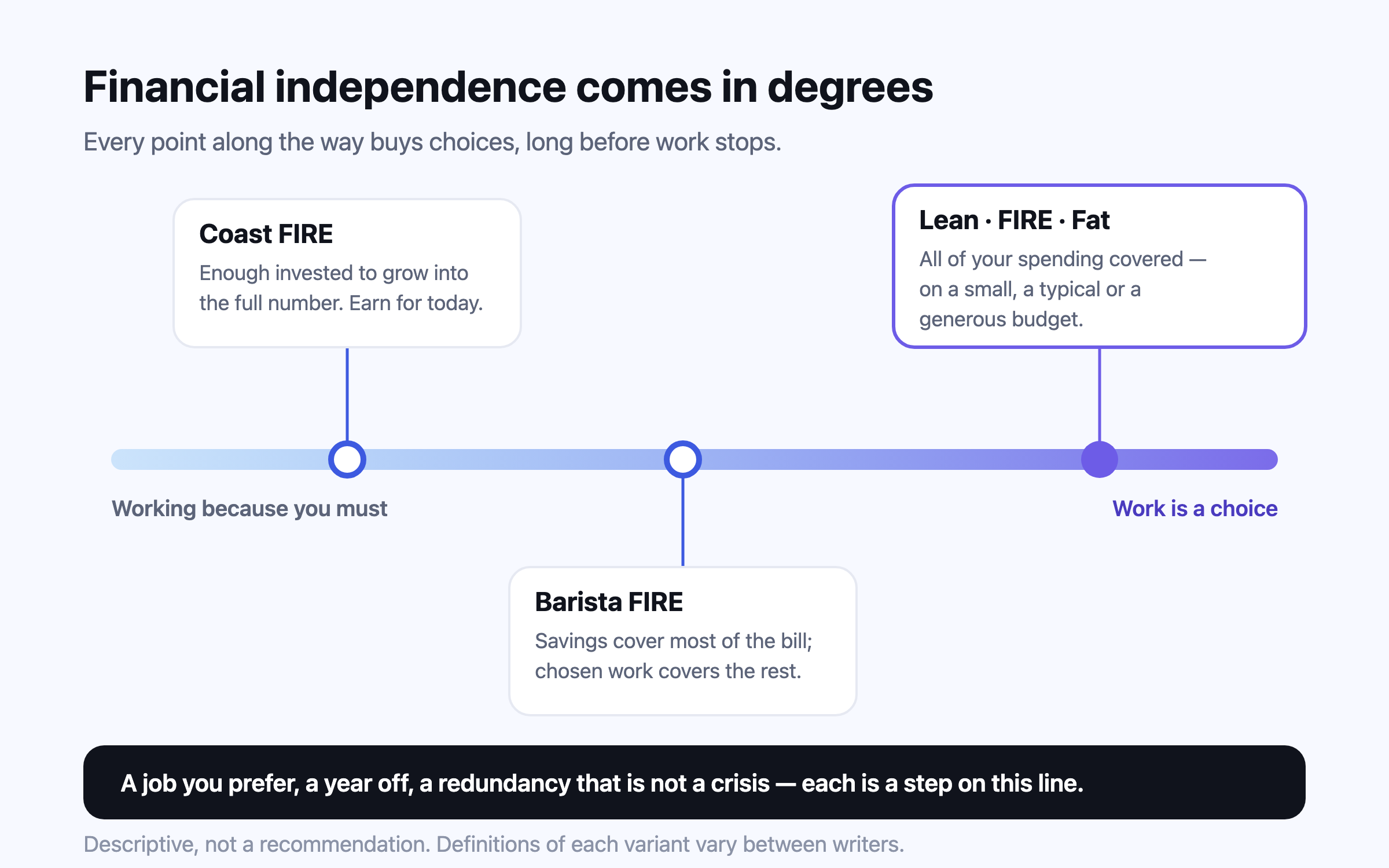
FIRE stands for financial independence, retire early: save and invest a large share of your income until your investments can pay for your life, then decide whether paid work stays in it. The idea has its roots in Vicki Robin and Joe Dominguez’s 1992 book Your Money or Your Life1 and went mainstream through blogs such as Mr. Money Mustache, launched in 2011 by an engineer who had stopped full-time work at 302. FIRE gets the fundamentals right — savings rate, conscious spending and owning your time. It is weakest where the “retire early” half meets healthcare, long horizons and bad market timing.
Where FIRE came from
Robin and Dominguez treated money as life energy: the hours of your life you trade for it. Their nine-step programme asks readers to track every unit of money in and out, value each purchase in the hours it cost, and stop when spending reaches “enough”. They defined financial independence as income sufficient for your basic needs and comforts from a source other than paid employment3. The book was first published by Viking Penguin in 1992 and revised in 1998, 2008 and 20181; its publisher reports more than a million copies sold4.
Financial Independence is the experience of having enough — and then some.
Mr. Money Mustache gave the idea its arithmetic. He and his then wife left their tech jobs in 2005 by living on about half of what their peers spent and investing the rest5. His 2012 post on “the shockingly simple math” argued that the time to independence depends mainly on one number, your savings rate. Assuming investment returns of 5% after inflation and a 4% withdrawal rate, a household saving 10% of take-home pay needs about 51 years of work, while one saving 50% needs about 166.
The movement’s shorthand target, “25 times your annual spending”, is simply the 4% rule turned upside down: if you can draw 4% a year, you need 25 years’ worth of spending invested7. Where that rule comes from and how far it travels is covered in the 4% rule by country.
Lean, fat, barista and coast FIRE
As the movement grew it split into flavours, each a different answer to how much is enough and how much work stays in the picture7:
| Flavour | What it means | What it trades away |
|---|---|---|
| Lean FIRE | Independence on a deliberately small budget, often saving more than half of income | Room for higher costs later — health, children, parents |
| Fat FIRE | Independence while keeping a higher standard of living | Time: a much larger target takes longer to reach |
| Barista FIRE | Savings cover part of spending; part-time or more meaningful work covers the rest, often for benefits such as health cover | Full independence, in exchange for reaching a working version of it sooner |
| Coast FIRE | Enough already invested that it can grow into the full target by a later age without new contributions; you keep working to cover today | Nothing yet — it is a milestone, not an end point |
What FIRE gets right
- The savings rate is the lever that matters most. It works twice: more saved each year, and a smaller target because you are used to living on less. Mainstream guidance suggests saving 10% to 15% for later life; committed FIRE households aim for 60% to 70%7.
- Spending is a choice, and it can be measured. Tracking where money goes, and asking whether each line is worth the hours it cost, is the part of Your Money or Your Life that has aged best3.
- A number turns a wish into a plan. Writing down what independence actually costs a year is the step most people skip, and everything else depends on it.
- Time is the asset. The point was never to stop doing things, but to choose what to do without needing to be paid for it.
The fair criticisms
- Healthcare. Charles Schwab lists health insurance before Medicare, market downturns, rising costs and burnout among the main risks of retiring early8. Outside the US the details differ, but medical costs rise faster than prices in many countries, and that is a cost a 45-year-old must fund for decades (healthcare costs when you stop early).
- Long horizons need lower withdrawal rates. The research behind the 4% rule tested 30 years. Morningstar puts a safe starting rate for a 50-year horizon at 2.9%, which raises the multiple of spending you need well above 259.
- Order matters as much as average. A crash in the first years of drawing down does damage a later one does not, and an early retiree spends longer exposed to it (sequence-of-returns risk).
- Extreme frugality can cost more than it saves. A budget cut to the bone leaves no margin for children, ageing parents or a partner whose plans differ — and a decade of deprivation to stop work at 40 is a trade some people later regret.
- Work is more than income. Purpose, structure and colleagues do not show up in a spreadsheet. Many people who reach independence keep working, on their own terms — which is a reason to aim for FI even if the RE never happens.
FIRE in India
An article in the Indian Institute of Banking & Finance’s journal traces FIRE’s spread in India to the mid-2010s, carried by personal-finance blogs, YouTube channels and online communities, with interest rising again after the pandemic10. The principles travel; several numbers do not.
- Inflation is higher. The Reserve Bank of India targets 4% consumer inflation within a band of 2% to 6%11, and costs such as school fees and medical care can rise faster than the headline rate. A plan needs each kind of cost inflating at its own rate.
- Households are larger. Supporting parents, children’s education and weddings are real future outflows that a 25-times-spending rule does not see. They belong in the plan as goals with years attached.
- Much retirement money is locked. EPF, PPF and NPS each restrict withdrawals until set ages or conditions, so stopping early needs a bridge of savings you can actually reach.
- Many households earn abroad and settle at home. A plan built in dirhams or dollars and spent in rupees has to convert today’s savings and price tomorrow’s costs where they will be paid.
- A lower withdrawal rate is prudent. Nivritee’s FI number divides by 3.5% for a plan settling in India, rather than 4%12.
What financial independence buys if you never stop working
The US Consumer Financial Protection Bureau defines financial well-being as how far your finances and money choices give you security and freedom of choice, and breaks it into four parts: control over day-to-day money, the capacity to absorb a shock, being on track for your goals, and the freedom to make choices that let you enjoy life13. FIRE is a fast route to all four, and none of them requires leaving work.
Partial independence is valuable long before the full number. Enough to coast means you could take a lower-paid job you would prefer. A year or two of runway means a redundancy is an inconvenience, not a crisis. Being past your number means work becomes something you choose — the outcome Robin and Dominguez were describing all along3.
Questions people ask
What does FIRE stand for?
Financial independence, retire early: saving and investing a large share of income until your investments can cover your spending, so paid work becomes optional.
How much do I need for FIRE in India?
The common rule is 25 times your yearly spending, which assumes a 4% withdrawal rate7. For a long horizon and Indian inflation a lower rate is prudent; Nivritee’s FI number uses 3.5% — about 29 times spending — before tax and goals such as education are added12.
What is the difference between lean FIRE and fat FIRE?
Lean FIRE aims for independence on a deliberately small budget; fat FIRE keeps a higher standard of living and so needs a much larger target7.
What is coast FIRE?
The point at which what you have already invested can grow into your full target by a later age without further contributions, so you only need to earn enough to cover today’s spending7.
Is FIRE realistic?
The financial independence half is realistic for many households with a high savings rate; the retire-early half needs care, because long horizons call for lower withdrawal rates9 and healthcare and a bad early market can upset a tight plan.
Sources
- About Vicki — Vicki Robin, 2026.
- Meet Mr. Money Mustache — Mr. Money Mustache, 2011-04.
- Your Money or Your Life summary (Clare Moss with Laurence Toltz) — Vicki Robin, 2026.
- Your Money or Your Life: 9 Steps to Transforming Your Relationship with Money and Achieving Financial Independence (revised 2018) — Penguin Random House, 2018.
- About Mr. Money Mustache — Mr. Money Mustache, 2026.
- The Shockingly Simple Math Behind Early Retirement — Mr. Money Mustache, 2012-01.
- FIRE Movement: What It Is, How It Works — NerdWallet, 2026-07.
- What Is the FIRE Movement? Financial Independence, Retire Early — Charles Schwab, 2026-06.
- How Much Can You Safely Withdraw If You Retire Early? — Morningstar (Amy C. Arnott), 2026-09.
- The F.I.R.E. Movement (Bank Quest, October–December 2024) — Indian Institute of Banking & Finance, 2024-12.
- Monetary policy framework: the inflation target — Reserve Bank of India, 2026-03.
- What is my FI number? — Nivritee Help Centre, 2026-10.
- About financial well-being — US Consumer Financial Protection Bureau, 2026.
This is general information, not financial, tax or legal advice for your circumstances. Rules and figures change; check the official source for your country, and consult a licensed professional before making financial decisions. Projections are estimates, not predictions.