A raise quickly becomes the new normal. Deciding what is enough is what turns more income into more freedom.
Lifestyle inflation is spending that rises to meet each raise, and psychology explains why it feels natural: people adapt to what they have. Income does keep helping most people, but a plan that lets spending rise in lockstep never gets closer to independence. The arithmetic says savings rate, more than income, decides how many years it takes — so the strongest guardrail is to decide what enough looks like and route part of every raise to savings before it can be spent.
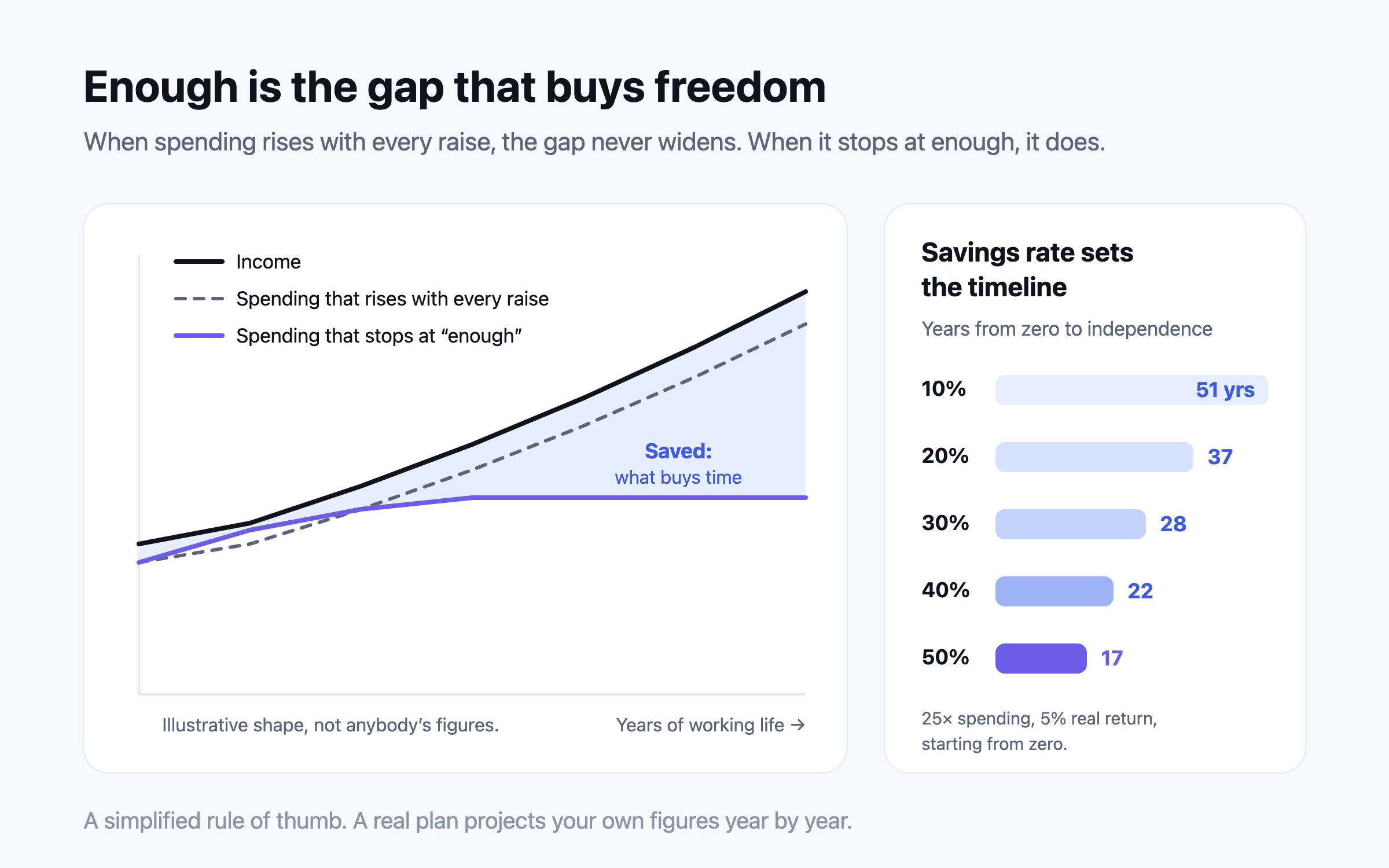
Lifestyle inflation — or lifestyle creep — is what happens when spending rises to meet income. A raise arrives, and within a year it is a bigger flat, a better car, more dinners out and a nicer holiday. None of these is a mistake on its own. The problem is the pattern: if spending rises in step with every raise, the gap between what comes in and what goes out never widens, and that gap is what buys financial independence.
The good news is that the pattern is well understood. Psychology explains why it feels effortless, research on income and wellbeing explains what more money does and does not do, and simple arithmetic shows exactly what it costs in years.
Why a raise stops feeling like a raise
In 1971 the psychologists Philip Brickman and Donald Campbell described what they called a hedonic treadmill: people adapt to improvements in their circumstances, so their sense of wellbeing drifts back towards where it was. A new level of comfort quickly becomes the baseline against which everything else is judged.
Brickman went on to test the idea on an extreme case. With Dan Coates and Ronnie Janoff-Bulman he compared major lottery winners with neighbours who had not won, and found the winners were not significantly happier — and took less pleasure from ordinary everyday things.1 Two forces were at work: habituation, as the new pleasures became normal, and contrast, as everyday life looked dimmer beside the big win.1 A raise is a much smaller version of the same thing. The upgrade feels good for a while, then it is simply how you live — and the cost of living that way is now permanent.
Does more income make people happier?
For a decade the best-known answer was Daniel Kahneman and Angus Deaton’s 2010 study of US Gallup data: life evaluation kept rising with income, but day-to-day emotional wellbeing stopped improving at around $75,000 a year.2 In 2021 Matthew Killingsworth, using real-time experience sampling, found that experienced wellbeing kept rising above $75,000.3
Rather than argue, Kahneman and Killingsworth reanalysed the data together, with Barbara Mellers as arbiter. Their 2023 paper found that for most people happiness kept rising with income up to at least $500,000, while for the least happy 20% it levelled off at around $100,000 — beyond which, they suggested, the miseries that remain are not ones money can fix.4
So the honest summary is not “money does not buy happiness”. It is that more income tends to help — but the help comes from what the money makes possible, not from a lifestyle that has quietly absorbed it. A reasonable reading is that the lasting value lies in security, time and choice — the things a widening gap between income and spending buys.
Enough: the goalpost that stops moving
Morgan Housel’s *The Psychology of Money* gives the idea its plainest form.5 His argument, in short: if expectations rise as fast as income, there is never a point at which you feel you have enough — and people who never reach that point are tempted to risk what they already have, and need, in pursuit of what they do not.
In an earlier essay Housel makes a related point about status: much spending is meant as a signal to other people, who tend to picture themselves with the car rather than admire its driver — and real wealth is largely invisible, made of the purchases you chose not to make.6
The hardest financial skill is getting the goalpost to stop moving.
“Enough” does not mean frugal. It means deciding, in advance, what a good life costs for your household — and recognising that every amount spent beyond it is a choice to work longer.
The arithmetic: savings rate sets the timeline
There is a neat piece of arithmetic behind this, popularised in the financial independence community: if you start from nothing, the number of years until your savings could fund your spending depends almost entirely on what share of your take-home pay you save, not on how much you earn.7 The reason is that each unit you do not spend counts twice — it is invested, and it is a unit your future life does not need to fund.
| Savings rate | Years from zero to independence |
|---|---|
| 10% | about 51 |
| 20% | about 37 |
| 30% | about 28 |
| 40% | about 22 |
| 50% | about 17 |
| 60% | about 12 |
Read the table as a lesson about lifestyle inflation. A household that lets its spending rise to meet each raise keeps its savings rate flat — and so keeps its timeline flat, however much it earns. A household that saves, say, half of every raise sees its savings rate climb year by year, and the date moves closer from both ends: more is saved, and less is needed.7
The shortcut has limits: it assumes one return, a fixed multiple of spending and nothing changing for decades. A real plan has goals, loans, schemes, inflation that differs for education and healthcare, and spending that changes after you stop work. That is what a year-by-year projection is for — the table only shows why the savings rate matters so much.
Guardrails that work
The most persuasive evidence for a guardrail comes from Richard Thaler and Shlomo Benartzi’s Save More Tomorrow programme. Employees agreed in advance to put part of each future pay rise into savings. Because the money was never in their pay packet, it was never missed: participants’ average saving rose from 3.5% to 13.6% of income over 40 months.8
- Split every raise before it lands. Decide now what share of the next increase goes to savings — half is a simple starting point — and set up the transfer the month it starts.
- Name your enough. Write down what a good year costs for your household, by category. Spending beyond it is not forbidden; it is just a conscious choice.
- Benchmark against a typical range, not your friends. Compare each category with what households like yours in your country and city typically spend. Far above typical is worth a look; far below is often a figure that has not been counted.
- Watch the savings rate, not the balance. A balance rises with the markets; the savings rate is the part you control.
- Ask of each upgrade whether you would still notice it a year from now. If the answer is no, it is a cost you are signing up to keep paying for a pleasure that has already faded.
- Review once a year, ideally together — see how couples can talk about money.
How Nivritee helps you hold the line
Questions people ask
What is lifestyle inflation?
Lifestyle inflation, or lifestyle creep, is spending that rises as income rises, so that each raise is absorbed by a more expensive way of living rather than saved. It keeps the savings rate flat however much you earn.
How do I stop lifestyle creep?
Decide in advance what share of each raise goes to savings and automate it the month the raise starts, write down what “enough” costs for your household, and compare your spending with a typical range for households like yours.
How much of a raise should I save?
There is no single right share, but committing a fixed part of every future raise works: in the Save More Tomorrow programme, average saving rose from 3.5% to 13.6% of income over 40 months.8
Does money stop making you happier after $75,000?
A 2023 joint reanalysis found that for most people happiness keeps rising with income to at least $500,000; only for the least happy 20% does it level off, at around $100,000.4
How does savings rate affect early retirement?
Starting from zero, years to financial independence fall sharply as the savings rate rises — roughly 51 years at 10%, 28 at 30% and 17 at 50%, under the simple assumptions of a common FIRE method.7
Sources
- Lottery winners and accident victims: is happiness relative? (Journal of Personality and Social Psychology 36:8) — Philip Brickman, Dan Coates and Ronnie Janoff-Bulman, American Psychological Association, 1978.
- High income improves evaluation of life but not emotional well-being (PNAS 107) — Daniel Kahneman and Angus Deaton, Princeton University, 2010.
- Experienced well-being rises with income, even above $75,000 per year (PNAS 118) — Matthew A. Killingsworth, PNAS, 2021.
- Income and emotional well-being: a conflict resolved (PNAS 120) — Matthew A. Killingsworth, Daniel Kahneman and Barbara Mellers, PNAS, 2023-03.
- The Psychology of Money — Morgan Housel, Harriman House, 2020-09.
- The Psychology of Money — Morgan Housel, Collaborative Fund, 2018-06.
- The shockingly simple math behind early retirement — Mr. Money Mustache, 2012-01.
- Save More Tomorrow: using behavioral economics to increase employee saving (Journal of Political Economy 112) — Richard H. Thaler and Shlomo Benartzi, UCLA Anderson, 2004.
This is general information, not financial, tax or legal advice for your circumstances. Rules and figures change; check the official source for your country, and consult a licensed professional before making financial decisions. Projections are estimates, not predictions.