Money is the disagreement most closely linked to divorce. A shared picture and a regular hour make it far easier to talk about.
Money disagreements are common and, in long-run data, more strongly linked to divorce than any other kind. What helps is not agreeing on everything but seeing the same picture: a structure for joint and personal money, a regular money date, an agreed answer to who sees what, and one plan that holds two careers which may stop at different times.
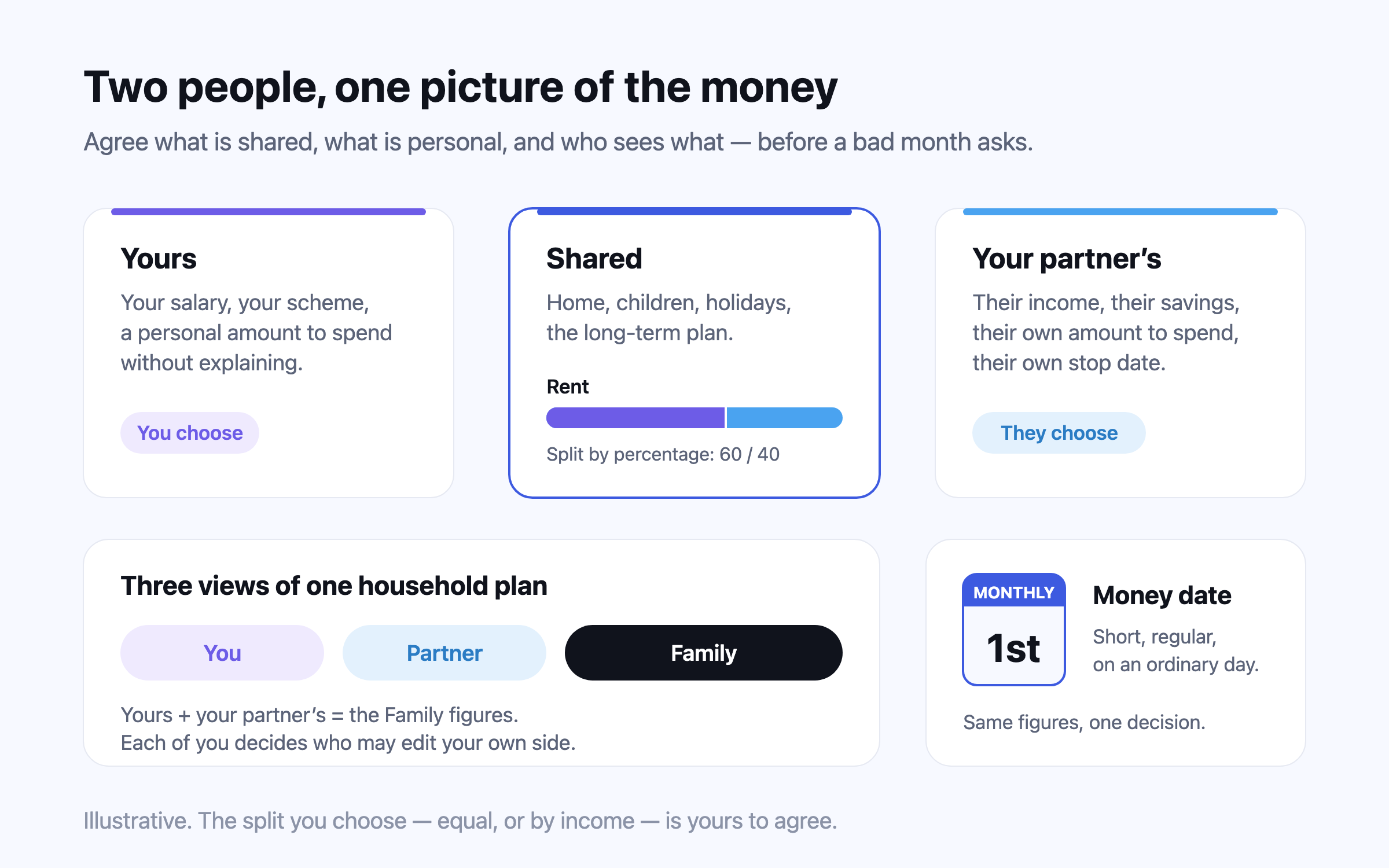
Many couples disagree about money at least some of the time, and that on its own is not a warning sign. The research points somewhere more specific: the trouble comes from surprises — a debt one partner did not know about, a different idea of how much is enough, a decision made alone. The couples who cope best are not the ones who think alike; they are the ones who look at the same figures, on a schedule, with an agreed answer to what each person keeps to themselves.
What the research says about couples and money
45%1
of partners say they argue about money at least occasionally
43%2
of US adults with combined finances admit some act of financial deception
72%3
of US adults feel stressed about money at least some of the time
Fidelity has surveyed couples since 2007, interviewing each partner separately and then comparing the answers. Its 2024 study of 1,794 couples found that 45% argue about money at least occasionally, that more than a third were unsure how much their partner earns, and that 53% of couples not yet retired disagreed about how much they needed to have saved.1 Nearly nine in ten still said they communicate well — which is the interesting part. Couples believe they talk, and yet do not hold the same numbers in their heads.1
The long-run evidence is sharper. Jeffrey Dew, Sonya Britt and Sandra Huston followed more than 4,500 US couples through the National Survey of Families and Households and found that, for both wives and husbands, disagreements about money predicted divorce more strongly than any other type of disagreement — and the link held whatever the couple’s income, debt or net worth.4 In other words, it was not being poor that predicted the break-up; it was fighting about money. The same study found that the effect ran through how couples argued and how satisfied they were, which is something a couple can change.4
Secrets are part of it. In a 2021 Harris Poll for the National Endowment for Financial Education, 43% of US adults who had combined finances admitted some act of financial deception — most often hiding a purchase, an account, a bill or cash — and 85% of them said it affected the relationship.2
The problem is usually the surprise, not the money
Read the reasons people give for hiding money and a pattern appears. In the NEFE poll, 38% said they believed some of their finances should stay private, and 33% said they were embarrassed or afraid of what their partner would think.2 Neither is malicious. The first is a reasonable wish that has never been agreed out loud; the second is a fear that grows the longer a figure stays unspoken.
Dew’s team also found that a sense of unfairness about money mattered only through the arguments it caused.4 That suggests the useful work is upstream: agree the rules before there is anything to be unfair about, and make the figures visible early enough that nobody discovers them in a crisis.
Joint, yours and mine: choosing a structure
There is now experimental evidence on account structure. Jenny Olson and colleagues randomly assigned 230 engaged or newly married couples to merge their money into a joint account, keep separate accounts, or carry on as they chose, and followed them for two years.5 The usual decline in relationship quality after the wedding appeared in the separate-account and no-change groups; the joint-account couples held steady. The researchers credit better feelings about how money is handled, more aligned goals and a stronger sense of “we”.5
The same researchers are careful about the limits: a joint account asks each partner to give up some independence, and in a relationship where one person controls the other it can make things worse.5 So the practical answer for most couples is a structure rather than a single rule:
- Shared — the household’s costs and goals: housing, groceries, children, the holiday, the long-term plan. Funded by both, in a proportion you agree (equal, or by income).
- Yours and your partner’s — a personal amount each of you spends without asking or explaining. It is what makes the shared part feel fair rather than supervised.
- Agreed in advance — the size of purchase either of you mentions before making it, and which debts and savings count as the household’s.
Whatever the split, write the proportions down. A shared cost split 60/40 by income is a decision; a shared cost nobody ever divided is an argument waiting for a bad month.
A monthly money date that does not become an argument
Many couples find that a short, regular check-in works better than a long talk when something has gone wrong. The point is that money is discussed on an ordinary day, when nothing is at stake. A simple shape:
- Pick a fixed slot — the first weekend of the month is common — and keep it short.
- Start with what went well: a debt paid down, a goal funded, a month that came in under what you expected.
- Look at the same figures together: what came in, what went out, what you owe, what you hold.
- Name one decision for the month ahead, and who will do it.
- Once a year, make it longer: the big goals, the dates each of you hopes to stop or slow down, and anything that has changed.
Deciding what each of you sees
Privacy and secrecy are different things. Wanting a personal account, a gift fund or a parent you support quietly is a legitimate preference — it only becomes a secret when it was never agreed. The fix is to make visibility a decision you take together: what is fully shared, what each of you can see but not change, and what stays personal by agreement.
It also helps to say who outside the couple sees anything. Many households have a chartered accountant, a lawyer or a parent who helps; deciding in advance what they can look at avoids both oversharing and the awkward email that forwards everything.
Two careers that stop at different times
Fidelity’s couples say they expect to stop working at around 63 on average, but averages hide the gap inside a household.1 Partners are often different ages, earn on different curves, and may want to stop, slow down or take a break at different points. A plan that assumes both incomes end in the same year is wrong for most couples in one direction or the other.
- Plan the years with one income. If one partner stops first, the household runs on one salary plus savings for a while. That stretch is often what decides whether the plan works.
- Keep each person’s schemes separate. Pensions, provident funds and retirement accounts belong to one person and open at that person’s age.
- Shared costs do not stop with the first salary. Housing, children and the household carry on until both have stopped — and beyond.
- Look at both views. “Are we fine together?” and “Is each of us fine on our own share?” are different questions with different answers.
How Nivritee helps a couple plan together
Related reading: what your partner needs to know and lifestyle inflation and knowing when it is enough.
Questions people ask
How do couples manage money together?
Most couples who manage well use a structure rather than a single rule: a shared pot for household costs and goals, a personal amount each partner spends freely, and an agreed threshold for mentioning big purchases — reviewed together on a regular, short money date.
Should married couples have a joint bank account?
In a randomised study of 230 engaged and newly married couples, those assigned a joint account kept their relationship quality over two years while others declined.5 The researchers also note it asks for some independence, so many couples combine a joint account with a personal one each.
What is financial infidelity?
Hiding money matters from a partner — a purchase, an account, a debt or income. In a 2021 NEFE poll, 43% of US adults with combined finances admitted some act of it.2
Do money arguments really predict divorce?
In a study of more than 4,500 US couples, disagreements about money predicted divorce more strongly than any other type of disagreement, regardless of income or net worth.4
How do you plan for financial independence when partners stop working at different ages?
Plan the household as one, with a separate stop age for each person, so the years running on one income are part of the projection. Nivritee’s FIRE Planner takes a stop age for each partner.
Sources
- 2024 Couples & Money Study: Most couples give themselves high marks in communication, yet hidden frustrations remain — Fidelity Investments (via Business Wire), 2024-02.
- 2 in 5 Americans admit to financial infidelity against their partner — National Endowment for Financial Education / The Harris Poll, 2021-11.
- Stress in America: Paying with our health — report highlights — American Psychological Association, 2015-02.
- Examining the relationship between financial issues and divorce (Family Relations 61:4) — Jeffrey Dew, Sonya Britt and Sandra Huston, Wiley, 2012.
- The key to a happy marriage? A joint bank account (on Olson, Rick, Small and Finkel, Journal of Consumer Research) — Kellogg Insight, Northwestern University, 2023-05.
This is general information, not financial, tax or legal advice for your circumstances. Rules and figures change; check the official source for your country, and consult a licensed professional before making financial decisions. Projections are estimates, not predictions.