Family readiness is not a folder for a bad day. It is a picture your partner already has, on an ordinary one.
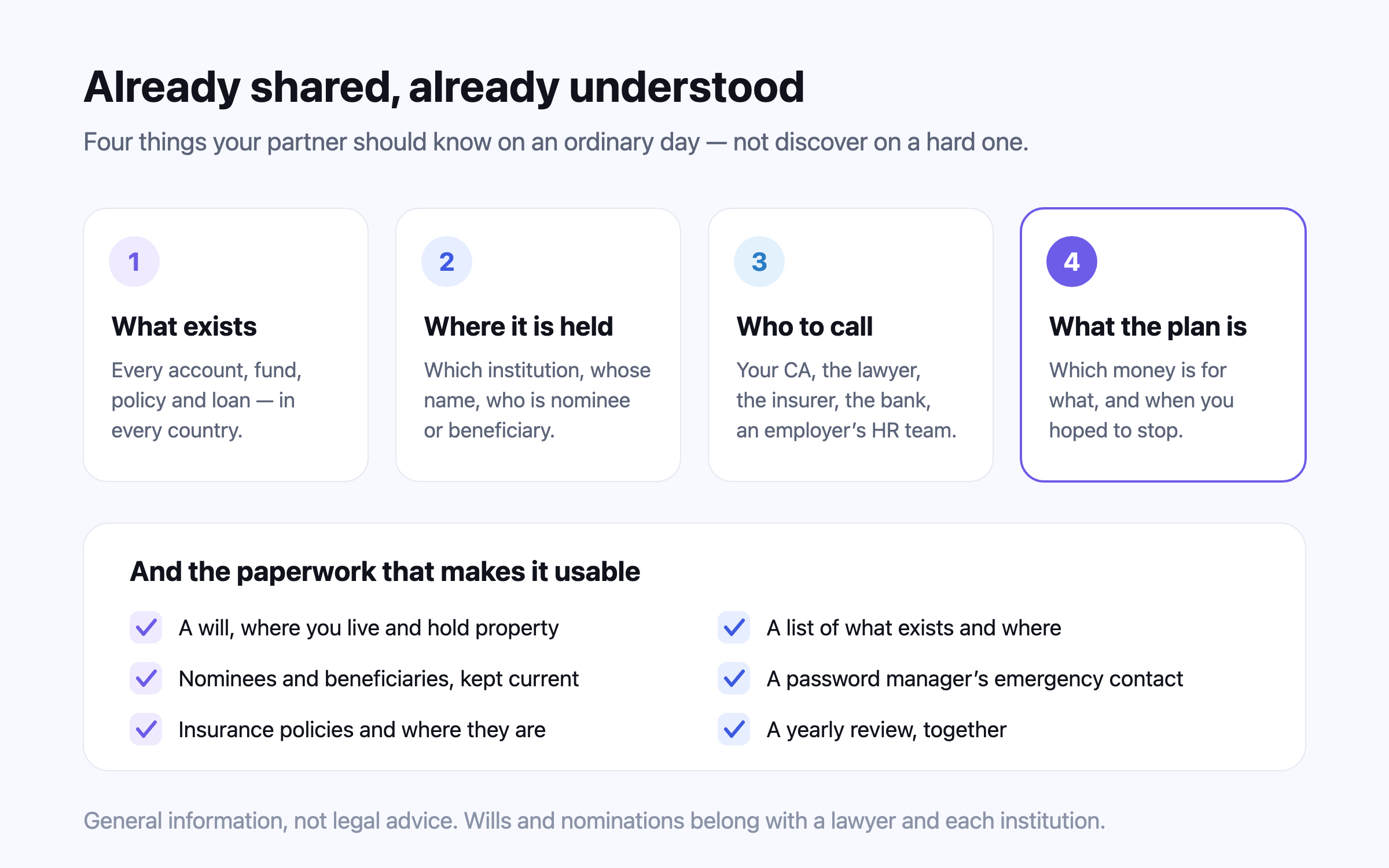
In most households one person knows where everything is. Readiness means your partner knows four things too — what you own and owe, where each is held, who to call, and what the plan is — plus the paperwork that makes it usable: a will, up-to-date nominations or beneficiaries, insurance details and a way into the accounts. The easiest time to share all of it is now, when nothing is wrong.
Ask a couple who looks after the money and most will name one person. That is a sensible division of labour on an ordinary day. It becomes a problem only when the person who knows is unavailable — travelling, unwell, or simply not there — and the other has to work out what exists from scratch. Family readiness is the opposite of that scramble: everything already shared, already understood, so nothing has to be found, unlocked or explained at a hard moment.
None of this needs to be gloomy. Most of it is the same work as planning well: knowing what you have, deciding what it is for, and making sure the two of you see the same picture.
Why one person usually knows where everything is
20%1
of couples say they make financial decisions together, in UBS’s survey
48%1
of women in the same survey said their spouse handles long-term decisions
46%2
of US adults have a will
UBS’s 2021 survey of 1,500 wealthy investors who were married or in long-term partnerships found that only 20% made financial decisions together, and 48% of the women said their spouse took responsibility for long-term decisions such as investing and estate planning.1 Fidelity’s 2024 couples study adds the everyday version: more than a third of couples were unsure how much their partner earns, and one in five primary decision-makers felt resentful about handling money alone.3
The specialist-and-passenger pattern is not wrong. The gap is only that the passenger often does not know the route. Closing it does not require both of you to become experts — it requires the knowledge to live somewhere both of you can reach.
The four things your partner needs
1. What exists
Every account, investment, deposit, property, pension or provident fund, insurance policy and loan — in every country. Families who have lived or worked abroad often have a forgotten salary account, a pension from an old job or a deposit in a home-country bank. A complete list with approximate values is worth more than a perfect list that never gets finished.
2. Where each one is held
The institution, the type of account, whose name it is in, whether it is joint, and who is named as nominee or beneficiary. The account numbers and logins belong in a secure place of their own (more on that below) — the point here is that your partner knows which doors exist.
3. Who to call
The people who already know part of the picture: your chartered accountant or tax preparer, the lawyer who drafted the will, an employer’s HR or benefits team, the insurance agent, a relationship manager at the bank. A name and a way to reach each one saves days.
4. What the plan was
This is the part checklists usually leave out. Which money is for the children’s education, which is the emergency buffer, which is the long-term corpus that should not be touched in a bad year, and roughly when you hoped to stop working. Without the plan, a list of accounts is just a list; with it, your partner can keep going in the direction you chose together.
A readiness checklist
- A will, written with a lawyer where you live and where you hold property, and kept somewhere your partner knows. In the US, fewer than half of adults have one.2
- Nominations and beneficiaries on every bank account, investment, pension and insurance policy — checked after any marriage, birth, divorce or move.
- Insurance details: which policies exist, the insurer, the sum assured in broad terms, and where the documents are.
- A list of what exists and where, kept current — the four things above.
- A way into the accounts: a password manager with an emergency-access or legacy-contact feature, and the legacy-contact settings some phone and email providers offer. Never write passwords into a shared document.
- The people to call, with how to reach them.
- A yearly review together, ideally at the same money date where you look at the rest of the plan.
India: a nominee is not always the owner
In India, naming a nominee is what lets a bank, depository or fund house release money quickly — but a nominee is not automatically the person who inherits. In December 2023 the Supreme Court held that a nominee for shares and securities holds them in trust for the legal heirs, and that a valid will prevails over a nomination.4 The nominee and the will should therefore point the same way.
- Bank deposits and lockers: from 1 November 2025, depositors can name up to four nominees under the Banking Laws (Amendment) Act, 2025.5
- Demat accounts and mutual fund folios: SEBI revised the nomination rules in January 2025, including more nominees per account and clearer claim processes.6
- Unclaimed money is real money: deposits unclaimed for ten years move to the RBI’s Depositor Education and Awareness Fund, which held ₹78,213 crore at the end of March 2024.7 The RBI’s UDGAM portal lets a family search for unclaimed deposits across participating banks.8
The UK and the US: wills, probate and beneficiaries
United Kingdom. Probate is the legal right to deal with someone’s estate. It is not always needed: money and property held jointly usually pass straight to the surviving owner, and some institutions release smaller balances without it.9 In England and Wales, unmarried partners do not currently inherit automatically when there is no will; in June 2026 the government consulted on changing that, which is a reason to write a will rather than wait.10
United States. Accounts with a named beneficiary or a transfer-on-death (TOD) registration pass outside the will — FINRA notes that a TOD supersedes a will or trust, so the two should be coordinated.11 FINRA also suggests keeping statements somewhere your executor can find them and asking each firm who it has on record as beneficiary.11
Where Nivritee fits — and where it does not
Readiness has two halves. One is documents and access: wills, nominations, account numbers, passwords. Those belong with a lawyer, with each institution and in a password manager — and Nivritee does not hold any of them. The other half is knowing what exists and what the plan is, and that is exactly what a shared household plan holds.
The best moment to do all of this is an unremarkable Sunday. Start with the list of what exists, share it, and let the rest follow at your next money date — see how couples can talk about money. Start free.
Questions people ask
What should my spouse know about our finances?
Four things: what you own and owe, where each item is held and in whose name, who to call (your CA, lawyer, insurer, bank), and what the plan is — which money is for what, and when you hoped to stop working. Plus where the will and policies are kept.
What is the difference between a nominee and a legal heir in India?
A nominee is who the institution pays; a legal heir is who is entitled to inherit. The Supreme Court held in 2023 that a nominee for securities holds them for the legal heirs, and that a valid will prevails over a nomination.4
Does a beneficiary designation override a will?
In the US, generally yes for accounts that carry one: FINRA notes that a transfer-on-death registration supersedes a will or trust, so keep the two consistent.11 Check the rules where you live with a lawyer.
How do I organise my finances for my family?
Make a list of every account and asset with where it is held, name nominees or beneficiaries, write a will, store logins in a password manager with an emergency contact, and review it together once a year.
Can my accountant see my finances without being able to change anything?
In Nivritee, yes: invite your CA or lawyer as a read-only viewer and choose which sections they see. They can never edit, and you can withdraw access at any time.
Sources
- Own Your Worth: only 20% of couples participate equally in financial decisions — UBS, 2021-05.
- How many Americans have a will? — Gallup, 2021-06.
- 2024 Couples & Money Study — Fidelity Investments (via Business Wire), 2024-02.
- Shakti Yezdani v. Jayanand Jayant Salgaonkar, Supreme Court of India, 14 December 2023 — Indian Kanoon (judgment text), 2023-12.
- Banking Laws Amendment Act: key nomination provisions effective from 1st November — All India Radio News (Ministry of Finance announcement), 2025-10.
- Circular on revise and revamp nomination facilities in the Indian securities market — Securities and Exchange Board of India, 2025-01.
- Unclaimed deposits with banks rise 26% to Rs 78,213 crore: RBI report — Business Standard, reporting the RBI Annual Report 2023-24, 2024-05.
- Onboarding of more banks on UDGAM portal — Reserve Bank of India, 2023-10.
- Applying for probate — GOV.UK, 2026-10.
- Millions of unmarried couples to get stronger rights — GOV.UK, Ministry of Justice, 2026-06.
- Plan now to smooth the transfer of your brokerage account assets on death — FINRA, 2023-01.
This is general information, not financial, tax or legal advice for your circumstances. Rules and figures change; check the official source for your country, and consult a licensed professional before making financial decisions. Projections are estimates, not predictions.