More than half of Americans in their 40s are sandwiched between an ageing parent and their own children — and in much of Asia it is the norm. Planned for, it need not cost you your own independence.
Being “sandwiched” between an ageing parent and your own children is common: 54% of Americans in their 40s are, and most older Indians live with their children. The costs that come with it — care and health — rise faster than prices in general. Families who name the cost, share it, insure early and keep saving something for themselves come through it best.
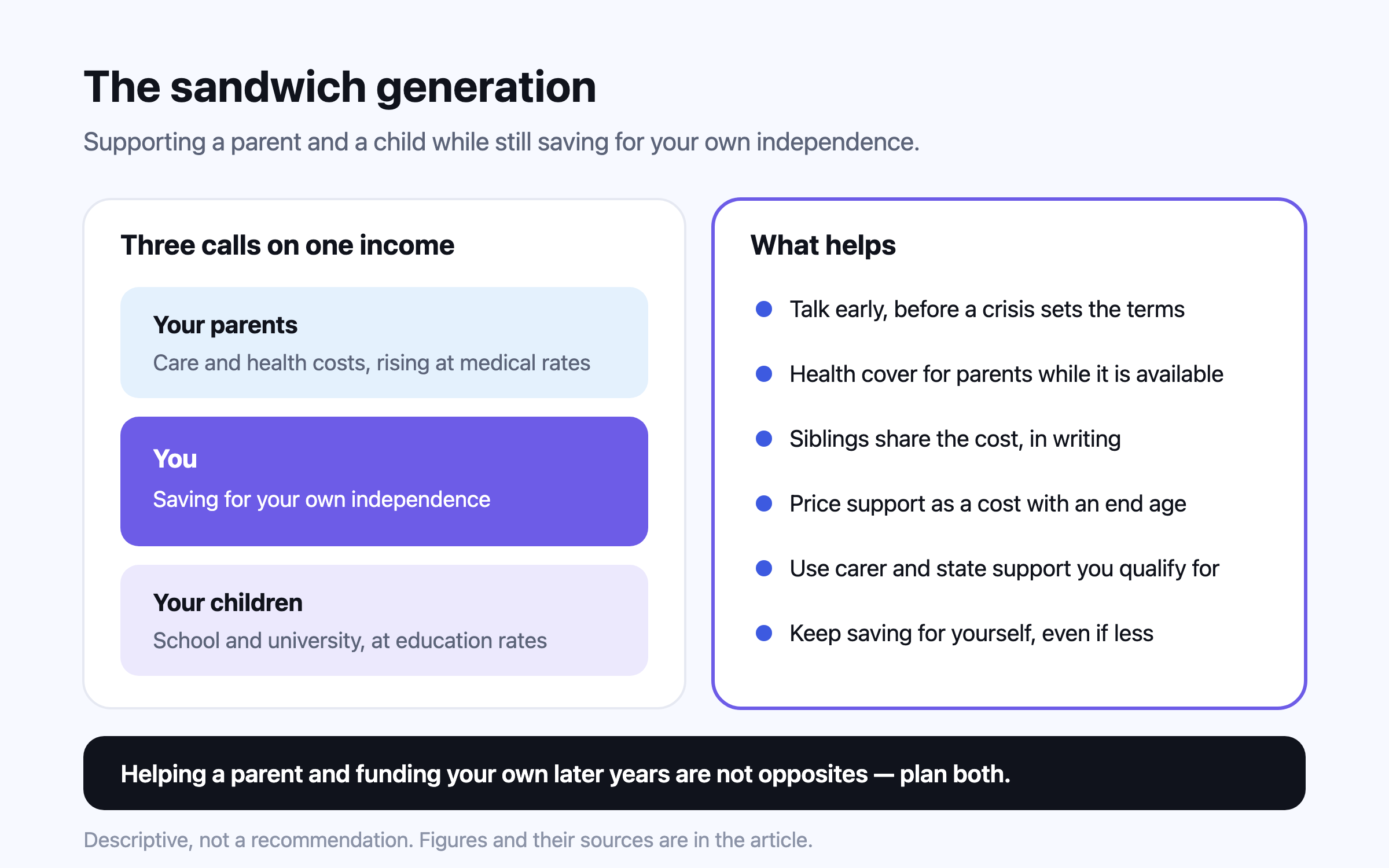
Somewhere in their forties, many people find their money pulled three ways at once: children who still need school fees, parents who increasingly need help, and their own savings for the years after work, which nobody else will fund. The phrase for it — the sandwich generation — makes it sound like a squeeze, and sometimes it is. But it is also one of the most ordinary stages of family life, and the data shows a clear pattern in who comes through it well: the families who see the cost early, share it out loud and keep a little going into their own future.
How many people are sandwiched
54%1
of US adults in their 40s have a parent 65+ and a child they are raising or supporting
63 million2
family caregivers in the US, about one adult in four
1.3 million+3
sandwich carers in the UK
29.6%4
of Japan’s population aged 65 or over, a record
Pew Research Center’s latest count, from a survey of 8,750 US adults in September 2025, found 54% of adults in their 40s have a living parent aged 65 or older and are either raising a child under 18 or financially supporting an adult child; across all adults the share is 25%1. Pew’s earlier, more detailed study found 21% of middle-aged adults had given a parent 65 or older financial support in the past year — 32% of those who had such a parent — and 15% were supporting both a parent and a child5.
The caring is often as heavy as the money. AARP and the National Alliance for Caregiving count 63 million family caregivers in the US in 2025, up 20 million in a decade, and 29% of them are caring for an adult while also raising children2. In the UK, the Office for National Statistics estimates more than 1.3 million sandwich carers, and almost 27% of them report symptoms of mental ill-health, against 22% of the population as a whole3.
In much of Asia, it is the default
Western surveys treat the sandwich as a phase. In much of Asia it is simply how families are organised. India’s Longitudinal Ageing Study, the largest survey of its kind, found that among people aged 60 and over, 40.6% live with a spouse and children and 27.6% with children but no spouse, while only 5.7% live alone6. 15% of older Indians had received financial help from family or friends in the past year, fewer than one in five had health insurance, and 36% were still working6.
That is about to matter more. People aged 60 and over were 8.6% of India’s population in the 2011 Census6, and UNFPA projects the share will reach about 20% by 2050, with 18.7% of older Indians reporting no income at all7. Health costs fall heavily on families: out-of-pocket spending was still 39.4% of India’s total health expenditure in 2021–22, down from 64.2% in 2013–148.
Japan shows where the trend leads. Its share of people aged 65 and over reached a record 29.6% in 20264, and about 110,000 people left a job in the year to September 2022 to care for an ageing or sick family member9. Japan answered with compulsory long-term care insurance, paid into from age 4010. Singapore is building a similar floor: CareShield Life pays a monthly benefit for severe disability, S$689 in 2026 and rising 4% a year to S$806 in 203011, and the Home Caregiving Grant for families looking after a relative at home rises to up to S$600 a month from April 202612.
What care costs, and how fast it rises
The US publishes the clearest prices. CareScout’s 2025 survey put the national median at $80,080 a year for a non-medical in-home caregiver working 44 hours a week, $74,400 for assisted living and $129,575 for a private room in a nursing home13. Most family help is smaller and steadier than that: AARP found US caregivers spent an average of $7,242 a year of their own money on caring, about 26% of their income14.
Whatever the starting figure, health and care costs rise faster than prices in general. WTW’s 2026 survey of insurers projects medical benefit costs rising 10.3% globally in 2026 and 14.0% in Asia Pacific15. Nivritee’s default medical inflation for each market is set from that survey, and the table shows what it does to a cost of 100 over ten years — about the span many families support a parent for — beside the general rate16.
| Market | General inflation | Medical inflation | 100 today, in 10 years at general | 100 today, in 10 years at medical |
|---|---|---|---|---|
| India | 4.0% | 12.0% | 148 | 311 |
| Malaysia | 2.5% | 12.0% | 128 | 311 |
| Singapore | 2.0% | 11.0% | 122 | 284 |
| Hong Kong | 2.5% | 11.0% | 128 | 284 |
| Australia | 2.5% | 9.5% | 128 | 248 |
| New Zealand | 2.0% | 9.5% | 122 | 248 |
| United States | 2.0% | 9.2% | 122 | 241 |
| Canada | 2.0% | 9.2% | 122 | 241 |
| United Kingdom | 2.0% | 8.2% | 122 | 220 |
| Europe (euro area) | 2.0% | 8.2% | 122 | 220 |
| Japan | 2.0% | 5.0% | 122 | 163 |
In India’s case, a parent’s medical bill of ₹1 lakh a year today is projected at about ₹3.11 lakh in ten years at the default medical rate, against ₹1.48 lakh if it rose only with prices in general16. A plan that prices a parent’s care at general inflation understates it by more than half, which is why the rate deserves as much attention as the amount. The wider gap between kinds of inflation is set out in Inflation is not one number.
What it does to your own saving
The cost that is easiest to miss is the one to your own later life. In AARP’s 2025 study, a little over a third of US family caregivers had stopped saving, 24% had used up their short-term savings, 13% had drawn on long-term savings such as retirement accounts, and 23% had taken on debt because of caring17. In Japan, the roughly 110,000 people who left work to care in a single year gave up not just a salary but years of pension contributions9.
None of that makes helping a parent a mistake. It makes it a cost to plan for, like any other — and the families who manage it best tend to keep saving something for themselves even in the heaviest years, because a parent’s care today should not become their own children’s care bill thirty years from now.
Practical ways to carry it
- Insure parents while you still can, and never let it lapse. India’s insurance regulator removed the 65-year entry-age cap on new health policies from April 202418, and bars insurers from refusing a renewal on grounds of age once a policy has been renewed without a break19. Under India’s old tax regime, premiums for parents are deductible up to ₹50,000 a year where a parent is a senior citizen20. Singapore covers its citizens and permanent residents born in 1980 or later under CareShield Life from age 3021.
- Share the cost between siblings, and write the split down. An unspoken arrangement tends to settle on whichever child lives closest. Agree a monthly figure or a percentage each, what counts as shared (care, medicines, the house) and what happens when one of you cannot pay for a while.
- Compare care at home with care in a facility honestly. At home is often cheaper in money and dearer in time: in the US, full-time paid help at home costs a little more than assisted living13. Count the hours a family member gives up as a cost too.
- Claim the support that exists. Singapore’s Home Caregiving Grant, Japan’s long-term care insurance, carers’ allowances elsewhere — these are designed for exactly this.
- Protect your own income. Leaving work is the single most expensive way to provide care. Flexible hours, paid help for part of the week or a sibling taking a turn usually costs less over a career.
- Keep a floor under your own saving. Even a reduced amount keeps compounding and keeps the habit; in the AARP study, a little over a third of caregivers had stopped saving altogether17.
The conversations that make it easier
Most families have these conversations too late, in a hospital corridor, when every option is more expensive. Three are worth having early and calmly. With your parents: what they have, what they would want, and who holds the paperwork. With your siblings: who pays for what, written down. And with your partner: how much the household can give without stopping its own saving, and whose career flexes if care grows. The last is the one couples most often avoid — how couples can talk about money sets out what the research says helps, and what your partner needs to know covers making sure the person beside you has the whole picture.
How Nivritee helps
Questions people ask
What is the sandwich generation?
Adults who are supporting an ageing parent while also raising or supporting their own children. Pew Research Center found 54% of US adults in their 40s are in that position1.
How much does it cost to care for an elderly parent?
It ranges widely. AARP found US family caregivers spent an average of $7,242 a year of their own money, about 26% of their income14, while full-time paid care runs from about $74,400 a year for assisted living to $129,575 for a private nursing-home room13.
Should I support my parents or save for my own retirement?
Most families do some of both. Keeping even a reduced amount going into your own savings matters, because a little over a third of US caregivers in AARP’s 2025 study had stopped saving altogether17. This is information, not financial advice.
Can I claim a tax deduction for my parents’ health insurance in India?
Under the old tax regime, premiums paid for parents are deductible, up to ₹50,000 a year where a parent is a senior citizen20. Check the current rules for the regime you file under.
Sources
- More than half of Americans in their 40s are “sandwiched” between an aging parent and their own children — Pew Research Center, 2025-09.
- Caregiving in the US 2025 — AARP and the National Alliance for Caregiving, 2025-07.
- More than one in four sandwich carers report symptoms of mental ill-health — Office for National Statistics, 2019-01.
- Statistical topics no. 149: Japan’s elderly population (Respect for the Aged Day) — Statistics Bureau of Japan, 2026-09.
- The Sandwich Generation: rising financial burdens for middle-aged Americans — Pew Research Center, 2012.
- The Longitudinal Ageing Study in India, Wave 1, 2017–18: key findings — International Institute for Population Sciences (Economic & Political Weekly), 2022-12.
- India Ageing Report 2023: elderly to make up over 20% of the population by 2050 — UNFPA India, 2023-09.
- National Health Accounts estimates for 2020-21 and 2021-22 — Ministry of Health and Family Welfare, via the Press Information Bureau, 2024-09.
- 2022 Employment Status Survey: summary of results — Statistics Bureau of Japan, 2022-10.
- Long-Term Care Insurance System: toward long-term care supported by society as a whole — Ministry of Health, Labour and Welfare, Japan, 2024-12.
- Government accepts CareShield Life Council’s recommendations to enhance CareShield Life — Ministry of Health, Singapore, 2025-08.
- Keeping healthcare affordable and sustainable for all (Home Caregiving Grant enhancement) — Ministry of Health, Singapore, 2025-03.
- CareScout releases 2025 Cost of Care Survey results — Genworth / CareScout, 2026-03.
- Caregiving out-of-pocket costs study 2021 — AARP, 2021-06.
- Double-digit healthcare cost increases projected to persist into 2026 and beyond (2026 Global Medical Trends Survey) — WTW, 2025-11.
- Should I change the six assumptions? (Nivritee’s default rates by country, with their basis) — Nivritee Help Centre, 2026-10.
- Caregiving in the US 2025: key findings on caregivers’ finances — AARP, 2025.
- IRDAI removes age cap on health insurance purchase — DD News (Prasar Bharati), 2024-04.
- FAQs on health insurance regulations (renewability under the IRDAI Health Insurance Regulations) — Insurance Regulatory and Development Authority of India, 2026.
- Deductions for health insurance premiums (section 80D) — Income Tax Department, Government of India, 2026.
- CareShield Life — Central Provident Fund Board, Singapore, 2026.
This is general information, not financial, tax or legal advice for your circumstances. Rules and figures change; check the official source for your country, and consult a licensed professional before making financial decisions. Projections are estimates, not predictions.