A degree raises earnings by about half on average across the OECD — but for one graduate in five or more, it does not pay
Across the OECD, adults with a tertiary degree earn 54% more than those who stopped at upper secondary school, and are more likely to be in work. The average hides a wide spread: in England about 20% of women and 30% of men can expect a negative lifetime return, and the subject studied makes a very large difference. A degree is usually worth it; whether a particular one is depends on the subject, the cost and the country.
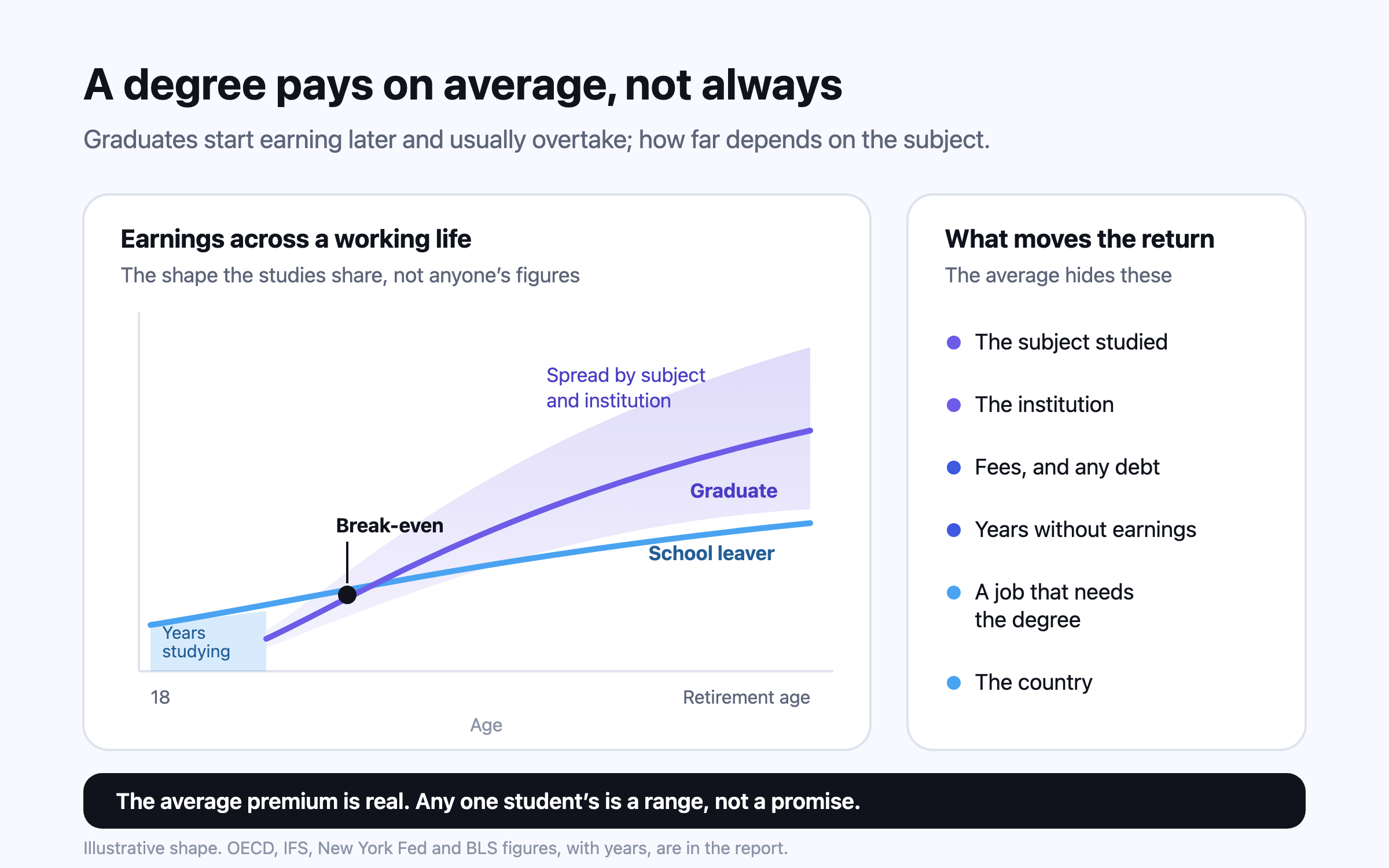
The short answer: on average, yes. Across OECD countries in 2024, adults aged 25 to 64 with a tertiary degree earned 54% more than those whose education ended at upper secondary school, and in 2025 87% of them were in work against 78%1. But the average is made of very different outcomes. The Institute for Fiscal Studies estimates that in England about 20% of women and 30% of men can expect a negative lifetime return from their degree once its costs are counted2, and in the United States 42% of recent graduates work in jobs that do not need one3. The question worth asking is not whether degrees pay, but whether this degree, at this price, does.
+54%1
Earnings of tertiary-educated adults vs upper secondary, OECD average, 2024
+80%1
Master’s or doctoral graduates vs upper secondary, OECD average
£100,0002
Average net lifetime return to an English undergraduate degree (about 15%)
42%3
US recent graduates in jobs that do not require a degree, 2026 Q2
The earnings premium, country by country
The OECD measures the premium as an index: the earnings of full-time, full-year workers aged 25 to 64 at each level of education, with upper secondary set to 1001. On average a bachelor’s degree is worth 39% more and a master’s or doctorate 80% more, while those without upper secondary education earn 17% less1.
| Country | Any tertiary degree | Bachelor’s | Master’s or doctoral |
|---|---|---|---|
| United States | 170 | 165 | 214 |
| United Kingdom | 135 | 133 | 149 |
| Canada | 141 | 148 | 172 |
| Australia | 131 | 131 | 150 |
| Germany | 153 | 148 | 175 |
| Chile | 206 | 221 | 379 |
| Brazil | 238 | Not published | Not published |
| Denmark | 123 | 112 | 142 |
| Norway | 118 | 106 | 131 |
| Sweden | 125 | 115 | 144 |
The spread is the striking part. The premium is 25% or less in Denmark, Norway and Sweden and more than 100% in Chile, Colombia, Brazil and South Africa1. In Chile a master’s or doctoral graduate earns 3.79 times what an upper-secondary worker does; in the United Kingdom, 1.49 times1. The usual explanation is supply and pay-setting: where graduates are scarce relative to demand the premium is large, and where most young people already go to university and pay is compressed by collective bargaining, it is smaller. The United States sits high among rich countries, with tertiary graduates earning 70% more1.
American labour statistics tell the same story at a finer grain. In 2025 the median full-time worker aged 25 or over with a bachelor’s degree earned $1,578 a week, against $966 with a high-school diploma — about 63% more — and $1,876 with a master’s degree4. Over a working life, Georgetown University’s Center on Education and the Workforce put median earnings at $2.8 million for a bachelor’s degree and $1.6 million for a high-school diploma, 75% more5.
Employment: the return people forget
A degree raises the chance of being in work at all. Across the OECD in 2025, 87% of tertiary-educated adults were employed, against 78% with upper secondary education and 60% below it; the rate rises with each level, from 86% for a bachelor’s to 90% for a master’s and 94% for a doctorate1. In the United States the unemployment rate in 2025 was 2.8% for bachelor’s graduates and 4.3% for those with a high-school diploma4.
India is the exception in the OECD’s own tables. There, 64% of tertiary-educated adults were employed in 2025, against 67% of those with upper secondary education and 66% below it1. The table does not say why, and the OECD publishes no Indian earnings premium to set beside it, so neither should be read as a verdict on Indian degrees. It is, though, a reminder that the international averages describe rich-country labour markets, and that a degree is a route to the jobs that need one only where such jobs exist in sufficient number.
Averages hide the spread: subject, institution and the job
The most detailed evidence is from England, where the IFS links graduates’ tax records to their degrees. Its 2026 estimate puts the average net lifetime return — the extra lifetime earnings a degree brings, after tax and student-loan repayments — at about £100,000, or 15%: £109,000 for men and £90,000 for women2. The medians are lower, £60,000 for men and £67,000 for women, because a minority of very large returns pulls the average up2. The same study finds about 20% of women and 30% of men can expect a negative return2, and its average is about 30% lower than the IFS’s 2020 estimate of roughly £130,000 for men and £100,000 for women6.
- Subject. Medicine and economics return over £400,000 on average in England; creative arts, philosophy and languages return little or, for many, less than nothing2. Across the OECD, STEM qualifications are most often linked to the highest earnings, and arts, humanities and education to the lowest7.
- The job it leads to. Among recent US graduates in 2024, 12.8% of nursing majors were underemployed, against 63.9% in the performing arts and 65.8% in criminal justice3. A degree that does not lead to a graduate job has a much smaller premium.
- Over-qualification. The OECD’s Survey of Adult Skills found about 23% of workers on average across the OECD are over-qualified for their job — 37% in England and 35% in Japan — and that being over-qualified carries a wage penalty of about 12% against equally skilled, well-matched workers8.
- Age. The premium grows across a career: 38% for 25-to-34-year-olds against 65% for 45-to-54-year-olds, OECD average1. The return is back-loaded, while the cost — fees, debt and missed earnings — comes first.
Underemployment is not only a problem for weak subjects. In the United States in mid-2026, 33.7% of all college graduates aged 22 to 65 and about 42% of recent graduates aged 22 to 27 were in jobs that do not typically require a degree3. Yet even recent graduates earned a median $60,000 in 2025, against $40,000 for workers of the same age with only a high-school diploma3. Both facts are true at once: a degree raises expected pay, and a large share of graduates spend years in jobs that did not need it.
The cost side: fees, debt and years without earnings
A return is a premium minus a cost, and the cost has three parts. The first is tuition and living costs, which range from almost nothing at a German state university to tens of thousands a year for an international student in the United Kingdom, the United States or Canada — set out in what higher education costs by country. The second is debt and its interest, which works very differently in each country; see student debt systems compared. The third is the one most families leave out: three or four years of earnings a school leaver would have had.
Counting all three, the OECD estimated the private net financial return to tertiary education — lifetime gains minus costs, discounted at 2% a year — at USD 364,200 for a man and USD 300,900 for a woman on average in 2022, highest in the United States7. The figure is built on each country’s own typical costs for its own students. A family paying an international fee, or borrowing at a commercial rate, starts several years further behind, which is why the same degree can have a very different return for two students in the same lecture hall.
The public return, and why home students pay less
Graduates pay more tax over a lifetime, so governments gain too. The OECD put the average public net financial return to tertiary education at about USD 127,000 for a man and USD 60,600 for a woman in its most recent estimate9. In England the IFS estimates the Exchequer gains £107,000 per male and £48,000 per female graduate on average, but makes a loss on about 40% of degrees once unpaid student loans are counted2. That public gain is the argument for subsidising home students — and it is why an international student, whose taxes will mostly be paid elsewhere, is charged the full cost.
How to weigh it for your family
- Start from the subject and the kind of job it leads to, not the institution’s name. In the English data, the average return ranges from close to zero or below for some subjects to over £400,000 for others2.
- Price the whole cost: fees, living costs, the interest on any loan and the years of earnings forgone.
- Compare the premium in the country where the graduate is likely to work, not where the degree is earned — the premium in the Nordic countries is a quarter or less of Chile’s1.
- Treat the average as the middle of a range. Plan for the degree paying off later than hoped, or not at all, and see whether the household can carry that.
- Put the cost into the same plan as everything else, so it competes honestly with your own independence — the trade-off is set out in your child’s education or your independence.
Questions people ask
Is a degree worth it financially?
On average, yes: across the OECD, tertiary-educated adults earn 54% more than those with upper secondary education1. But in England about 20% of women and 30% of men can expect a negative lifetime return once costs are counted2.
Which degrees have the best return on investment?
In England, medicine and economics return over £400,000 on average over a lifetime, while creative arts, philosophy and languages return little or nothing2. Across the OECD, STEM qualifications are most often linked to the highest earnings7.
Is a master’s degree worth it?
On average, master’s and doctoral graduates earn 80% more than upper-secondary workers across the OECD, against 39% for a bachelor’s1. In the United States the median master’s graduate earned $1,876 a week in 2025 against $1,578 for a bachelor’s4 — so the extra year or two pays only if the gap outweighs its fees and forgone pay.
What percentage of college graduates are underemployed?
In the United States in mid-2026, about 42% of recent graduates aged 22 to 27 and 33.7% of all graduates were in jobs that do not typically require a degree3. The rate ranges from 12.8% for nursing majors to 65.8% for criminal justice3.
Is a degree worth it in India?
The OECD publishes no earnings premium for India, and its tables show 64% of tertiary-educated Indian adults in work in 2025, against 67% with upper secondary education1. Those figures do not settle the question for any one course; the subject and the jobs it leads to matter far more.
Sources
- Education at a Glance 2026: OECD Indicators (Tables A3.1 and A4.1) — OECD, 2026-09.
- New estimates of the impact of undergraduate degrees on lifetime earnings (Britton, Ogden, Ornadel and Waltmann) — Institute for Fiscal Studies, for the Department for Education, 2026-06.
- The Labor Market for Recent College Graduates — Federal Reserve Bank of New York, 2026-08.
- Education pays: unemployment rates and earnings by educational attainment, 2025 — US Bureau of Labor Statistics, 2026-08.
- The College Payoff: More Education Doesn’t Always Mean More Earnings — Georgetown University Center on Education and the Workforce, 2021-10.
- The impact of undergraduate degrees on lifetime earnings (Britton, Dearden, van der Erve and Waltmann) — Institute for Fiscal Studies, for the Department for Education, 2020-02.
- Education at a Glance 2025: OECD Indicators (field of study and financial returns) — OECD, 2025-09.
- Do Adults Have the Skills They Need to Thrive in a Changing World? Survey of Adult Skills 2023 — OECD, 2024-12.
- Public returns from education — OECD, 2021.
This is general information, not financial, tax or legal advice for your circumstances. Rules and figures change; check the official source for your country, and consult a licensed professional before making financial decisions. Projections are estimates, not predictions.