International students pay two to nearly six times the home fee — and the fee keeps rising while you save
In every destination that charges tuition, an international undergraduate pays several times the home fee: about 5.2 times in Canada, 2.2 to 4.8 times at NUS in Singapore, and three times at IIT Hyderabad. Germany is the exception, charging most students only a semester contribution. Living costs are the part nobody subsidises, and a fee twelve years away should be priced at that country’s education inflation, not today’s figure.
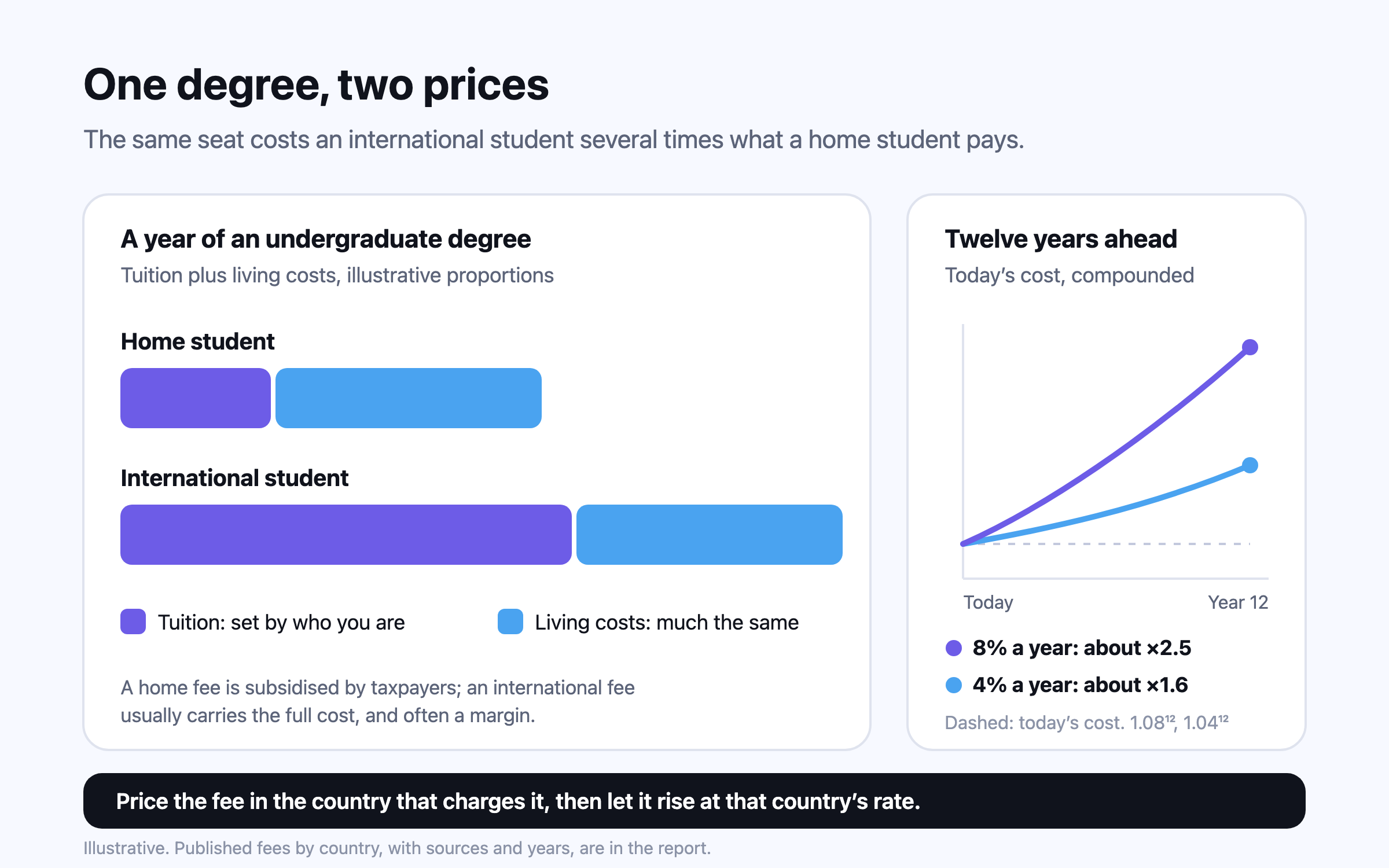
The short answer: what a degree costs depends less on the country than on whether the student counts as home or international there. A Canadian undergraduate paid an average of C$8,021 in tuition for 2026/2027 and an international one C$42,062, about 5.2 times as much1. At the National University of Singapore a citizen studying computing pays S$8,300 a year and an international student without the tuition grant S$39,7002. Germany’s state universities generally charge no fees for a bachelor’s degree at all3. Living costs, which no government subsidises for anyone, are often the larger half of the bill.
5.2×1
International vs Canadian undergraduate tuition, Canada 2026/2027 (C$42,062 vs C$8,021)
£9,7904
Maximum fee for a home undergraduate in England, 2026/27
$45,0005
Average published tuition and fees, US private non-profit four-year, 2025-26
€9923
Funds a student must prove each month for a German student visa, 2025–26
Tuition for a home and an international student, country by country
The table sets the price a home student is charged beside the price for a student from abroad. Where a statistics office publishes a national average it is used; where none exists, a named university’s own fee schedule is shown as an example rather than a national figure.
| Country | Year | Home student, a year | International student, a year | Basis |
|---|---|---|---|---|
| United States | 2025-26 | $11,950 (public four-year, in-state) | $31,880 (public, out-of-state); $45,000 (private non-profit) | National average, College Board |
| United Kingdom (England) | 2026/27 | Up to £9,790 | £25,850 to £30,650 (University of Reading) | Fee cap; one university’s schedule |
| Canada | 2026/2027 | C$8,021 | C$42,062 | National average, Statistics Canada |
| Germany | 2025 | Generally none at state universities; semester contribution €70 to €430 | Generally none; €1,500 a semester for non-EU students in Baden-Württemberg | DAAD |
| Singapore | AY2026/27 | S$8,300 (citizen, computing) | S$18,050 (ASEAN) or S$21,400 (other countries) with the tuition grant; S$39,700 without it | National University of Singapore |
| India | July–December 2026 | ₹1,00,000 a semester (IIT, general and OBC); ₹0 for SC, ST and PH | ₹3,00,000 a semester (foreign nationals) | IIT Hyderabad |
| Japan | From FY2025 entry | ¥642,960, plus a ¥282,000 admission fee | No separate rate listed | University of Tokyo |
| Hong Kong | 2027/28 entry | HK$49,500 (local, subsidised) | HK$250,000 (non-STEM) to HK$280,000 (STEM) | University of Hong Kong |
- United States. The College Board’s average published tuition and fees for 2025-26 were $11,950 at a public four-year college for a state resident, $31,880 for a student from out of state and $45,000 at a private non-profit college5. Its private figure is 3.8 times the in-state one, and both are sticker prices that grants reduce for many American families5.
- United Kingdom. A home undergraduate in England pays up to £9,790 in 2026/27, up from £9,535 in 2025/26, and borrows it from the government if they choose4. International fees are set by each university: the University of Reading charges £25,850 for a classroom course and £30,650 for one with substantial laboratory work6.
- Canada. Statistics Canada’s survey of every public degree-granting institution put average undergraduate tuition at C$8,021 for Canadians and C$42,062 for international students in 2026/20271. A decade earlier the international figure was 3.6 times the domestic one; it passed five times in 2025/202610.
- Germany. The DAAD, Germany’s academic exchange service, states that there are generally no fees for bachelor’s and most master’s courses at state institutions, with a semester contribution of €70 to €430; Baden-Württemberg charges non-EU students €1,500 a semester3.
- Singapore. NUS publishes five prices for the same course. For computing in AY2026/27 they run from S$8,300 for a citizen and S$11,600 for a permanent resident, through S$18,050 for a student from another ASEAN country and S$21,400 for any other international student with the Ministry of Education tuition grant, to S$39,700 without the grant2.
- India. IIT Hyderabad charges ₹1,00,000 a semester to general and OBC undergraduates admitted in 2026, nothing to SC, ST and PH students, and ₹3,00,000 a semester to foreign nationals7. Private universities set their own fees course by course, so no fair national range can be given here.
- Japan and Hong Kong. The University of Tokyo raised undergraduate tuition to ¥642,960 for students admitted from 2025, from ¥535,800, and lists no separate international rate8. The University of Hong Kong charges a subsidised local student HK$49,500 a year from 2027/28, and a non-local student HK$250,000 to HK$280,0009.
Living costs: the half nobody subsidises
Tuition can be zero; rent and food cannot. The most reliable published guide to living costs is what each government makes an international student prove before it issues a visa. These are minimums designed to keep a student solvent, not estimates of a comfortable year, and every one of them excludes tuition.
| Country | Funds a student must show for living costs | In force |
|---|---|---|
| United States (all colleges, average) | $13,900 housing and food at a public four-year college; $15,920 at a private non-profit | 2025-26 |
| United Kingdom | £1,529 a month in London, £1,171 elsewhere, for up to 9 months | 2026 |
| Canada | C$23,448 a year for a single student outside Quebec | Applications from 1 September 2026 |
| Australia | AUD29,710 a year for the student; AUD10,394 for a partner | 2026 |
| Germany | €992 a month for a year, €11,904 in all, usually in a blocked account | 2025, unchanged in 2026 |
Nine months at the London rate comes to £13,761 and nine months elsewhere to £10,539, before a single lecture is paid for11. In the United States the College Board’s full budget — tuition, fees, housing and food — averaged $25,850 for an in-state public student, $45,780 out of state and $60,920 at a private non-profit college in 2025-265. For a family abroad, living costs also arrive in the destination’s currency every month, which is where a currency move does its damage.
Why the international fee is so much higher
A home fee is a subsidised price. Governments fund universities partly through grants and set the home fee below the cost of teaching — in England by law, through a capped maximum4; in Singapore openly, through a Ministry of Education tuition grant that the fee schedule prices separately2; in Germany entirely, by charging no tuition at state institutions3. An international student is outside that bargain, so the fee carries the full cost of teaching and, in several systems, a margin that cross-subsidises research and home students.
- It is widening. In Canada international undergraduate tuition was 3.6 times the domestic figure a decade before 2025/2026 and more than five times by then10; in 2026/2027 it was 5.2 times1.
- It is policy, not market rate. Hong Kong’s government created separate subsidised and non-subsidised fee categories from 2027/2815, and Baden-Württemberg is the one German state that charges non-EU students3. A rule can change between a child’s birth and their first term.
- Status follows residence and nationality, not where a family’s money is. A family living in Dubai with a child applying to a university in England, Canada or Singapore should expect the international fee unless the university’s own fee-status rules say otherwise. Each university publishes its test; checking it before the savings target is set can change the target several times over.
What education inflation does over 10 to 15 years
A family saving for a child who is six is saving for a fee that will be set in twelve years’ time. No multi-country series measures university fee inflation, so Nivritee’s defaults derive an education inflation rate per country: headline inflation plus a spread, widest where education is mostly private16. The defaults are 8.0% for India, 4.5% for the United States, Australia and Singapore, 4.0% for the United Kingdom, Canada and New Zealand, 3.5% for the euro area and 3.0% for Japan16. Read why one inflation rate is not enough for where each comes from.
| Today’s annual cost | Country rate | In 12 years |
|---|---|---|
| £25,850 (UK international, classroom course) | 4.0% (United Kingdom) | about £41,387 |
| ₹2,00,000 (IIT tuition, two semesters) | 8.0% (India) | about ₹5.04 lakh |
| $60,920 (US private non-profit, full budget) | 4.5% (United States) | about $103,313 |
At 8.0% a year a cost roughly doubles in nine years, and in twelve it reaches about 2.5 times today’s figure; at 4.0% it reaches about 1.6 times16. So a family in India saving for an IIT seat is aiming at about ₹5.04 lakh a year, not ₹2 lakh, and a family aiming at a UK classroom degree is aiming at about £41,387 a year, not £25,85076. Those are the figures a savings target should be built on.
Two further effects stack on top for a family paying from abroad. The fee rises at the destination’s education inflation, and the family’s own currency may lose value against it at the same time; a fee priced in pounds and paid from rupees carries both. The second is not knowable in advance, which is why it is worth testing rather than ignoring — see home bias and currency risk.
Building the cost into a plan
- Decide the student’s likely status — home or international — at each university you are considering, from the university’s own fee-status rules.
- Take tuition and a living-cost figure for one year, in the destination’s currency, from the publisher’s own page for the current year.
- Multiply by the length of the course, or enter each year of the course as its own goal, so a four-year degree is four costs in four years rather than one.
- Let each cost rise at the destination’s education inflation, not your general rate.
- Look at what the total does to the rest of your plan — the year you could stop working moves too, and the trade-off is set out in your child’s education or your independence.
What these figures cannot tell you
- Sticker price is not net price. Grants, scholarships and bursaries reduce what many home students pay, especially in the United States, and some universities offer merit awards to international students. The published fee is the right figure to plan against; the net figure is the right one to hope for.
- A single university is not a country. Where this report uses Reading, NUS, an IIT, the University of Tokyo or HKU, it is an example of a published schedule, not a national average.
- Rules move. The fee cap in England, the Canadian proof of funds and Hong Kong’s fee categories all changed within the last two years41215. Re-check the source before relying on a figure.
- Paying for a degree is a decision with a return as well as a cost. What graduates go on to earn, and how that varies by subject, is the subject of whether a degree is worth it; how each country lends for it is in student debt systems compared.
Questions people ask
Which country is cheapest to study in as an international student?
On tuition, Germany: its state universities generally charge no fees for a bachelor’s degree, though Baden-Württemberg charges non-EU students €1,500 a semester3. Living costs are not free — a German student visa requires proof of €992 a month3.
How much does it cost to study in the UK as an international student?
Tuition is set by each university; the University of Reading charges £25,850 to £30,650 a year in 2026/276. On top, a student visa requires £1,529 a month in London or £1,171 elsewhere for up to nine months11.
How much more do international students pay in Canada?
About 5.2 times as much: average undergraduate tuition in 2026/2027 was C$42,062 for international students against C$8,021 for Canadians1. A decade earlier the multiple was 3.610.
What is the average cost of college in the US in 2025-26?
Average published tuition and fees were $11,950 at a public four-year college in-state, $31,880 out of state and $45,000 at a private non-profit5. With housing and food, the average budgets were $25,850, $45,780 and $60,9205.
How much should I save for my child’s university education?
Start from today’s published fee and living costs at the kind of university you expect, then compound them at that country’s education inflation to the year of entry. At 8.0% a year, India’s default, a cost reaches about 2.5 times today’s figure in twelve years16; at 4.0% it reaches about 1.6 times.
Is education inflation higher than normal inflation?
Usually, yes. Nivritee’s defaults set education inflation one to four points above each country’s general rate — 8.0% against 4.0% in India, 4.0% against 2.0% in the United Kingdom16. They are derived assumptions, not a measured series, and can be changed in a plan.
Sources
- Canadian and international tuition fees by level of study, table 37-10-0045-01 (2026/2027) — Statistics Canada, 2026-09.
- Undergraduate tuition fees per annum, Academic Year 2026/2027 — National University of Singapore, Registrar’s Office, 2026-03.
- Finances: tuition fees, semester contribution and proof of financial resources — DAAD (German Academic Exchange Service), 2025.
- Student finance for undergraduates: tuition fee loan — GOV.UK, 2026.
- Trends in College Pricing and Student Aid 2025 — College Board, 2025-11.
- Fees for international students: undergraduate — University of Reading, 2026.
- Fee structure for the semester July–December 2026 (UG, newly enrolled) — Indian Institute of Technology Hyderabad, 2026-05.
- 授業料、入学料、検定料の額 (tuition, admission and examination fees) — The University of Tokyo, 2025-04.
- Fees and scholarships: undergraduate tuition fees from 2027/28 — The University of Hong Kong, 2026.
- Tuition in Canada: Modest increases and widening gaps, 2025/2026 — Statistics Canada, The Daily, 2025-09.
- Student visa: money — GOV.UK (UK Visas and Immigration), 2026.
- Study permit: proof of financial support — Immigration, Refugees and Citizenship Canada, 2026-09.
- Student visa (subclass 500): financial capacity — Australian Government, Department of Home Affairs, 2026.
- Merkblatt: Visum zum Studium (proof of funds, Stand September 2026) — German Federal Foreign Office, Embassy Amman, 2026-09.
- Press release: tuition fees for local and non-local students at UGC-funded universities — Government of the Hong Kong SAR, 2025-07.
- Should I change the six assumptions? (Nivritee’s default rates by country, with their basis) — Nivritee Help Centre, 2026-10.
This is general information, not financial, tax or legal advice for your circumstances. Rules and figures change; check the official source for your country, and consult a licensed professional before making financial decisions. Projections are estimates, not predictions.