Saving for a child’s education comes down to three things: the year it starts, the rate fees rise at, and the account and currency you hold the money in
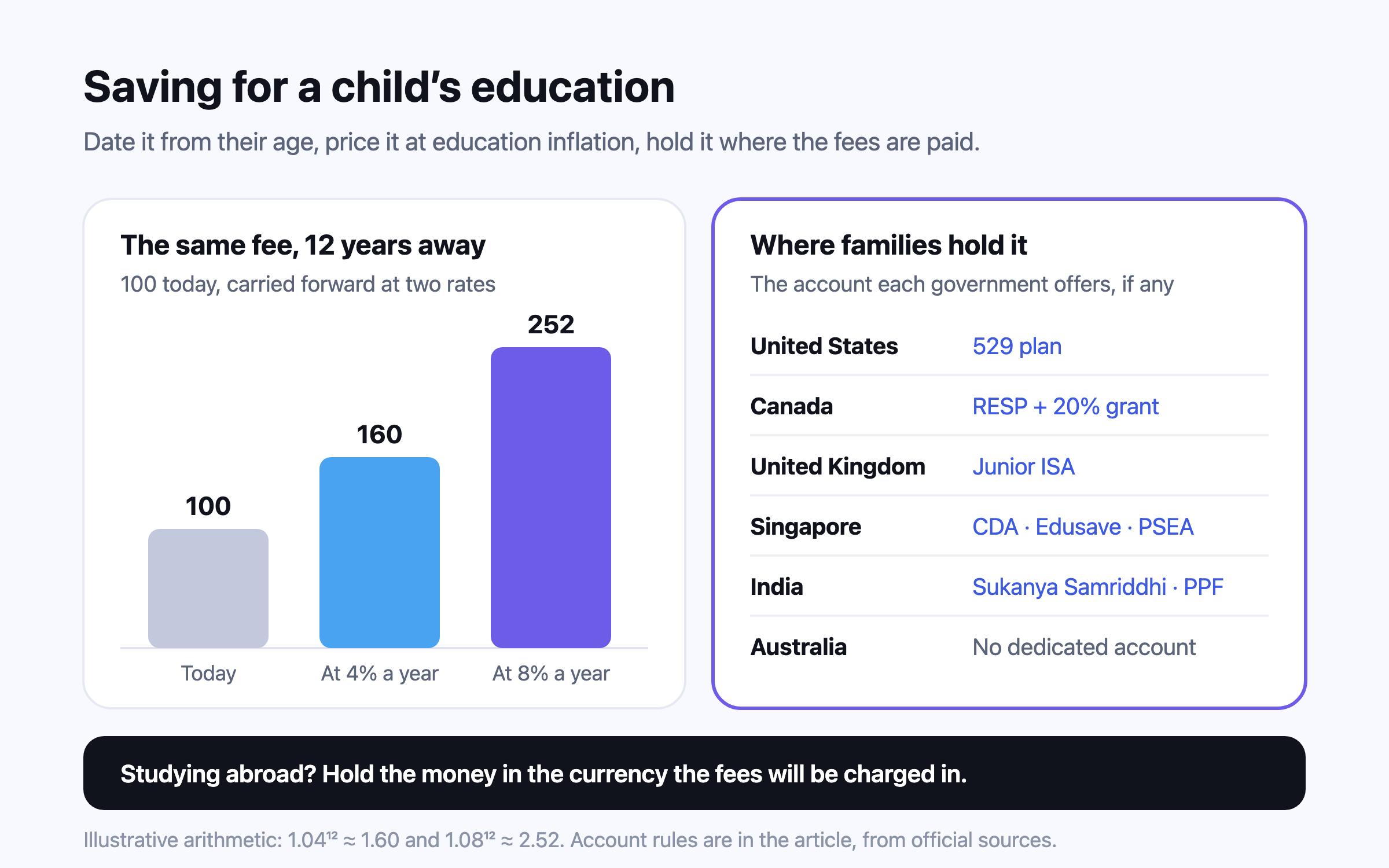
Count the years from your child’s age to about eighteen, price the course today, and carry it forward at education inflation rather than general inflation — in Nivritee’s defaults, 3.0–8.0% a year against 2.0–4.0%. Then use the account your government offers where one exists, and hold the money in the currency the fees will be charged in.
A child’s education is the goal most families start saving for first, and one of the easiest to under-save for. The date is fixed and close, the cost tends to rise faster than prices in general, and for a growing number of families the bill will arrive in another country’s currency. This report covers the three decisions that matter most — when, how much, and where to hold the money — across the eleven markets Nivritee plans for and the main study destinations, with every account rule and rate from the government or regulator that sets it.
Start with the date, not the amount
Higher education usually begins around eighteen, so the time you have is roughly eighteen minus your child’s age today: a six-year-old’s first fees are about twelve years away, a twelve-year-old’s about six. That distance decides almost everything else. With twelve years, most of the money can sit in growth assets and the monthly amount is modest; with six, there is less time to recover from a fall in markets and far less time for compounding to do the work.
Time also changes what the goal costs. A fee that rises at 8% a year roughly doubles in nine years and grows to about 2.52 times today’s figure in twelve; at 4% it grows to about 1.60 times over the same twelve years1. That is why the second decision — which inflation rate to use — matters as much as the first.
Education inflation is not general inflation
Where statistics offices publish an education price index, it has usually outrun prices in general over long periods. In the United States, the consumer price index for college tuition and fees rose about 2.96 times between August 2000 and August 2026, roughly 4.3% a year, while all prices rose about 1.94 times, roughly 2.6% a year23. The most recent year was calmer, at 2.8% for college tuition4. In the UK, the education component of the CPI rose 5.1% in the year to August 20265; in Australia, education prices rose 4.8% in the year to July 2026 against 3.5% for the CPI as a whole6.
No statistics office publishes a comparable cross-country series, so Nivritee’s default education rate for each market is derived: the central bank’s inflation target plus a spread of one to four points, widest where schooling and universities are mostly private1. The table shows what each default does to a fee of 100 over twelve years — the distance for a six-year-old — and why it is worth carrying each education goal at its own rate. The method is explained in full in Inflation is not one number.
| Market | General inflation | Education inflation | 100 today, in 12 years at general | 100 today, in 12 years at education |
|---|---|---|---|---|
| India | 4.0% | 8.0% | 160 | 252 |
| Malaysia | 2.5% | 5.5% | 134 | 190 |
| Singapore | 2.0% | 4.5% | 127 | 170 |
| Hong Kong | 2.5% | 5.0% | 134 | 180 |
| Australia | 2.5% | 4.5% | 134 | 170 |
| New Zealand | 2.0% | 4.0% | 127 | 160 |
| United States | 2.0% | 4.5% | 127 | 170 |
| Canada | 2.0% | 4.0% | 127 | 160 |
| United Kingdom | 2.0% | 4.0% | 127 | 160 |
| Europe (euro area) | 2.0% | 3.5% | 127 | 151 |
| Japan | 2.0% | 3.0% | 127 | 143 |
The accounts each government offers
Several governments add money or waive tax on education savings, and where they do, using the account is usually the single best-returning decision a family can make — a grant is a return before any market moves. The terms below are from each government’s own pages; they change, so check them before you open anything.
| Country | Account | What the government adds | Key limits |
|---|---|---|---|
| United States | 529 plan | Earnings free of federal tax when spent on qualified education | Up to $20,000 a year for K-12 tuition; up to $35,000 in a lifetime can roll into a Roth IRA |
| Canada | RESP | Canada Education Savings Grant: 20% of the first $2,500 a year, $500 | Grant up to $7,200 per child; contributions up to $50,000 per child |
| United Kingdom | Junior ISA | No tax on interest or gains | £9,000 a year (2026–27); the child can withdraw at 18 |
| Singapore | Child Development Account, then Edusave and PSEA | First Step Grant of S$5,000 for a first child, and matching up to S$4,000 | Edusave S$230 a year in primary school, S$290 in secondary |
| India | Sukanya Samriddhi Account (girls) | Government-set rate, 8.2% for October–December 2026 | ₹250 to ₹1.5 lakh a year; opened before the girl turns 10 |
| India | Public Provident Fund | Government-set rate, 7.1% for October–December 2026 | ₹500 to ₹1.5 lakh a year; 15-year term |
| Australia | No dedicated account | Investment bonds held 10 years are not taxed on withdrawal | Families also use ordinary investments in a parent’s name |
United States: the 529 plan
A 529 is a state-run plan whose earnings are not taxed federally, and generally not by the state, when spent on qualified education7. Since 2026 up to $20,000 a year can go to K-12 tuition, double the earlier $10,000, and money left over after 15 years can move into the beneficiary’s Roth IRA, up to $35,000 over a lifetime8. Americans held about $595 billion in 529 savings and prepaid plans at the end of March 2026, by one industry count17.
Canada: the RESP and its grant
The Canada Education Savings Grant adds 20% to the first $2,500 a family puts into a Registered Education Savings Plan each year — $500 — up to $7,200 per child, with more for lower-income families, and the Canada Learning Bond adds up to $2,000 with no contribution needed9. Contributions are capped at $50,000 per child over a lifetime, with no annual limit10.
United Kingdom: the Junior ISA
A Junior ISA takes up to £9,000 a year in 2026–27, free of tax on interest and gains; the child can manage it from 16 and withdraw from 1811. That last rule is the trade-off: the money becomes the child’s, to spend on a degree or on anything else.
Singapore: CDA, Edusave and PSEA
Singapore builds the account for parents. A child born on or after 18 February 2025 receives a First Step Grant of S$5,000 in a Child Development Account (the same for a second child), and the government matches parents’ savings up to S$4,000 for a first child12. Singaporean pupils also receive yearly Edusave contributions — S$230 a year in primary school and S$290 in secondary13. Unused balances move into a Post-Secondary Education Account, which earns 2.5% a year and can pay for polytechnic or university fees until the year the holder turns 3118.
India: Sukanya Samriddhi and PPF
For a daughter under ten, the Sukanya Samriddhi Account takes ₹250 to ₹1.5 lakh a year for fifteen years, lets half the balance be withdrawn for education once she turns 18 or passes Class 10, and matures 21 years after opening15; its rate was held at 8.2% for October–December 2026, with the Public Provident Fund at 7.1%14. The PPF takes ₹500 to ₹1.5 lakh a year over a fifteen-year term19. Both government schemes are fixed-rate and long, which suits a goal fifteen years out and not one three years out.
Australia: no dedicated account
Australia has no education account of its own. Families commonly use investment bonds — insurance-wrapped funds whose bonuses are not taxed if withdrawn after the tenth year16 — or ordinary investments in the lower-earning parent’s name. For domestic students, a large part of the university bill is deferred through the government’s HECS-HELP loan rather than saved for in advance.
Studying abroad: save in the currency of the fees
Most of the accounts above are designed for a child who studies at home. A family in India, Malaysia or the Gulf saving for a degree in the UK, Canada, Australia or the US faces two risks the home-country accounts do not address: the destination’s fees rise at the destination’s education inflation, and the family’s own currency can weaken against the one the fees are charged in. Over a decade, the second can matter as much as the first.
- Price the goal in the destination’s currency, from the universities’ own fee pages, and carry it forward at that country’s education rate rather than your own.
- Hold at least part of the money in that currency as the date approaches — a deposit, or a fund denominated in it — so a fall in your own currency in the final years does not land on the bill. The wider case is set out in home bias and currency risk.
- Shift toward safer holdings over the last three to five years. Money needed soon has little time to recover from a market fall.
- Plan the whole cost, not only tuition. Living costs, health cover and flights often equal the fees; the higher education costs by country report sets out both, market by market.
A simple order of work
- Decide the shape of the goal: home or abroad, public or private, tuition only or living costs too. These choices move the total more than any investment decision.
- Price it today and date it from the child’s age.
- Carry it forward at education inflation for the country the fees will be paid in.
- Claim what the government gives first — a grant, a match or a tax exemption is a return no market can offer.
- Invest the rest for the time you have, and move toward cash and short-dated holdings in the final few years.
- Check it against your own independence. An education fund that empties your own later-life savings has moved a problem, not solved it — the trade-off is weighed in your child’s education or your independence.
How Nivritee helps
Questions people ask
How much should I save for my child’s education?
Price the course in today’s money, carry it forward to the year it starts at education inflation, and divide by the months you have. A fee of 100 today becomes about 252 in twelve years at 8% a year but about 160 at 4%, so the rate matters as much as the fee1.
What is the education inflation rate?
It differs by country and is not usually published as a single figure. US college tuition prices rose about 4.3% a year between 2000 and 2026 against about 2.6% for all prices23; Nivritee’s default education rates run from 3.0% in Japan to 8.0% in India1.
What is the Junior ISA limit for 2026–27?
The Junior ISA allowance is £9,000 for the 2026 to 2027 tax year, and the child can withdraw the money from age 1811.
How much is the Canada Education Savings Grant?
The CESG adds 20% to the first $2,500 contributed to an RESP each year — up to $500 a year and $7,200 per child over a lifetime, with more for lower-income families9.
What is the Sukanya Samriddhi Yojana interest rate?
The government held it at 8.2% for October–December 202614. The account is for a girl under ten, takes ₹250 to ₹1.5 lakh a year, and matures 21 years after opening15.
Should I save for a child’s overseas education in rupees or in the foreign currency?
Fees abroad are charged in the destination’s currency and rise at its education inflation, so a weaker rupee raises the bill on top. Many families hold a growing share of the fund in that currency as the start date approaches; this is information, not financial advice.
Sources
- Should I change the six assumptions? (Nivritee’s default rates by country, with their basis) — Nivritee Help Centre, 2026-10.
- CPI-U: College tuition and fees in U.S. city average (CUUR0000SEEB01) — U.S. Bureau of Labor Statistics, 2026-08.
- CPI-U: All items in U.S. city average (CUUR0000SA0) — U.S. Bureau of Labor Statistics, 2026-08.
- Consumer Price Index news release, table 2: CPI-U detailed expenditure categories, August 2026 — U.S. Bureau of Labor Statistics, 2026-08.
- CPI annual rate 10: Education (D7GH) — Office for National Statistics, 2026-08.
- Consumer Price Index, Australia, July 2026 — Australian Bureau of Statistics, 2026-07.
- 529 plans: questions and answers — Internal Revenue Service, 2026-01.
- Topic no. 313, Qualified tuition programs (QTPs) — Internal Revenue Service, 2026-09.
- How much money can be added to Registered Education Savings Plans — Employment and Social Development Canada, 2026-08.
- Registered Education Savings Plans: contributions — Canada Revenue Agency, 2026-02.
- Junior Individual Savings Accounts (ISA): overview — GOV.UK, 2026.
- Baby Bonus Scheme: First Step Grant and co-matching in the Child Development Account — Made for Families (Government of Singapore), 2026-08.
- Edusave Account: overview — Ministry of Education, Singapore, 2026-08.
- Small savings scheme interest rates unchanged for Q3 FY27: PPF, SCSS, SSY rates — Business Today (reporting the Department of Economic Affairs memorandum of 30 September 2026), 2026-09.
- Sukanya Samriddhi Account Scheme, 2019 (G.S.R. 914(E)) — National Savings Institute, Ministry of Finance, 2019-12.
- myTax 2026: bonuses from life insurance companies and friendly societies — Australian Taxation Office, 2026.
- 1Q 2026 529 and ABLE market sizing highlights (ISS Market Intelligence data) — ISS Market Intelligence, via the 529 & ABLE conference, 2026-03.
- Post-Secondary Education Account (PSEA): overview — Ministry of Education, Singapore, 2026-08.
- Public Provident Fund — National Savings Institute, Ministry of Finance, 2026.
This is general information, not financial, tax or legal advice for your circumstances. Rules and figures change; check the official source for your country, and consult a licensed professional before making financial decisions. Projections are estimates, not predictions.