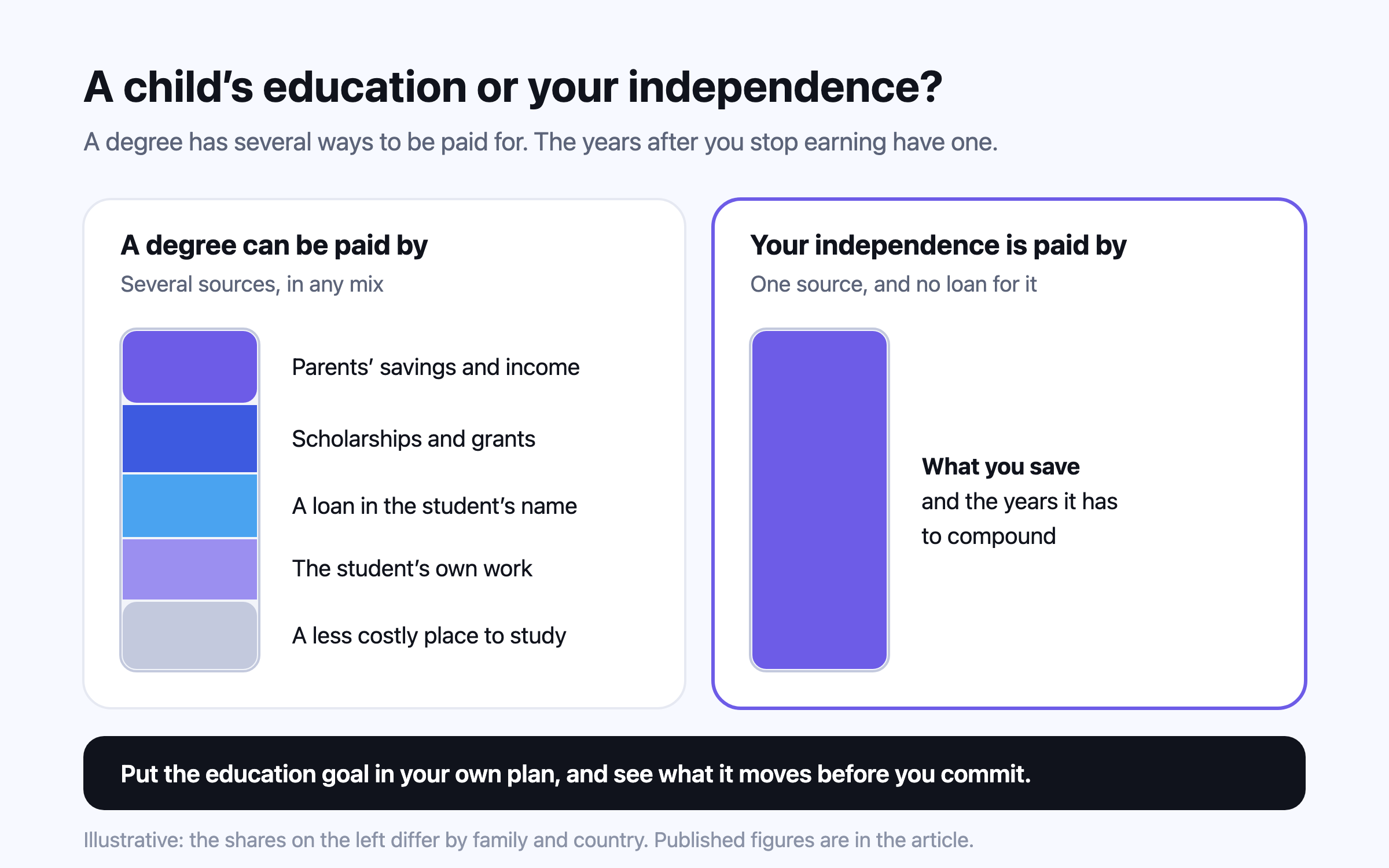
A degree can be paid for by scholarships, loans, work and a cheaper destination. The years after you stop earning can only be paid for by you.
Most parents put a child’s education first, and many quietly save less for themselves to pay for it. Planning bodies argue the other way round: education can be funded several ways, while nobody lends you money to live on later. The useful step is not choosing one, but putting the real cost — at home or abroad — into your own plan and seeing what it moves.
Few money decisions carry as much feeling as paying for a child’s education. For many families, especially those weighing a degree abroad, it is the single largest goal they will fund, and it lands in the decade when their own savings should be compounding hardest. This article sets out what parents actually pay, what the published fees say about studying abroad against studying at home, the argument for putting your own independence first, and how to test the trade-off on your own figures rather than in the abstract.
What parents actually pay
$34,0191
average spent per US college family in 2025–26, up 10% in a year
39%1
of that came from parents’ income and savings
82%2
of parents in 15 markets ready to make personal sacrifices for their child to succeed
20%2
had paid less into their own long-term savings to fund it
The most detailed picture comes from the United States. Sallie Mae’s nineteenth How America Pays for College study, which surveyed 1,000 students and 1,000 parents in April and May 2026, found families spent an average of $34,019 on college in 2025–26, 10% more than the year before1. Parents’ own income and savings covered the largest share, 39%, and parent borrowing another 11%; scholarships paid for 15%, grants 12%, student borrowing 11% and the student’s own income and savings 10%1. Put together, half the bill fell on parents and the other half was met by everyone and everything else.
Outside the US the evidence is older but points the same way. HSBC’s Value of Education study, run by Ipsos MORI among 8,481 parents in 15 countries and territories in 2017, put the average spent on a child’s education from primary school to a first degree at about USD 44,221, ranging from about USD 132,161 in Hong Kong to about USD 16,708 in France, with India at about USD 18,9092. Most parents paid from day-to-day income (74%), with 36% drawing on general savings, investments or insurance and only 21% using a dedicated education plan2. And the sacrifices were real: 40% had cut their own leisure spending, 21% worked extra hours and 20% had paid less into their own long-term savings or investments to cover it2.
The oxygen-mask argument
Airline safety briefings tell parents to fit their own oxygen mask before helping a child, because a parent who passes out helps nobody. Financial-planning writers borrow the image for this exact choice. The reasoning is structural rather than selfish: a degree can be paid for in several ways, and the years after you stop earning can be paid for in only one.
Remember, you can’t take out a loan to fund your retirement.
Vanguard’s own guidance on juggling family goals ranks saving for later life ahead of saving for college for that reason3. Most parents feel the opposite: in T. Rowe Price’s 2018 Parents, Kids & Money survey, 74% of US parents said saving for their children’s college was a higher priority than saving for their own retirement4. Both positions are defensible, and the gap between them is why the decision deserves arithmetic rather than instinct.
- For putting your own savings first: money set aside in your thirties and forties has the longest time to compound; a shortfall later in life cannot be borrowed against; and parents who run short often become a financial responsibility for the same children they paid to educate — the sandwich the next generation then inherits.
- For putting the education first: the window is fixed and short, a strong education can change a child’s whole earning life, and in many families supporting a degree is part of an understood exchange across generations rather than a one-way gift.
- What both sides agree on: the worst outcome is deciding without numbers — promising a destination before knowing what it costs, or quietly stopping your own saving without seeing what that does to the age you could stop working.
Study abroad against study at home: the published fees
The choice of where to study often moves the cost more than any savings or investment decision a family can make. The fees below come from governments, statistics offices and universities themselves, and they show why: the same degree can cost several times as much depending on where it is taken and whether the student counts as a local.
| Where | Who pays what | Published figure |
|---|---|---|
| United States | Public four-year, in-state tuition and fees, 2025–26 | $11,950 a year |
| United States | Public four-year, out-of-state | $31,880 a year |
| United States | Private non-profit four-year | $45,000 a year |
| Canada | Canadian undergraduates, average tuition, 2025–26 | C$7,734 a year |
| Canada | International undergraduates, average tuition | C$41,746 a year |
| England | Home undergraduate fee cap, 2025–26 → 2026–27 | £9,535 → £9,790 a year |
| Germany | State universities, most bachelor’s and master’s courses | Generally no tuition |
| Germany | Non-EU students in Baden-Württemberg | €1,500 a semester |
| Germany | Proof of funds for living costs (student visa) | €992 a month, €11,904 a year |
| India | IIT Madras B.Tech tuition, Indian nationals, 2025 | ₹1,00,000 a semester |
Two multiples stand out. An international undergraduate in Canada pays on average more than five times what a Canadian does — C$41,746 against C$7,734 a year6. In the United States, an out-of-state student at a public university pays about 2.7 times the in-state rate, $31,880 against $11,9505. At the other end, Germany’s state universities generally charge no tuition for most courses, and even the non-EU fee in Baden-Württemberg is €1,500 a semester8; living costs, for which a visa applicant must show €11,904 a year, become the main bill8.
For families in Asia, HSBC’s 2024 Quality of Life research put the cost of a three- or four-year degree in the US, UK, Australia or Canada at USD 192,000–256,000 per child, and estimated it could consume up to 66% of parents’ retirement savings in India and Indonesia and up to 30% in Singapore10. Demand is not slowing: UNESCO counts about 6.9 million students studying outside their home country, three times the number in 200011, and India sent about 508,000 abroad in 2021, second only to China12. In HSBC’s 2017 survey, 55% of Indian parents said they would consider sending a child to university abroad2.
The trade-offs, named plainly
Paying in full from parents’ savings is only one of five levers, and each of the others has a cost that lands on somebody.
- A loan in the student’s name. It moves the cost to the person who benefits from the degree, and some systems tie repayment to income. England’s Plan 5 loans take 9% of income above £25,000 a year and write off what is left after 40 years13. The trade-off is a deduction that may run for much of a working life — weigh it with the companion piece on student debt systems.
- A loan in the parents’ name. Usually dearer: US federal Direct Loans to undergraduates carried 6.39% for 2025–26, while PLUS loans to parents carried 8.94%14. It also puts debt on the balance sheet that should be shrinking as you approach the years you stop earning.
- Scholarships and grants. In the Sallie Mae data they covered 27% of the average bill between them1 — real money, but rarely known until after the decision to apply abroad has been made.
- The student’s own work. Covered 10% of the US bill1; abroad it is capped by visa rules and competes with study time.
- A less costly place to study. Germany, a home-country university, or a first degree at home and a master’s abroad can cut the total by more than any investment return — and whether the expensive option pays for itself is a separate question, taken up in is a degree worth it.
How to test it on your own plan
- Price each option in today’s money. A degree at home, a degree abroad, and a mixed route — tuition plus living costs, from the universities’ own fee pages.
- Date it from your child’s age. Higher education usually starts around eighteen; Nivritee suggests an education goal dated from each child’s age, with the year filled in and the cost left for you.
- Enter the cost in the currency it is charged in. A life goal’s cost can be typed in pounds, dollars or euros and is converted into your plan’s reporting currency; it rises each year at your plan’s education inflation rate, which you can change.
- Read what moved. Compare the projected independence age and the verdict with and without the goal. A goal that pushes the age back by a year or two is a decision; one that turns the verdict from Workable to Short is a warning.
- Run the stress tests. A career break, a job loss or a stretch of high inflation lands differently when a large goal sits in the same decade.
- Look at the levers. Under “What would move this” the Overview prices saving a little more, living on a little less later, or clearing your costliest loan in years — see what the levers are.
Do it as a couple. Two parents often hold different assumptions about who is paying for what, and an education goal is exactly the kind of figure one partner knows and the other guesses. A shared plan, where each of you can see the goal and its effect on both your independence ages, turns an argument about values into a conversation about numbers — the approach set out in how couples can talk about money.
Questions people ask
Should I save for my child’s education or my retirement first?
Planning bodies such as Vanguard put your own later-life savings first, because education can be met by scholarships, loans and work while nobody lends you money to live on later3. Most parents lean the other way — 74% in a 2018 T. Rowe Price survey4 — so the practical answer is to put the education goal into your own plan and see what it does to the age you could stop working.
How much do parents usually pay for college?
In the US, families spent an average of $34,019 in 2025–26; parents’ income and savings covered 39% and parent borrowing another 11%1. The rest came from scholarships, grants, student loans and the student’s own earnings.
How much more does it cost to study abroad than at home?
It depends sharply on where. International undergraduates in Canada pay on average more than five times the Canadian rate6, while Germany’s state universities generally charge no tuition for most courses8. HSBC put a three- or four-year degree in the US, UK, Australia or Canada at USD 192,000–256,000 per child10.
Is it better for my child to take an education loan?
It moves the cost to the person who benefits, and some systems tie repayment to income — England’s Plan 5 takes 9% above £25,000 and writes off the rest after 40 years13. Parent loans are usually dearer: US PLUS loans carried 8.94% against 6.39% for undergraduates in 2025–2614. This is information, not financial advice.
Can studying abroad affect my retirement savings?
It can, substantially. HSBC estimated that funding an overseas degree could take up to 66% of parents’ retirement savings in India and Indonesia and up to 30% in Singapore10.
Sources
- How America Pays for College 2026 — Sallie Mae and Ipsos, 2026.
- The Value of Education: Higher and higher — global report — HSBC (research by Ipsos MORI), 2017-06.
- Juggling multiple financial goals — Vanguard, 2026.
- T. Rowe Price: Parents are less stressed about college costs and getting wiser about covering them (Parents, Kids & Money survey) — T. Rowe Price, via PR Newswire, 2018-09.
- Trends in College Pricing 2025: highlights — College Board, 2025.
- Canadian and international tuition fees by level of study, 2025/2026 — Statistics Canada, The Daily, 2025-09.
- Higher education fee limits: final stage impact assessment (DfE167) — Department for Education, 2026-01.
- Finances: tuition fees, semester contribution and proof of financial resources — DAAD (German Academic Exchange Service), 2026.
- UG Admission 2025: fee structure — IIT Madras, 2025.
- Survey reveals financial impact of study abroad on families (Quality of Life Report 2024) — HSBC Singapore, 2024-06.
- Record number of higher education students highlights global need for recognition of qualifications — UNESCO, 2025-06.
- World Migration Report 2024, chapter 2: international students — International Organization for Migration (from UNESCO Institute for Statistics data), 2024.
- Repaying your student loan: what you pay, and when it is written off — GOV.UK, 2026.
- Federal student loan programs: interest rates for loans first disbursed 1 July 2025 to 30 June 2026 — U.S. Department of Education, Federal Register, 2026-03.
This is general information, not financial, tax or legal advice for your circumstances. Rules and figures change; check the official source for your country, and consult a licensed professional before making financial decisions. Projections are estimates, not predictions.