Age is a rough proxy for what really sets your mix: how many years the money has to run, and how steady your income is.
Rules like “own your age in bonds” and target-date funds both cut shares as you age — Vanguard’s default path holds 90% in shares until about 40 and 30% by 72. The research behind them is really about horizon and human capital: a long horizon and a steady salary can carry more shares, while the years either side of stopping work carry the most risk. Early retirees face a longer horizon and a longer danger window at once.
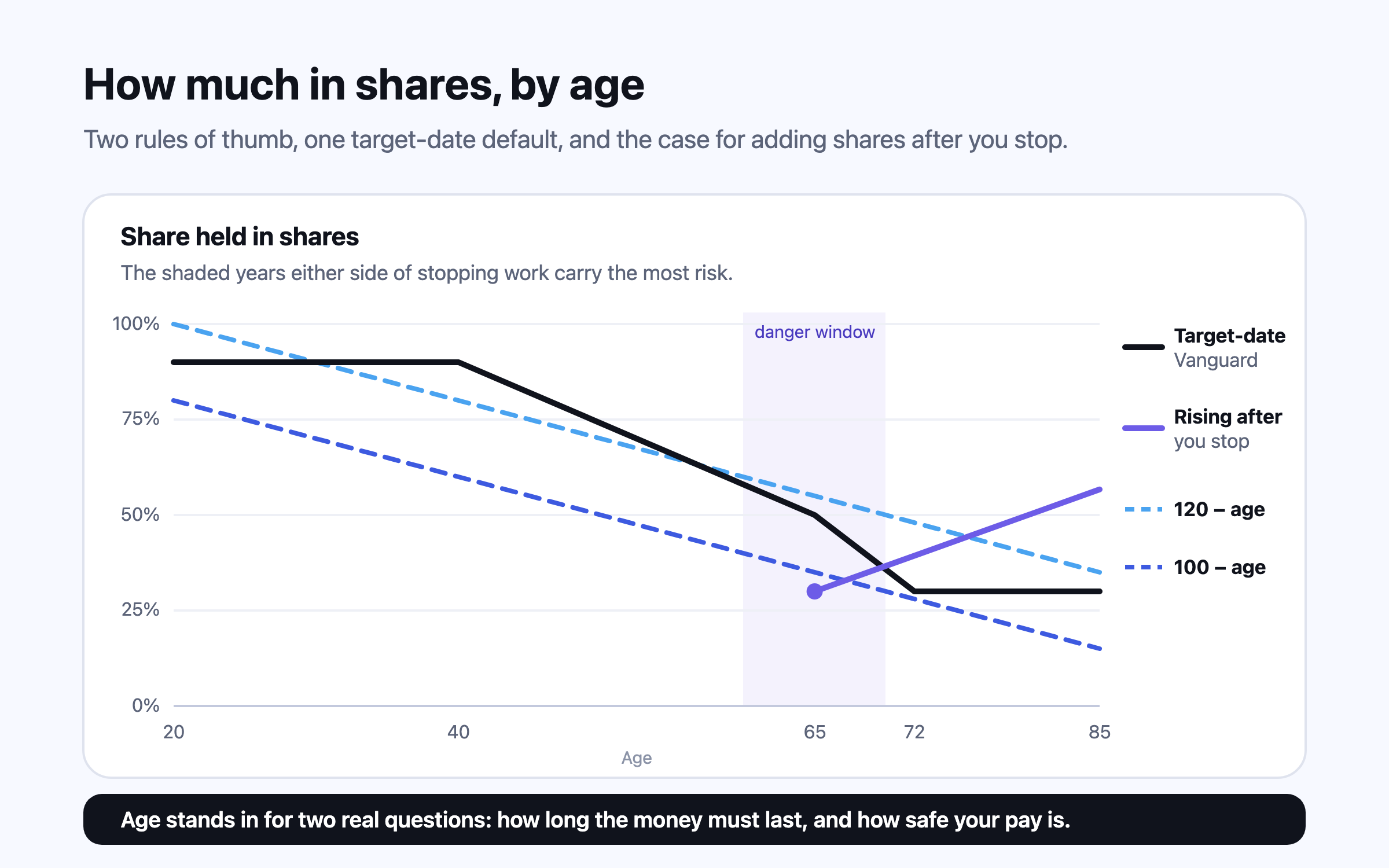
Almost every rule about how to split money between shares and safer assets uses age as its input, because age is easy to know. What the research actually cares about is two things age only approximates: how long the money has to run before it is spent, and how much of your future income is already safe. This article traces the common rules to their sources, shows what the target-date industry does with your age, and sets out the evidence that the safest point to hold the fewest shares is around the day you stop work — not at the end of life.
Where “100 minus age” came from
The best-known version is John Bogle’s. The Vanguard founder’s rule of thumb was to own roughly the same percentage of bonds as your age, so a 30-year-old holds 30% in bonds and 70% in shares1. Written the other way round it becomes “100 minus your age in shares”. Variants such as “110 minus age” and “120 minus age” are widely repeated, usually justified by longer lives and lower bond yields than when the rule was first written; none has a single author or a study behind it, and they are best read as a more aggressive version of the same straight line.
| Age | 100 minus age | 110 minus age | 120 minus age | Vanguard target-date default |
|---|---|---|---|---|
| 25 | 75% | 85% | 95% | 90% |
| 40 | 60% | 70% | 80% | 90%, starting to fall |
| 65 | 35% | 45% | 55% | about 50% |
| 72 | 28% | 38% | 48% | 30%, its final mix |
The straight lines have one virtue — they are easy to follow — and one flaw: they move every year whether or not anything about your money has changed. A 40-year-old with a secure public-sector pension and a 40-year-old freelancer with no pension are told the same thing.
Target-date funds: the glide path as a product
Target-date funds turned the age rule into a product, and they now hold a large share of American workplace savings. Vanguard’s How America Saves 2026 reports that 96% of the plans it administers offer target-date funds, and 69% of participants have their money in a professionally managed allocation such as a target-date fund3. Morningstar counts $4.8 trillion in target-date strategies at the end of 2025, up 20.3% in a year4.
Vanguard’s default path holds 90% in shares early in a career, begins cutting them gradually around age 40, adds short-term inflation-protected government bonds from about 60, sits at about 50% in shares at 65, and reaches its final mix of 30% shares and 70% bonds at 72 — the age its research finds withdrawals most commonly begin2. Across the industry, the median target-date series holds 93% in shares 45 years from retirement4, and in Morningstar’s 2022 survey the median held about 43% at the target date itself5.
“To” versus “through”
Glide paths split into two designs. A “to” path stops changing at the target date and holds its most conservative mix from that day. A “through” path keeps reducing shares for another 10 to 20 years after the target date, so it usually holds more in shares on the day itself5. Morningstar found that four-fifths of the 28 series launched in the decade to 2022 used a “through” design5. The difference matters most for the reader of this article: a “to” fund assumes the money is spent soon after the date; a “through” fund assumes it must last decades more.
The case for adding shares after you stop
In 2013 Wade Pfau and Michael Kitces turned the conventional path upside down. Their simulations started retirement with few shares and raised the share over time. A path from 30% to 70% in shares succeeded slightly more often than a static 60/40 mix — 95.1% against 93.2% — while holding less in shares on average6. In the bad cases it mattered more: at the fifth percentile the rising path lasted the full 30 years against 27.7 for the static mix6. The paper was published in the Journal of Financial Planning in January 20147.
The logic follows from sequence of returns risk. The years just before and after stopping work are when a portfolio is largest and when a crash does the most lasting damage, because withdrawals lock losses in. Holding fewest shares at that moment, then letting the share drift up as the danger window passes, protects the vulnerable years. If markets do well early, the rising path lags — it is insurance, and insurance costs something in the good outcomes.
What changes for early retirees
Stopping at 45 rather than 65 changes two things at once. The horizon lengthens, so the money must outrun inflation for longer; and the danger window still sits at the start, with decades left to compound any early damage. Morningstar’s 2026 estimates for a portfolio of 40% shares at a 90% chance of success fall from 3.9% a year for 30 years to 3.3% for 40 and 2.9% for 508. In that study, higher share allocations generally produced lower safe starting rates for a fixed inflation-adjusted withdrawal, though longer horizons tolerated slightly more in shares8.
Karsten Jeske’s Early Retirement Now series reaches a complementary result for 60-year horizons using US data back to 1871: a path rising from 60% to 100% in shares over roughly eight to eleven years supported a fail-safe withdrawal of roughly 3.4% to 3.5%, against 3.14% for a static 80% mix9. He also stresses the cost: the rising path underperforms when markets rally early9. The two studies differ in method and in what they count as failure, which is why their equity shares look so different — but both say the first decade, not the average, sets what an early retiree can spend.
Your income is an asset too
The deepest reason age matters is human capital: the value of the earnings still ahead of you. Roger Ibbotson, Moshe Milevsky, Peng Chen and Kevin Zhu set out the idea for the CFA Institute Research Foundation in 2007. A young person’s largest asset is usually future pay, and a portfolio should be built around it: safe, steady earnings behave like a bond, so somebody with them can hold more in shares; earnings that rise and fall with the stock market behave like shares, so somebody with them should hold less risk elsewhere10. The share falls with age because human capital is spent down year by year until, at independence, almost all wealth is financial.
Milevsky’s shorthand for this is to ask whether you are a stock or a bond. A tenured professor’s salary is bond-like and safe; a stockbroker’s pay is stock-like and risky11. Two 35-year-olds with identical savings can therefore reasonably hold very different mixes. For how pay itself tends to grow across a working life, see how income grows across a career.
From age to jobs: a better question to ask
- Money needed within a year or two has no business in shares, whatever your age: a fall cannot be waited out.
- Money needed in the next several years — the runway after you stop — belongs in steady assets so that a crash never forces a sale.
- Money not needed for a decade or more can carry the volatility that buys long-run growth, and for a long horizon arguably must.
- Steady income still to come — a salary, a pension, rent — counts as a bond-like asset beside the portfolio, and lets the portfolio itself take more risk.
Seen this way, “100 minus age” is a rough average over households, and a target-date fund is that average sold as a product. Both are reasonable defaults for somebody who will not think about it again. Somebody planning to stop early, or carrying a pension, or earning in a volatile industry, can do better by asking what each part of the money is for and when it will be needed.
This is information, not financial, tax or legal advice, and nothing here recommends a fund or a particular mix.
How Nivritee frames your mix
Questions people ask
What is the 100 minus age rule?
It says to hold 100 minus your age as a percentage in shares and the rest in bonds — the reverse of John Bogle’s rule of thumb to own roughly your age in bonds1. At 40 that means 60% in shares.
Is 120 minus age better than 100 minus age?
It is more aggressive: at 40 it gives 80% in shares rather than 60%. Neither has a study behind its exact numbers; the research behind both says the right mix depends on your horizon and how safe your income is, not your age alone10.
How much should be in stocks at retirement?
Target-date funds vary: Vanguard’s default holds about 50% in shares at 65 and 30% by 722, and the median target-date series held about 43% at its target date in Morningstar’s 2022 survey5. A rising-equity path starts lower, around 30%, and adds shares over time6.
What asset allocation should an early retiree use?
There is no single answer, but a longer horizon lowers the safe withdrawal rate — Morningstar estimates 2.9% for 50 years against 3.9% for 308 — and research on rising equity glide paths suggests holding fewer shares in the first years and more later9.
What is the difference between a “to” and a “through” target-date fund?
A “to” fund reaches its most conservative mix on the target date and stays there; a “through” fund keeps reducing shares for another 10 to 20 years, so it usually holds more in shares at the target date5.
Sources
- Vanguard Founder Advises Riding Out The Storm — NPR, 2008-10.
- Target-date fund glide path — Vanguard Institutional, 2026.
- How America Saves 2026 — Vanguard, 2026.
- Target-Date Funds Continue Their Rapid Rise (2026 Target-Date Landscape) — Morningstar (Mahi Roy), 2026-03.
- How Much Risk Is Your Target-Date Fund Taking? — Morningstar (interview with Megan Pacholok), 2022-03.
- Should Equity Exposure Decrease In Retirement, Or Is A Rising Equity Glidepath Actually Better? — Michael Kitces, Kitces.com, 2013-09.
- Reducing Retirement Risk with a Rising Equity Glide-Path (Journal of Financial Planning, January 2014) — Wade D. Pfau and Michael E. Kitces, via SSRN, 2013-09.
- How Much Can You Safely Withdraw If You Retire Early? — Morningstar (Amy C. Arnott), 2026-09.
- The Ultimate Guide to Safe Withdrawal Rates, Part 19: Equity Glidepaths in Retirement — Karsten Jeske, Early Retirement Now, 2017-09.
- Lifetime Financial Advice: Human Capital, Asset Allocation, and Insurance — Roger G. Ibbotson, Moshe A. Milevsky, Peng Chen and Kevin X. Zhu / CFA Institute Research Foundation, 2007-04.
- Lifetime Financial Advice: A Personalized Optimal Multilevel Approach — Thomas M. Idzorek and Paul D. Kaplan / CFA Institute Research Foundation, 2024.
- Why does a rung say my money is in the wrong place? — Nivritee Help Centre, 2026-10.
- What are the six investment readings? — Nivritee Help Centre, 2026-10.
- What investment return should I assume? — Nivritee Help Centre, 2026-10.
- What does each stress test assume? — Nivritee Help Centre, 2026-10.
This is general information, not financial, tax or legal advice for your circumstances. Rules and figures change; check the official source for your country, and consult a licensed professional before making financial decisions. Projections are estimates, not predictions.