State pensions replace between about two-fifths and a little over half of an average earner’s net pay in the countries compared here, and far less for higher earners — the rest is yours to fund.
For a man on average pay, mandatory pensions replace 63.2% of net earnings on the OECD average, but around half in the US, UK, Australia and Germany and less in Canada, New Zealand, Japan and India. At twice average pay the share falls further, and Singapore, Hong Kong and India rely mostly on the worker’s own account. Here is what each system pays in 2026, how claiming age changes it, and what it leaves a middle-class household to save.
Nivritee Research · 6 October 2026 · 14 min read
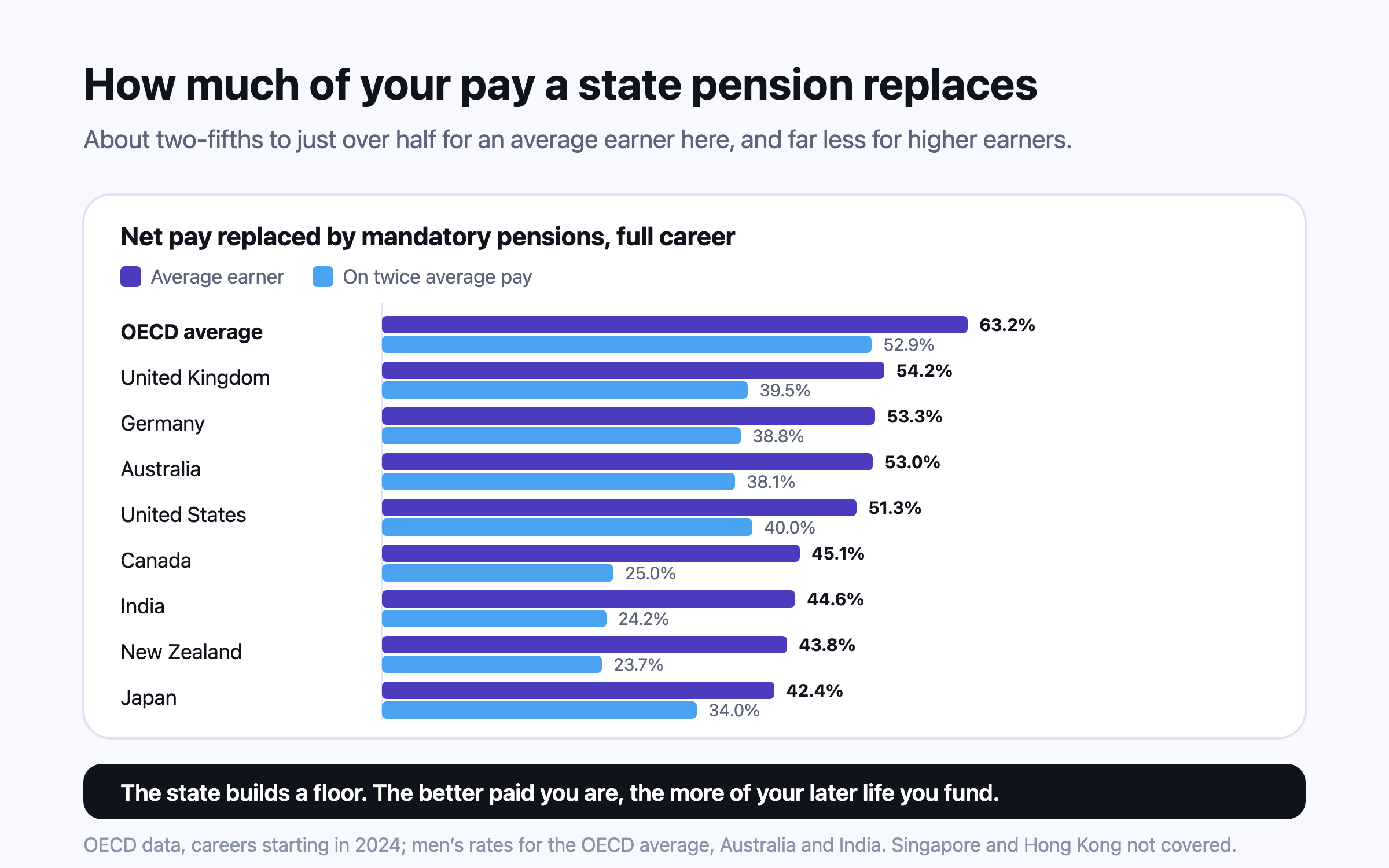
The short answer: for a man on average earnings who works a full career, mandatory pensions are projected to replace 63.2% of net pay on the OECD average (62.4% for a woman) — but 54.2% in the UK, 51.3% in the United States, 45.1% in Canada and 42.4% in Japan1. For somebody on twice average pay the OECD average falls to 52.9%, and in Canada to 25.0%1. State pensions are designed to stop old-age poverty, not to preserve a professional household’s standard of living. The better you are paid, the larger the share of your later life you fund yourself.
India’s EPS pension a month at 58 after 33 years at the ₹15,000 wage cap in force until September 2026
This article sets out what each system pays in 2026 and how, then what it means for the savings a household has to build. For the step after this — turning the gap into a target — see how much do you need to retire.
Three kinds of system
Almost every country’s arrangement is a mix of three building blocks, and which one dominates tells you most of what you need to know.
Contributory, earnings-related pensions. You pay in through payroll and the pension depends on your record: US Social Security, the Canada Pension Plan, Japan’s employees’ pension and Germany’s statutory pension. The UK’s new State Pension is contributory but flat — your years count, not your pay.
Residence-based or means-tested pensions. Paid for years lived in the country, sometimes reduced by income or assets: Canada’s Old Age Security, New Zealand Superannuation and Australia’s Age Pension.
Compulsory personal accounts. Your own money, invested, with rules on when and how you can take it: Singapore’s CPF, Hong Kong’s MPF, India’s EPF and Australia’s superannuation. What you get depends on what went in and how it grew.
The first two pay an income for life that rises with prices or wages — the hardest thing for a private saver to buy. The third gives you a pot, and the longevity and inflation risk is yours unless you convert it into an annuity. That difference matters more than the headline amounts.
Headline figures from each government or scheme, as of October 2026: US maximums for a worker who earned the taxable maximum every year from 22 and claimed in January 2026; OAS for ages 65 to 74, October to December 2026; Australian rates from 20 September 2026; NZ rates from 1 April 2026; Japan for fiscal 2026; Germany from 1 July 2026. Starting ages for Australia and Germany from the OECD. 456789101112133141516171819
Country
Main system
Headline amount, 2026
Normal starting age
Means-tested?
United States
Social Security
Up to $5,181 a month if claimed at 70; $2,969 at 62
67 (claim 62–70)
No
Canada
CPP + Old Age Security
CPP up to C$1,507.65 a month at 65; OAS up to C$762.50
65 (CPP 60–70)
OAS clawed back on high incomes
United Kingdom
New State Pension
£241.30 a week (2026-27)
66, rising to 67 from 2026 to 2028
No
Australia
Age Pension + super
Up to A$1,237.70 a fortnight single, A$1,866 a couple
67
Yes, income and assets
New Zealand
NZ Superannuation
NZ$44,412 a year after tax for a couple
65
No
Singapore
CPF LIFE
About S$1,780 a month from 65 at the 2026 Full Retirement Sum
65
No; depends on savings
Hong Kong
MPF accounts
5% + 5% of pay, capped at HK$1,500 each a month
65 (60 if stopped work)
Not applicable
India
EPF/EPS, NPS, APY
EPS ₹7,500 a month after 33 years at the ₹15,000 cap, raised to ₹25,000 in September 2026; APY ₹1,000–5,000
58 (EPS), 60 (APY); NPS at 60 or after 15 years
APY closed to taxpayers
Japan
National + employees’ pension
Basic ¥70,608 a month; model couple ¥237,279
65 (claim 60–75)
No
Germany
Statutory pension
About €1,913 a month gross for 45 years at average pay
Rising to 67
No
United States: Social Security
Social Security is earnings-related, with a formula tilted towards lower earners. Your average indexed monthly earnings — career earnings adjusted for wage growth — are converted to a basic benefit at 90% of the first $1,286, 32% of the amount up to $7,749 and 15% above that, for people first eligible in 202620. Only earnings up to the taxable maximum count — $184,500 in 2026, taxed at 6.2% from both employee and employer21. You need 40 credits to qualify, and a credit took $1,890 of earnings in 2026, with at most four a year22. Benefits rose 2.8% in January 2026 with the cost-of-living adjustment, which tracks the third-quarter change in the CPI-W23.
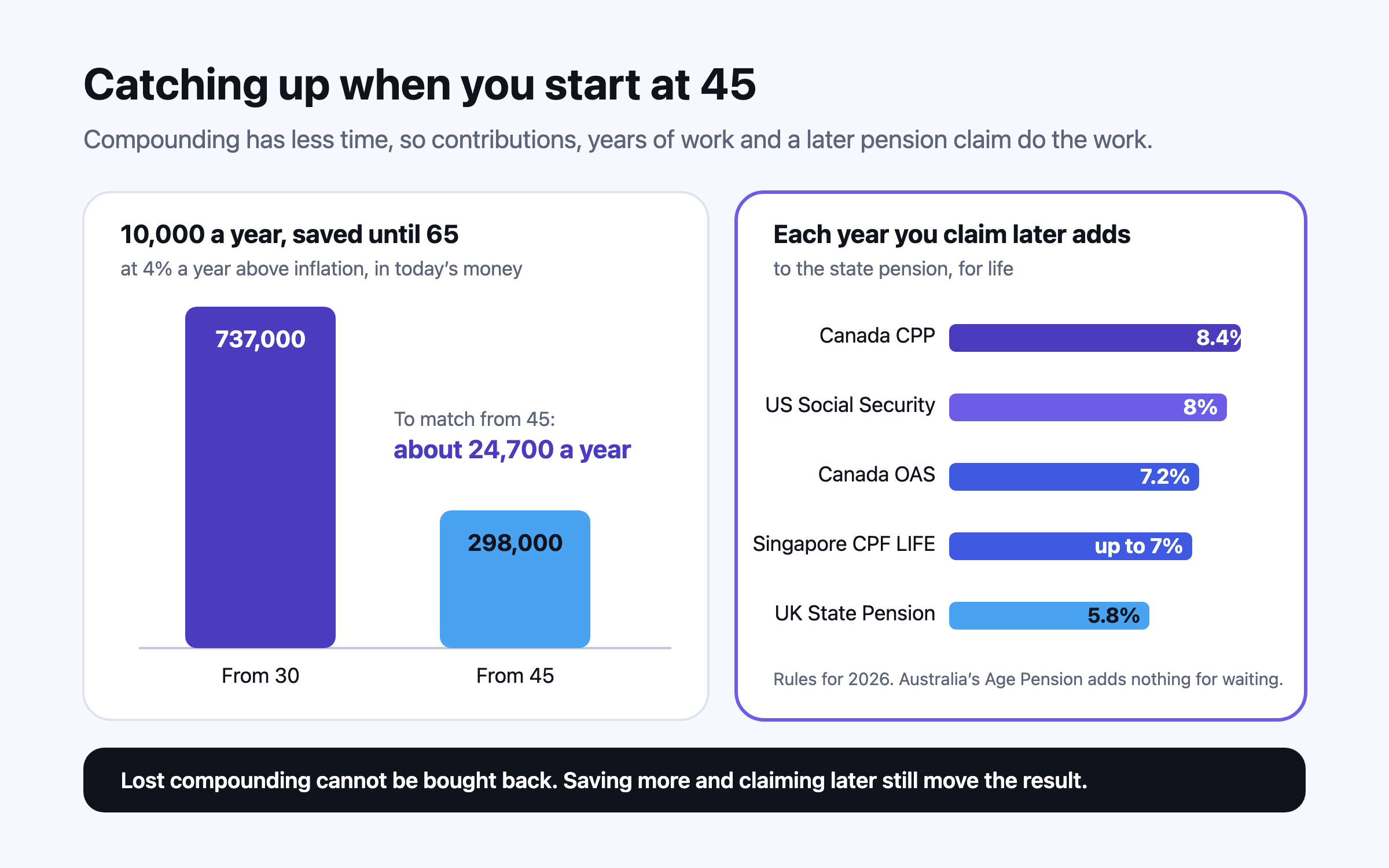
The claiming decision is the biggest lever a household has. For anyone born in 1960 or later the full retirement age is 67; claiming at 62 cuts the benefit by 30% for life, and each year of waiting beyond 67 adds 8% until 70242. So a benefit of $2,400 a month at 67 is $1,680 at 62 and $2,976 at 70. A worker who earned the taxable maximum every year from 22 and claimed in January 2026 got $2,969 a month at 62 and $5,181 at 704.
John Shoven and Sita Slavov, in research for the National Bureau of Economic Research, found that at the near-zero real interest rates of the early 2010s delaying was actuarially advantageous for a large share of people, and especially for the higher earner in a married couple, because the larger benefit becomes the survivor’s benefit25. The trade-off is the bridge: someone who stops at 62 and waits for 70 must fund eight years from savings. Two cautions apply. Up to 85% of benefits become taxable once combined income passes $34,000 for a single person or $44,000 for a married couple, thresholds that are not indexed for inflation26. And the 2026 Trustees Report projects that the retirement trust fund will be depleted in the fourth quarter of 2032, after which income would cover 78% of scheduled benefits unless the law changes26.
Canada: CPP and Old Age Security
Canada stacks two pensions. The Canada Pension Plan is earnings-related: in 2026 employees pay 5.95% of earnings between C$3,500 and C$74,600, matched by the employer, a maximum of C$4,230.45 each27. Since 2024, earnings between C$74,600 and C$85,000 also carry a second additional contribution of 4%, at most C$416 each in 202628. The maximum CPP at 65 for a pension starting in January 2026 is C$1,507.65 a month, but the average new pension in July 2026 was C$858.345 — most people do not have the long, high-earning record the maximum needs. Starting before 65 cuts it by 0.6% a month, up to 36% at 60; starting later adds 0.7% a month, up to 42% at 7029.
Old Age Security is paid for residence rather than contributions: 40 years in Canada after age 18 for the full amount, at least 10 for a partial one30. For October to December 2026 it pays up to C$762.50 a month from 65 to 74 and C$838.75 from 75, indexed every quarter6. Each month of delay after 65 adds 0.6%, up to 36% at 7031. High earners repay it: 15% of net income above C$95,323 for 2026, clawing back the whole pension well above that32. Low-income pensioners can add the Guaranteed Income Supplement, up to C$1,138.90 a month for a single person6.
Jess, 40, Toronto, earns C$150,000, about twice the CPP earnings limit. If she reaches the maximum CPP and full OAS at 65, together they would pay C$2,270.15 a month in today’s money, C$27,241.80 a year — about 18% of her current salary56. Those are today’s maximums. The enhancement phased in since 2019 is designed to raise the maximum CPP by more than 50% for someone who pays the enhanced contributions for 40 years33, so her own figure should be higher, though still a small part of her pay. Here is the OECD’s point about higher earners made concrete: for her household, the state covers the floor, and workplace pensions, RRSPs and TFSAs carry the rest.
United Kingdom: the new State Pension
The full new State Pension is £241.30 a week in 2026-27, about £12,548 a year7. It is flat: what counts is National Insurance qualifying years, not pay. You need 10 qualifying years to get anything and, for anyone whose record started after April 2016, 35 for the full rate; people with records from before 2016 may get more or less, and the State Pension forecast on GOV.UK shows the actual figure734. It rises each April by the highest of earnings growth, prices and 2.5%, the so-called triple lock7.
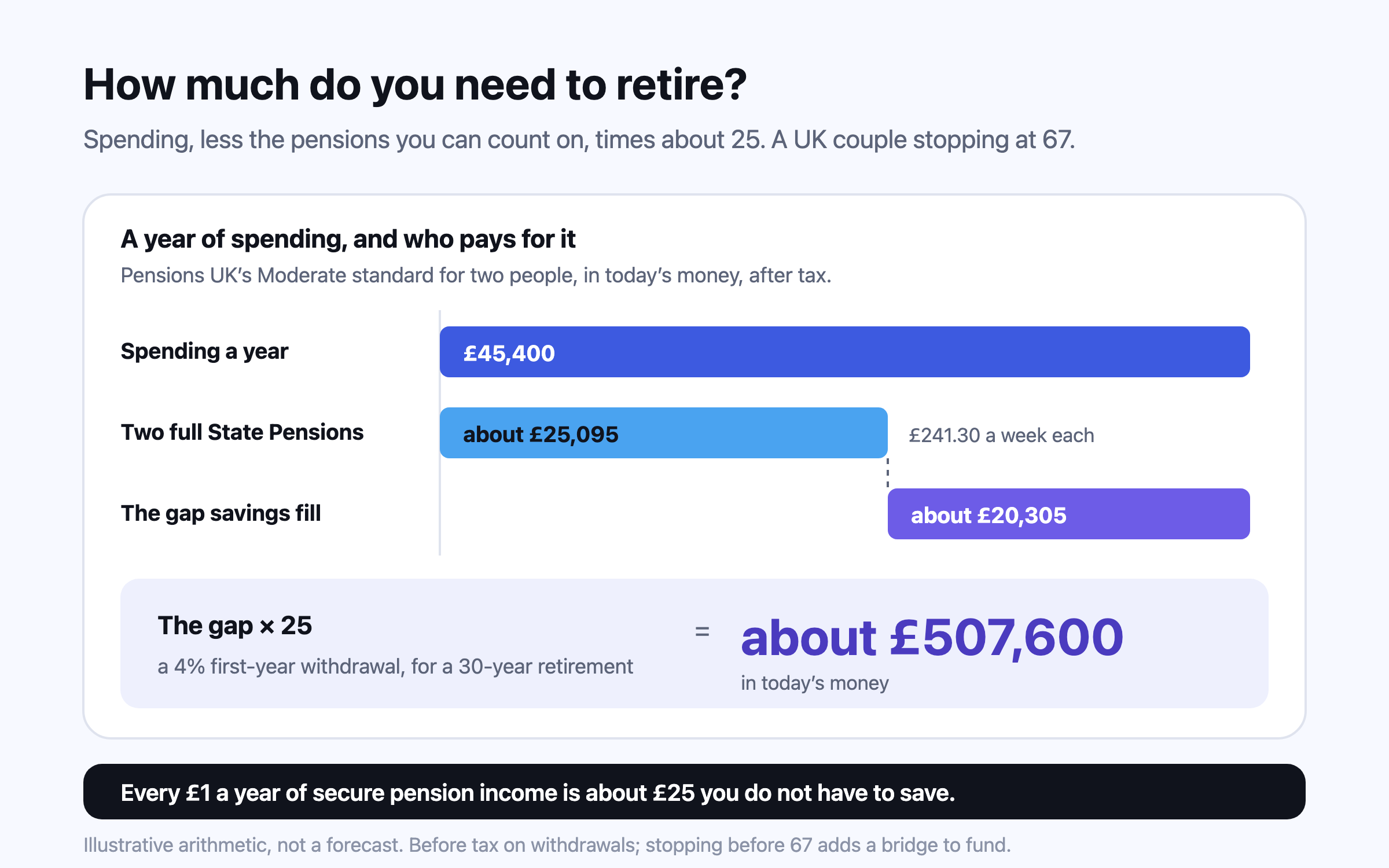
The State Pension age is 66 now and rises to 67 between 2026 and 2028: anyone born on or after 6 March 1961 reaches it at 67. A rise to 68 is legislated for 2044 to 2046, and a review launched in July 2025 is looking at that timetable again8. Deferring adds 1% for every nine weeks, just under 5.8% a year, though it takes over 15 years of the higher pension to recover a year of payments forgone35. Most employees also have a workplace pension through automatic enrolment: in most schemes a minimum of 8% of earnings between £6,240 and £50,270, of which at least 3% comes from the employer36. For a couple, two full State Pensions — about £25,095 a year — cover more than half of Pensions UK’s Moderate retirement budget of £45,400 for two, which is why the UK system works best for households near average pay37.
Australia: the Age Pension and super
Australia combines compulsory saving with a means-tested pension. Employers must pay the Super Guarantee, 12% of earnings in 2026-2738, into a superannuation fund that can generally be reached once you have stopped work after 60, the preservation age for anyone born after 30 June 196439. The Age Pension starts at 6719. From 20 September 2026 the full rate, including supplements, is A$1,237.70 a fortnight for a single person and A$933 each for a couple, A$1,866 together9 — about A$48,516 a year for a couple.
The means test is what makes Australia unusual. Payments reduce as income or assets rise, and stop altogether above the cut-off: from 20 September 2026 a homeowning couple with assessable assets above A$1,121,000 gets no Age Pension, and a homeowning single person above A$745,7509. Homeowners face lower limits than non-homeowners — A$1,388,000 for a couple who do not own their home — because the home itself is left out of the test9. For a middle-class couple that means the Age Pension often starts small or at zero and grows as super is drawn down, which is why ASFA’s comfortable-retirement savings figure is so much lower than a simple 25-times calculation (worked through here).
New Zealand: NZ Super
New Zealand Superannuation is the simplest system here: paid from 65 to every eligible resident, regardless of other income or assets. From 1 April 2026 a couple who both qualify receive NZ$44,412 a year after tax at the standard M code, and a single person living alone NZ$28,86810. The residence requirement, once 10 years since age 20, is rising step by step to 20 years by July 2042, with five of them after age 5010. KiwiSaver sits on top: the default employee and matching employer contribution rose from 3% to 3.5% on 1 April 2026 and is due to reach 4% in 202840.
Liam and Chloe, both 60, Auckland, own their home and expect to spend NZ$70,000 a year after tax. NZ Super covers NZ$44,412 of it10, leaving NZ$25,588, which at 25 times is about NZ$639,700 in KiwiSaver and other savings. Few systems do as much, as simply, for a couple who own their home.
Singapore: CPF LIFE
Singapore has no state pension in the Western sense; it has the Central Provident Fund, a compulsory savings account. For employees aged 55 and below, 37% of wages goes in — 20% from the employee and 17% from the employer — on monthly ordinary wages up to S$8,000 from 1 January 20264142. At 55 a Retirement Account is formed, and from 65 it pays a life annuity through CPF LIFE11.
CPF Board estimates on the CPF LIFE Standard Plan at a 4% interest rate. The Full Retirement Sum rises to S$228,200 for members turning 55 in 2027. 11
Retirement sum, members turning 55 in 2026
Amount set aside at 55
Estimated monthly payout from 65
Basic Retirement Sum
S$110,200
S$950
Full Retirement Sum
S$220,400
S$1,780
Enhanced Retirement Sum
S$440,800
S$3,440
The payout depends entirely on what is in the account at 55, which is why a household with spare cash at 55 may top up to the Enhanced Retirement Sum: S$440,800 buys an estimated S$3,440 a month for life11. The sums rise for each new cohort — the Full Retirement Sum was S$213,000 for members turning 55 in 2025 and is S$228,200 for 2027 — so someone 45 today will face a higher figure at 5511.
Hong Kong: the MPF
Hong Kong’s Mandatory Provident Fund requires employees and employers each to contribute 5% of relevant income between HK$7,100 and HK$30,000 a month, so the most either pays is HK$1,500 a month12. Benefits can be taken at 65, or from 60 for somebody who has stopped work for good, as a lump sum or in instalments1343. The cap matters: for a professional earning HK$60,000 a month, the mandatory HK$3,000 going in is just 5% of pay in total. The MPF was built as a floor, and a Hong Kong household on that salary has to build most of its later income itself.
India: EPF, EPS, NPS and APY
India has no universal state pension for the middle class. Salaried employees in covered firms belong to the Employees’ Provident Fund: 12% of basic wages and dearness allowance from the employee and 12% from the employer44, of which the employer’s 8.33% goes into the Employees’ Pension Scheme, on pay up to ₹25,000 a month since the wage ceiling was raised from ₹15,000 on 17 September 2026345. The EPF itself is a savings account, not a pension; the Central Board of Trustees recommended 8.25% interest for 2025-2646.
The EPS pays a monthly pension from 58 after at least ten years of service, by a simple formula: pensionable salary × pensionable service ÷ 70, with the salary capped at ₹15,000 a month for service from September 2014 and ₹6,500 before that3. Someone who reaches 58 with 20 or more years has two years added, so 33 years at the ₹15,000 cap counts as 35 and gives ₹7,500 a month. It can start from 50 at 4% less for each year before 58, or be deferred to 60 for 4% more a year, and the minimum is ₹1,000 a month3. The ceiling had not moved for twelve years when the Cabinet raised it to ₹25,000 from 17 September 2026, saying the pensionable-wage framework would better reflect current pay47; EPS contributions are now worked out on up to ₹25,000 a month45. Even so, for a professional household the EPS remains a footnote.
The National Pension System is voluntary for most private-sector workers, with tax benefits. Under the PFRDA rules amended in December 2025, a non-government subscriber exiting normally can now take up to 80% as a lump sum and must use at least 20% to buy an annuity, against 60% and 40% before; a corpus of ₹8 lakh or less can be taken whole15. The Atal Pension Yojana guarantees ₹1,000 to ₹5,000 a month from 60 but is open only to people aged 18 to 40 who are not income-tax payers14.
Tanvi and Rohit, both 35, Bengaluru, each earn well above the wage ceiling and started work at 24, in 2015. If both stay in EPS-covered jobs until 58, each will have 34 years of service plus the two-year bonus, 36 in all. Had the ₹15,000 cap stayed, the formula would give each about ₹7,714 a month (₹15,000 × 36 ÷ 70); their service from September 2026 counts against the new ₹25,000 ceiling, and even if every year counted at that cap the most it could give is about ₹12,857 (₹25,000 × 36 ÷ 70)345. Together that is between about ₹1.85 lakh and ₹3.09 lakh a year, in rupees of the late 2040s rather than today’s. They expect to spend ₹18 lakh a year in today’s money once they stop, so the EPS would cover between about a tenth and a sixth of it before inflation, and less after it. Their EPF, NPS and other investments carry the rest — which is why, for Indian households, how much you need is mostly a savings question.
Japan: the national and employees’ pensions
Japan has two tiers. Everyone aged 20 to 59 is in the national pension, and the full basic pension needs 40 years of contributions: for fiscal 2026 it is ¥70,608 a month1648. Ten years are needed to qualify at all48. Employees add the earnings-related kōsei nenkin. The government’s model household — one partner earning the average ¥455,000 a month including bonuses for 40 years, plus two basic pensions — receives ¥237,279 a month in fiscal 202616. Benefits rose 1.9% for the basic pension and 2.0% for the earnings-related part this year16.
Japan offers the widest claiming window here. Starting before 65 cuts the pension by 0.4% a month, up to 24% at 60, for people born on or after 2 April 1962; deferring adds 0.7% a month, up to 84% at 751749. The Tanakas, 63 and 62, Osaka, match the model household and spend ¥330,000 a month, ¥3,960,000 a year. The model pension covers ¥2,847,348 of it16, leaving ¥1,112,652, about ¥27.8 million at 25 times. Deferring both pensions to 70 would raise them by 42% for life49, at the cost of funding five years entirely from savings.
Germany: a euro-area example
Germany’s statutory pension is earnings-related and counted in points: a year at average pay earns one point, and each point was worth €42.52 a month from 1 July 2026, after a 4.24% increase18. The government’s “standard pensioner”, with 45 years at average pay, therefore receives about €1,913 a month before health and care contributions and tax. Until 2031 the law holds the pension level at 48% of average earnings, measured net of social contributions and before tax50. The normal pension age is rising from 66.2 to 6719. With voluntary occupational and private pensions the OECD’s replacement rate for an average German earner rises from 53.3% to 67.9%1.
Replacement rates side by side
Net pension replacement rates from mandatory schemes for a full career starting in 2024, OECD Pensions at a Glance 2025, for men. Women’s rates are lower on the OECD average (62.4% at average pay), in Australia (50.1%) and in India (43.3%), and the same elsewhere in this table. Singapore and Hong Kong are not covered. 1
Country
Half average pay
Average pay
Twice average pay
OECD average (men)
75.4%
63.2%
52.9%
United Kingdom
76.2%
54.2%
39.5%
Germany
57.7%
53.3%
38.8%
Australia (men)
82.7%
53.0%
38.1%
United States
62.5%
51.3%
40.0%
Canada
56.0%
45.1%
25.0%
India (men)
44.6%
44.6%
24.2%
New Zealand
67.0%
43.8%
23.7%
Japan
61.8%
42.4%
34.0%
Two patterns stand out. Every system is progressive: the share replaced falls as pay rises, most steeply in Canada, New Zealand and India, where a flat or capped pension is a small fraction of a high salary1. And voluntary saving changes the picture more than any state rule. Add workplace and personal pensions at typical contribution rates and the OECD’s figure for an average earner rises from 51.3% to 100.7% in the United States, from 45.1% to 70.6% in Canada and from 43.8% to 68.6% in New Zealand1. The countries with the lowest state replacement rates are the ones that most expect you to save.
What it means for your own saving
Get the official figure. Every system above publishes a personal statement or forecast: my Social Security, My Service Canada Account, the UK State Pension forecast, myGov, the CPF and MPF portals, the EPFO passbook, Japan’s nenkin net, the German Renteninformation. Use it rather than a national average.
Put it in today’s money and at its real start age. A pension that starts at 67 does nothing for the years before it, and stopping work early can mean fewer qualifying years.
Decide the claiming age deliberately. In the US, Canada, the UK and Japan, waiting raises the pension for life; the cost is funding the wait from savings.
Count only what you can rely on. Treat means-tested amounts, such as Australia’s Age Pension or Canada’s OAS for a high earner, as uncertain until you have run the test.
The households above share one lesson. Jess in Toronto, Tanvi and Rohit in Bengaluru and the Tanakas in Osaka all find the state covers a floor and not their lifestyle, while Liam and Chloe in Auckland find it covers most of a modest one. Where you sit depends less on the country than on how far your spending is above that country’s average, and on whether your later life is in the same country as your contribution record. Catching up on retirement savings covers what to do if the gap looks large.
Putting your pension into your plan
Questions people ask
Which country has the best state pension?
It depends on what you earn. For an average earner, mandatory pensions replace 63.2% of net pay across the OECD, against 51.3% in the US and 54.2% in the UK; for someone on twice average pay, Canada’s system replaces only 25.0%1.
Should I claim Social Security at 62 or 70?
Claiming at 62 cuts a benefit by 30% for life for anyone born in 1960 or later, and waiting from 67 to 70 adds 8% a year242. Research for the NBER found delay pays for many people at low real interest rates, especially the higher earner in a couple25.
How much is the UK State Pension in 2026?
The full new State Pension is £241.30 a week for 2026-27, and needs 35 qualifying years for anyone whose National Insurance record started after April 2016; 10 years are needed to get anything734.
What is the maximum CPP and OAS in 2026?
The maximum CPP at 65 is C$1,507.65 a month for a pension starting in January 2026; OAS pays up to C$762.50 a month at 65 to 74 for October to December 2026, with recovery tax above C$95,323 of 2026 income5632.
How much does CPF LIFE pay?
For members turning 55 in 2026, setting aside the Full Retirement Sum of S$220,400 gives an estimated S$1,780 a month from 65 on the Standard Plan; the Enhanced Retirement Sum of S$440,800 gives about S$3,44011.
How is the EPS pension calculated?
Pensionable salary × pensionable service ÷ 70. Pensionable salary was capped at ₹15,000 a month (₹6,500 for service before September 2014), and EPS contributions have been worked out on up to ₹25,000 since 17 September 2026. Two years are added for anyone reaching 58 with 20 or more years, so 33 years at the ₹15,000 cap gives ₹7,500 a month from 58345.
Is buying an annuity compulsory under NPS?
For non-government subscribers exiting normally, at least 20% of the corpus must buy an annuity since the December 2025 amendments, down from 40%; a corpus of ₹8 lakh or less can be withdrawn in full15.
Can I get my state pension if I move abroad?
Often, but not always in full. Rules differ by country and by treaty; some pensions are paid abroad without yearly increases and residence-based ones can stop. Check the paying country’s rules before you plan on it51.
Start from what you will spend, not from what you earn. Subtract the state and workplace pensions you can rely on, and multiply what is left by about 25 for a 30-year retirement, or by closer to 30 for a 40-year one. Real spending has tended to drift down about 1% a year through retirement while healthcare rises, and a 65-year-old today can expect to live another 15 to 25 years depending on country and sex — so plan for the long end.
Most households in their late forties have less put by than the rules of thumb say, and in the US fewer than two in three families aged 45–54 hold a retirement account at all. Fifteen or twenty years is still long enough to change the result, but not through returns: the levers that work are a much higher saving rate, using the catch-up and carry-forward rules each country offers, working a few more years, and claiming the state pension later.
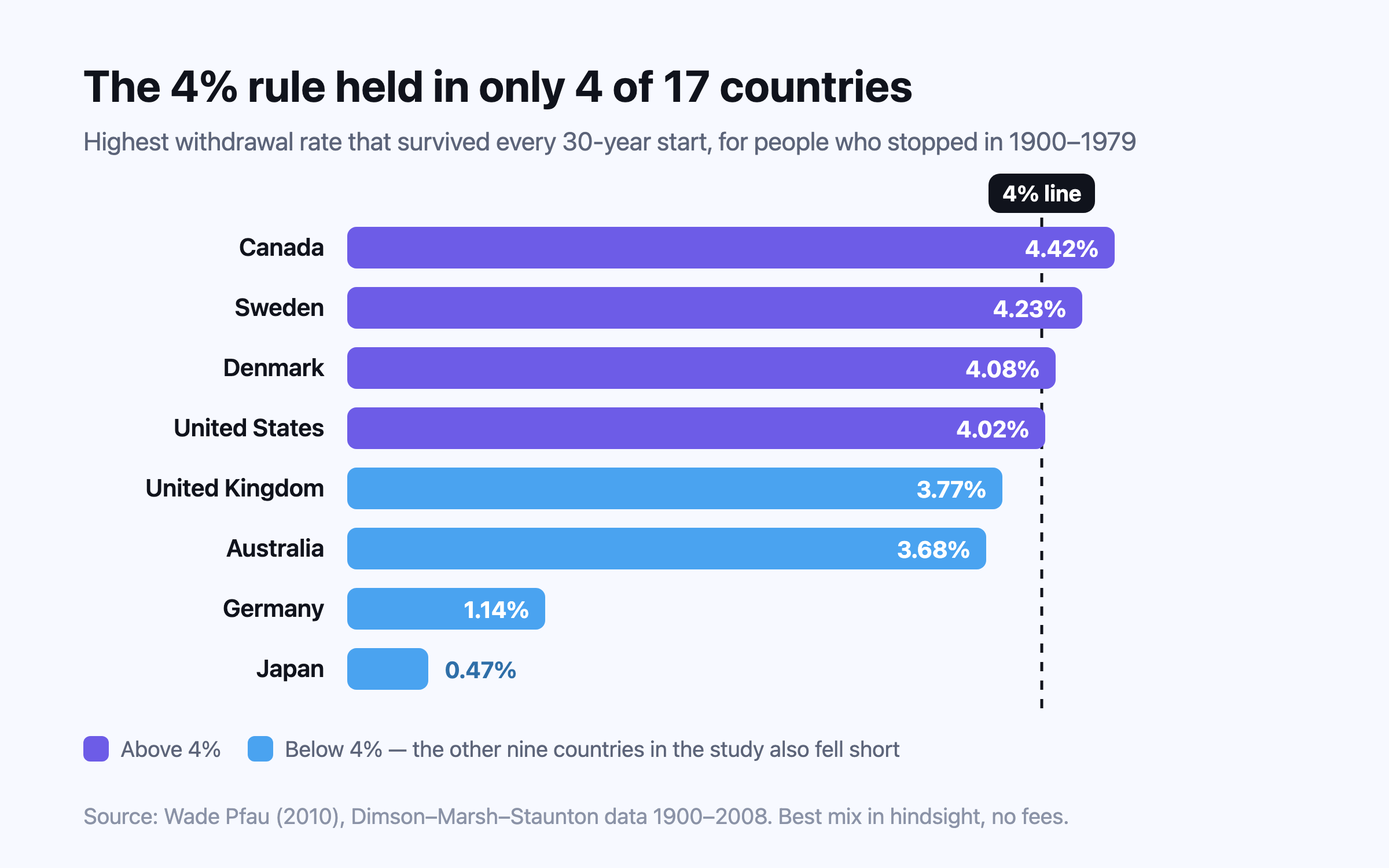
The 4% rule says a first-year withdrawal of 4% of savings, raised with inflation each year, lasted at least 30 years in US market history. Tested across 17 countries it held in only four, and longer horizons need lower rates — so treat it as a starting point to test against your own spending, country and timeline.
This is general information, not financial, tax or legal advice for your circumstances. Rules and figures change; check the official source for your country, and consult a licensed professional before making financial decisions. Projections are estimates, not predictions.