Starting late is common. At 45 or 50, the saving rate, a few more working years and a later pension claim matter more than returns.
Most households in their late forties have less put by than the rules of thumb say, and in the US fewer than two in three families aged 45–54 hold a retirement account at all. Fifteen or twenty years is still long enough to change the result, but not through returns: the levers that work are a much higher saving rate, using the catch-up and carry-forward rules each country offers, working a few more years, and claiming the state pension later.
Nivritee Research · 6 October 2026 · 12 min read
The short answer: if you are 45 or 50 with little saved, you are in large company, and you still have time to change the outcome — but the tools are different from a 30-year-old’s. Compounding has less time to do the work, so the result now depends mostly on how much you put in, how long you keep working, and when you claim the state pension. In the US, 62.2% of families whose head is aged 45–54 had a retirement account in 2022, so more than a third had none at all1. A study published by the National Bureau of Economic Research found that working three to six months longer improves the retirement standard of living as much as saving an extra one percentage point of earnings for 30 years2. That is the arithmetic of a late start: years and contributions are the levers; returns are not.
UK working-age people undersaving for retirement, on DWP’s measure
How common a late start really is
The Federal Reserve’s Survey of Consumer Finances is the most detailed picture of American balance sheets, and its 2022 round is still the latest; the Fed’s own index page says so6. Across all families, 54.3% held a retirement account, and among those who did the median balance was $86,9007. By age, the median for account-holding families with a head aged 45–54 was $115,000, and $185,000 for 55–641. Those are the middle of the households that have an account at all; the families without one are not in the median.
Britain looks similar once pensions are measured properly. In the Office for National Statistics’ Wealth and Assets Survey for April 2020 to March 2022, 79% of people aged 45–54 had some private pension wealth, and the median for those who did was £80,000; for women in that band the median was £57,900, against £108,100 for men3. The Department for Work and Pensions estimated in 2023 that 38% of working-age people, about 12.5 million, were undersaving against target replacement rates, and 51% against the Pensions and Lifetime Savings Association’s “Moderate” living standard5.
Each country measures something different: the US counts families and accounts, Great Britain counts individuals and pension wealth of every kind, Australia counts tax-file holders with a super balance, and Singapore counts CPF members against a fixed sum. Read each row against its own definition, not against the others. 1389
Country
What was measured
Age band
Figure
United States
Families holding a retirement account
45–54
62.2%
United States
Median balance, families that hold one
45–54
$115,000
United States
Median balance, families that hold one
55–64
$185,000
Great Britain
People with any private pension wealth
45–54
79%
Great Britain
Median private pension wealth, holders
45–54
£80,000
Australia
Median super balance, men / women (accounts above zero)
50–54
A$192,196 / A$134,309
Singapore
Active CPF members turning 55 in 2021 without the Basic Retirement Sum set aside
55
about 33%
Australia’s compulsory superannuation means few people have nothing, but balances are lower than many expect: in the 2023–24 tax statistics the median super balance for men aged 45–49 was A$154,751 and for women A$110,8648. Singapore’s CPF works the same way, and the gap is narrowing: about 33% of active members turning 55 in 2021 had not set aside that cohort’s Basic Retirement Sum, down from 40% in 2017, and the Ministry of Manpower expected eight in ten of those turning 55 in 2027 to reach at least the basic payout910.
India has no comparable survey of retirement balances by age, and nothing here substitutes one. What is clear from the structure is that the employees’ provident fund covers formal salaried work, so a household that spent its thirties self-employed, abroad or in a startup paid in stock can reach 45 with a thin EPF account and a home loan. For how household wealth by age compares across the markets that do publish it, see what households of your age hold, in 11 countries.
Why returns cannot rescue a late start
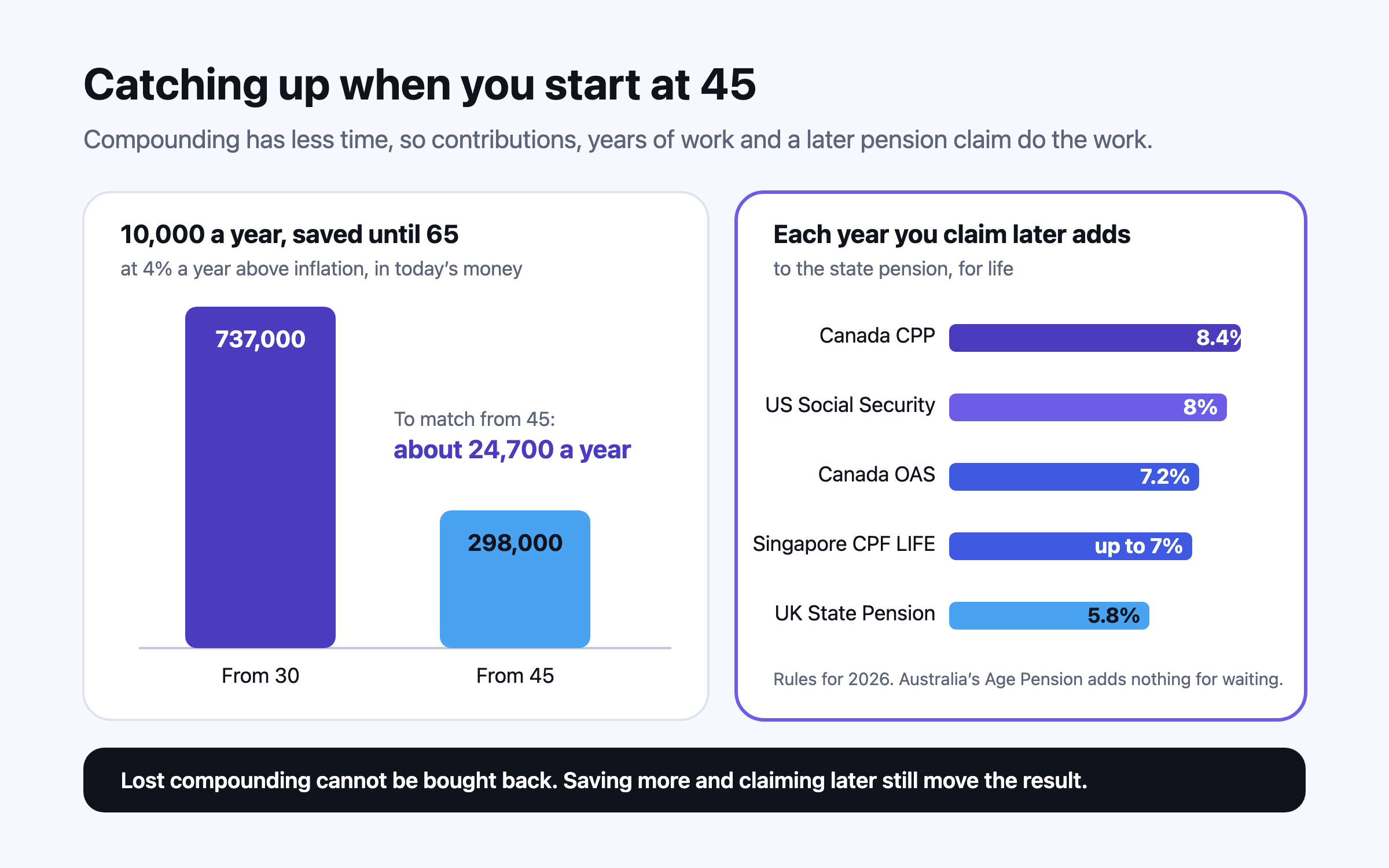
Start with the uncomfortable sum. At an illustrative 4% a year above inflation, 10,000 a year saved from 30 to 65 grows to about 736,522 in today’s money; the same 10,000 a year from 45 grows to about 297,781. To reach the early starter’s figure from 45, the late starter has to put away about 24,734 a year, roughly two and a half times as much11. The currency does not matter; the ratio does.
The tempting answer is to chase a higher return, and that is where late starters get hurt. A portfolio that has 15 years to run has less time to recover from a bad decade, and the years just before and after you stop are when a fall does the most damage, because withdrawals lock losses in. That risk is set out in sequence of returns risk, and what the evidence says about how much to hold in shares at each age is in asset allocation by age. The honest summary: a sensible equity share still matters at 50, but taking extra risk to make up for lost time is a bet, not a plan.
Morgan Housel’s argument in *The Psychology of Money* is that every plan needs room for error, because reality rarely follows the forecast12. A late start uses up some of that room before you begin. That is the reason the levers below are all things you control rather than things the market does.
The levers that move the result, in order
1. The saving rate
In your forties and fifties the saving rate does almost all the work, and it often has room to rise: children leave, childcare stops, a mortgage is paid down or off. The most reliable way to raise it is to send the increase straight to a pension or retirement account before it reaches the current account, which is what the research on defaults and pre-commitment shows (how to save more). The catch-up and carry-forward rules in the next section exist to let people do exactly this with tax relief, and the US version is aimed squarely at people over 5013.
2. A few more years of work
Working longer does three things at once: more years of contributions, more years of growth, and fewer years the money has to last. Gila Bronshtein, Jason Scott, John Shoven and Sita Slavov modelled US workers and found that delaying retirement by three to six months had the same effect on the retirement standard of living as saving an extra one percentage point of earnings for 30 years2. Part of that effect comes from Social Security: the model has people claim it when they stop work, so working longer also means a larger pension. For somebody who started saving at 45, that trade is the best on offer.
The caveat is that working longer is a plan you may not be allowed to keep. In the 2026 Retirement Confidence Survey, 46% of US retirees said they left the workforce earlier than planned; 41% of those cited a health problem or disability and 35% changes at their company. Workers expect to retire at a median age of 65; retirees report that they did so at a median of 624. Count the extra years as a margin, not as the foundation.
3. Claiming the state pension later
Where a state pension rises for every year you wait, deferring it is one of the cheapest ways to buy income that lasts for life and rises with prices. The table sets out the rules as each government publishes them for 2026.
Increases are on the pension you would otherwise have received at the standard age. Claiming early works the other way: US benefits are cut 30% at 62 for somebody whose full retirement age is 67, and CPP is cut 36% at 60. Australia’s Age Pension is means-tested and pays no increase for waiting; India has no universal state pension. 1415161718192021
Pension
Standard age
Each year you wait adds
Most it can add
US Social Security
67 if born 1960 or later
8% (two-thirds of 1% a month)
24%, at 70
UK new State Pension
66, rising to 67 from 2026 to 2028
just under 5.8% (1% per 9 weeks)
no fixed cap
Canada Pension Plan
65
8.4% (0.7% a month)
42%, at 70
Canada Old Age Security
65
7.2% (0.6% a month)
36%, at 70
Singapore CPF LIFE
65
up to 7%
up to 35%, at 70
Deferring is not free: you live on savings, or keep working, during the years you wait, and a household in poor health may collect less in total. But for a couple where one partner is likely to live long, the larger pension is the closest thing to insurance against running out that any government sells, and a late starter is exactly the household that needs it. For what each country’s state pension pays, see state pensions compared22.
4. A smaller spending need
Cutting what the household spends works twice: it frees money to save now and it shrinks the sum you need later. A household that trims 6,000 a year and saves the difference for 15 years at 4% above inflation builds about 120,142; and if its savings were to be drawn at 3.5% a year, the same 6,000 less spending lowers the target by about 171,42923. The second effect is usually the larger, and it is the one people forget. What a smaller spending need really costs in daily life is the subject of lifestyle inflation and enough.
5. The house
For many households in their fifties the home is the largest asset, and moving to a smaller or cheaper one is the one catch-up lever that releases a lump sum. It is also the least reversible, and costs of moving, stamp duty and the emotional cost of leaving are real. Treat downsizing as a decision to model, not as the plan by default, and keep the home out of the figure your income must come from until you have actually decided to sell.
Catch-up and carry-forward rules for 2026
Most systems let older savers put in more than the standard limit, or use allowances they did not use in earlier years. The details differ sharply, and getting them right is worth real money. A common misunderstanding: the US limits do not carry forward, so a year not used is gone, while the UK, Canada and Australia let unused room accumulate242526.
Limits as published by each tax authority or scheme for 2026 or the 2026–27 tax year. Canadian figures in Canadian dollars. Rules have conditions this table cannot hold — check your own room on your tax statement or with the scheme before contributing. 1327282429303125263233343536
Country
Standard yearly limit (2026)
Extra for older savers or unused room
Worth knowing
US 401(k), 403(b), 457
$24,500
+$8,000 at 50 or over; +$11,250 instead at ages 60–63
From 2026, catch-ups by people whose prior-year wages exceeded $150,000 must go in as Roth
US IRA
$7,500
+$1,100 at 50 or over
No carry-forward of unused years
UK pensions
£60,000 annual allowance, and no more than 100% of earnings for relief
Unused allowance from the previous 3 tax years
Taper from adjusted income above £260,000, to a £10,000 floor; £10,000 limit once a pension is flexibly accessed
Canada RRSP
18% of last year’s earned income, up to $33,810
Unused room carries forward
TFSA: $7,000 for 2026
Australia super
Concessional cap A$32,500 from 1 July 2026 (A$30,000 before)
Unused concessional cap from up to 5 years, if total super balance was under A$500,000
Non-concessional cap A$130,000 for 2026–27; employer guarantee 12%
Singapore CPF
Tax relief for cash top-ups: S$8,000 for yourself
+S$8,000 for top-ups to family members
Matched Retirement Savings Scheme: up to S$2,000 a year matched, from 55, for lower incomes
India NPS
₹50,000 extra deduction (old tax regime)
Employer contributions deductible up to 14% of salary under the new regime
Open to citizens aged 18 to 85
United States. The IRS raised the 2026 401(k) limit to $24,500 and the age-50 catch-up to $8,000; under SECURE 2.0, people aged 60 to 63 get a larger catch-up of $11,250 instead13. The Roth requirement for higher earners applies to 2026 contributions under a good-faith reading, with the final regulations binding from 202727.
United Kingdom. Carry forward lets somebody with high earnings in one year, or a lump sum, contribute more than £60,000, provided they were a member of a registered scheme in the earlier years and earn at least as much as they pay in2437.
Canada. Room you never used since you started filing is still there; the figure is on your notice of assessment. Using it in a high-income year buys the deduction at a higher marginal rate25.
Australia. The five-year carry-forward was designed for people with broken work histories — often women returning from caring — and only works while the total super balance is under A$500,00026.
Singapore. Cash top-ups to your own or a family member’s CPF account earn tax relief up to S$8,000 each, and the money earns CPF interest and raises CPF LIFE payouts33.
India. Since PFRDA’s December 2025 amendments, a non-government NPS subscriber can stay invested to 85 and, at a normal exit, must annuitise at least 20% of the corpus rather than 40%38.
Six households, worked through
The figures below are illustrative arithmetic, not forecasts. Each grows money at 4% a year above inflation, so every result is in today’s money; contributions go in at the end of each year, and nothing is taxed or charged. Real returns could be higher or lower, and fees reduce them (what fees cost over 30 years)11.
Jen, 50, Columbus, Ohio
Jen is an operations manager on $135,000 with $140,000 in her 401(k), deferring $9,000 a year. Her children have left home. If she carries on as she is, her account is projected at about $432,344 at 65. If she defers the 2026 limit plus the age-50 catch-up, $32,500 a year, and the larger $35,750 from 60 to 63, it is projected at about $917,252 — more than double13. Her prior-year wages are under $150,000, so her catch-up can still go in pre-tax39.
Two more decisions move her further. Working to 67 instead of 65 lifts the projected balance to about $1,058,399. And if her Social Security estimate is $2,800 a month at her full retirement age of 67, claiming at 62 would cut it to $1,960, while waiting to 70 would raise it to $3,472, before cost-of-living increases1615.
Hannah, 48, Manchester
Hannah is a logistics project manager on £68,000 with £45,000 in her workplace pension, and she has inherited £40,000 from her mother. She pays £24,000 into a personal pension; her provider claims 20% basic-rate relief, making a £30,000 gross contribution, well inside the £60,000 annual allowance3728. Because £17,730 of her income is taxed at 40%, she can reclaim another 20% on that amount through Self Assessment, £3,546. The £30,000 in her pension has cost her £20,45440.
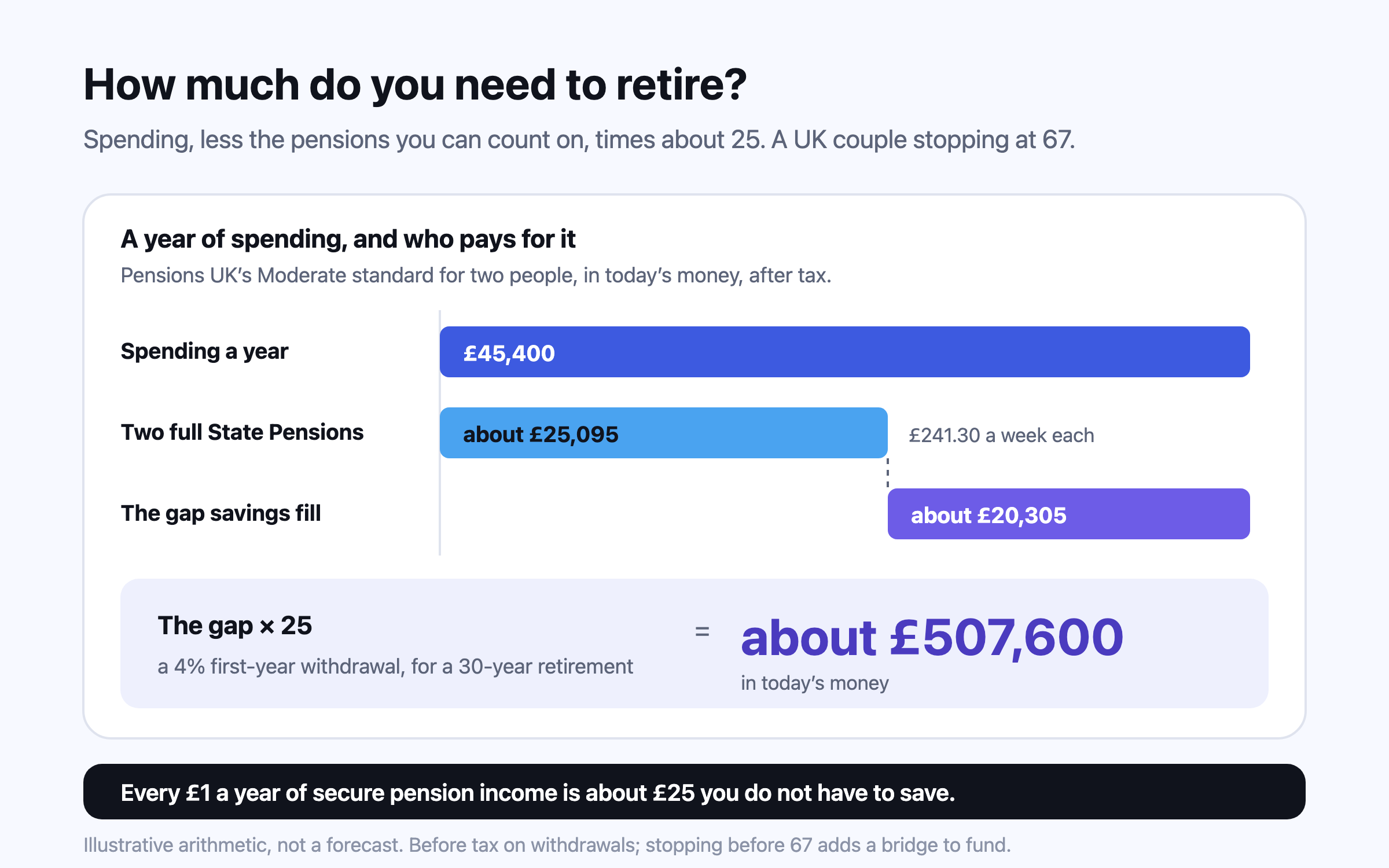
Left to grow at 4% above inflation until she is 67, that one contribution is projected at about £63,205 in today’s money. Her State Pension at the 2026–27 full rate of £241.30 a week is £12,547.60 a year; deferring it one year adds just under 5.8%, which GOV.UK puts at £13.99 a week, about £727 a year, for life2217.
Nisha, 45, Mississauga
Nisha earns C$110,000 with no workplace pension and C$38,000 in her RRSP. Her notice of assessment shows unused room carried forward, and her new room for 2026 is 18% of last year’s earned income, C$19,800, below the C$33,810 ceiling3125. Saving C$20,000 a year until 65 is projected to give about C$678,824, against about C$261,931 if she stayed at C$6,000 a year.
Her Canada Pension Plan estimate is C$1,100 a month at 65. Starting it at 60 would cut that to C$704; waiting to 70 would raise it to C$1,562, and Old Age Security would rise by up to 36% on the same delay1920.
Mel, 47, Brisbane
Mel is a nurse on A$105,000. Her employer pays the 12% super guarantee, A$12,600, all of which counts towards the concessional cap of A$32,500 from 1 July 20263226. That leaves A$19,900 she can salary-sacrifice this year, and because her balance is under A$500,000, any cap she left unused in the previous five years can be added on top26. Her super cannot be touched before her preservation age of 60, which is the point: money put in at 47 is out of reach for 13 years41.
Jia Hao Ming, 44, Tampines
Jia Hao Ming tops up his own CPF retirement savings with S$8,000 in cash and his mother’s with another S$8,000, taking S$16,000 off his assessable income for the year33. When he turns 65 he can defer CPF LIFE; each year of deferral raises the payout by up to 7%, to as much as 35% more at 7021. For reference, members turning 55 in 2026 face a Full Retirement Sum of S$220,400 and an Enhanced Retirement Sum of S$440,800; his own cohort’s sums have not yet been set42.
Rohan and Neha, 42 and 40, Pune
Rohan and Neha have ₹3.2 lakh a month of take-home pay, ₹22 lakh in EPF between them and a home loan, and nothing else invested: their thirties went on a startup that did not survive. They start a ₹50,000 monthly SIP. At 4% a year above inflation for the 18 years until Rohan is 60, it is projected at about ₹1.57 crore in today’s money, and their existing EPF alone, without further contributions, at about ₹44.6 lakh11. Rohan also asks his employer to route part of his pay into NPS: on a basic salary of ₹1.5 lakh a month, the new-regime limit of 14% is ₹21,000 a month that is deductible35.
What cannot be fixed, and what to do about it
Some of a late start is permanent. The compounding that 15 missing years would have done is gone, and no contribution limit is large enough to replace it for most incomes. The aim changes accordingly: not the lifestyle a 30-year-old saver might have planned, but a dependable floor of income, a smaller gap to fill from savings, and as much flexibility as possible about when to stop.
A partial stop is still a stop. Two or three days a week of paid work at 62 to 67 does the same job as several hundred thousand of extra savings, and it keeps the option of working longer if markets are unkind.
Guaranteed income is worth more to a late starter. A larger deferred state pension, or a lifetime annuity bought with part of the pot, removes the risk that the household outlives its money21.
Debt has to be gone before work stops. A mortgage that runs into the late sixties is a fixed outflow drawn from a smaller pot; see pay off debt or invest.
Protect the plan from a shock. For a household with 15 years to go, two years without income can do more damage than a market fall; an emergency fund and the right insurance come before chasing returns4.
The reassuring finding in the data is how many people are in the same place. In the 2026 Retirement Confidence Survey, 63% of US workers aged 45–54 said they or their spouse had saved for retirement, and 20% of that age group reported under $1,000 in savings and investments, not counting their home43. A plan that starts at 45 is not unusual, and the households that do best from here are the ones that write down a number, a saving rate and a date, and then check them every year.
How Nivritee helps
Questions people ask
Is it too late to start saving for retirement at 45?
No. Twenty years is long enough to build a meaningful sum, but it takes a higher saving rate: at 4% above inflation, matching what 10,000 a year from 30 would have built takes about 24,700 a year from 4511. Working a little longer and claiming the state pension later do much of the rest.
What is the 401(k) catch-up contribution limit for 2026?
The standard limit is $24,500, and people aged 50 or over can add $8,000. Under SECURE 2.0, those aged 60 to 63 can add $11,250 instead13.
Can I pay more than £60,000 into my pension in one year?
Yes, if you have unused annual allowance from the previous three tax years and you were a member of a registered pension scheme in those years. Tax relief is still limited to 100% of your earnings for the year2437.
Do unused RRSP contributions carry forward?
Yes. Unused RRSP deduction room carries forward to later years, and new room each year is 18% of the previous year’s earned income up to the annual limit, which is $33,810 for 20263125.
Can I catch up on super contributions in Australia?
If your total super balance was under A$500,000 on the previous 30 June, you can use concessional cap you did not use in up to five earlier years. The concessional cap itself is A$32,500 from 1 July 202626.
Is it worth delaying Social Security or the State Pension?
Each year of delay adds 8% to US Social Security up to 70 and just under 5.8% to the UK State Pension1517. It is usually worth it for a household in good health with other savings to live on meanwhile, and least worth it for somebody in poor health.
Should I take more investment risk to catch up?
Usually not more than your age and horizon justify. With 15 years to go, a large fall shortly before you stop does more damage than at 35, and the reliable levers — saving more, working longer, claiming later — carry no market risk2.
How much should I have saved by 50?
There is no single right figure, but the medians give a reference: US families aged 45–54 who held a retirement account had a median of $115,000 in 2022, and people in Great Britain aged 45–54 with a private pension had a median of £80,000 in 2020–2213. What matters more is whether your own savings meet your own spending.
Start from what you will spend, not from what you earn. Subtract the state and workplace pensions you can rely on, and multiply what is left by about 25 for a 30-year retirement, or by closer to 30 for a 40-year one. Real spending has tended to drift down about 1% a year through retirement while healthcare rises, and a 65-year-old today can expect to live another 15 to 25 years depending on country and sex — so plan for the long end.
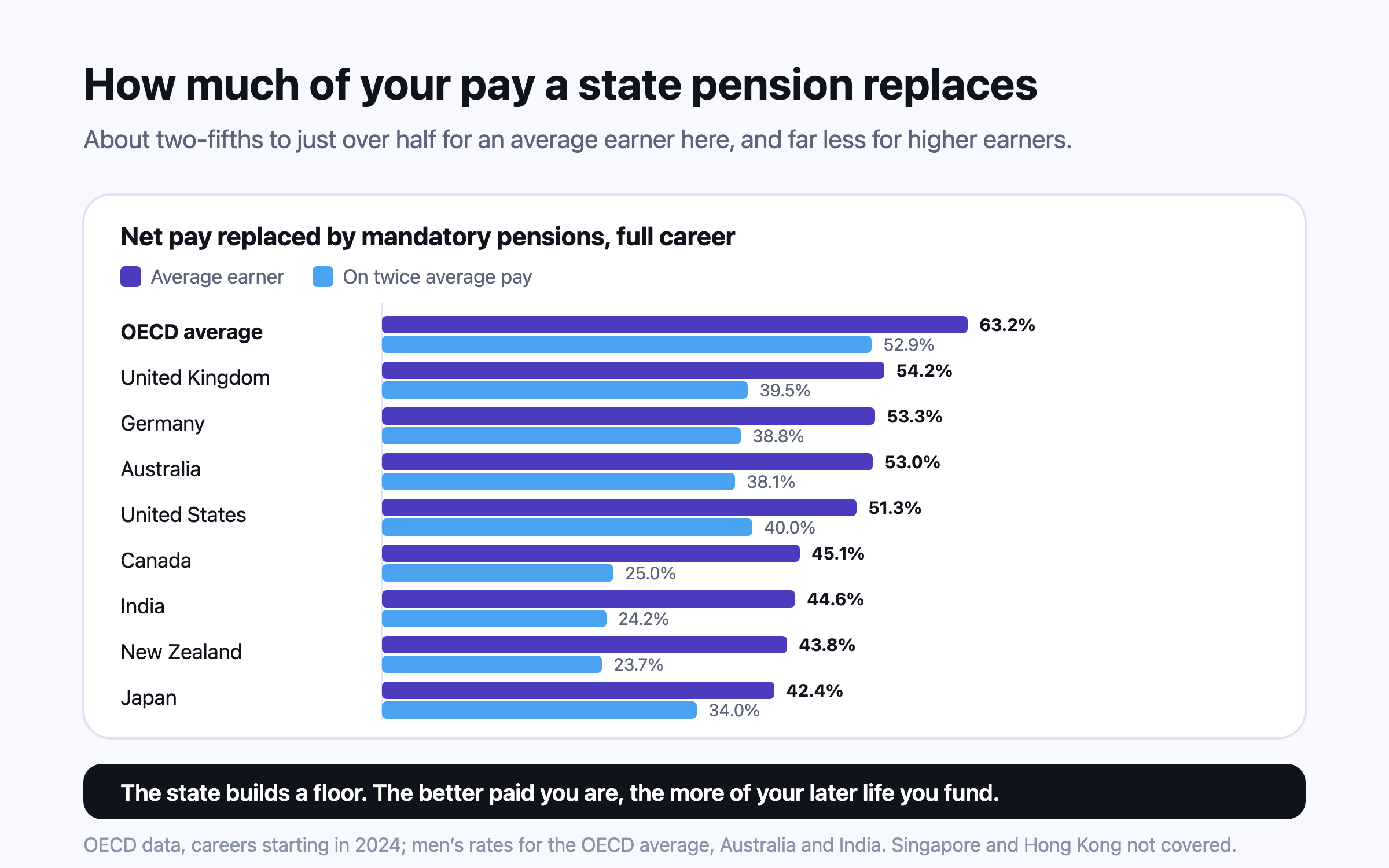
For a man on average pay, mandatory pensions replace 63.2% of net earnings on the OECD average, but around half in the US, UK, Australia and Germany and less in Canada, New Zealand, Japan and India. At twice average pay the share falls further, and Singapore, Hong Kong and India rely mostly on the worker’s own account. Here is what each system pays in 2026, how claiming age changes it, and what it leaves a middle-class household to save.
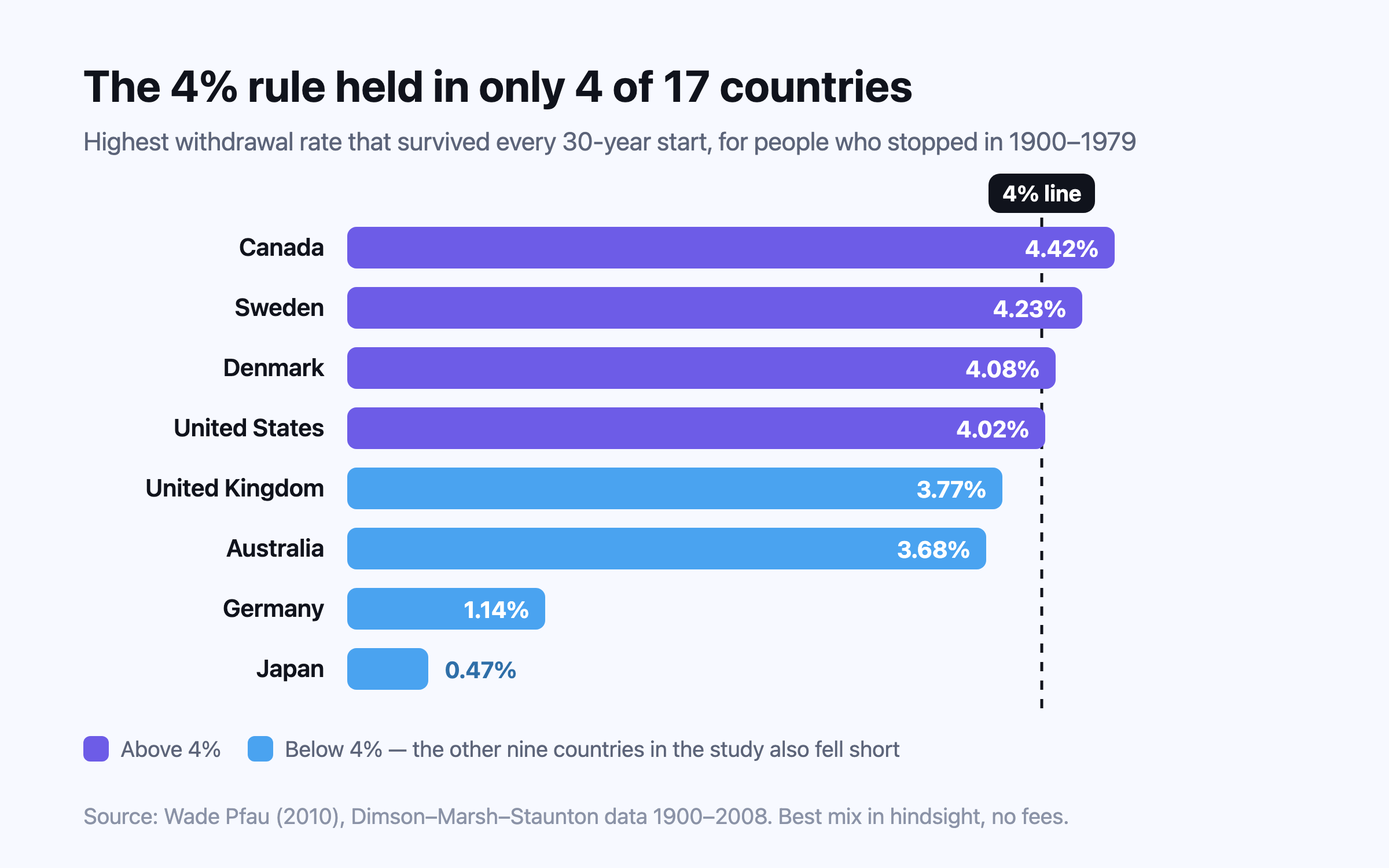
The 4% rule says a first-year withdrawal of 4% of savings, raised with inflation each year, lasted at least 30 years in US market history. Tested across 17 countries it held in only four, and longer horizons need lower rates — so treat it as a starting point to test against your own spending, country and timeline.
This is general information, not financial, tax or legal advice for your circumstances. Rules and figures change; check the official source for your country, and consult a licensed professional before making financial decisions. Projections are estimates, not predictions.