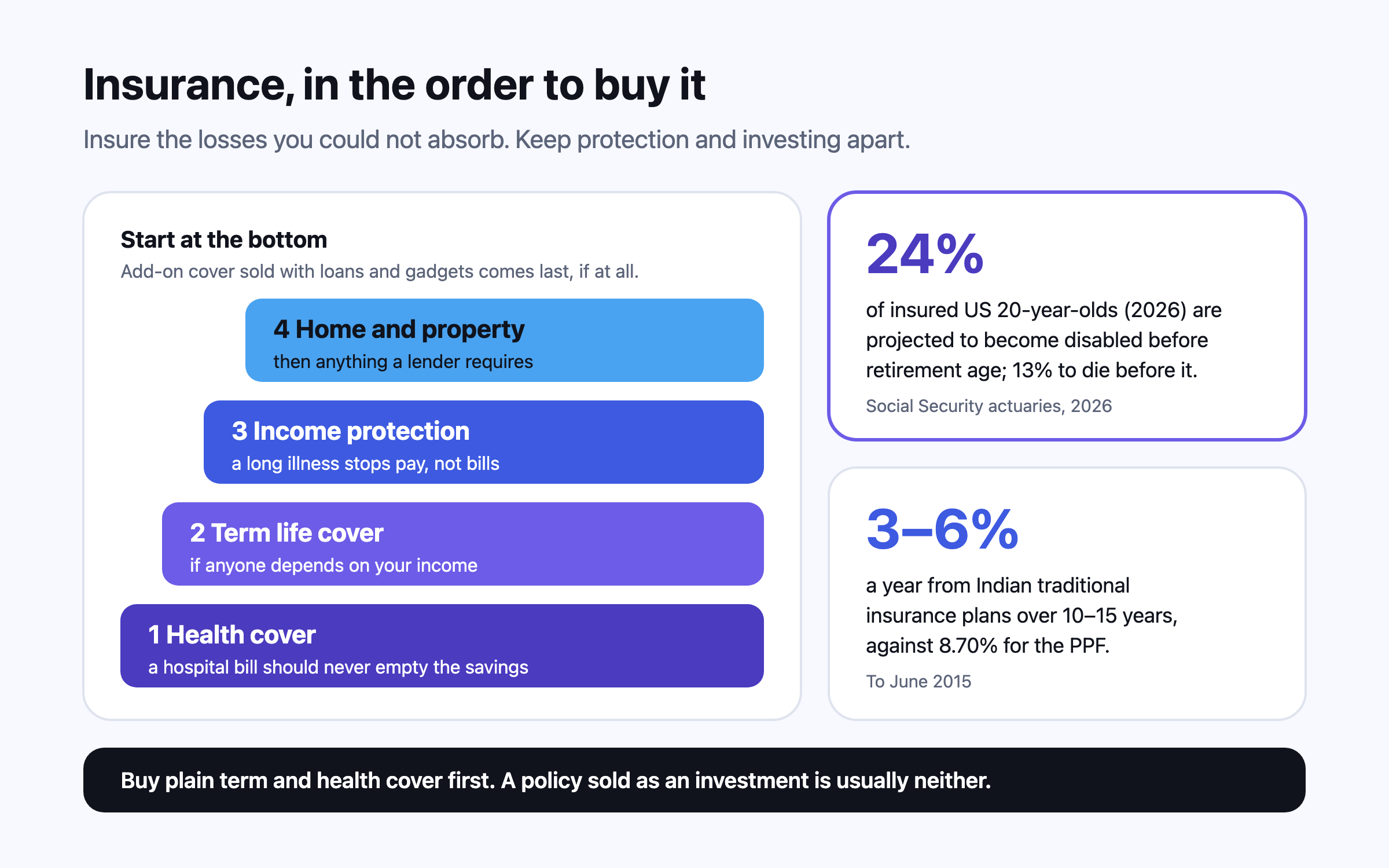
Insure the losses you could not absorb: health first, then life cover if anyone depends on you, then your income. Keep insurance and investing apart.
Insurance is for losses a household could not pay for itself: a large medical bill, the death of an earner somebody depends on, or years without income after an illness. Buy cover for those first, in that order, as plain term and health policies; size life cover to what dependants would need rather than to a multiple of salary; and be wary of policies that mix insurance with investment, which in India have returned 3–6% a year over 10 to 15 years.
Nivritee Research · 6 October 2026 · 12 min read
The short answer: insure the things that would ruin you, not the things that would merely annoy you. For most households that means, in order: health cover, so a hospital stay cannot wipe out savings; term life cover, if a partner, children or parents depend on your income; and protection for the income itself, because a long illness is more likely than an early death. Property and everything else comes after. The US Social Security actuaries project that 24% of insured workers reaching 20 in 2026 will become disabled before their normal retirement age, against 13% who will die before it1. It is common to insure the second risk and leave the first uninsured.
Yearly return of Indian traditional insurance plans over 10–15 years, to June 2015
The order: insure what you could not absorb
Insurance is a bad bet on average and a good one at the edges. Premiums have to cover claims, the insurer’s costs and its profit, so the household pays more than it expects to get back; what it buys is protection against an outcome so large it would change the family’s life. That is why a phone or an extended warranty is poor value and hospital cover is not. The ordering below follows from that test, and it is the same in every country even though the products differ.
Health cover. A serious illness or accident is among the likeliest large bills a family faces, and in systems without universal public care it can exceed every other asset.
Term life cover, if anyone depends on you. A partner, children, or parents who rely on your income. With no dependants and no shared debts, you may need little or none4.
Income protection or disability cover. A long illness stops income without stopping costs, and it is more likely than death before retirement age1.
Home and contents, and any cover a lender requires.
Everything else is optional, and often poor value: add-on cover sold with a loan, a phone or a flight.
The Australian regulator’s consumer site puts the second step plainly: if nobody depends on you financially, you may not need life cover, but consider cover for being sick or injured instead4. Insurance comes after a small emergency fund and alongside paying down costly debt, not after investing; the order is set out in pay off debt or invest, and how large the cash buffer should be in how big an emergency fund should be.
Term life, whole life, endowments and ULIPs
A term policy pays a sum if you die within a fixed period and nothing if you do not. Because most policyholders outlive the term, it is cheap for the cover it buys. Whole life, endowment, money-back and unit-linked plans (ULIPs in India) add a savings or investment element, so they pay out in more circumstances — and cost many times more for the same amount of cover. The common objection to term, that the premiums are wasted if you survive, misunderstands what was bought: a household that pays for fire cover and does not have a fire has not wasted its money.
The evidence on returns from bundled plans is poor. In a 2016 working paper on products Indian banks sell as tax savers, Monika Halan and Renuka Sane put the yearly return on traditional insurance plans at 3–6% over 10 and 15 years to June 2015, and negative over five, against 8.70% for the Public Provident Fund over 15 years; the insurance figures are their estimates from Morningstar data and industry sources3. They also worked out that a distributor selling a 15-year traditional plan could collect up to 26% of the policy’s lifetime commission in its first year, against about 1% for a mutual fund distributor, which goes a long way to explaining how these plans are sold3. In an earlier estimate, Susan Thomas, Renuka Sane and Monika Halan put the loss to Indian investors from unit-linked policies (ULIPs) at about ₹1.5 trillion between 2004-05 and 2009-10, mostly through policies that lapsed early5.
Early exit is where the money goes. Indian life insurers paid out ₹2.33 lakh crore on surrenders and withdrawals in 2024-252. For policies sold from October 2024, the regulator requires a special surrender value once a full year’s premium has been paid, which reduces the penalty for leaving; older policies keep the terms they were sold on, and a policy surrendered in its early years can still return less than was paid in67. Halan’s own book, *Let’s Talk Money*, makes the household version of the argument: buy insurance to protect and investments to grow, and do not let one product pretend to do both8.
The case for and against “buy term and invest the rest”
The standard advice is to buy cheap term cover and invest the difference in premium yourself. The arithmetic usually favours it, because an investment account carries no mortality and commission costs, and it leaves the money accessible. The honest critique is behavioural: the strategy only works if the difference is actually invested, every year, for decades. A household that buys term and spends the difference has neither the cover of the permanent policy nor the savings. Permanent cover also has genuine uses — an estate tax bill in the US, a dependant who will need support for life — that are narrower than the way it is sold. If you would not invest the difference without being forced to, fix that with an automatic transfer, not with an insurance policy.
How much life cover
Two methods are in common use. The income multiple — ten or fifteen times salary — is quick and ignores everything that makes your household different. The needs-based method is what regulators describe: add up what your family would need to pay the mortgage, debts, childcare, school fees and living costs, subtract what they would receive from savings, pensions and existing cover, and insure the difference4. Use the multiple only as a check on the result.
Estimate what your dependants would need each year without your income, in today’s money, and for how many years: until the youngest child is independent, and until your partner reaches their own independence.
Turn that into a lump sum at a cautious return above inflation; the examples below assume two percentage points a year above it.
Add the debts to be cleared — the home loan first — and fixed goals such as education.
Subtract savings and investments they could use. Do not subtract employer group cover: it ends when the job does.
Choose a term that ends when the need does, and review it at each big change: a child, a house, a separation.
Many households are under-insured on this measure. LIMRA’s 2026 survey found that 52% of American adults owned life insurance and that 38%, roughly 92 million people, said they needed cover or more of it; healthy adults under 30 overestimated the cost of a typical term policy by five to six times9. In Canada, 23 million people hold life insurance with a combined $6 trillion of cover10.
Health cover, country by country
Public systems and their gaps as described by each health ministry, regulator or industry body. The UK figure counts referral-to-treatment pathways in England; some patients wait on more than one. 1112131014151617
Country
What the public system does
What households add
Figure worth knowing
United States
Medicare from 65; Medicaid by income
Employer cover, or a Marketplace plan
Average employer family premium $26,993 a year in 2025, of which workers paid $6,850
United Kingdom
The NHS, free at the point of use
Private medical insurance, often through work, mainly to shorten waits
NHS England waiting list 7.3 million cases at the end of July 2026
India
PM-JAY for eligible families; state schemes
Group cover through work, individual or family floater policies
Households paid 43.41% of all health spending out of pocket in 2022-23
Canada
Provincial plans cover hospital and doctor care
Extended health benefits for drugs, dental and vision
27 million Canadians have supplementary health benefits
Australia
Medicare
Private hospital and extras cover
45.8% of the population had private hospital cover in June 2026
Singapore
MediShield Life covers every citizen and PR, sized for public-ward bills
Integrated Shield Plans for private or A-class wards, with riders
From 1 April 2026, new riders may not cover the minimum deductible
United States. KFF’s 2025 survey put the average premium for employer cover at $9,325 for a single worker and $26,993 for a family, and an average deductible of $1,886 for single cover with a general deductible11. Marketplace plans became dearer for many in 2026 after the enhanced premium tax credits expired at the end of 202518. The cover is tied to the job; see what to do after a job loss.
United Kingdom. The NHS covers everybody, so private medical insurance buys speed and choice rather than access. With 7.3 million cases on the English waiting list at the end of July 2026 (about 6.2 million patients) and a median wait of 12 weeks, that speed has a value, but it is a convenience to weigh against the premium, not a necessity12.
India. Households paid 43.41% of total health expenditure out of pocket in 2022-23, and private health insurance financed 9.19%13. Insurers covered 58 crore lives in 2024-25, but only about 10.3% through policies people bought themselves; most were in government schemes or employer group cover2. A family relying on group cover is uninsured the day the job ends. Nivritee projects Indian medical costs rising 12.0% a year by default, against 4.0% general inflation, which is why a cover amount adequate today is thin in ten years19.
Canada. Provincial plans pay for hospital and physician care; prescription drugs, dental, vision and therapies sit largely with employer benefit plans, which cover 27 million people10. Losing the job usually ends them.
Australia. Above an income of A$105,000 for a single person or A$210,000 for a family in 2026-27, people without private hospital cover pay the Medicare Levy Surcharge of 1% to 1.5% of income20. Separately, Lifetime Health Cover adds a 2% loading to hospital premiums for every year over 30 that you are without cover, up to 70%, removed after ten years of continuous cover21.
Singapore. MediShield Life covers every citizen and permanent resident regardless of age or health15. From 1 April 2026, new Integrated Shield Plan riders may no longer cover the minimum deductible, and the yearly cap on what a policyholder pays in co-payments must be at least S$6,000, up from S$3,000; MOH expected premiums for new private-hospital riders to be about 30% lower. Riders bought from 27 November 2025 move to the new rules at the first renewal after 1 April 2028, and insurers decide for older ones17. CareShield Life covers long-term disability for those born in 1980 or later from age 30, paying out when someone cannot perform three of six activities of daily living22.
Income protection: the cover most families skip
The SSA actuaries’ figure needs reading carefully. It applies to an illustrative worker who becomes insured at 20 and stays insured to a normal retirement age of 67, and “disabled” means unable to do any substantial paid work for at least a year, including people who later recover1. It is therefore not the chance of a permanent, total disability. It is, however, the chance of a long spell without the ability to earn — and for a household with a mortgage and children, a year or two without income can do more damage than any other event short of death.
State support for that spell is thin. In Britain, Statutory Sick Pay is £123.25 a week, or 80% of normal weekly earnings if lower, for up to 28 weeks, and it is for employees, not the self-employed23. In Australia, most super funds automatically provide life and total and permanent disability cover, and some add income protection, with premiums taken from the member’s balance; cover is cancelled on an account that has received no contributions for 16 months, and new members under 25 or with balances under A$6,000 must opt in24. That default cover is convenient and often too small, and it shrinks the super it is paid from.
Private income protection typically replaces part of earnings after a deferred period — the weeks or months you wait before it pays. Matching that period to your emergency fund is what makes the two work together: three months of cash buys a cheaper policy with a three-month deferral. For the self-employed, who receive no sick pay at all, it matters most.
Claim settlement ratios, read properly
In India the claim settlement ratio is the most quoted figure in insurance advertising, and it is easy to misread. For individual life policies, insurers paid 97.82% of death claims by number in 2024-25 and 96.29% by amount; 1.01% were repudiated and the rest rejected or pending2. Health insurance is different: general and health insurers settled 87.5% of claims by number, but paid only 71.14% of the amount claimed, with 13.98% disallowed under policy terms and 8.61% repudiated2. A claim can be “settled” and still leave a large bill: room-rent limits, co-payments, sub-limits and items the policy excludes are where the difference goes.
The incurred claims ratio — claims paid as a share of premiums earned — answers a different question: how much of the premium comes back to policyholders at all. For the health business of Indian general and health insurers it was 86.98% in 2024-25, but 77.93% for individual policies against 92.41% for group ones2. A buyer should read both ratios, and the exclusions page, before the brochure.
The traps: mis-selling and add-on cover
Mis-selling is not a local problem. British banks and lenders paid £38.3 billion in refunds and compensation for mis-sold payment protection insurance between January 2011 and December 201925. In Australia, ASIC found that consumers with consumer credit insurance sold alongside credit cards received 11 cents in claims for every dollar of premium, and 19 cents across all such policies, between 2011 and 201826. In India, complaints about unfair business practices made up 22.14% of grievances against life insurers in 2024-25, up from 19.33%, and the regulator’s own annual report calls mis-selling a significant concern2.
A policy sold as an investment or a tax saver. Ask for the cover amount and the premium separately; if the cover is small relative to the premium, it is mainly a savings product with heavy costs3.
Cover bundled with a loan. Credit insurance sold with a card or personal loan has paid out a small share of premiums; a separate term policy usually covers the same debt more cheaply26.
Group cover counted as your own. Employer life and health cover ends with the job. Count it as a bonus, not as the plan.
A non-disclosure. Leaving out a health condition on the form is the commonest reason a claim is refused. Disclose everything, in writing.
Surrendering in a hurry. If you hold a traditional plan, compare its paid-up value and what it is projected to earn from here with the alternatives before surrendering; the premiums already paid are gone either way7.
Four households, worked through
Karthik and Divya, Bengaluru
Karthik, 36, earns ₹30 lakh a year; Divya, 34, looks after their four-year-old. Without Karthik’s income the family would need ₹12 lakh a year for 20 years, which at 2% above inflation is about ₹1.96 crore in today’s money. Add the ₹60 lakh home loan and ₹40 lakh for their daughter’s education, subtract ₹35 lakh of savings, and the need is about ₹2.61 crore4. Ten times his income would have said ₹3 crore; the needs-based figure is lower and is theirs. His employer’s group cover is left out because it ends with the job, and they buy a family floater health policy of their own for the same reason2. The ₹1 lakh a year they pay into an endowment plan is the next question: they ask the insurer for its paid-up value before deciding anything7.
The Garcias, Austin
Mike, 38, earns $120,000 and Laura, 38, $60,000; they have two children and a $310,000 mortgage. If Mike died, the family would need to replace the $60,000 a year of his pay it lives on, after tax and his own costs, for 18 years: about $899,522 at 2% above inflation; with the mortgage cleared and $150,000 of savings subtracted, the need is about $1.06 million in term cover4. Laura needs her own policy too: her income pays for childcare and a third of the household. Both check whether their employers offer long-term disability cover, since the SSA actuaries’ 24% estimate is a better guide to their risk than either of their life policies1.
Rachel, Bristol
Rachel, 41, is a self-employed physiotherapist and a single parent. She would get no Statutory Sick Pay, so income protection is her first purchase after her emergency fund; she chooses a deferred period equal to the four months of cash she holds23. She buys decreasing term cover to match her repayment mortgage and level cover for her son’s needs, and decides against private medical insurance: the NHS covers her, and the premium would come out of the fund that makes the deferral work.
Mei and Josh, Sydney
Both 31, with a combined income of A$190,000, below the 2026-27 family threshold for the Medicare Levy Surcharge of A$210,000, so the surcharge is not yet a reason to buy hospital cover20. What decides it is the loading: if they first take out hospital cover at 40, their premiums carry a 20% Lifetime Health Cover loading for ten years21. They also check the default life and disability cover inside their super, which costs them nothing up front but comes out of their balances24.
How Nivritee helps
Questions people ask
What insurance should I buy first?
Health cover, then term life cover if anyone depends on your income, then income or disability protection, then home and contents. If nobody depends on you financially you may not need life cover, but cover for illness or injury still matters4.
Is term insurance better than whole life or an endowment plan?
For protection, usually yes: term buys far more cover per unit of premium. Indian traditional plans returned 3–6% a year over 10 to 15 years in one study, against 8.70% for the PPF over 15 years3.
How much life insurance do I need?
Add what your dependants would need — living costs until they are independent, debts and goals — and subtract what they would already have. That needs-based figure is what regulators describe; ten times income is only a rough check4.
What does claim settlement ratio mean?
The share of claims an insurer paid. Indian life insurers paid 97.82% of individual death claims by number in 2024-25; general and health insurers paid 87.5% of health claims by number but only 71.14% of the amount claimed2.
Do I need private health insurance in Australia?
It depends on income and age. In 2026-27 singles earning over A$105,000 and families over A$210,000 without hospital cover pay the Medicare Levy Surcharge, and a 2% Lifetime Health Cover loading applies for each year over 30 that you go without2021.
Are Integrated Shield Plan riders changing in Singapore?
Yes. From 1 April 2026, new riders may not cover the minimum deductible and the co-payment cap rises from S$3,000 to S$6,000 a year; MOH expected premiums for the new riders to be about 30% lower17.
What are the chances of becoming disabled before retirement?
The US Social Security actuaries project 24% for an insured worker reaching 20 in 2026, using a definition that includes disabilities lasting a year or more from which people later recover1.
Should I surrender my endowment or money-back policy?
Not without comparing. Ask for the surrender and paid-up values, compare what the policy is projected to pay from here with alternatives, and remember the premiums already paid are gone either way. For policies sold from October 2024, a special surrender value applies once a full year’s premium has been paid67.
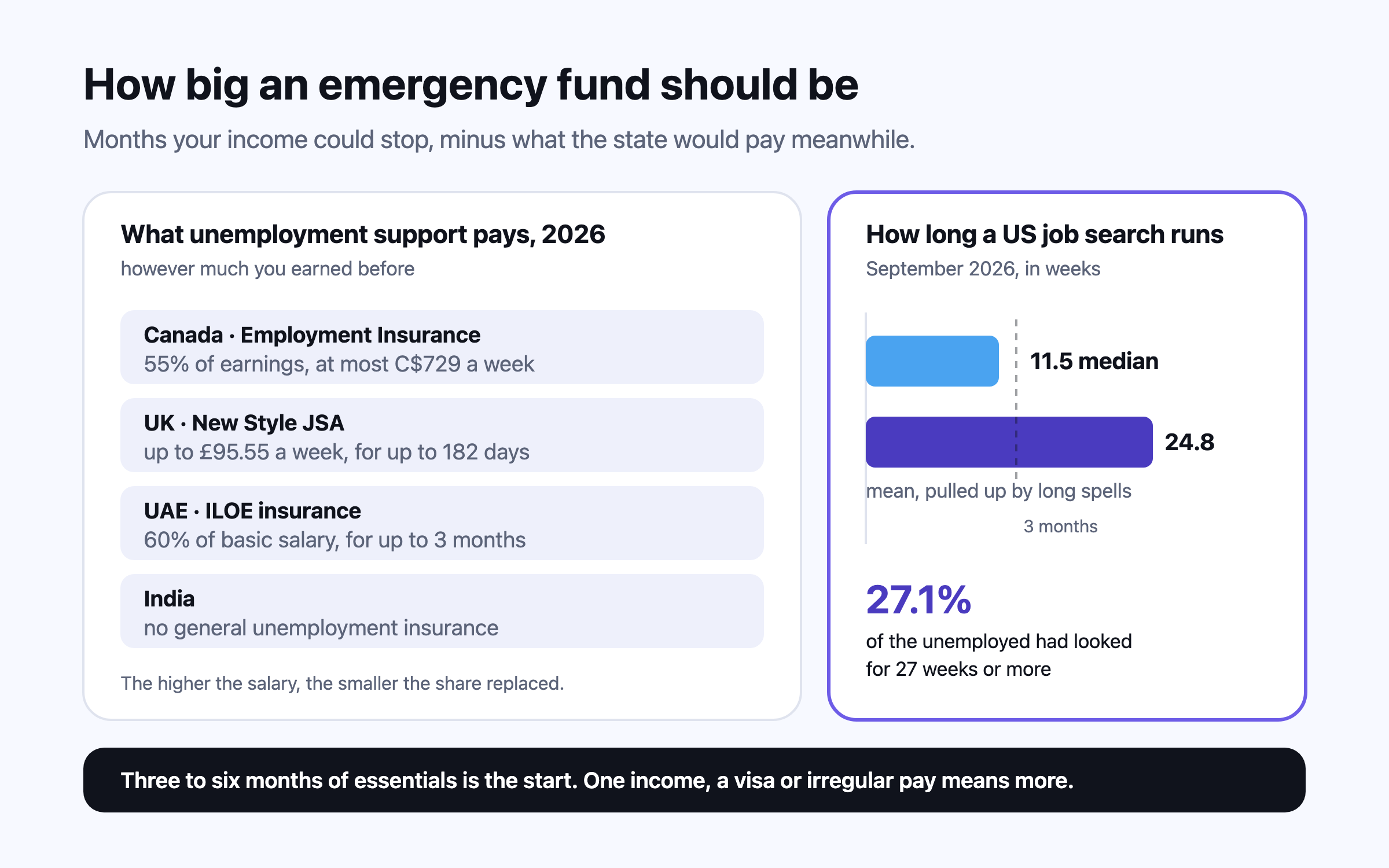
Three to six months of essential spending is a sensible starting range, but nobody can trace it to a study. The size that fits your household depends on how long a job search takes where you live, how much of your income unemployment benefits would replace — often far less than half for a middle-class salary — and whether a visa, a single income or irregular pay shortens the time you have.
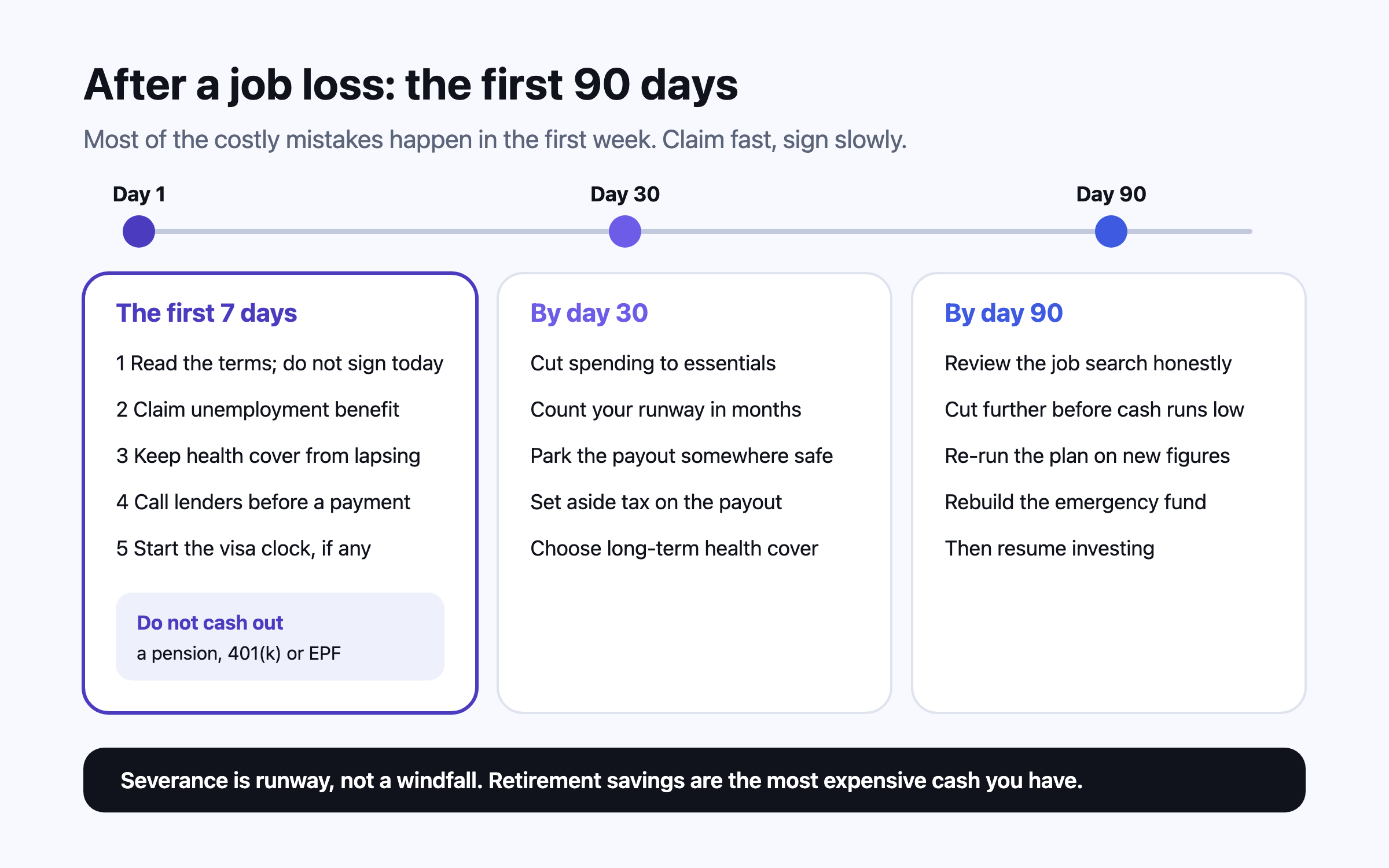
Most of the expensive mistakes after a layoff happen in the first fortnight: signing a severance agreement unread, claiming benefits late, letting health cover lapse, missing a loan payment without calling the lender, and cashing out retirement savings. This is the order to do things in, with the 2026 rules for the US, UK, India, Canada, Australia, Singapore and the UAE.
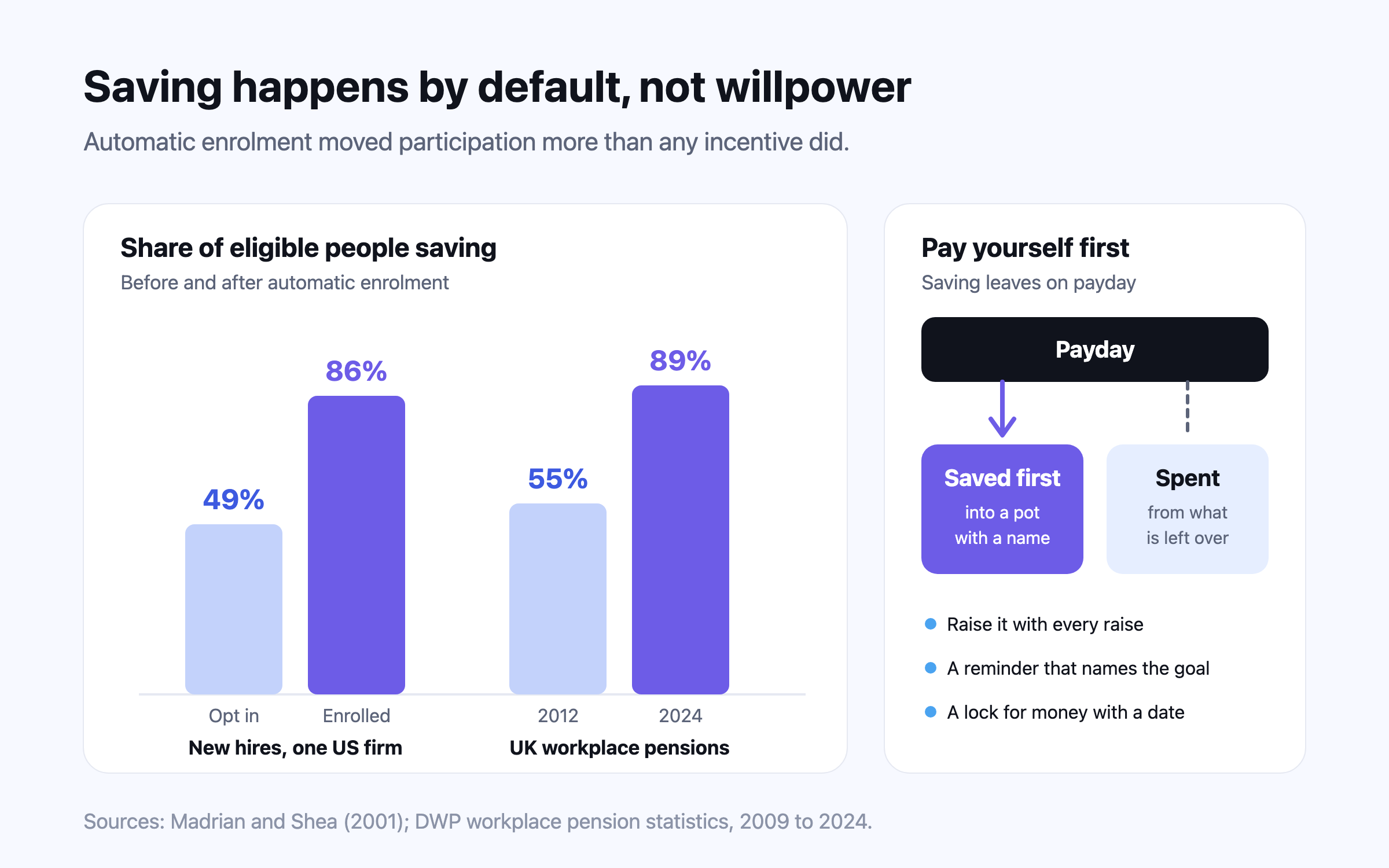
The most reliable way to save more is to make saving happen without a decision each month. In one US company, 86% of staff hired under automatic enrolment were in its 401(k), against 49% of those hired the year before; in Great Britain, workplace pension participation rose from 55% to 89% after automatic enrolment; in Denmark, automatic contributions raised total saving while tax incentives mostly moved money between accounts. Commitment, reminders and clearly labelled pots add to that — information on its own adds surprisingly little.
This is general information, not financial, tax or legal advice for your circumstances. Rules and figures change; check the official source for your country, and consult a licensed professional before making financial decisions. Projections are estimates, not predictions.