Three to six months is a convention, not a finding. Size the fund to how long your income could stop and what the state would pay meanwhile.
Three to six months of essential spending is a sensible starting range, but nobody can trace it to a study. The size that fits your household depends on how long a job search takes where you live, how much of your income unemployment benefits would replace — often far less than half for a middle-class salary — and whether a visa, a single income or irregular pay shortens the time you have.
Nivritee Research · 6 October 2026 · 10 min read
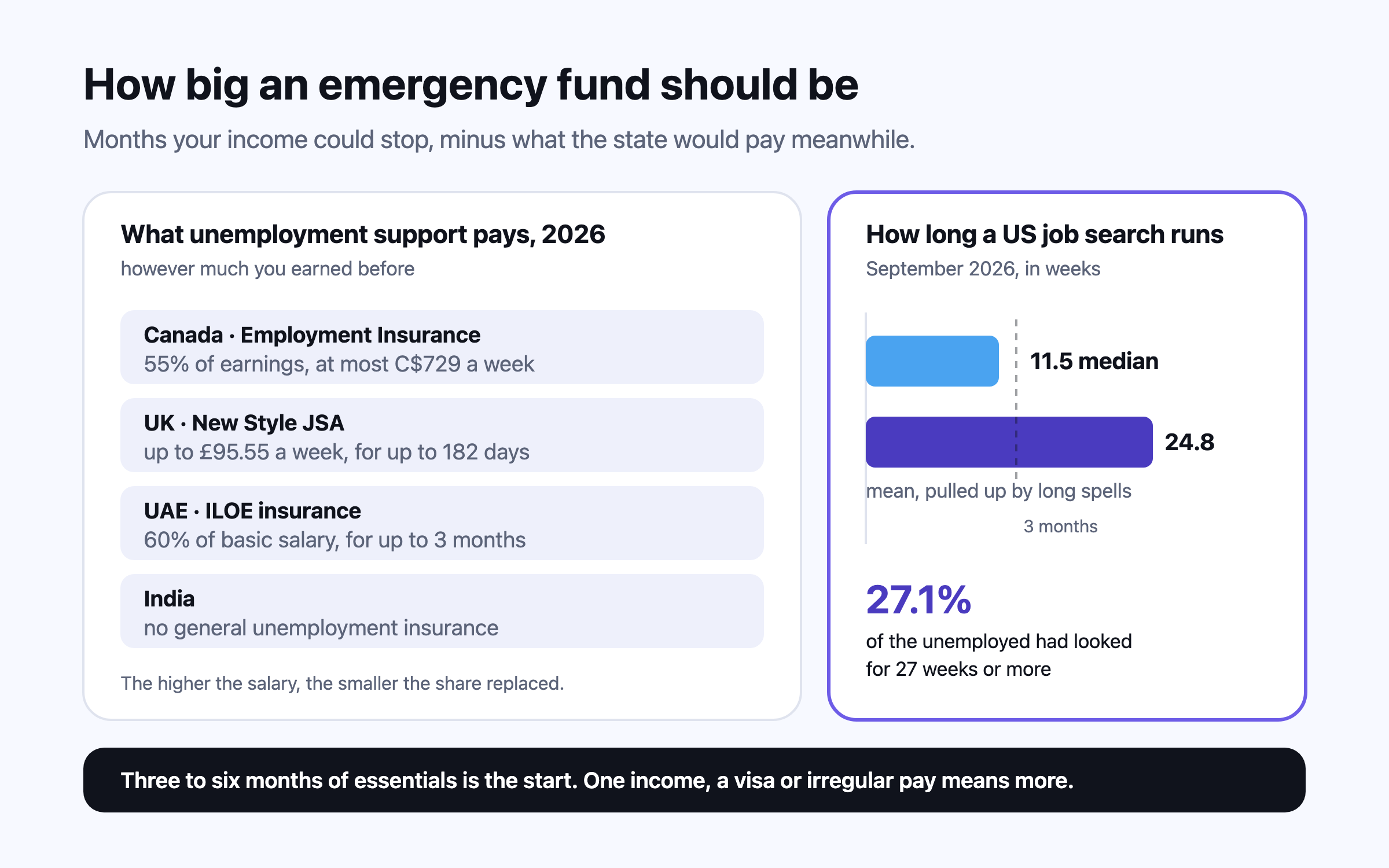
The short answer: keep enough cash to cover your essential spending for as long as your income could realistically stop, minus whatever the state would pay you meanwhile. For most salaried households that lands between three and six months of essentials; for a single earner, a freelancer, or anyone whose visa depends on their job, it is more. The reason the usual rule is too low for many middle-class families is benefits: Canada’s Employment Insurance pays at most C$729 a week, and Britain’s New Style Jobseeker’s Allowance £95.55, however much you earned12.
Take-home pay a typical US family needs in cash to absorb a normal income dip and spending spike
Where “three to six months” comes from
Nobody has traced the rule to a study. It appears in bank leaflets, regulators’ guides and personal-finance books as received wisdom, and the honest description is a convention that the evidence broadly supports rather than a number anybody derived. What the research does show is that having a buffer matters a great deal, and that the first few weeks of cover do the most work.
The JPMorgan Chase Institute measured how far real families’ bank balances swing. It found that a typical family needs roughly six weeks of take-home income in liquid assets to ride out an ordinary income dip and spending spike arriving together, and that 65% of families lacked that much6. Vanguard’s survey of its own investors found that having at least $2,000 put by went with 21% higher financial well-being, and that reaching three to six months of expenses added a further 13%7. The Consumer Financial Protection Bureau found that 24% of consumers had no emergency savings at all and 39% had some, but less than a month of income8. All three are associations, not experiments, but they point the same way.
The Federal Reserve’s annual survey of household well-being shows how many people sit below even the first step. In October 2025, 63% of US adults said they would cover a hypothetical $400 emergency expense using cash, savings or a credit card paid off at the next statement, the same share as in each of the three previous years and below the 68% peak of 20213. Separately, 55% said they had three months of expenses in a rainy-day fund, and 30% said they could not cover three months by any means, including borrowing or selling assets4.
Morgan Housel’s case in *The Psychology of Money* is that room for error is what lets a plan survive the events nobody forecast9. An emergency fund is that room in its most literal form: it decides whether a lost job becomes a hard few months or a sale of investments at the bottom of a market.
How long it takes to find work
The right number of months starts with how long income actually stops for. National labour surveys measure it, and the figures are longer than most people assume once the spells that run past six months are included.
The latest release from each statistics office as of early October 2026. The US mean is pulled up by long spells, which is why it is twice the median. Britain and Australia publish duration in tables not reproduced here; their headline rates are shown for context. 510111213
Country
Latest reading
What it measures
United States
Median 11.5 weeks; mean 24.8 weeks; 27.1% unemployed 27 weeks or more (September 2026)
Length of the current spell of unemployment
Canada
24.0% of the unemployed searching for 27 weeks or more (August 2026)
Residents unemployed for 25 weeks or more, as a share of the labour force
Two readings matter for sizing. The median US spell of 11.5 weeks in September 2026 is under three months, which is where the bottom of the rule comes from; the mean of 24.8 weeks, and the 27.1% of unemployed Americans who had been looking for 27 weeks or more, are why the top of it is six5. In Canada, 24.0% of the unemployed in August 2026 had been searching continuously for 27 weeks or more10. Senior and specialised roles usually take longer to replace than the average job, which is the case for building beyond six months if your pay is well above the median for your field.
What the state would pay you meanwhile
Unemployment insurance is designed to replace part of a modest wage, so the higher your salary, the smaller the share it covers. That is the single biggest reason middle- and upper-middle-income households need more of their own cash than the headline rule suggests.
Rules as published by each authority for 2026. Canadian figures in Canadian dollars. Australia’s JobSeeker Payment is means-tested and starts only after a liquid assets waiting period for people with savings; Singapore introduced SkillsFuture Jobseeker Support in 2025 for residents who lose their jobs, with an income cap. Check each programme’s current rate before relying on it. 14152161711819
Country
Main benefit
How much
For how long
United States
State unemployment insurance
Average $500.61 a week (Q2 2026); each state sets its own maximum
Up to 26 weeks in most states; at most 12 in Arkansas and Florida, and 12 to 20 in North Carolina depending on its unemployment rate
United Kingdom
New Style Jobseeker’s Allowance
Up to £95.55 a week at 25 or over
Up to 182 days
United Kingdom
Universal Credit (means-tested)
£424.90 a month standard allowance, single, 25 or over
No entitlement with more than £16,000 in savings
Canada
Employment Insurance
55% of average insurable earnings, at most $729 a week
14 to 45 weeks (up to 65 for some long-tenured workers, temporarily); the one-week waiting period is waived for now
UAE
Involuntary Loss of Employment insurance
60% of average basic salary, capped at AED 10,000 or AED 20,000 a month
Up to 3 months a claim, after 12 months of premiums
India
No general unemployment insurance
—
—
The US average benefit is $500.61 a week, and the average claimant drew it for 15.8 weeks in the second quarter of 2026, when the exhaustion rate — roughly, the share of claimants who used up their whole entitlement — was 39.26%14. In a 2016 study of its own customers, the JPMorgan Chase Institute found that unemployment insurance kept the typical drop in spending after a job loss to about 5%, but that in states paying for six months, 27% of claimants were still out of work when benefits ran out20. Canada’s cap is set by the 2026 maximum insurable earnings of C$68,900 a year; anybody earning more still receives no more than C$729 a week1. The usual unpaid first week is waived for claims starting between 30 March 2025 and 9 October 2027, after the government extended the waiver by a year in August 20261821.
In Britain, New Style JSA depends on Class 1 National Insurance paid as an employee over the previous two tax years, so the self-employed are generally excluded22. Universal Credit is means-tested and closed to anybody with more than £16,000 in savings, which means a well-funded emergency fund and Universal Credit rarely coexist17. India has no general unemployment insurance for salaried workers; the Employees’ State Insurance Corporation’s small unemployment allowance applies only to insured workers below its wage ceiling, which leaves out most middle-class salaries. Australia’s JobSeeker Payment works the other way round from what savers expect: a single person with no dependants holding A$5,500 or more in cash and other liquid assets waits between one and 13 weeks before it starts, and the full 13 weeks applies from A$11,50023. A Gulf-based household is better covered than it was: the UAE’s compulsory scheme, in force since 2023, pays 60% of the average basic salary for up to three months, but basic salary is often only part of a Gulf pay package, which also carries housing and transport allowances that the scheme ignores19.
Sizing it for your household
Start from essential spending, not income: housing, food, utilities, insurance premiums, school fees and the minimum payment on every loan. Leave out holidays, eating out and anything you would stop in a crisis. Then adjust the number of months for the risks your household actually carries.
A judgement, not a rule: these ranges follow from the job-search and benefit evidence above and are a place to start, not a prescription. A household with secure public-sector jobs and no debt can sit lower; one with a large mortgage and a single earner should sit higher. 524
Household
A reasonable starting point
Why
Two salaried incomes in different industries
3 months of essentials
One income is likely to continue; the fund covers the gap, not the whole bill
Two incomes in the same company or sector
6 months
A sector downturn can hit both at once
One income, with dependants
6 to 9 months
No second salary to fall back on
Freelance, commission or bonus-heavy pay
6 to 12 months
Income gaps are routine, and benefits often exclude the self-employed
Visa tied to the job
6 months or more, plus the cost of moving
The deadline to find work, or leave, can be shorter than a normal job search
Close to stopping work
1 to 2 years of spending, in cash and short-term deposits
Protects against selling investments in a fall; see the bucket strategy
Irregular income is common, not exotic. In the Federal Reserve’s 2025 survey, 30% of US adults said their income varied at least occasionally through the year, and 58% of the self-employed said it varied from month to month, against 28% of employees24. For those households the fund does a second job, smoothing ordinary lean months, and it needs to be larger for that reason alone.
When your visa depends on your job
For a household on a work visa, losing the job starts a clock. A US H-1B worker keeps status for up to 60 consecutive days after employment ends, or until the authorised stay runs out if sooner, once per validity period, and may not work during it25. In Singapore, an Employment Pass is cancelled when employment ends, and the employer can request a Short-Term Visit Pass of up to 90 days, during which the holder cannot work26. In the UAE, the government says grace periods after a residence permit is cancelled reach up to six months depending on the category of resident, and the ILOE benefit runs for at most three months2719. A visa-dependent fund has to cover two scenarios: a new job found inside the window, and a move home with flights, deposits forfeited and a gap before the next salary in another currency. The second usually costs more.
Five households, worked through
Daniel and Grace, Toronto: one income, two children
Daniel earns C$105,000 and Grace is at home with their two children. Their essentials, with the mortgage, come to C$6,800 a month. If Daniel lost his job and qualified for the maximum EI benefit of C$729 a week, it would cover about C$3,159 a month, leaving C$3,641 a month to come from savings1. Six months of their essentials is C$40,800; with only one income, they aim for that and treat it as the floor.
Shruti and Nikhil, Pune: two incomes in one industry
Both 34 and both in IT services, with ₹2.4 lakh a month of take-home pay and essentials of ₹1.2 lakh including a ₹45,000 home-loan EMI. Two incomes would normally justify three months, but both depend on the same sector, so they hold six: ₹7.2 lakh. They keep ₹1.2 lakh in the savings account, ₹3.6 lakh in fixed deposits at the same bank, and ₹2.4 lakh in a liquid fund. The bank holds ₹4.8 lakh of theirs, inside the ₹5 lakh that deposit insurance covers per depositor per bank28.
Hannah, London: a freelance designer
Hannah’s essentials are £2,900 a month. As a self-employed worker she would not qualify for New Style JSA, so she holds nine months, £26,100, in easy-access accounts, well inside the £120,000 the FSCS protects per person per firm2229. Above £16,000 of savings she would not qualify for Universal Credit either, so her fund is the whole of her safety net, by design17.
Arun and Meera, Dubai: a visa tied to one job
Arun’s basic salary is AED 18,000 a month within a larger package, and the family’s essentials, with rent and school fees, are AED 22,000. If he lost his job involuntarily, the ILOE scheme would pay 60% of his basic, AED 10,800 a month, for up to three months, leaving AED 11,200 a month to find19. Six months of essentials is AED 132,000, of which the scheme would cover at most AED 32,400; the other AED 99,600, plus the cost of a possible move back to India, is theirs to hold. For what happens to his end-of-service gratuity, see Gulf gratuity and pensions.
Ravi and Anjali, Austin: H-1B and H-4
Ravi works on an H-1B visa and Anjali is on an H-4. Their essentials are $7,500 a month, so six months is $45,000. Even a benefit at the US average of $500.61 a week would replace about $2,169 a month, and the 60-day grace period is shorter than the median job search14255. They keep six months in cash and, separately, enough for one-way flights and a deposit in India, so that a forced move is never financed by selling investments in a hurry.
Where to keep it, as of autumn 2026
An emergency fund has one job: to be there, in full, within days. That rules out anything that can fall in value at the moment you need it. Shares fall in recessions, and recessions are when jobs are lost (recessions, jobs and markets). Within the safe options, the aim is to earn a fair rate without giving up access.
Policy rates set the level that savings rates follow, with a lag; what a household earns depends on the account. Rates and limits as published by each central bank, deposit insurer or data provider between September and early October 2026. Singapore has no policy interest rate; the MAS manages the exchange rate instead. 3031323334293536283738394041
Country
Policy rate
Where people usually keep it
Deposit protection
United States
3.75–4.00% (raised 16 September 2026)
High-yield savings or money market funds (Crane 100 seven-day yield 3.69%, 5 October 2026); the FDIC’s national average savings rate was 0.37% in September 2026
$250,000 per depositor per bank (FDIC); money market funds are not deposits
United Kingdom
3.75% (held 17 September 2026)
Easy-access savings accounts
£120,000 per person per firm (FSCS)
India
5.50% repo rate (raised 7 October 2026)
Savings account (SBI pays 2.50%), fixed deposits with a sweep, liquid funds
₹5 lakh per depositor per bank (DICGC); funds are not insured
Canada
2.25% (held 2 September 2026)
High-interest savings accounts
$100,000 per category per member institution (CDIC)
Australia
4.60% (raised 29 September 2026)
High-interest savings accounts
$250,000 per account holder per bank (Financial Claims Scheme)
S$100,000 per depositor per bank (SDIC); government securities are not deposits
United States. The gap between the 0.37% national average on savings in September 2026 and the 3.69% money market funds were paying in early October is the single easiest saving most households can make3132. A money market fund is not FDIC-insured, but government money market funds hold short-term Treasury and agency paper.
India. A liquid fund may only hold debt and money-market securities maturing within 91 days, which keeps its price steady, and redemptions usually reach the bank the next working day42. An FD with an auto-sweep earns a fixed-deposit rate on money that moves to the savings account when it is spent. Split the fund across two banks if it exceeds the ₹5 lakh DICGC limit at one28.
Singapore. Singapore Savings Bonds can be redeemed in any month with no penalty, with the money paid by the second business day of the following month, and the government backs the full amount43. That makes them a good second layer behind a savings account, not the first.
Everywhere. Keep one month in the current account you pay bills from, the rest one step away. Do not count a credit card or an overdraft as part of the fund: it is a way of borrowing the emergency, at the worst rate.
Emergency fund, debt or investing first
The usual order is a small starter buffer first, so a broken boiler does not go on a card; then high-interest debt; then the rest of the fund alongside any employer pension match; then investing. A household carrying a credit-card balance gains more by clearing it than by holding a large cash balance, but only once a month or so of cover is in place. The full order, with the evidence for each step, is in pay off debt or invest.
A fund can also be too big. Cash held well beyond what the household’s risks justify loses value to inflation year after year (inflation is not one number). When the fund reaches its target, send the monthly transfer to long-term savings instead, and top the fund back up after any withdrawal before resuming. For somebody close to stopping work, the cash cushion becomes part of a wider plan for drawing income, set out in the bucket strategy.
List your essentials for one month: housing, food, utilities, insurance, school fees, minimum loan payments.
Look up what your country’s unemployment benefit would pay you, and for how long, using the tables above.
Choose the number of months for your household type, and add the cost of a move if your visa depends on your job.
Subtract what benefits would pay over those months. The remainder is your target.
Hold one month in your current account and the rest in a protected, instantly accessible place; automate a monthly transfer until you reach it.
How Nivritee helps
Questions people ask
How many months should my emergency fund cover?
Three to six months of essential spending is the usual range. Lean towards three with two independent incomes, and six or more with one income, irregular pay or a visa tied to your job. In the US the median unemployment spell was 11.5 weeks in September 2026 but the mean was 24.8 weeks5.
Should my emergency fund be based on income or expenses?
Expenses, and only the essential ones: what must still be paid if your income stopped tomorrow. Basing it on income usually overstates it, because taxes, pension contributions and discretionary spending stop or shrink when income does.
Can I keep my emergency fund in index funds or shares?
It is risky, because share prices tend to fall in recessions, which is when jobs are lost. Keep the fund in insured deposits, money market funds, liquid funds or government savings bonds, and invest only what is above it3342.
Where should I keep an emergency fund in India?
A month in your savings account, and the rest in a sweep-in fixed deposit or a liquid fund, which may only hold securities maturing within 91 days42. Bank deposits are insured up to ₹5 lakh per depositor per bank, so split a larger fund across banks28.
Should I build an emergency fund or pay off debt first?
Build a small buffer of about a month first, then clear high-interest debt, then complete the fund. Without the buffer, the next surprise goes straight back on the card. See pay off debt or invest.
How much emergency fund do I need on an H-1B visa?
More than a citizen in the same job. H-1B status lasts up to 60 days after employment ends, which is shorter than the median US job search, so plan for six months of essentials plus the cost of moving home255.
Does having savings stop me getting unemployment benefits?
It depends on the benefit. Contribution-based benefits such as New Style JSA in the UK and Canada’s EI ignore savings122. Means-tested ones do not: UK Universal Credit is closed to anybody with more than £16,000 in savings17.
What percentage of Americans can cover a $400 emergency?
In the Federal Reserve’s survey for 2025, 63% of adults said they would cover a $400 emergency expense with cash, savings or a credit card paid off at the next statement3.
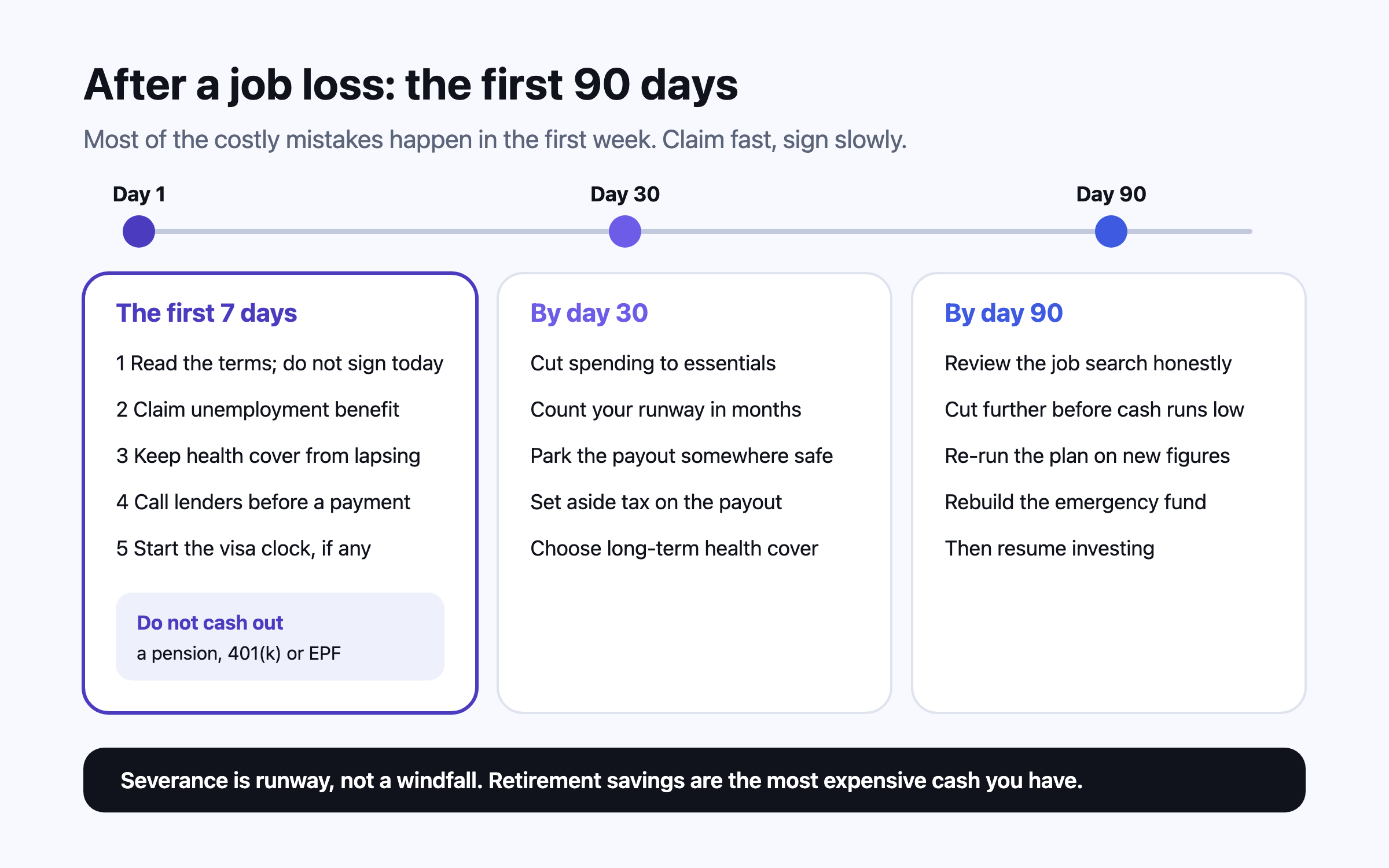
Most of the expensive mistakes after a layoff happen in the first fortnight: signing a severance agreement unread, claiming benefits late, letting health cover lapse, missing a loan payment without calling the lender, and cashing out retirement savings. This is the order to do things in, with the 2026 rules for the US, UK, India, Canada, Australia, Singapore and the UAE.
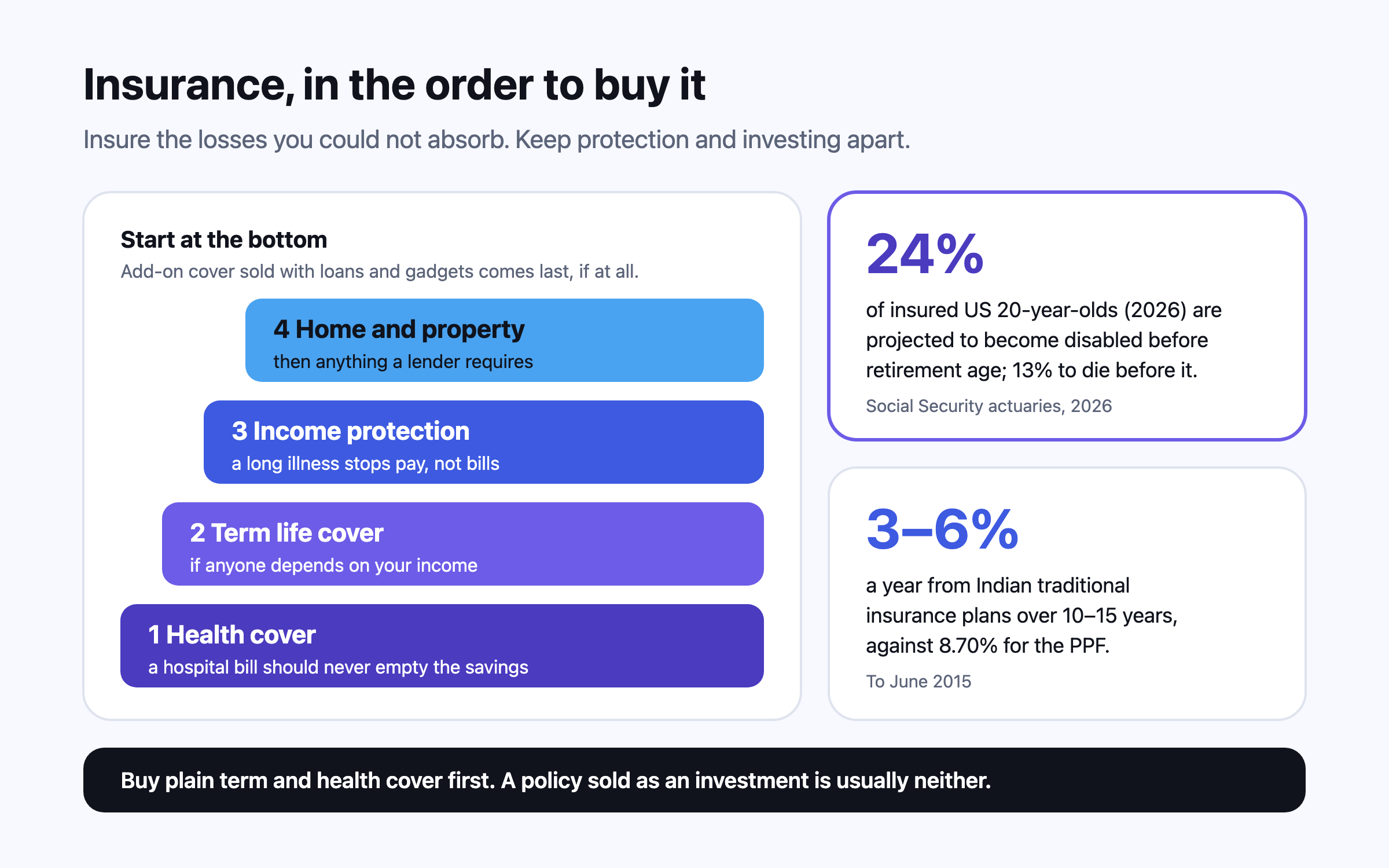
Insurance is for losses a household could not pay for itself: a large medical bill, the death of an earner somebody depends on, or years without income after an illness. Buy cover for those first, in that order, as plain term and health policies; size life cover to what dependants would need rather than to a multiple of salary; and be wary of policies that mix insurance with investment, which in India have returned 3–6% a year over 10 to 15 years.
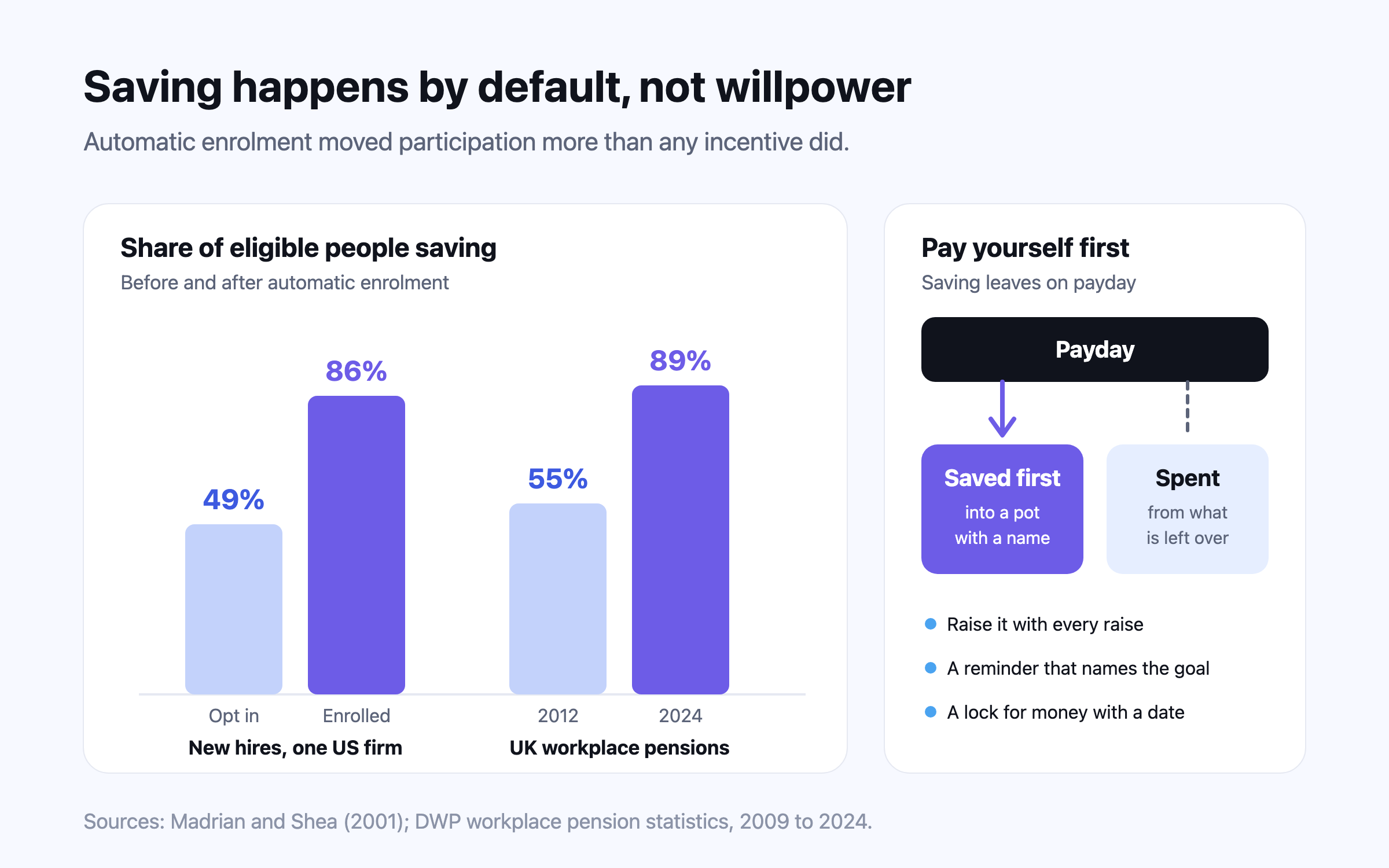
The most reliable way to save more is to make saving happen without a decision each month. In one US company, 86% of staff hired under automatic enrolment were in its 401(k), against 49% of those hired the year before; in Great Britain, workplace pension participation rose from 55% to 89% after automatic enrolment; in Denmark, automatic contributions raised total saving while tax incentives mostly moved money between accounts. Commitment, reminders and clearly labelled pots add to that — information on its own adds surprisingly little.
This is general information, not financial, tax or legal advice for your circumstances. Rules and figures change; check the official source for your country, and consult a licensed professional before making financial decisions. Projections are estimates, not predictions.