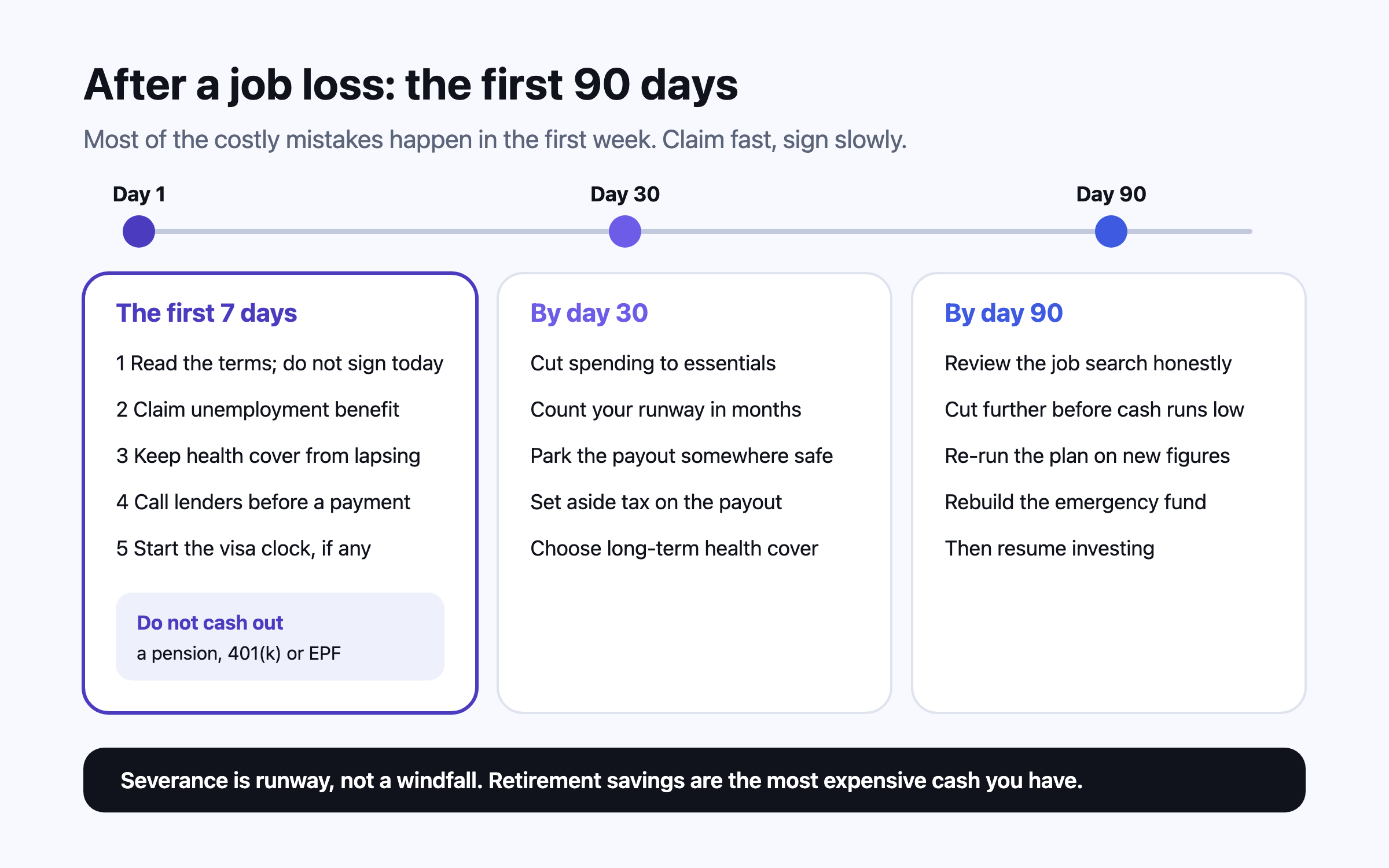
After a job loss, the first week decides most of the money: claim benefits, keep health cover, read the severance terms, and do not cash out a pension.
Most of the expensive mistakes after a layoff happen in the first fortnight: signing a severance agreement unread, claiming benefits late, letting health cover lapse, missing a loan payment without calling the lender, and cashing out retirement savings. This is the order to do things in, with the 2026 rules for the US, UK, India, Canada, Australia, Singapore and the UAE.
Nivritee Research · 6 October 2026 · 12 min read
The short answer: in the first week, do five things and avoid one. Read the severance or redundancy terms before signing anything; apply for unemployment benefits the day you can; make sure health cover does not lapse; tell every lender before a payment is missed; and write down what the household must pay each month. The one thing to avoid is cashing out retirement savings: in the US, money taken from a 401(k) before 59½ usually costs a 10% additional tax on top of income tax, and the compounding it would have earned is gone for good1.
UK redundancy rate among employees, May to July 2026
How common layoffs have been since 2023
Losing a job is routine in a large economy, even a healthy one. The US Bureau of Labor Statistics counted 19.8 million layoffs and discharges in 2023, 20.0 million in 2024 and 21.2 million in 2025; in August 2026 there were 1.6 million, a rate of 1.0% of employment26. Announced cuts tell the story of particular industries. Challenger, Gray & Christmas counted 1,206,374 announced job cuts in 2025, 58% more than in 2024, with government and technology the largest sources3. In the first nine months of 2026 the total fell to 573,195, but technology cuts rose to 165,925, and artificial intelligence was the most cited reason, behind 120,136 announced cuts4.
In Britain the redundancy rate was 3.9 per 1,000 employees in May to July 2026, down from 5.3 in August to October 20255. None of this predicts any one household’s luck. It does say that a job loss is an ordinary event, and the money decisions in its first weeks are the same whatever caused it.
The first seven days
Do not sign on the day. Ask for the severance or settlement terms in writing, and the deadline to accept. Check them against the statutory minimum in the table below; anything above it is negotiable, and in many countries an employment lawyer will review an agreement for a fixed fee.
Claim unemployment benefit at once. Most systems pay from the date you claim, not the date you lost the job, and some lose you money if you wait: Canada says applying more than four weeks after your last day of work may cost you benefits7. A severance payment does not usually stop you claiming.
Secure health cover. In the US you have 60 days to elect COBRA and a 60-day window to buy a Marketplace plan; in India the employer’s group policy ends with the job89.
Call every lender before a payment is due. Lenders have more options before an account is in arrears than after. Write down each loan, its payment date and the minimum due.
Leave retirement accounts where they are. Withdrawing early is usually the most expensive money available to you.
If your visa depends on the job, start the clock today. A US H-1B worker has up to 60 days; a Singapore Employment Pass holder can be given a visit pass of up to 90 days but cannot work on it1011.
What you are owed: severance and final pay
Every country sets a legal floor, and many employers pay more. Knowing the floor tells you whether an offer is generous or merely the minimum dressed up, and what you give up by signing a settlement that waives your right to claim.
Statutory minimums as published by each government in 2026. Contracts, collective agreements and, in Canada, the courts’ common-law notice often give more; none of these figures limit what an employer may offer. 12131415161718192021222324
Country
Statutory minimum on redundancy
Notes
United Kingdom
Half, one or one and a half weeks’ pay per year of service by age band, after 2 years; weekly pay capped at £751 and the total at £22,530 from 6 April 2026
Up to 20 years counted; notice pay is separate
United States
None under federal law
The WARN Act requires 60 days’ notice of a plant closing or mass layoff by employers with 100 or more employees
Canada (Ontario)
Termination pay of 1 to 8 weeks; severance pay of 1 week per year, up to 26 weeks, after 5 years at a large employer
Federally regulated employers follow the Canada Labour Code
Australia
4 to 16 weeks’ pay by length of service, after 1 year, at employers with 15 or more staff
At 10 years or more the scale drops to 12 weeks
Singapore
No statutory amount; the tripartite norm is 2 weeks to 1 month’s pay per year of service, after 2 years
Employers with 10 or more staff must notify MOM within 5 working days
UAE (private sector)
End-of-service gratuity: 21 days’ basic pay per year for the first 5 years, 30 days after, capped at 2 years’ pay
Due within 14 days of the contract ending
India
Gratuity of 15 days’ wages per year after 5 years’ service (1 year for fixed-term staff since November 2025), capped at ₹20 lakh
Notice pay and leave encashment come on top
In India, gratuity is 15 days’ wages for every completed year of service, with a month’s wages divided by 26, payable after five years. The rule moved from the Payment of Gratuity Act into the Code on Social Security when the four Labour Codes took effect on 21 November 2025, and fixed-term employees now qualify after one year2224. The Code also changed what counts as wages: if allowances make up more than half of total pay, the excess is added back, which raises gratuity for anybody whose basic salary is a small share of their package22. The ceiling has been ₹20 lakh since 201823. Unused earned leave is paid out too, and for non-government employees encashment on leaving is tax-free up to ₹25 lakh25. In the Gulf, the gratuity is often the single largest sum a household receives on leaving; how it is calculated, and why it is not a pension, is set out in Gulf gratuity and pensions when you move21.
Benefits: claim now, not when the severance runs out
The most common mistake is waiting. The US Department of Labor tells people to contact their state programme as soon as possible, and it generally takes two to three weeks for the first payment to arrive after a claim is filed26. In Britain, New Style Jobseeker’s Allowance and Universal Credit are generally paid from the date you claim, not the date the job ended, so a late claim is money lost. Canada normally allocates separation payments against the start of a claim, but under temporary measures for claims beginning between 30 March 2025 and 9 October 2027 separation earnings are not deducted and the waiting week is waived; the government extended both by a year in August 20262728.
Australia works differently: a redundancy payment can create an income maintenance period before JobSeeker Payment starts — a 10-week payment may mean a 10-week wait — and savings above A$5,500 for a single person can add a liquid assets waiting period of up to 13 weeks. Services Australia still tells people to claim straight away, before the employer has paid2930. In the UAE, a claim under the unemployment insurance scheme must be made within 30 days of the end of employment31. What each country’s benefit pays, and why it replaces only a small share of a middle-class salary, is in how big an emergency fund should be.
Health cover: the gap that costs most
In the US, losing a job usually means losing employer health insurance, and the replacement is expensive. COBRA lets you keep the same plan for up to 18 months, but you pay up to 102% of its full cost, including the part your employer used to pay; you have at least 60 days to elect it and 45 days after that to pay the first premium, and cover then applies back to the day it ended8. KFF’s 2025 survey put the average total premium for employer family cover at $26,993 a year and single cover at $9,32532.
The alternative is a Marketplace plan: losing job-based cover opens a Special Enrollment Period of 60 days before or after the loss9. Compare the two on your projected income for the year, which after a layoff may be low enough for premium tax credits. Those credits are smaller in 2026 than in recent years: the enhanced credits expired at the end of 2025, and Marketplace enrolment fell by about 3 million in early 2026 as net premiums rose33. Because COBRA can be elected late and applied backwards, some people keep it in reserve during the 60 days while comparing — but the premiums then fall due from the start.
In India the employer’s group health policy ends with employment, and buying an individual policy at 45 restarts waiting periods for pre-existing conditions unless the credit carries over. IRDAI’s rules allow migration from a group policy to an individual policy with the same insurer, carrying the credits already earned, and portability to another insurer at renewal, again carrying the waiting periods already served34. Ask the insurer about migration before your last day. In Britain, Canada, Australia and Singapore the public system continues regardless of employment; what ends is the employer’s private or extended cover, which matters most for a household with ongoing treatment. For how much cover to hold of your own, see insurance basics.
Loans and credit: talk before you miss
Stopping payments quietly is the worst option, because the damage outlasts the job search. In the US, most negative information can stay on a credit report for seven years35. British consumer-credit lenders must treat customers in or approaching arrears with forbearance and due consideration; the FCA’s rules give examples, including reducing or waiving interest and charges, deferring arrears and accepting reduced payments for a reasonable period36. India has no standing relief scheme for borrowers who lose a job, so any restructuring or moratorium is at the lender’s discretion; ask in writing, early, and get any change confirmed before you rely on it.
Pay in this order: housing, utilities, insurance premiums, secured loans, then unsecured debt. Missing a mortgage or home-loan EMI risks the home; missing a credit-card payment risks a fee and a mark on your file.
Pay the minimum on cards, not more, until you know how long the gap will last; cash in the bank is worth more than a slightly smaller balance.
Cancel or pause discretionary direct debits and subscriptions in the first week; they are the easiest saving and the most often forgotten.
Do not borrow to keep up a lifestyle. A personal loan or a revolving card balance taken on to cover a gap of unknown length becomes a second problem on top of the first.
Retirement accounts: the most expensive cash you have
In the US, a distribution from a 401(k) before 59½ normally carries a 10% additional tax on top of income tax, and a cash payment from an employer plan has 20% withheld for tax at source137. The exception that matters after a layoff is the rule of 55: if you leave an employer in or after the year you turn 55, withdrawals from that employer’s plan escape the 10% charge. It does not apply to IRAs, so rolling the 401(k) into an IRA before taking what you need forfeits it381.
India changed its EPF withdrawal rules in October 2025, when EPFO’s board approved a simpler scheme. The Labour Ministry says that on unemployment a member can withdraw 75% of the PF balance, employer and employee shares with interest, immediately, and the remaining 25% after a year; the pension portion can be withdrawn after 36 months rather than two3940. The same clarification lists retrenchment among the grounds for withdrawing the whole balance, so ask EPFO which rule your claim falls under. The option to withdraw is not a reason to: EPFO’s board recommended 8.25% for 2025–26 in March 2026, a rate hard to match in anything comparably safe, and the balance keeps earning interest while you look for work41.
Elsewhere the rules mostly decide for you. Australian super stays preserved until 60 except on narrow hardship grounds, Singapore’s CPF cannot be drawn for living costs before 55, and a British pension cannot normally be touched before 5542. The one step everywhere is to keep the money where it is and make sure you know the account details for when you start the next job.
Tax on a payout
Rules as published by HMRC, the IRS, the CRA, the ATO and India’s Ministry of Finance. Withholding is a payment on account, not the final tax: the year’s actual liability depends on total income, which after a layoff is often lower, so a refund is common. 4344454625
Country
What is tax-free
What is taxed, and how it is withheld
United Kingdom
The first £30,000 of statutory and enhanced redundancy pay combined
Payment in lieu of notice is taxed as earnings, with National Insurance
United States
Nothing: severance is wages
Federal withholding of 22% on supplemental wages up to $1 million, plus Social Security and Medicare
Canada
Nothing in general; a retiring allowance has no CPP or EI withheld
Lump-sum withholding of 10% up to $5,000, 20% up to $15,000 and 30% above (lower in Quebec)
Australia
A genuine redundancy payment up to A$13,598 plus A$6,801 per year of service (2026–27)
The rest is an employment termination payment, taxed at concessional rates up to a cap
India
Leave encashment on leaving up to ₹25 lakh (non-government)
Notice pay is salary; check the treatment of retrenchment compensation and gratuity with a tax adviser
Withholding catches people both ways. In the US the flat 22% may be too little for a high earner or too much for a year that will now be short, and in Canada the 30% withheld on a large lump sum is often more than the year’s final bill4445. Set aside enough for the likely tax before spending a payout, then let the return settle the difference.
Days 8 to 90: triage, then a plan
By day 30, cut to essentials. Housing, food, utilities, insurance, school fees and minimum loan payments. Everything else waits. Divide your cash and expected benefits by that figure: the answer, in months, is your runway.
Put the payout somewhere safe and separate. A redundancy cheque is runway, not a windfall; keep it in an insured deposit or money market fund until you know when income restarts.
Settle health cover for the long run. By the end of the first month, decide between COBRA and a Marketplace plan, or between migrating and porting a group policy.
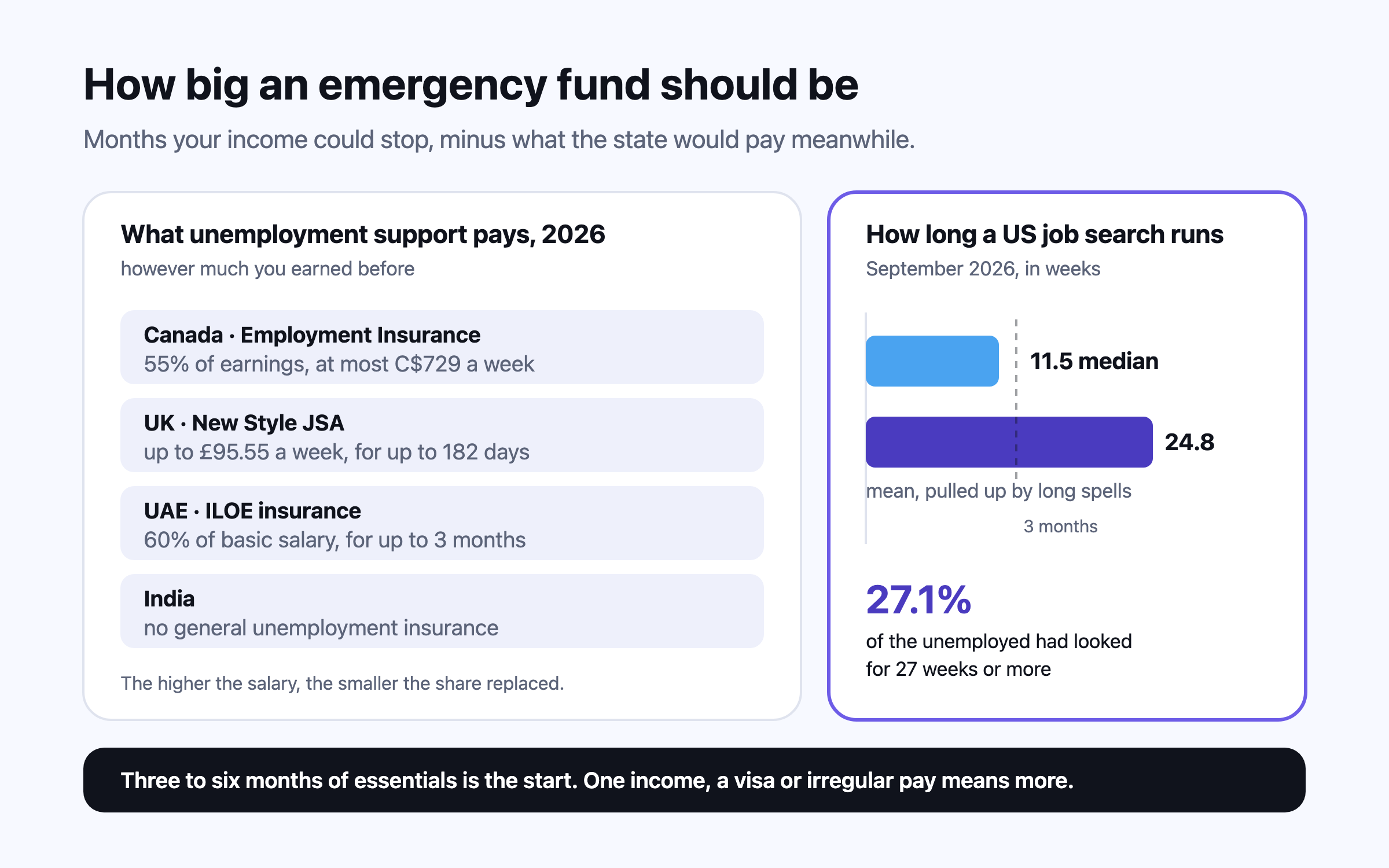
By day 60, review the job search honestly. In the US the median spell of unemployment was 11.5 weeks in September 2026, and more than a quarter of the unemployed had been looking for 27 weeks or more47. If the search is running long, cut further before savings run low, not after.
By day 90, rebuild the plan. Re-run your plan on the new income and the lower balance, decide whether the gap changes when you could stop working, and rebuild the emergency fund before resuming long-term investing.
Five households, worked through
Luke, 46, Leeds
Luke is made redundant after 12 years at a logistics firm, earning £1,150 a week. Seven of those years were before he turned 41 and five after, so the statutory formula gives 7 weeks plus 7.5 weeks: 14.5 weeks at the capped weekly pay of £751, or £10,889.5012. His employer offers £30,000 of redundancy pay plus three months’ pay in lieu of notice, £14,950. The £30,000 is within the tax-free allowance; the £14,950 is taxed as earnings43. He claims New Style JSA the same week and keeps the £30,000 in an easy-access account as runway.
Kevin, 56, Denver
Kevin’s company cuts his team and pays $40,000 of severance; 22%, $8,800, is withheld for federal tax at source44. If his family kept their employer plan through COBRA at the 2025 national average family premium, it would cost up to $27,533 a year, about $2,294 a month, so he prices a Marketplace plan against his much lower income for the year before deciding328. Because he left in the year he turned 56, he could draw from this employer’s 401(k) without the 10% additional tax if he had to — which is a reason not to roll it into an IRA yet38.
Karan, 38, Bengaluru
Karan is laid off after seven years at an IT services company, on ₹2,40,000 a month, half of it basic pay, so the Code’s wage rule adds nothing and gratuity is worked on ₹1,20,000. It is 15/26 of that for each year: about ₹4,84,615, well under the ₹20 lakh ceiling2223. His EPF balance is ₹18 lakh, of which ₹13.5 lakh could be withdrawn at once under the 75% rule39. He leaves it invested, uses the gratuity and leave encashment as runway, asks his insurer about migrating the group health policy before his last day, and writes to his bank about the ₹62,000 home-loan EMI before it falls due34.
Marc, 49, Ottawa
Marc works for an Ontario-regulated employer with a large payroll and is let go after 11 years, earning C$2,300 a week. The ESA minimum is 8 weeks’ termination pay, C$18,400, and 11 weeks’ severance pay, C$25,3001617. Paid as a lump sum above C$15,000, the severance has 30% withheld for tax45. He applies for EI within the four-week window; under the temporary measures his separation pay is not deducted from his benefit727. Because the ESA sets a floor, he has a lawyer review the offer against common-law notice before signing.
Sam, 44, Melbourne
Sam’s role at a large firm is made redundant after six years, on A$2,400 a week. The National Employment Standards give 11 weeks’ pay, A$26,40018. The tax-free limit for a genuine redundancy in 2026–27 is A$13,598 plus A$6,801 for each year of service, A$54,404 for him, so the whole statutory amount is tax-free46. He claims JobSeeker at once, knowing the payment may create an income maintenance period of about the same number of weeks29.
In Dubai the same week, a household with a basic salary of AED 15,000 and seven years’ service would be owed 165 days of basic pay in gratuity — 21 days for each of the first five years and 30 for each after — and, if they had paid into the unemployment insurance scheme for a year, 60% of basic for up to three months, AED 9,000 a month, claimed within 30 days2131. The residence visa’s grace period sets how long they have to find the next job48.
How Nivritee helps
Questions people ask
What should I do first after being laid off?
Apply for unemployment benefit, secure health cover, read the severance terms before signing, and call your lenders before any payment is due. Canada, for example, warns that applying for EI more than four weeks after your last day may cost you benefits7.
Can I claim unemployment benefits if I received severance?
Usually yes; claim at once rather than when the severance runs out. Some systems delay the start: Australia may apply an income maintenance period to a redundancy payment, and Canada normally allocates separation pay, though that is suspended under temporary measures for claims starting by 9 October 20272927.
Is COBRA or a Marketplace plan cheaper after a layoff?
It depends on your income for the year. COBRA can cost up to 102% of the plan’s full premium; a Marketplace plan may qualify for premium tax credits on a lower income. Losing job-based cover opens a 60-day Special Enrollment Period89.
Should I cash out my 401(k) after losing my job?
Usually not. Before 59½ a withdrawal normally carries a 10% additional tax plus income tax, and 20% is withheld at source. If you left in or after the year you turned 55, that employer’s plan is exempt from the 10%, but an IRA is not137.
How much of my EPF can I withdraw after losing my job?
Under the rules announced in October 2025, 75% of the PF balance immediately on unemployment and the remaining 25% after a year; the pension portion after 36 months39. Confirm with EPFO which rule applies to your claim.
How much statutory redundancy pay will I get in the UK?
Half a week’s pay for each full year under 22, one week for each year from 22 to 40, and one and a half weeks for each year at 41 or over, for up to 20 years, after two years’ service. From 6 April 2026 a week’s pay is capped at £751 and the total at £22,53012.
Is redundancy pay taxable?
In the UK the first £30,000 of redundancy pay is usually tax-free, but notice pay is taxed43. In the US severance is taxed as wages, and in Australia a genuine redundancy payment is tax-free up to A$13,598 plus A$6,801 per year of service in 2026–274446.
How long can I stay in the US on an H-1B after a layoff?
Up to 60 consecutive days, or until your authorised stay ends if that is sooner, once per validity period, and you may not work during it. In that time a new employer can petition for you, you can apply to change status, or you can leave1049.
Three to six months of essential spending is a sensible starting range, but nobody can trace it to a study. The size that fits your household depends on how long a job search takes where you live, how much of your income unemployment benefits would replace — often far less than half for a middle-class salary — and whether a visa, a single income or irregular pay shortens the time you have.
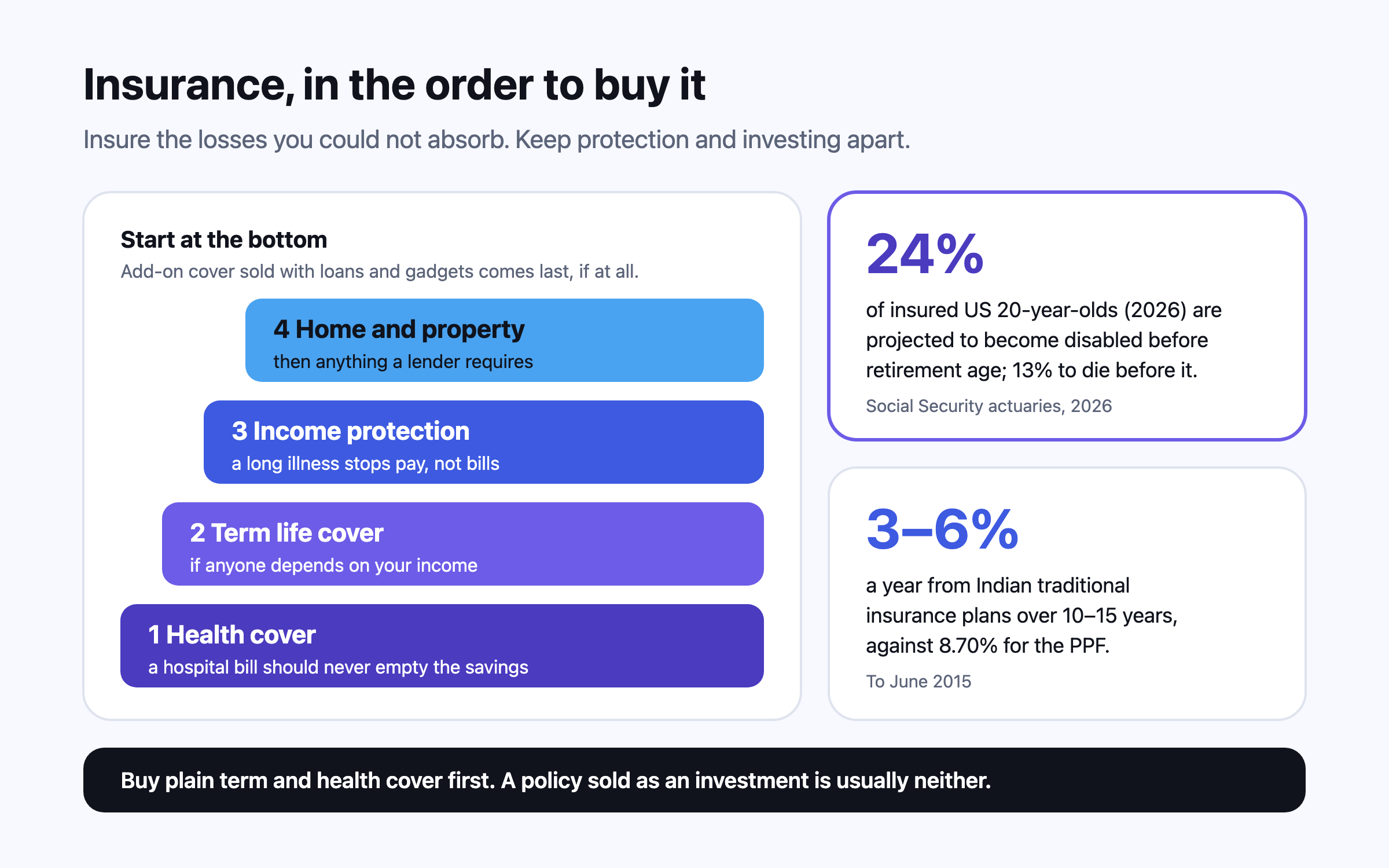
Insurance is for losses a household could not pay for itself: a large medical bill, the death of an earner somebody depends on, or years without income after an illness. Buy cover for those first, in that order, as plain term and health policies; size life cover to what dependants would need rather than to a multiple of salary; and be wary of policies that mix insurance with investment, which in India have returned 3–6% a year over 10 to 15 years.
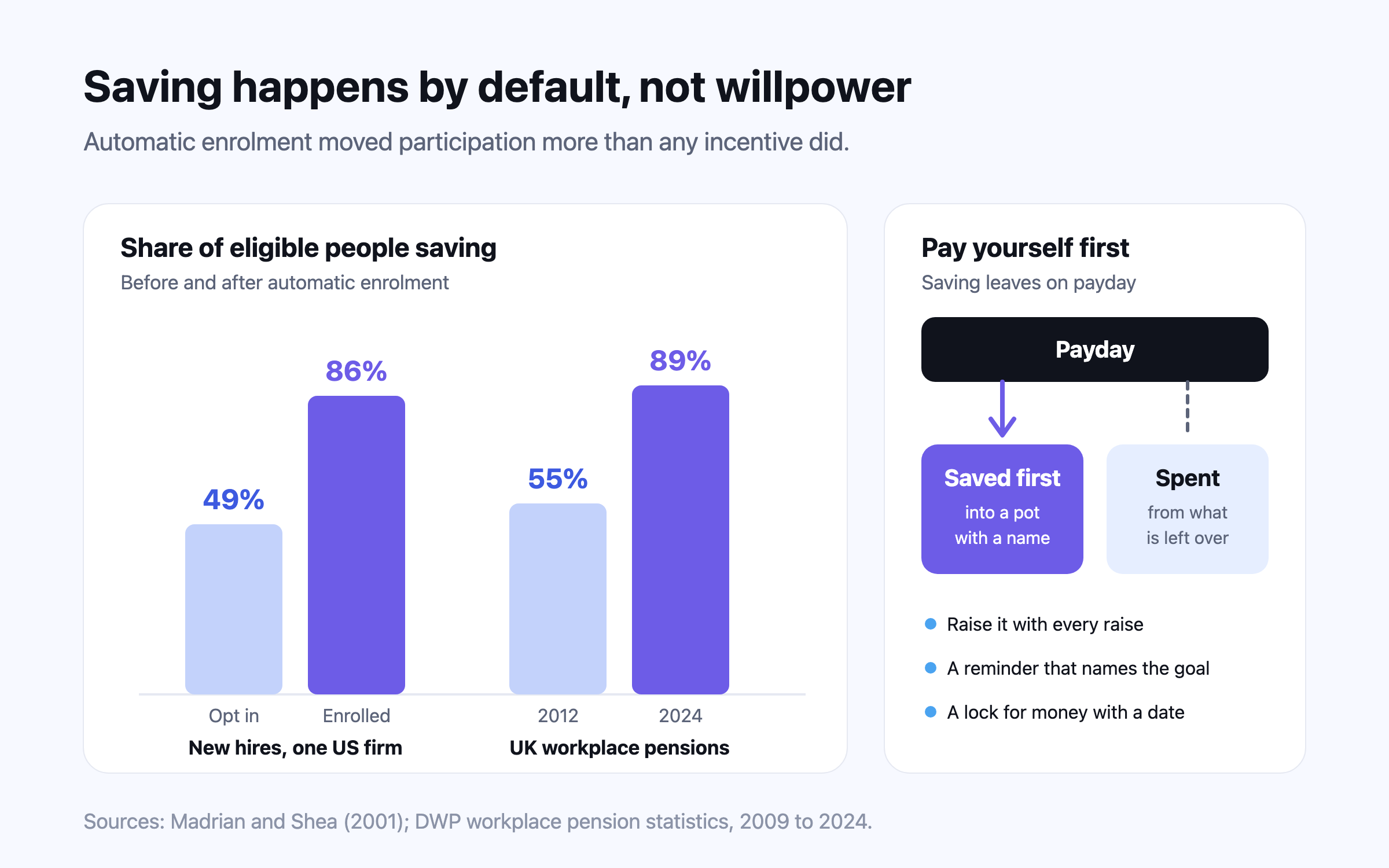
The most reliable way to save more is to make saving happen without a decision each month. In one US company, 86% of staff hired under automatic enrolment were in its 401(k), against 49% of those hired the year before; in Great Britain, workplace pension participation rose from 55% to 89% after automatic enrolment; in Denmark, automatic contributions raised total saving while tax incentives mostly moved money between accounts. Commitment, reminders and clearly labelled pots add to that — information on its own adds surprisingly little.
This is general information, not financial, tax or legal advice for your circumstances. Rules and figures change; check the official source for your country, and consult a licensed professional before making financial decisions. Projections are estimates, not predictions.