A ladder of deposits or bonds turns a lump sum into money that arrives on a schedule, whatever markets do.
A ladder splits a sum into deposits or bonds that mature one after another, usually a year apart, so a known amount arrives each year without selling anything. It suits the first years of independence. It does not remove reinvestment risk, inflation or deposit-insurance limits, so it works best as one rung of a larger plan.
Nivritee Research · 11 July 2026 · updated 15 October 2026 · 6 min read
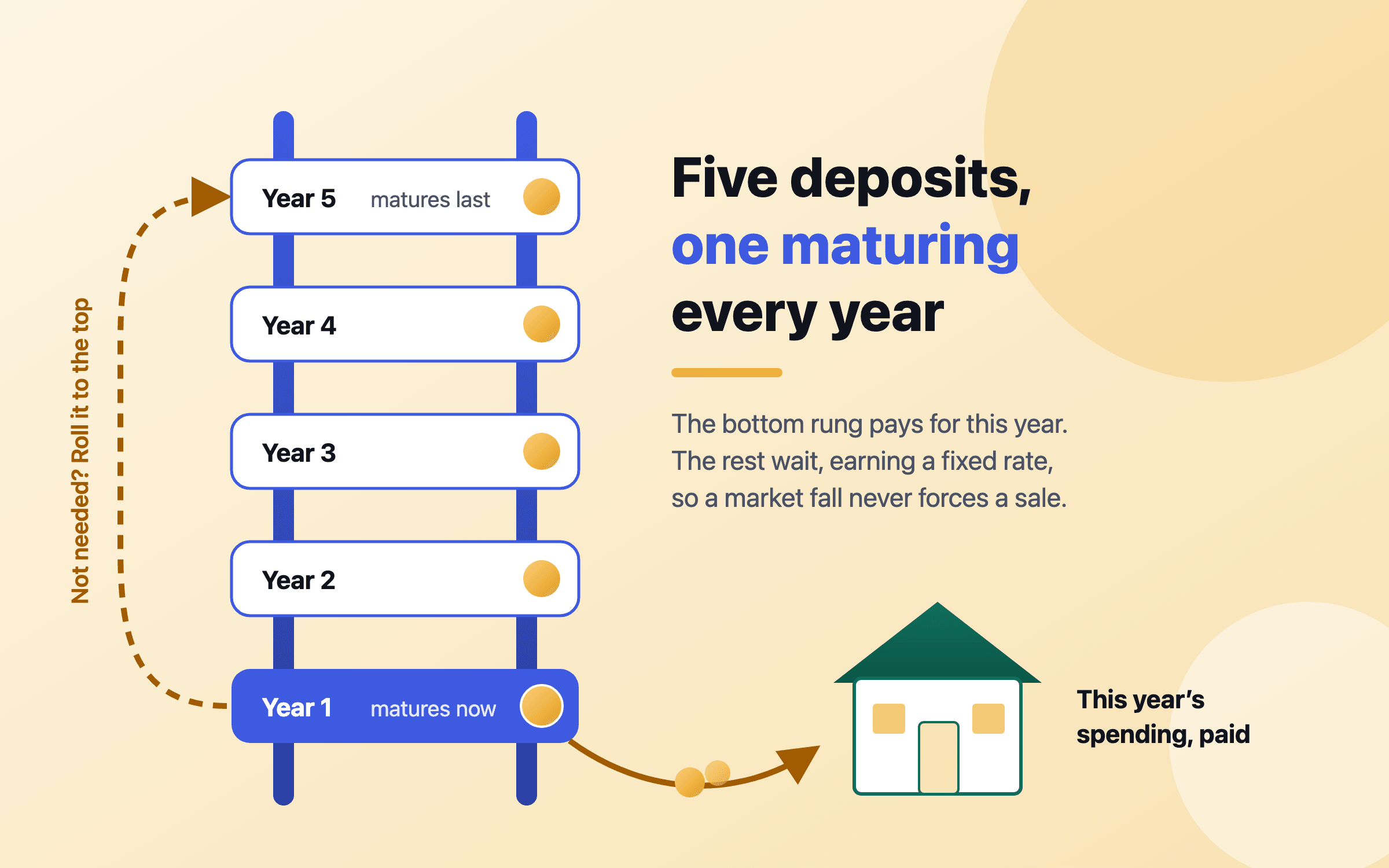
A ladder is a set of fixed deposits, certificates of deposit or bonds bought at the same time but maturing at different dates — one in a year, one in two, and so on. Each year one rung pays out. You spend it, or you put it back in at the top for the longest term. Vanguard’s explainer puts the idea simply: staggering maturities lets you balance return against access and ride out market swings1.
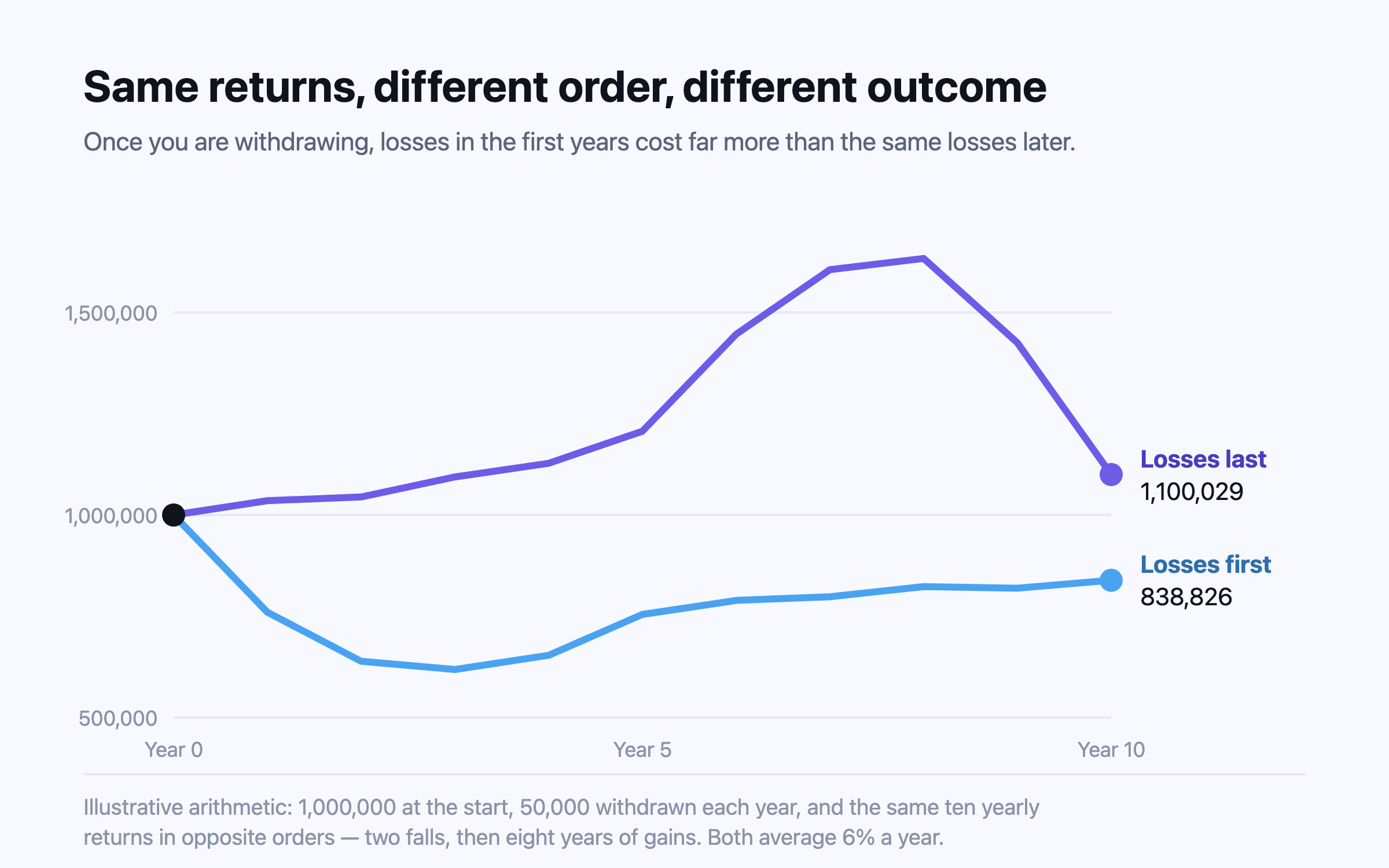
For somebody about to live on their savings, that schedule is the point. A year’s spending that is already sitting in a deposit maturing next spring does not care what the stock market does this winter. The research on sequence of returns risk shows why that matters most in the first years of drawing down: a fall early on forces sales at low prices, and the money sold never recovers.
How a ladder works
Decide what the ladder must pay. Usually a fixed sum each year for the first few years — the part of your spending that a pension, rent or part-time work will not cover.
Pick the number of rungs. Five is common: terms of one, two, three, four and five years. More rungs mean smaller amounts maturing more often; fewer mean more money in each.
Place each rung for the amount it must pay at maturity, not the amount it must hold today. Interest does part of the work, so later rungs need less put in.
When a rung matures, spend it or roll it. If the year’s money is not needed, it goes back in as a new five-year deposit at the top, and the ladder keeps its shape.
Refill from growth in good years. After a strong year for shares, topping up the top rung from your investments sells high. After a bad year, you skip the refill and let the ladder carry you.
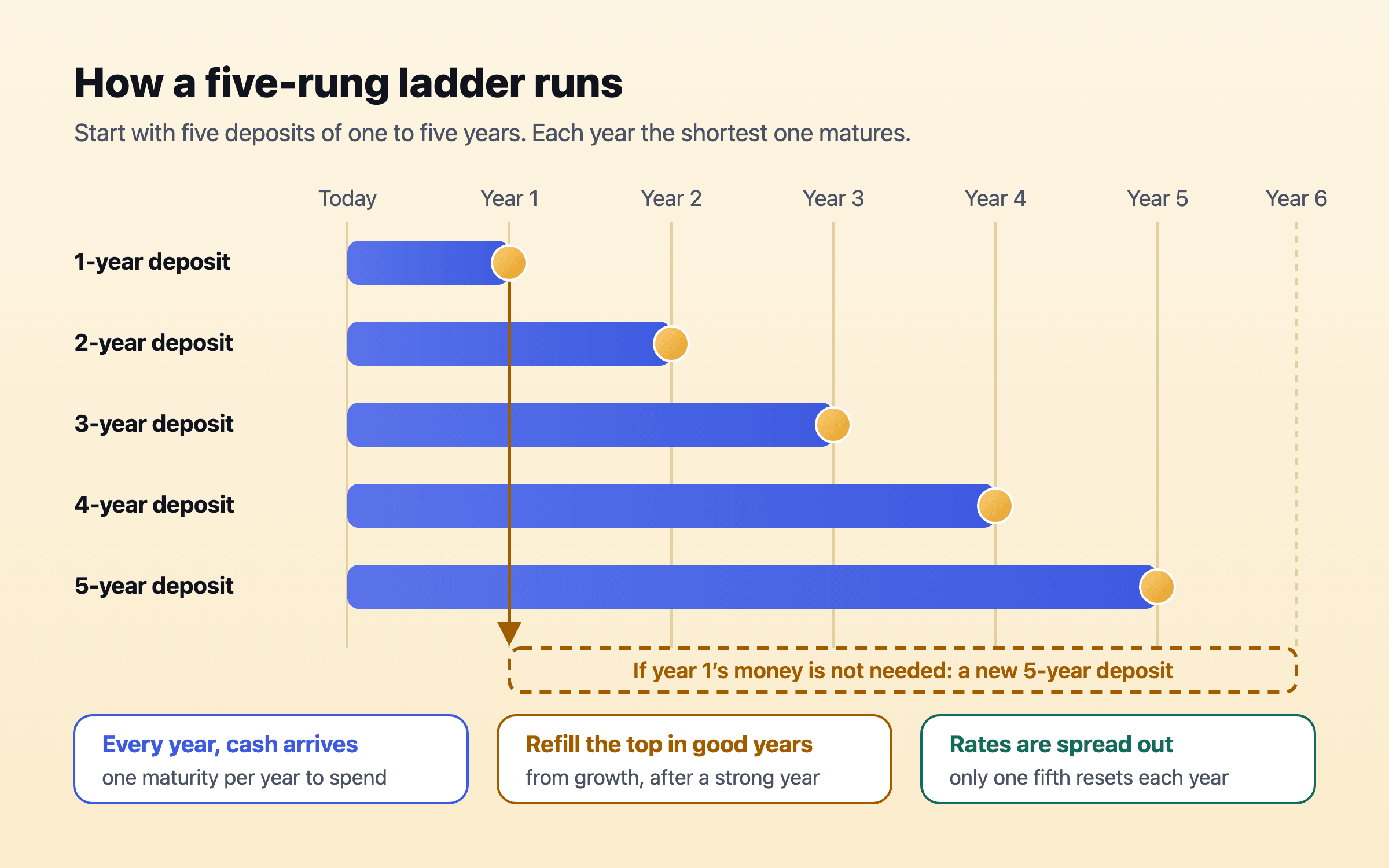
Five rungs placed on the same day. Each year the shortest one matures; money not needed that year becomes a new five-year rung, so the ladder never shortens.
Two things make this better than one big deposit. First, money arrives every year, so you never break a long deposit early — and FINRA notes that withdrawing early usually costs a penalty, typically part of the interest already earned2. Second, your rates are spread across five dates. Only a fifth of the ladder resets in any one year, so neither a peak nor a trough in rates decides everything.
What a rung pays in 2026, country by country
Rates turned up again in 2026. The Reserve Bank of India raised its repo rate by a quarter-point to 5.50% on 7 October3; the RBA lifted its cash rate to 4.60% from 30 September4. What a saver is offered follows only loosely:
India. SBI pays 6.25% on a one-to-two-year fixed deposit, 6.40% on two to three years, 6.30% on three to five and 6.05% on five to ten, with senior citizens paid half a point more (a full point on five to ten years, under SBI’s We-care scheme); that card dates from 15 December 2025 and had not changed by mid-October5. Post Office time deposits pay 6.9% for one year, rising to 7.5% for five, for October to December 20266.
United States. The one-year Treasury yielded 4.53% on 14 October, the two-year 4.82%, the three-year 4.92% and the five-year 5.00%7. The national average 12-month CD, by contrast, paid 1.73% in September8 — a gap that rewards shopping around, or using Treasuries for the rungs.
United Kingdom. Bank Rate is 3.75%9, and the top one-year fixed-term account on Moneyfacts’ best-buy table offered 5.15% on 14 October10 — the top of the market, not the average.
Australia. Banks’ advertised one-year term deposits averaged 5.00% at the end of September, and three-year ones 4.20%11.
Singapore. Rates are far lower: the six-month Treasury bill cleared at 1.90% on 8 October12, and the November Singapore Savings Bond pays 1.67% in its first year, averaging 2.45% over ten13.
What a short rung pays: one-year rates on offer, September–October 2026
Each rate is in its own currency and its own country’s inflation, so the bars compare instruments within a market better than they compare markets. The UK figure is a best buy; the US CD figure is a national average, far below what Treasuries pay. 6,5,10,11,7,12,8,13The figures in this chart
Rate
India: Post Office 1-year time deposit
6.90%
India: SBI 1-year fixed deposit
6.25%
UK: best 1-year fixed savings bond
5.15%
Australia: banks’ 1-year term deposit
5.00%
US: 1-year Treasury
4.53%
Singapore: 6-month T-bill
1.90%
US: average 12-month CD
1.73%
Singapore: Savings Bond, first year
1.67%
Deposits or government bonds?
A deposit ladder is the simplest to build: open five deposits at a bank or two, choose the terms, and let each one renew or pay out. A bond ladder buys government bonds or bills that mature in each year instead. Held to maturity, each bond repays its face value on a known date, which is what makes it behave like a deposit; sold before then, it fetches whatever the market pays, which may be less. A bond fund is different again — it never matures, so it cannot promise a sum on a date. If you want the schedule, own the bonds or the deposits, not a fund that holds them.
Which is better depends on the country. In the US in October 2026, Treasuries paid well above the average bank CD7,8. In India, small-savings schemes such as Post Office deposits paid more than SBI for every term6,5. Wherever you are, compare the rate after tax: interest on deposits and most bonds is taxed as income in most countries, which is one reason to keep a ladder inside a tax shelter where one exists.
What a ladder does not protect you from
Reinvestment risk. Every rung you roll over is re-priced at that day’s rate. Vanguard lists it among the drawbacks of short ladders: matured money may have to go back in at less1. The one-year US Treasury paid 5.49% in October 2023, 3.68% in September 2025 and 4.53% in October 202622,23,7.
Inflation. A fixed rate is fixed in money, not in what money buys. A five-year rung placed before an inflation spike pays exactly what it promised and buys less. Keep the ladder to the years you need it for, and let the rest of the portfolio do the growing.
Tax. Interest is usually taxed every year, even on a cumulative deposit that pays nothing out until maturity, so the after-tax rate is what to compare.
Concentration. Five deposits at one bank above the insurance limit is one risk, not five.
Reinvestment risk: the same one-year rung re-priced two years later, and a year after that
US 1-year Treasury
Australia: banks’ 1-year term deposit
US: 2 October 2023, 30 September 2025 and 14 October 2026. Australia: December 2023, September 2025 and September 2026. A rung rolled in 2025 locked in a rate almost two points lower than the one it replaced; one rolled in 2026 got most of it back. 22,23,7,11The figures in this chart
US 1-year Treasury
Australia: banks’ 1-year term deposit
Late 2023
5.49%
4.55%
September 2025
3.68%
3.60%
September–October 2026
4.53%
5.00%
A worked five-rung ladder
An illustrative couple in Pune, stopping work this year, want ₹10 lakh available at the start of each of the next five years while their equity funds are left alone. Rather than put ₹50 lakh aside, they place five SBI deposits, each sized to grow to ₹10 lakh at maturity at SBI’s October 2026 rates, compounded quarterly as Indian banks do5,24:
Illustrative arithmetic at the general-public rates on SBI’s card, before tax; banks’ own day counts can move each figure slightly. 5,24
Rung
Rate
Placed today
Pays at maturity
1 year
6.25%
₹9.40 lakh
₹10 lakh
2 years
6.40%
₹8.81 lakh
₹10 lakh
3 years
6.30%
₹8.29 lakh
₹10 lakh
4 years
6.30%
₹7.79 lakh
₹10 lakh
5 years
6.05%
₹7.41 lakh
₹10 lakh
Total
₹41.69 lakh
₹50 lakh
The ladder costs ₹41.69 lakh today for ₹50 lakh of spending money, so interest covers ₹8.31 lakh of it. At the senior-citizen rates on the same card, the five rungs would cost ₹40.93 lakh5. Each rung is above the ₹5 lakh DICGC limit, so the couple split every deposit across two banks, or use Post Office time deposits for part of it14,6. Notice the five-year rate is the lowest on the card: longer is not always better paid, which Vanguard also notes, and a ladder lets you take each term on its merits1.
Each spring the bottom rung matures and pays the year’s bills. If shares have had a good year, the couple sell enough to place a new five-year rung at the top; if not, they leave the equities alone and let the ladder shorten for a year. That one rule — refill only after good years — is the whole of the strategy, and the bucket strategy is the same idea described with three pots instead of five rungs.
Where the ladder sits in a plan
A ladder is not the whole of anybody’s savings. It covers a stretch of years — typically two to five — and the rest stays invested for the decades after. In the Freedom Ladder, that stretch is the Sustenance rung: years of full household spending, held in cash, deposits and bonds so a bad year never forces a sale of growth investments25. Survival below it is the emergency fund; Sufficiency above it is the corpus that has to last. How many years to hold is a judgement: the Sustenance rung suggests one and a half to three years from how steady your income is, and says that two to two and a half is typical25.
Questions people ask
What is an FD ladder?
A set of fixed deposits placed together but maturing in different years, so one pays out every year. Matured money is spent or put back as a new long deposit, keeping the ladder’s shape.
How many rungs should a CD or FD ladder have?
Five rungs a year apart is common, covering the next five years of planned withdrawals. Fewer rungs suit a shorter need; more rungs simply mean smaller, more frequent maturities.
Is a bond ladder better than a bond fund?
For a known sum on a known date, yes: a bond held to maturity repays its face value, while a fund never matures and its price moves with rates. A fund is simpler and more diversified when no date matters.
What happens to a ladder when interest rates fall?
Only the rung that matures is re-priced, so a fall reaches the ladder a fifth at a time. The US one-year Treasury fell from 5.49% in October 2023 to 3.68% in September 2025, which is the risk a ladder spreads rather than removes22,23.
How much of a fixed deposit is insured?
It depends on the country: ₹5 lakh per depositor per bank in India14, $250,000 per ownership category in the US15, £120,000 in the UK16 and A$250,000 in Australia17. Spread a large rung across banks to stay inside the limit.
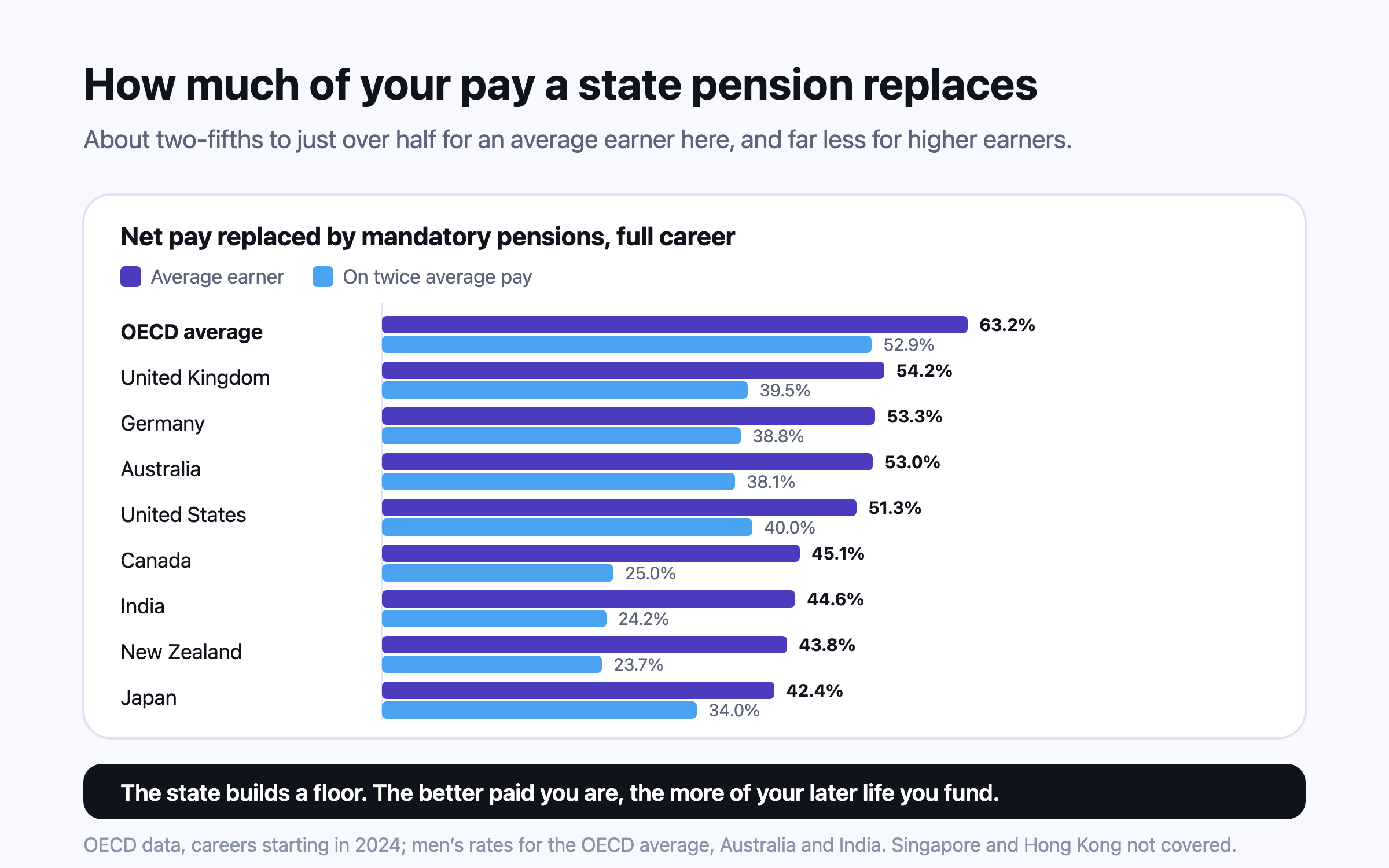
For a man on average pay, mandatory pensions replace 63.2% of net earnings on the OECD average, but around half in the US, UK, Australia and Germany and less in Canada, New Zealand, Japan and India. At twice average pay the share falls further, and Singapore, Hong Kong and India rely mostly on the worker’s own account. Here is what each system pays in 2026, how claiming age changes it, and what it leaves a middle-class household to save.
While you are saving, the order of good and bad years barely matters. Once you are withdrawing, a fall in the first few years forces you to sell low, and the money sold never recovers — so two people with the same average return can end decades apart. A cash runway, flexible spending and a modest starting withdrawal rate are the main defences.
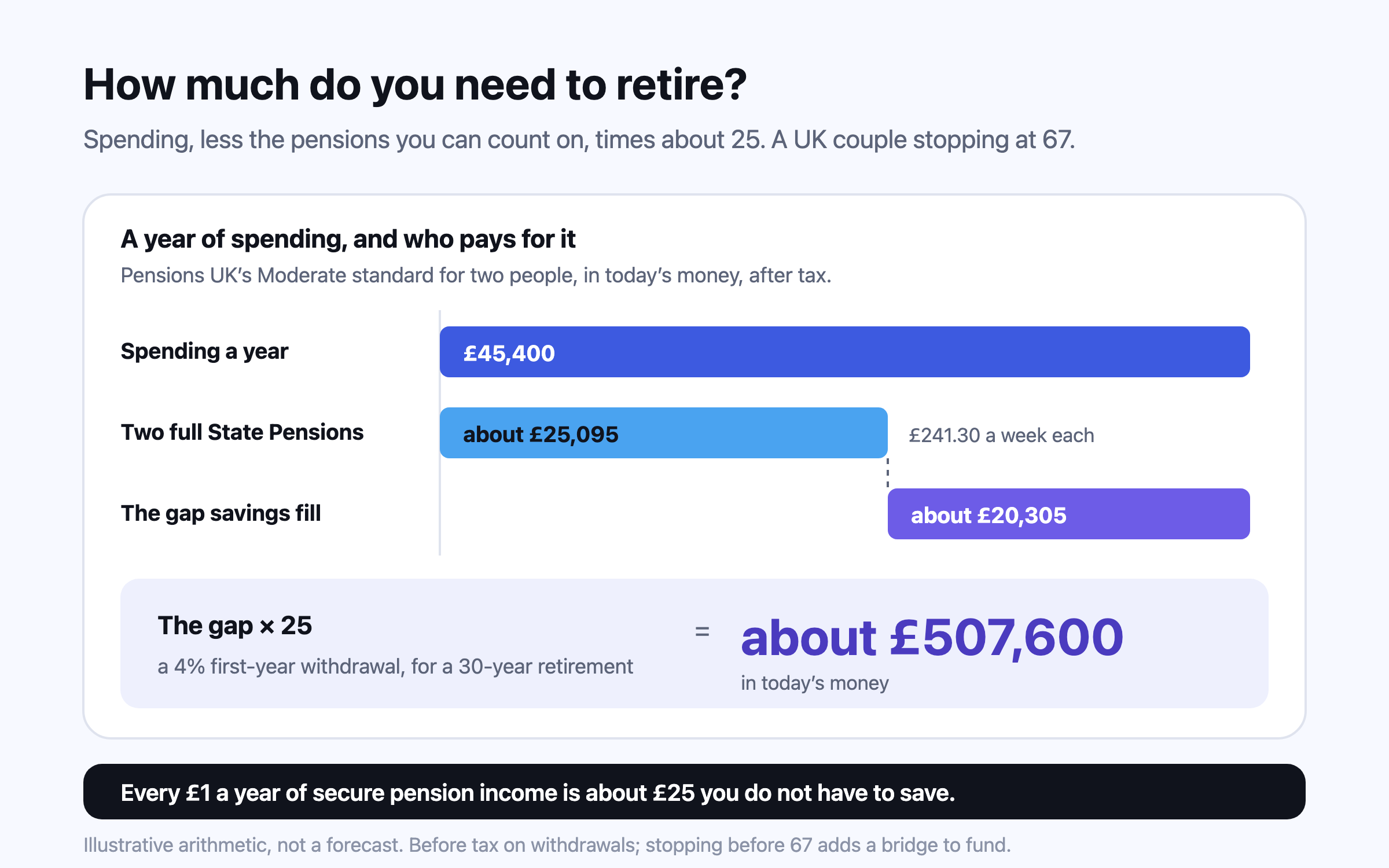
Start from what you will spend, not from what you earn. Subtract the state and workplace pensions you can rely on, and multiply what is left by about 25 for a 30-year retirement, or by closer to 30 for a 40-year one. Real spending has tended to drift down about 1% a year through retirement while healthcare rises, and a 65-year-old today can expect to live another 15 to 25 years depending on country and sex — so plan for the long end.
This is general information, not financial, tax or legal advice for your circumstances. Rules and figures change; check the official source for your country, and consult a licensed professional before making financial decisions. Projections are estimates, not predictions.