About half of adults in many countries have no will. A will, the right names on every account and one family file decide whether your money reaches the people you meant.
In the US, the UK, Canada, Singapore and Australia, roughly half of adults have no will. Money then moves by three routes: joint ownership, a name on the account, or a will — and where there is no will, a fixed legal order that may not match your wishes. Families with assets in more than one country need a plan for each, and everyone needs a family file that says what exists and where.
Nivritee Research · 2 October 2026 · updated 15 October 2026 · 7 min read
Nobody enjoys planning for their own death, which is why so few people finish it. Yet the work is mostly administrative, and most of it takes an afternoon: a will, the right names on each account, and one place where the people you leave behind can find out what exists. This guide covers how many people skip it and why, the three routes money takes when someone dies, what the law does when there is no will, the extra steps for families with money in more than one country, and a checklist for the family file.
About half of adults have no will
The surveys are strikingly similar across countries. Gallup found 46% of US adults had a will in 2021, so 54% did not.1 In the UK, 56% of adults told Opinium for Canada Life in 2022 that they had not written one.2 In Canada, half said they had no will and a further 13% had one that was out of date.3 A STEP survey of Singapore residents found 56% without a will4, and a 2026 La Trobe University study found 48% of Australians had not prepared one.5 We found no reliable national survey for India.
Share of adults without a will, by country, latest survey
Different surveys in different years, so treat the comparison as rough. Canada excludes the further 13% whose will is out of date; Singapore’s survey is small, and Australia’s figure is as reported from the La Trobe study. 4,2,1,3,5The figures in this chart
Without a will
Singapore (2020)
56%
United Kingdom (2022)
56%
United States (2021)
54%
Canada (2023)
50%
Australia (2026)
48%
Age explains much of it. In Gallup’s survey, 76% of Americans aged 65 and over had a will, against 36% of those aged 30 to 49 and 20% of those under 301 — although people in their thirties and forties are the ones most likely to have young children, a mortgage and a partner who depends on their income.
Share of US adults with a will, by age, 2021
Gallup, May 2021, 1,016 US adults. The age groups with the most people depending on them are the least likely to have a will. 1The figures in this chart
Has a will
18–29
20%
30–49
36%
50–64
53%
65 and over
76%
The reasons people give are ordinary ones. Among Canadians without a will, 24% said they were too young to need one — half of those aged 18 to 34 — and 16% that they had no assets worth worrying about; among those aged 55 and over without one, 26% said it was too expensive.3 Each is a reason to make a simple will, not to skip it: a young parent needs one most, a modest estate is the one least able to absorb legal costs, and a straightforward will is usually far cheaper than sorting out an estate without one.
Three routes money takes
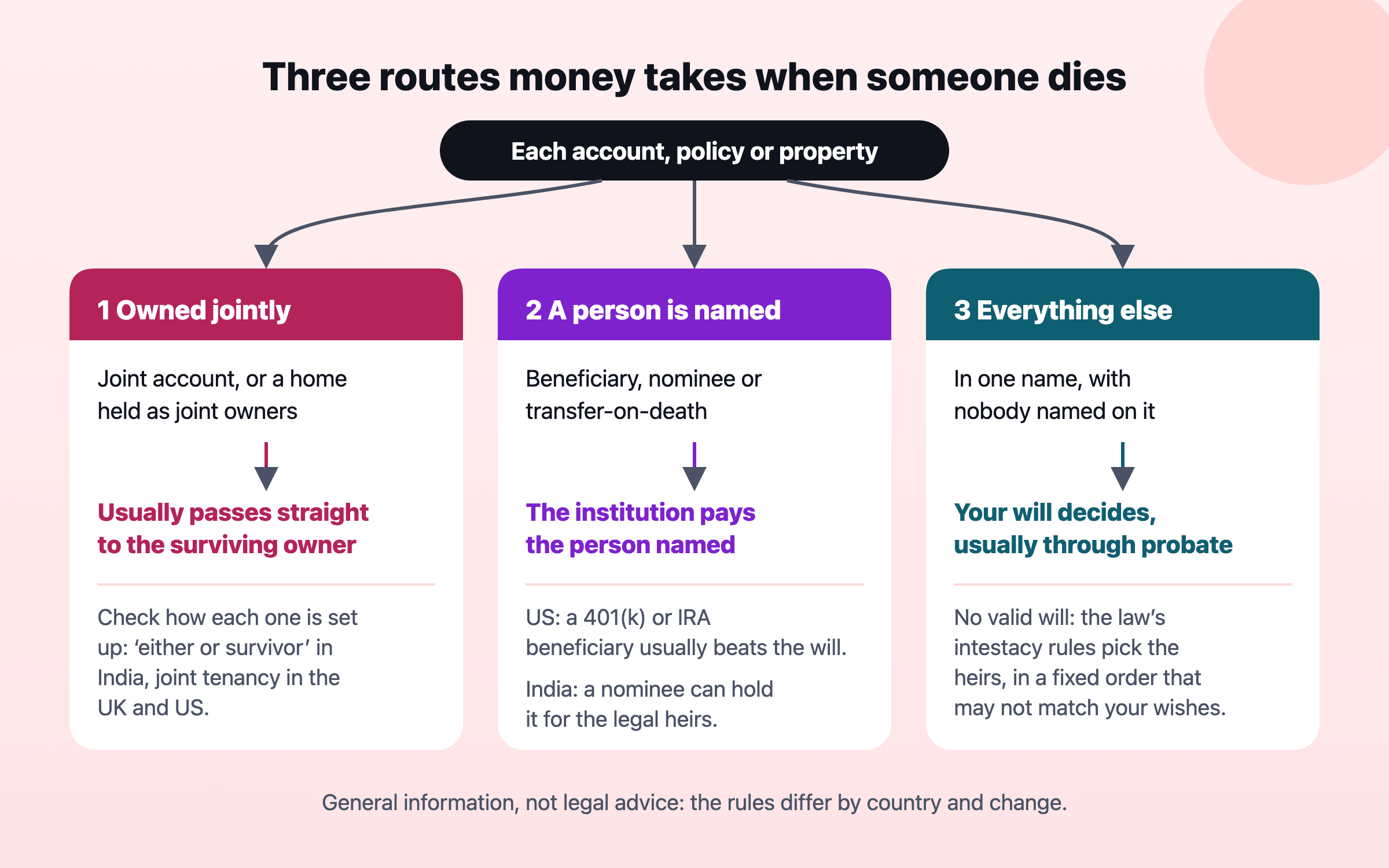
A will does not control everything you own. When someone dies, each account, policy and property follows one of three routes, and the first one that applies usually wins:
Joint ownership, a named person, or the will. A will only reaches what the first two routes leave behind.
Owned jointly. A joint account or a home held as joint owners usually passes to the survivor without waiting for the estate.
A person is named. Pensions, retirement accounts, life insurance, and in many countries bank and investment accounts carry a nominee or beneficiary. The institution pays that person.
Everything else goes through the estate: the will if there is one, and the law’s default order if there is not.
The second route is where most mistakes hide. In the US, FINRA notes that beneficiary designations on retirement accounts typically override the instructions in a will, and that on employer plans a spouse is typically required to be the primary beneficiary unless they sign a waiver.6 An old designation naming a former spouse or a parent who has since died can send money somewhere the will never intended.
India works differently. A nominee lets a bank, depository or fund house release money quickly, but the Supreme Court has held that a nominee for securities is not the absolute owner — what your partner needs to know sets out that ruling. The rules also change: SEBI’s circular of 29 May 2026 sets the limit at up to 3 nominees for demat accounts and mutual fund folios from 1 September 2026, makes nomination optional for joint accounts, and splits assets equally among nominees where no shares are given.7 Check each account’s nominations after any such change, and make sure they point the same way as the will.
When there is no will
Dying without a will — intestacy — does not mean the state takes everything. It means a fixed legal order decides, and that order often surprises families. A few examples:
England and Wales. A surviving spouse or civil partner with children takes the personal possessions, a fixed sum of £322,000 (from 26 July 2023), and half of whatever is left; the children share the other half.8,9 An unmarried partner is not on the list at all.9
Singapore. Under the Intestate Succession Act, a spouse with children receives half the estate and the children share the other half equally; the Act does not apply to the estates of Muslims.10
Abu Dhabi. For a foreign resident who dies without a will, the Judicial Department’s published rule under the emirate’s civil family law gives half to the surviving spouse and divides the other half equally between the children, with no difference between sons and daughters.11
India. Who inherits depends on the personal law that applies — the Hindu Succession Act, Muslim personal law or the Indian Succession Act — and each divides an estate differently.
Take an illustrative estate in England worth £500,000 after debts, left by someone with a spouse and two children and no will. The spouse takes £322,000 plus half of the remaining £178,000, so £411,000; the two children share £89,000, held for them until they are adults.8,9 That may be what the family wanted. If the couple were not married, or the house was meant for a child from an earlier relationship, it almost certainly is not. Under Singapore’s rules the spouse would instead receive half and each of the two children a quarter.10 Rules like these are why a short, simple will is worth more than its cost.
Families with money in more than one country
Many of our readers earn in one country and hold property, savings or family wealth in another. An estate that crosses borders can face two sets of rules, two probates and two sets of delays. Some practical points by place:
UAE. Non-Muslim residents can register a will that applies their chosen distribution. The DIFC Courts Wills Service, a joint initiative of the Government of Dubai and the DIFC Courts, offers full wills and narrower ones for property, financial assets, business interests, digital assets and guardianship of children.12 Abu Dhabi’s Judicial Department runs its own register, open to any resident who is not a UAE citizen whatever their religion, with a fee of AED 950 for a regular will.11
European Union. By default, the law of the country where you last lived usually governs your whole estate, but you can choose the law of your nationality instead in your will. The EU rules do not apply in Denmark or Ireland.13
India, for families abroad. Indian property and accounts are usually easiest to pass on with a will made for them in India, alongside a will where you live, drafted so neither cancels the other. Ask a lawyer in each country.
Everywhere. Keep nominations and beneficiaries current on accounts in every country, and list each one in the family file with the country it is in.
Money that nobody knows about simply goes missing. The UK’s Pensions Policy Institute estimated in October 2026 that there are around 3 million lost pension pots in the UK holding about £18.7 billion.14 In the US, the association of state unclaimed-property administrators says roughly 1 in 7 people has unclaimed cash or property waiting for them.15 A list of what exists is the cheapest protection there is.
The family file: a checklist
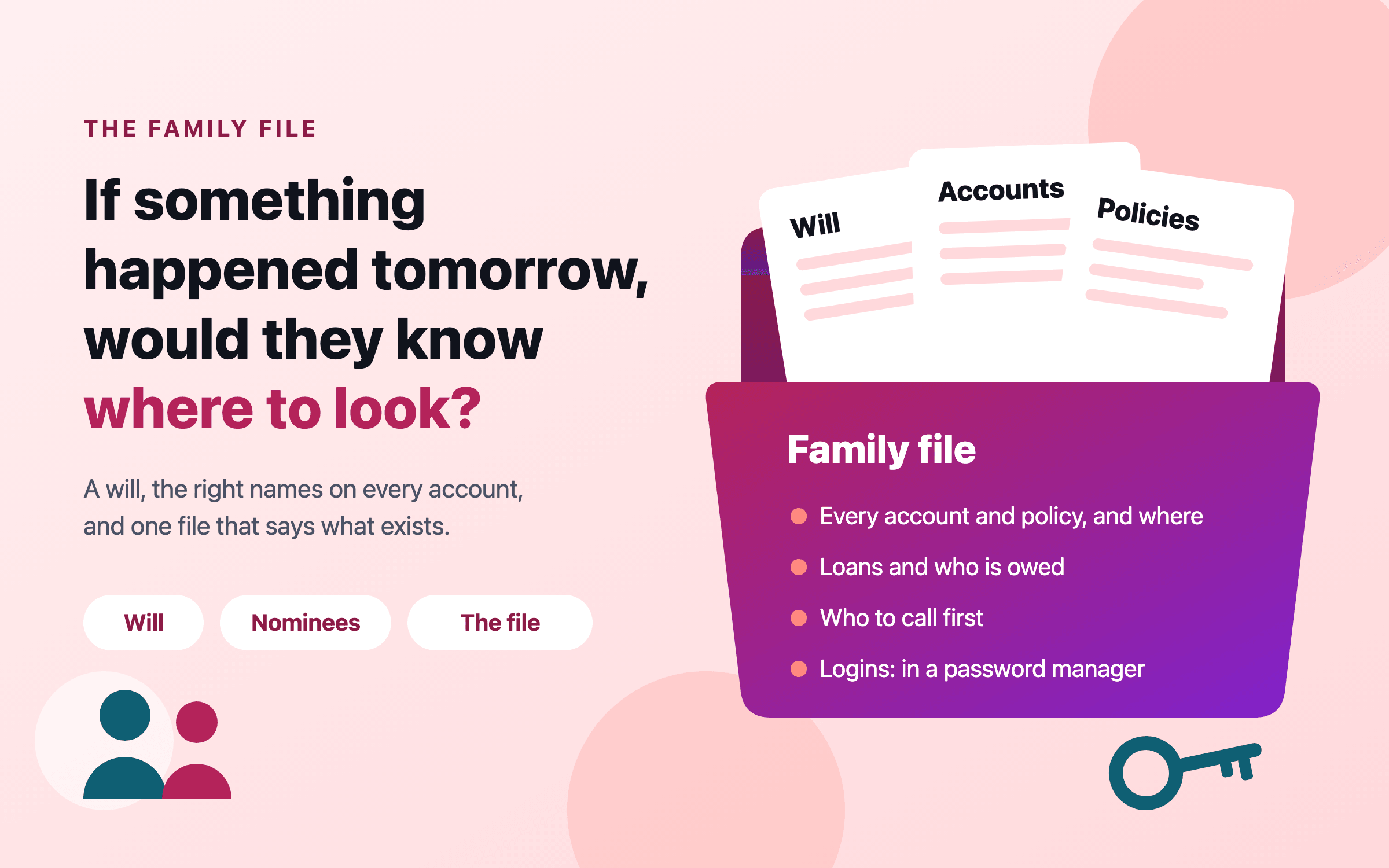
The family file is not a legal document. It is a short record, kept somewhere two people know about, that lets someone pick up your financial life without detective work. Keep account numbers and passwords out of it; the file says what exists and where, and the logins live in a password manager.
Every account. Bank, deposits, investments, retirement and provident funds, in every country — institution, type, whose name, and who is named on it.
Insurance. Life, health and property policies: the insurer, the policy number and roughly what each pays.
Property. Where the deeds are, and whether each home is owned jointly or alone.
What is owed. Mortgages, loans, cards, and any guarantee you have given for someone else.
The will, and where the signed original is kept; the executor’s name.
Who to call. The lawyer, the accountant, an employer’s benefits team, the insurance agent.
Digital access. A password manager with an emergency-access contact, and the legacy settings your phone and email offer — Apple, for instance, lets you name a Legacy Contact who can reach certain account data after your death.16
A note of intent. What the money is for: the children’s education, the emergency buffer, the long-term savings that should not be touched in a bad year.
Review it once a year and after every marriage, birth, divorce, move or new account. The most common failure is not a missing will; it is a will and a set of nominations that were right ten years ago.
How Nivritee helps
Nivritee does not write wills, hold documents or store passwords — those belong with a lawyer, each institution and a password manager. What it holds is the other half of the family file: what exists, where, and what it is for.
Roughly half, in most countries surveyed: 46% of US adults had one in 20211, while 56% of UK adults had not written one in 20222 and half of Canadians had none in 2023.3
Does a beneficiary designation override a will?
For US retirement accounts, typically yes: FINRA notes beneficiary designations typically override a will’s instructions.6 Keep both consistent and review designations after any marriage, divorce or death in the family.
What happens if you die without a will in the UK?
In England and Wales, a spouse or civil partner with children takes personal possessions, the first £322,000 and half of the rest, and the children share the other half; an unmarried partner is not on the list and has no automatic share.8,9
How many nominees can I add to a demat account or mutual fund?
From 1 September 2026, up to 3, under SEBI’s circular of 29 May 2026; where no shares are given, assets are split equally among them.7
Can an expat make a will in the UAE?
Yes. Non-Muslims can register a will with the DIFC Courts Wills Service12, and any resident who is not a UAE citizen can register one with Abu Dhabi’s Judicial Department, which charges AED 950 for a regular will.11
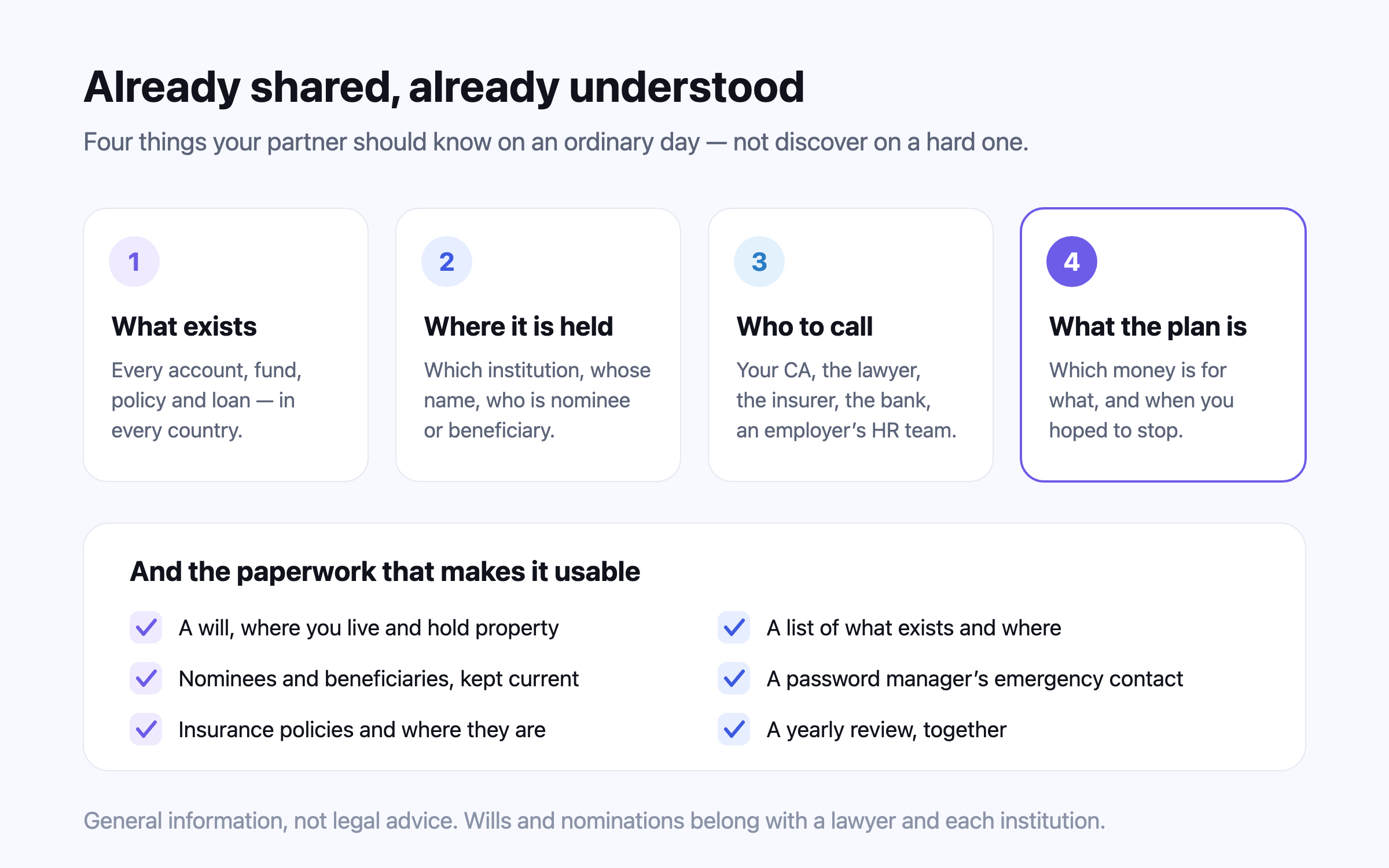
In most households one person knows where everything is. Readiness means your partner knows four things too — what you own and owe, where each is held, who to call, and what the plan is — plus the paperwork that makes it usable: a will, up-to-date nominations or beneficiaries, insurance details and a way into the accounts. The easiest time to share all of it is now, when nothing is wrong.
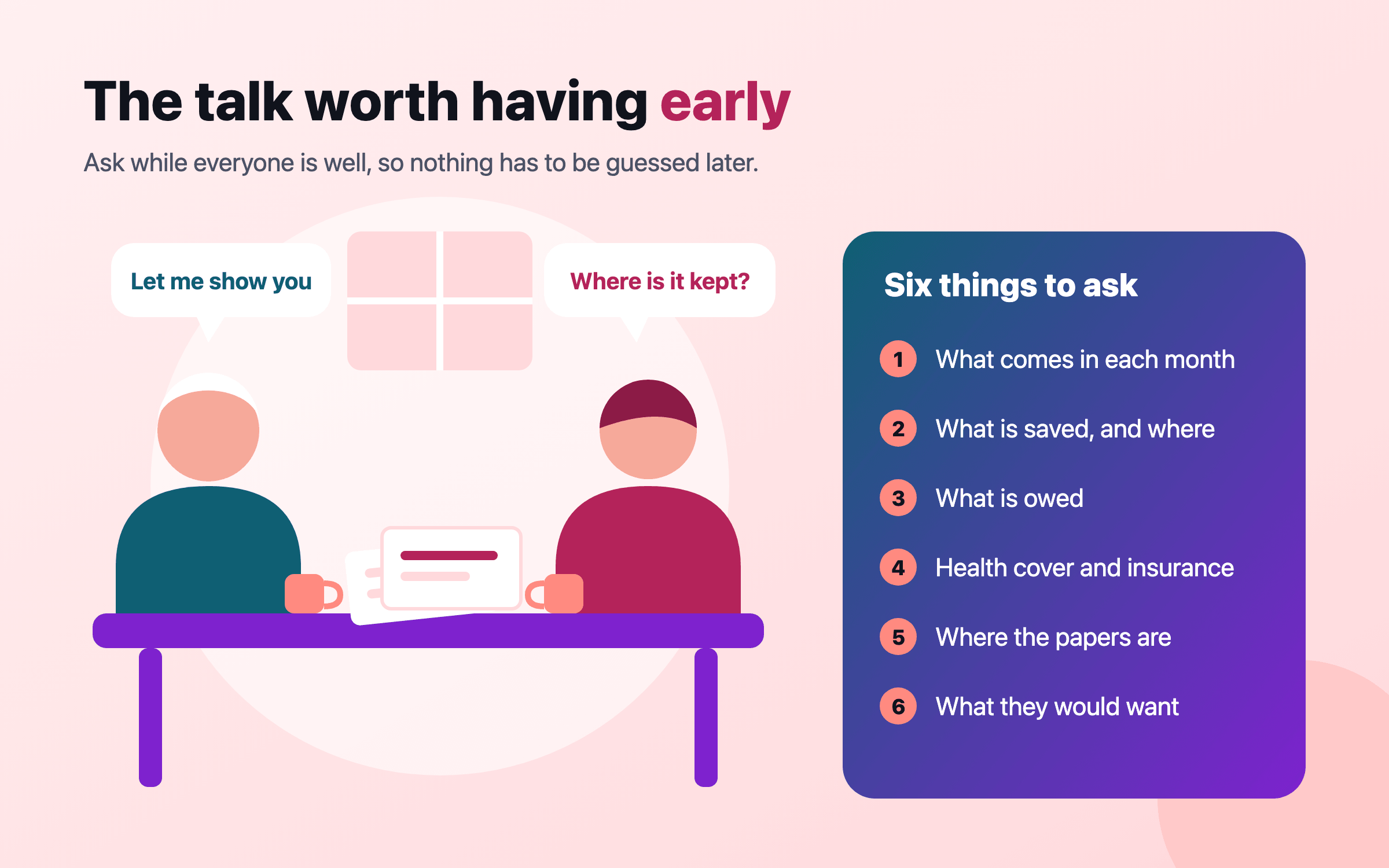
Most families have this conversation too late, in a hospital corridor. Asked early, it comes down to six things — what comes in, what is saved, what is owed, what cover exists, where the papers are and what your parents would want — plus a power of attorney signed while they are well, a watch for scams, and an agreed split of support between siblings that also fits inside your own plan.
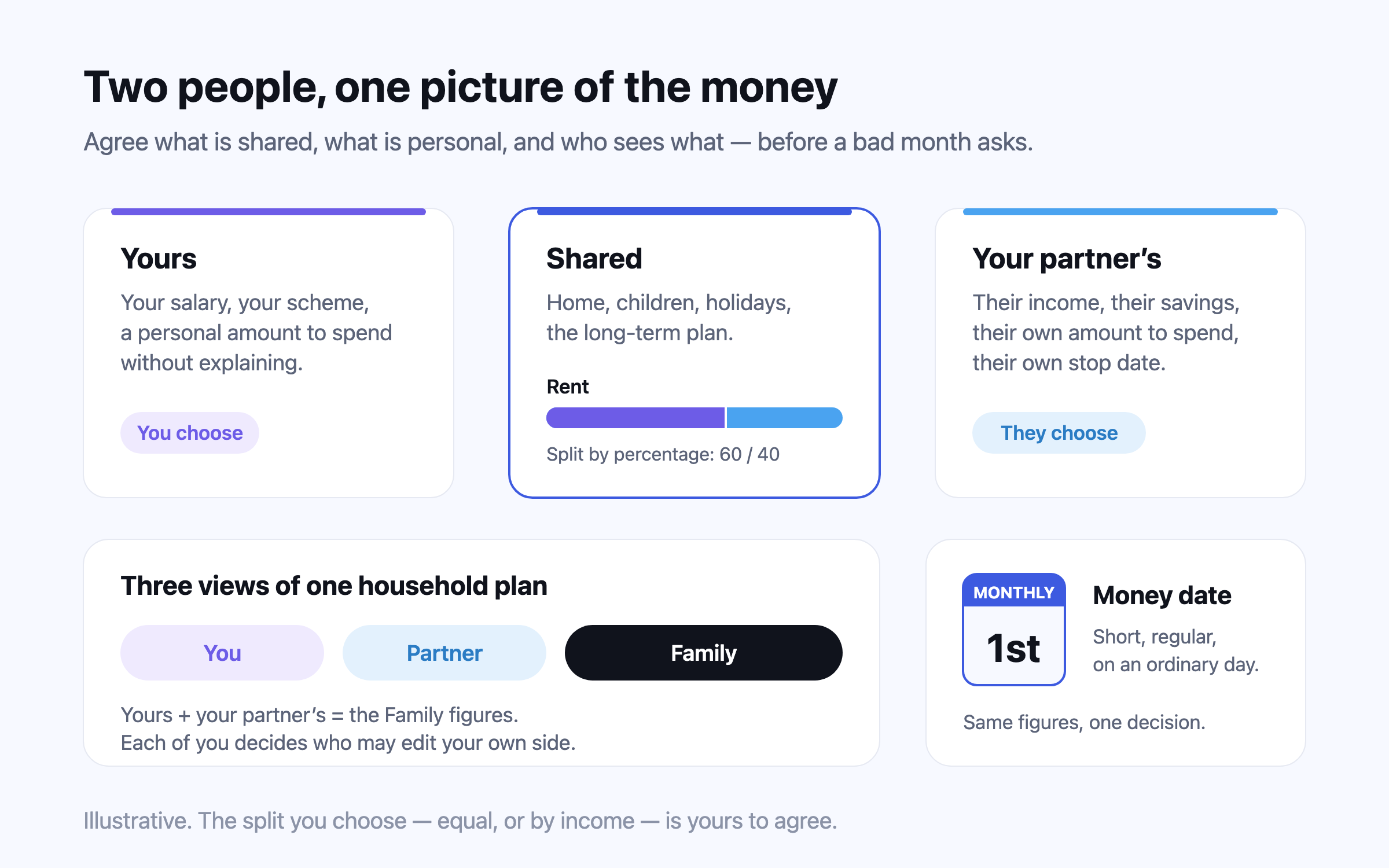
Money disagreements are common and, in long-run data, more strongly linked to divorce than any other kind. What helps is not agreeing on everything but seeing the same picture: a structure for joint and personal money, a regular money date, an agreed answer to who sees what, and one plan that holds two careers which may stop at different times.
This is general information, not financial, tax or legal advice for your circumstances. Rules and figures change; check the official source for your country, and consult a licensed professional before making financial decisions. Projections are estimates, not predictions.