The money talk with ageing parents is easiest while nothing is wrong. Six questions, one signed power of attorney and a plan for who pays what cover most of it.
Most families have this conversation too late, in a hospital corridor. Asked early, it comes down to six things — what comes in, what is saved, what is owed, what cover exists, where the papers are and what your parents would want — plus a power of attorney signed while they are well, a watch for scams, and an agreed split of support between siblings that also fits inside your own plan.
Nivritee Research · 9 September 2026 · updated 15 October 2026 · 7 min read
Few conversations are put off as reliably as the one about a parent’s money. Parents do not want to become a burden or to hand over control; children do not want to seem to be counting an inheritance. So nobody asks, until a fall, a diagnosis or a phone call from a bank forces the question at the worst possible moment — when decisions are rushed, documents are missing and the person who knew where everything was cannot say.
It does not have to go that way. This guide covers why the conversation matters more each year, what care actually costs, what to ask, how to spot the scams aimed at older people, how power of attorney works in several countries, and how brothers and sisters can share the support fairly — including how to fit it into your own plan without stopping your own saving.
More parents, living longer
The share of older people is rising almost everywhere. In 2024 about 10.2% of the world’s population was 65 or over; in Japan it was 29.8%, in Hong Kong 22.7%, across the European Union 22.0% and in the UK 19.5%.1 The United Nations projects that by the mid-2030s there will be more people aged 80 and over than infants under one, and that by the late 2070s people aged 65 and over will outnumber children under 18.2
Share of the population aged 65 and over, 2024
World Bank indicator SP.POP.65UP.TO.ZS, from UN population estimates. India and Malaysia are young today but ageing quickly; in absolute numbers India already has one of the largest older populations in the world. 1The figures in this chart
Aged 65 and over
Japan
29.8%
Hong Kong
22.7%
European Union
22.0%
Canada
19.8%
United Kingdom
19.5%
United States
17.9%
Australia
17.7%
New Zealand
17.2%
Singapore
13.7%
World
10.2%
Malaysia
7.7%
India
7.1%
Longer lives are good news, and they also mean money has to last longer, health costs arrive later and in larger amounts, and more families will at some point help a parent with paperwork, payments or decisions. The question is not whether to talk about it, but whether to talk early.
What care costs, and who pays
Care is the cost that most often catches families out, because few parents have priced it. In England, LaingBuisson’s figures reported by Which? put the average care home at £1,042 a week for residential care and £1,372 a week for nursing care in 2024–25 — residential care alone is about £54,000 a year.3 People who pay for themselves are charged more than councils pay for the same bed: £1,278 a week against £908 for residential care.3 The state means-tests: someone with capital above £23,250 pays in full, and between £14,250 and that limit contributes £1 a week for every £250.4
Average weekly care home fees in England, 2024–25: what councils pay and what private residents are charged
Paid by councils
Charged to people paying for themselves
For-profit care homes for older people in England, LaingBuisson data reported by Which?. A self-funder pays about £370 a week more for the same kind of place. 3The figures in this chart
Paid by councils
Charged to people paying for themselves
Residential care
£908
£1,278
Nursing care
£1,225
£1,594
In the US, the surprise is usually about who pays. Medicare does not pay for long-term custodial care, at home or in a nursing home, and Medigap does not cover it either.5 CareScout’s 2025 survey put the national median for assisted living at $6,200 a month.6 In India there is no single published figure we could source; costs depend heavily on the city and on whether care is at home, which is where most of it happens. The sandwich generation sets out more care costs, and how fast medical costs rise in each market.
What to ask, and how to start
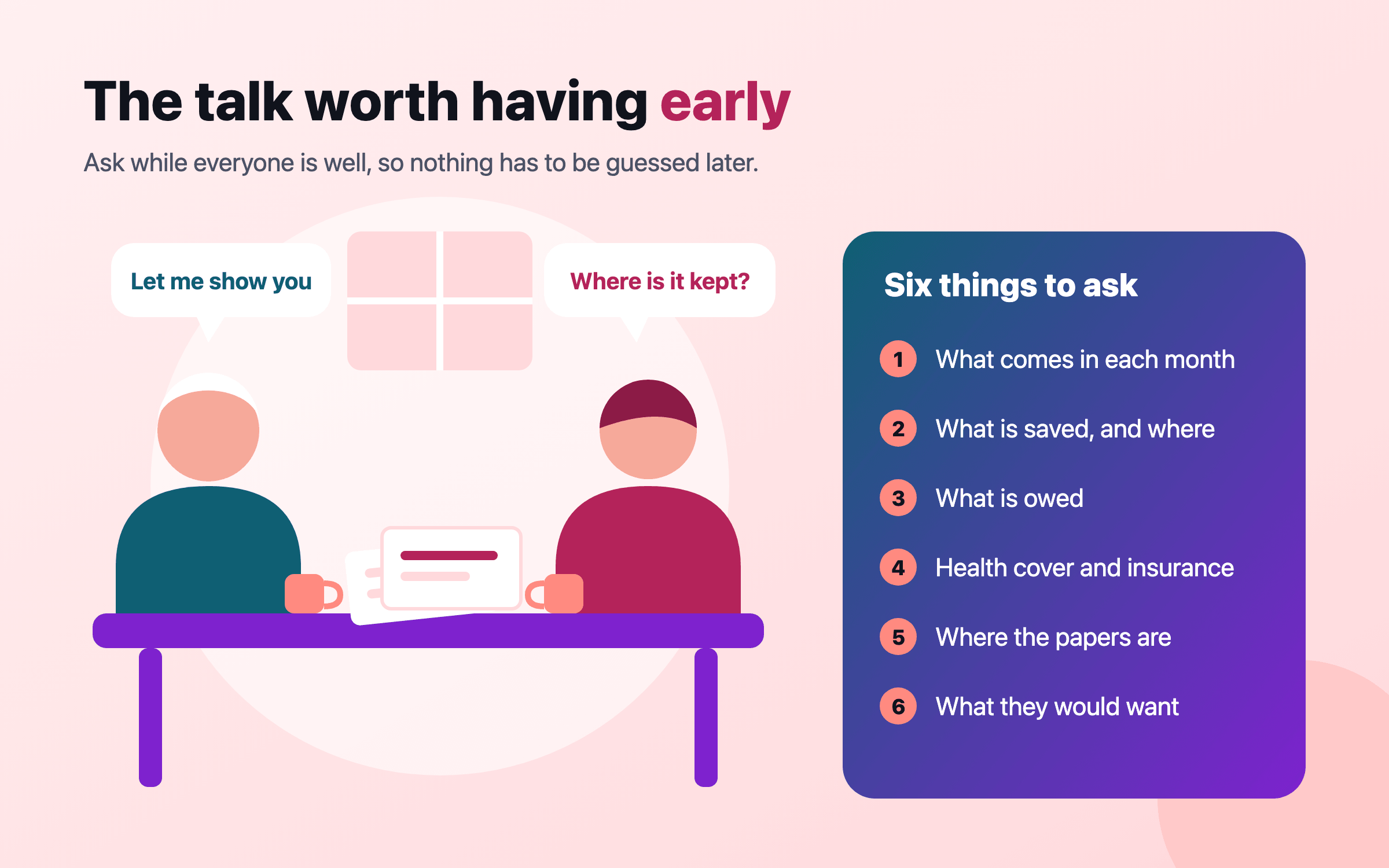
Start from their wishes rather than their wealth. “If you ever needed help with bills, who would you want to do it?” is easier to answer than “how much do you have?”, and it leads to the same place. Several short conversations work better than one long one. The things worth knowing, in roughly the order families find easiest:
What comes in each month. Pensions, annuities, rent, interest, any work. Roughly when each arrives and into which account.
What is saved, and where. Banks, deposits, investments, retirement accounts, property, gold. Not balances to the rupee or the pound — just enough to know what exists.
What is owed. A mortgage, a loan to a relative, a credit card, money they have guaranteed for someone else.
What cover exists. Health insurance and whether it renews for life, long-term care cover, life insurance, and the policy documents.
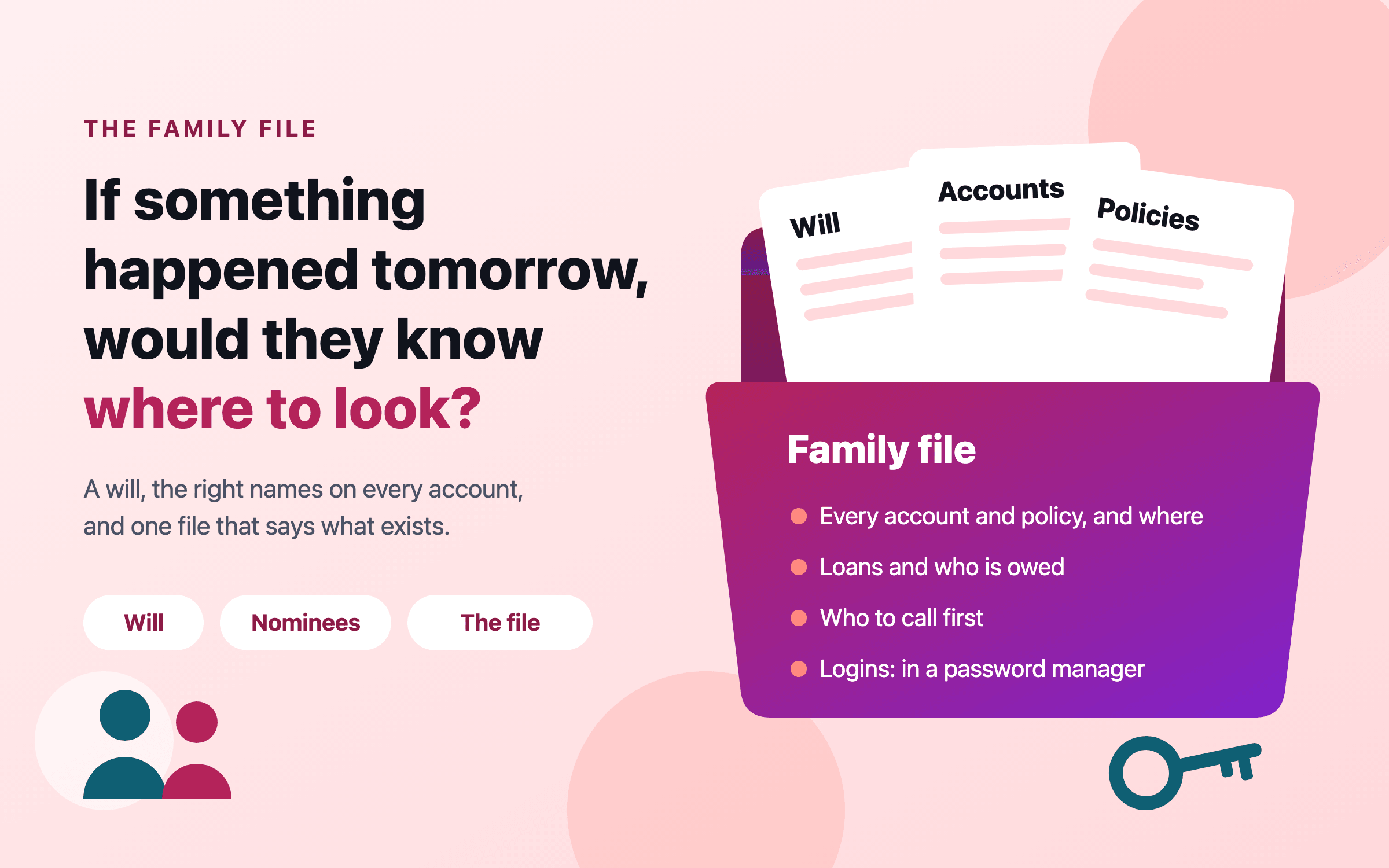
Where the papers are, and who to call: the will, property deeds, the accountant, the lawyer, the bank’s relationship manager. A list in one place is the goal — the family file sets out what goes in it.
What they would want. Where they would like to live if they need care, how they want decisions made, and who should make them.
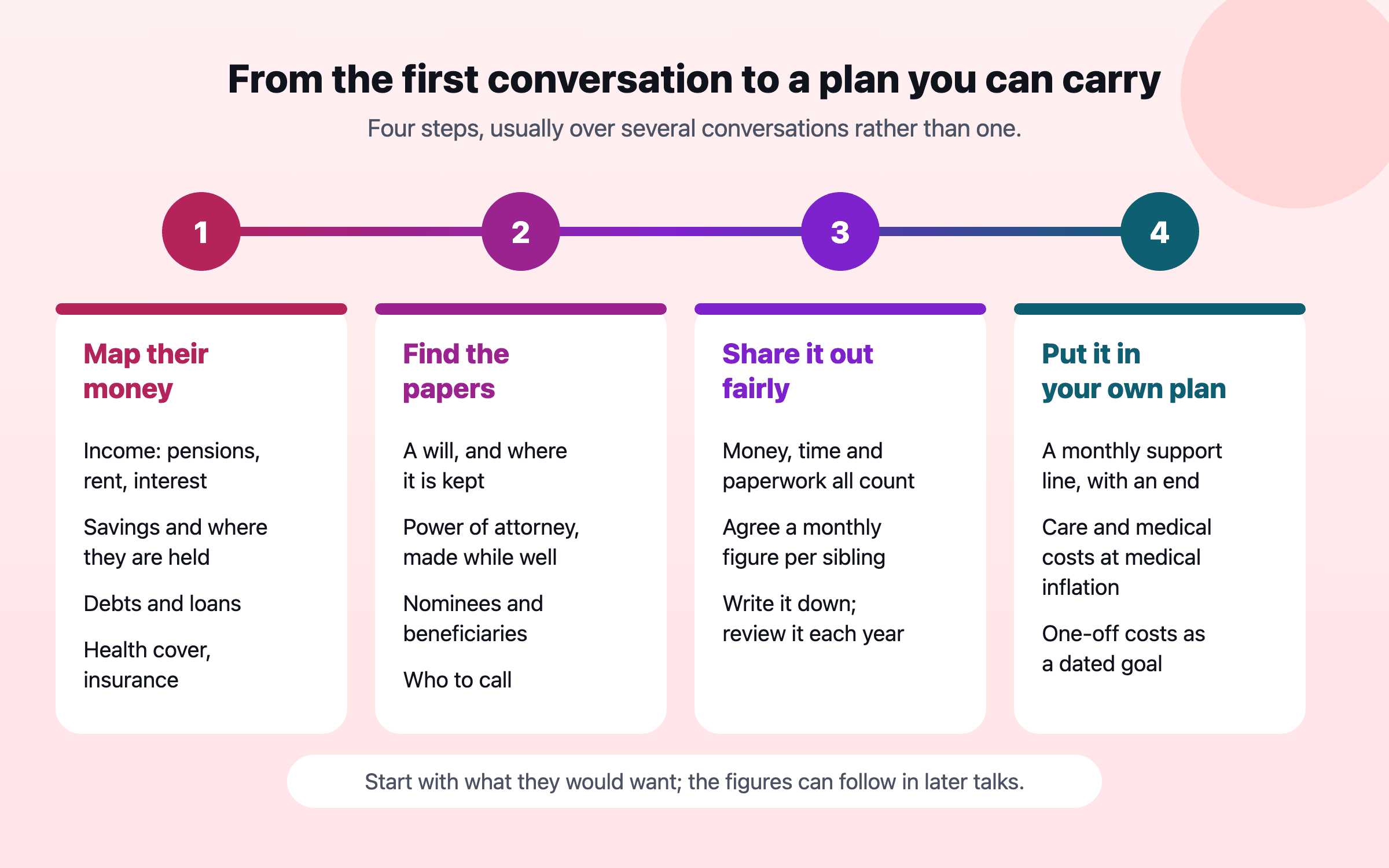
From the first conversation to a plan you can carry. Most families take these over several conversations, not one.
Scams aimed at older people
Fraud is now one of the largest financial risks of later life. In 2025 the FBI’s Internet Crime Complaint Center received 201,266 complaints from people aged 60 and over, reporting losses of $7.748 billion — up 59% on 2024 and an average of $38,500 each. More than 12,000 of them lost over $100,000.7 In England and Wales, Age UK estimates that two people aged 65 and over are scammed every minute.8 In India, the government has warned about “digital arrest” scams, in which callers posing as police, the CBI or the RBI keep a victim on a video call until they pay.9
Losses reported to the FBI by people aged 60 and over, 2025, by type of fraud
Self-reported complaints to the FBI’s Internet Crime Complaint Center. Much of the investment fraud ran through cryptocurrency. Complaints undercount losses, because many victims never report. 7The figures in this chart
Losses, US$ billion
Investment
$3.52bn
Tech and customer support
$1.04bn
Romance and confidence
$0.58bn
Business email compromise
$0.57bn
Government impersonation
$0.41bn
Most of these frauds share three signs, and teaching a parent to spot them is worth more than any software:
Urgency. A deadline, a threat of arrest, an account “about to be frozen”. Real banks and police do not demand action within the hour.
Secrecy. “Do not tell your family” is the clearest sign of all. Agree now that any request for money gets a call to you first.
An unusual way to pay. Gift cards, cryptocurrency, a wire to a “safe account”, or handing over a device or a one-time password.
Practical defences: a trusted-contact name on their bank and investment accounts where the firm offers one, alerts on large payments, and a family rule that nobody is embarrassed to ask. In India, scams can be reported on the 1930 helpline or at cybercrime.gov.in.9
Power of attorney, by country
A power of attorney lets a parent choose who can manage their money if they cannot. The one rule that holds almost everywhere: it must be made while the person still has mental capacity. After that, the family usually needs a court, which is slower, dearer and not their choice.
England and Wales. There are two lasting powers of attorney: property and financial affairs, and health and welfare. A person must be 18 or over and have mental capacity to make one, and it must be registered with the Office of the Public Guardian; the financial one can be used as soon as it is registered, with the person’s permission.10 Registering costs £92 each and takes eight to ten weeks if there are no mistakes.11
United States. Rules are set by each state; a power of attorney that keeps working if the person loses capacity is often called a durable one. The CFPB’s guide for agents sets out four duties: act only in the person’s best interest, manage their money carefully, keep it separate from your own, and keep good records.12
Singapore. A lasting power of attorney can be made by anyone aged 21 or over, for personal welfare, property and affairs, or both, and Singapore citizens can apply using the standard Form 1 free of charge; a certificate issuer’s fee still applies.13
Canada (Ontario). A power of attorney for property can be made from 18, and the attorney can act straight away unless the document says they may act only if the person becomes mentally incapable.14
India. Rules on whether a power of attorney survives a loss of capacity are less settled. Take legal advice, and meanwhile make sure joint accounts, nominations and a will are in place.
Whoever holds it, keep the parent’s money visibly separate from your own and write down what you spend on their behalf. That protects the parent and protects you from a sibling’s later question.
Sharing it between siblings
Care is rarely shared evenly. Angelina Grigoryeva’s study of US Health and Retirement Study data found daughters provide more care to elderly parents than sons do — and that sons provide less when they have a sister, while daughters provide more when they have a brother.15 Left unspoken, support tends to settle on whoever lives closest or says no least easily.
Count all three kinds of help. Money, time and paperwork. A sibling abroad who cannot visit can carry more of the cost; the one nearby carries more of the hours.
Agree a monthly figure or a percentage each, and what counts as shared: care, medicines, the house, the household help.
Name one person for the paperwork — usually the one holding the power of attorney — and agree that they report to the others.
Write it down, and say what happens if one of you cannot pay for a while.
Review it once a year and whenever a parent’s needs change.
Putting support for parents into your own plan
Whatever your share turns out to be, it belongs in your own plan as a real cost, with a start and an end, rather than something absorbed quietly from savings. Two kinds of cost need different treatment. A regular allowance or a share of care fees is ongoing spending that stops at some point. A one-off cost — a care-home deposit, an operation, adapting a house — is a goal with a year attached.
How do I start a conversation with my parents about money?
Start with their wishes, not their wealth: ask who they would want to help with bills if they ever needed it, and where their important papers are. Several short, calm conversations work better than one long one, and none should happen in a crisis.
What questions should I ask my ageing parents about their finances?
Six cover most of it: what comes in each month, what is saved and where, what is owed, what insurance and health cover exist, where the will and other papers are kept, and what they would want if they needed care.
How much does a care home cost in the UK?
In England the average in 2024–25 was £1,042 a week for residential care and £1,372 for nursing care, with people paying for themselves charged more than councils pay.3
When should parents set up a power of attorney?
While they are well. A power of attorney can only be made while a person has mental capacity; in England and Wales a lasting power of attorney must then be registered, which costs £92 and takes eight to ten weeks.11
How common is financial fraud against older people?
Very. Americans aged 60 and over reported losses of $7.748 billion to the FBI in 2025, the most of any age group, with investment and tech-support scams the costliest.7
In the US, the UK, Canada, Singapore and Australia, roughly half of adults have no will. Money then moves by three routes: joint ownership, a name on the account, or a will — and where there is no will, a fixed legal order that may not match your wishes. Families with assets in more than one country need a plan for each, and everyone needs a family file that says what exists and where.
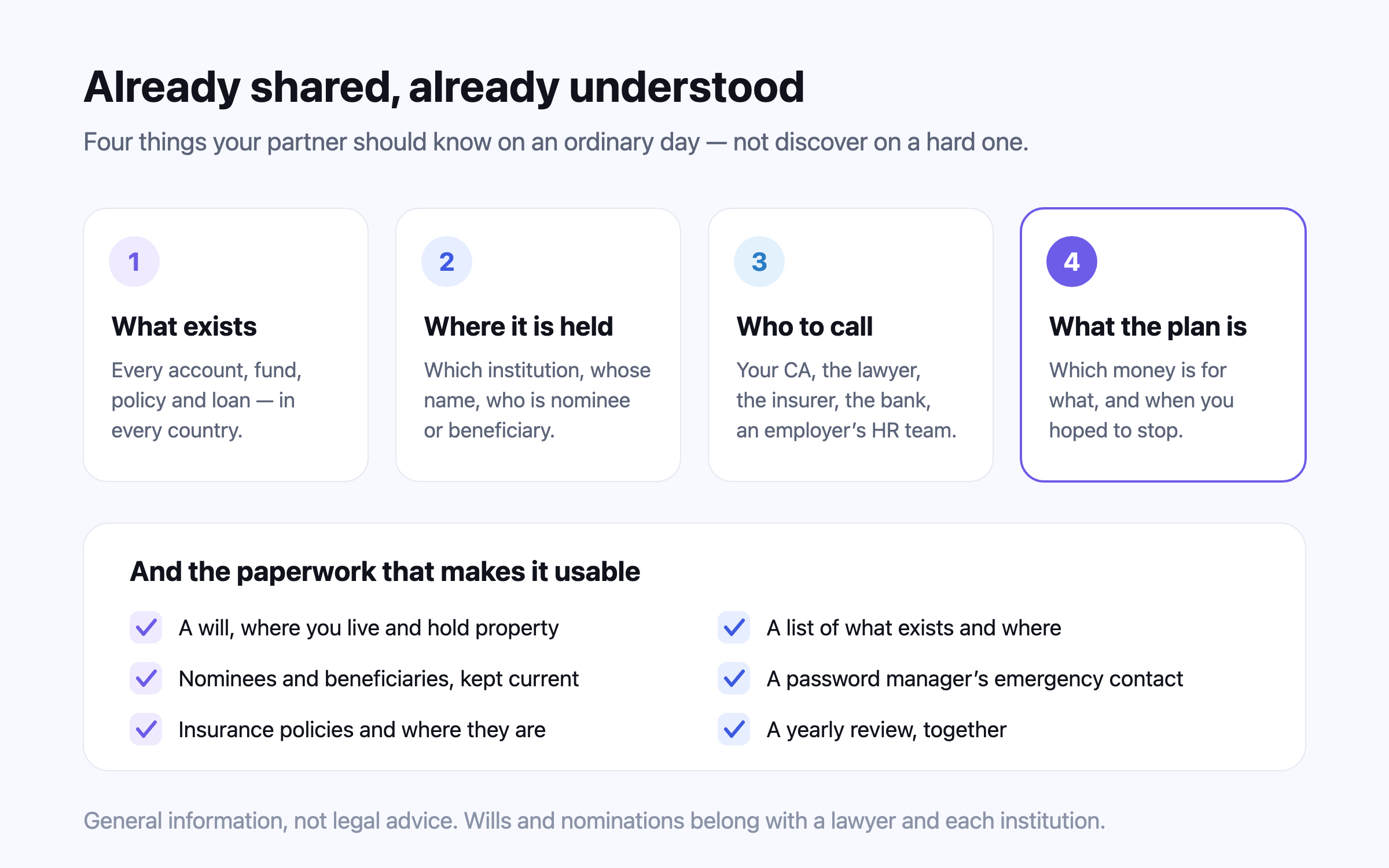
In most households one person knows where everything is. Readiness means your partner knows four things too — what you own and owe, where each is held, who to call, and what the plan is — plus the paperwork that makes it usable: a will, up-to-date nominations or beneficiaries, insurance details and a way into the accounts. The easiest time to share all of it is now, when nothing is wrong.
Money disagreements are common and, in long-run data, more strongly linked to divorce than any other kind. What helps is not agreeing on everything but seeing the same picture: a structure for joint and personal money, a regular money date, an agreed answer to who sees what, and one plan that holds two careers which may stop at different times.
This is general information, not financial, tax or legal advice for your circumstances. Rules and figures change; check the official source for your country, and consult a licensed professional before making financial decisions. Projections are estimates, not predictions.