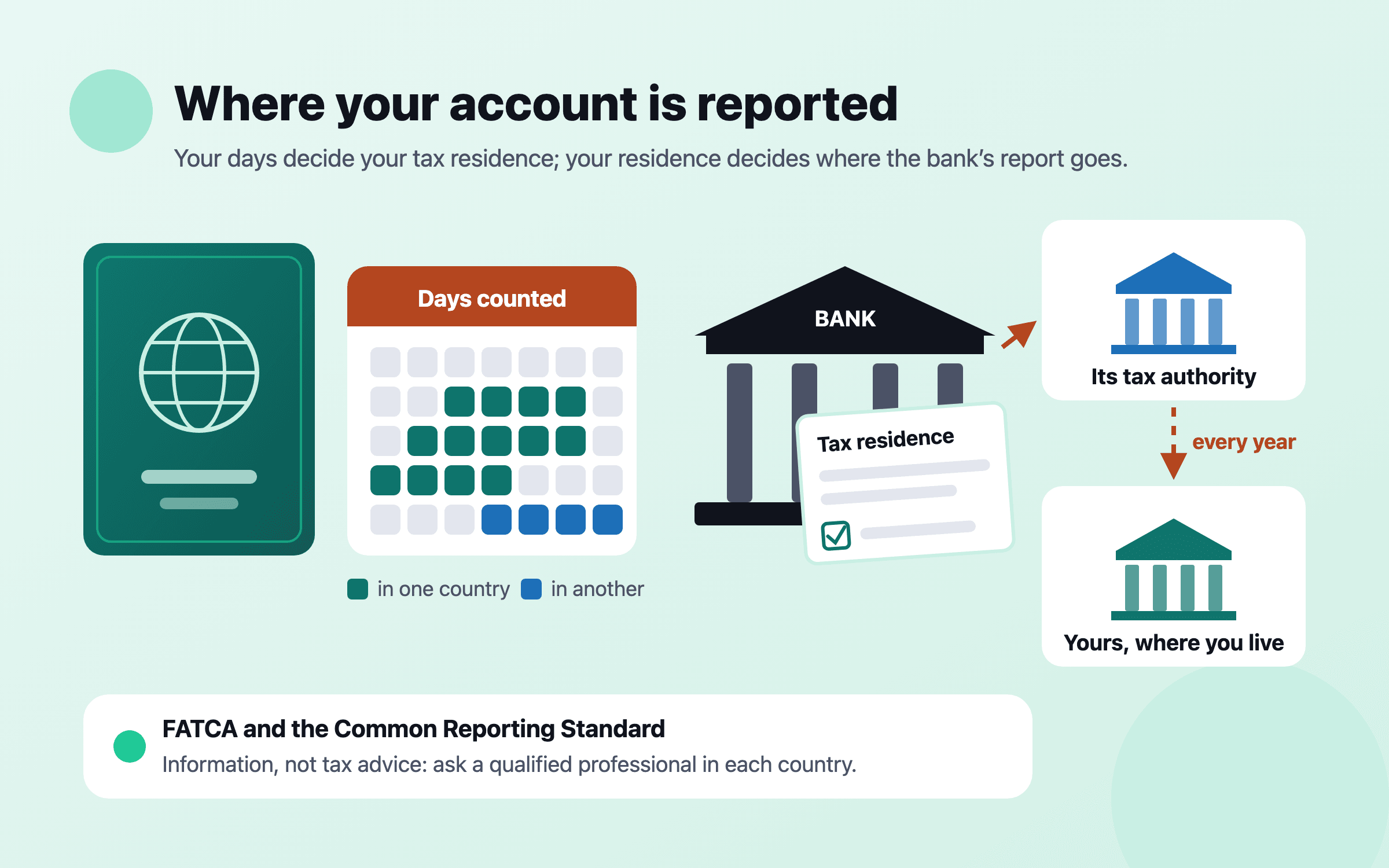
Your bank abroad probably reports what you hold to the tax authority where you live. Tax residency decides where that report goes, and for Americans, citizenship does too.
Under the OECD’s Common Reporting Standard, banks and funds report accounts held by non-residents to their own tax authority, which passes the details to the country where the holder is resident; 116 jurisdictions have begun exchanging. The US runs its own system, FATCA, and taxes its citizens wherever they live. Which country you are resident in is decided by each country’s own tests, mostly day counts, so keeping a record of your days and your papers is the first job.
Nivritee Research · 15 July 2026 · updated 15 October 2026 · 8 min read
Open an account abroad and, somewhere in the paperwork, you will be asked to declare your country of tax residence and, often, whether you are a US person. That form feeds two reporting systems: the OECD’s Common Reporting Standard (CRS) and the United States’ FATCA. In 2024 alone, tax authorities automatically exchanged information on over 171 million financial accounts with a total value of nearly EUR 13 trillion1. For a family that earns in one country, saves in another and may settle in a third, it helps to know what is reported, to whom, and what decides it.
What the Common Reporting Standard is
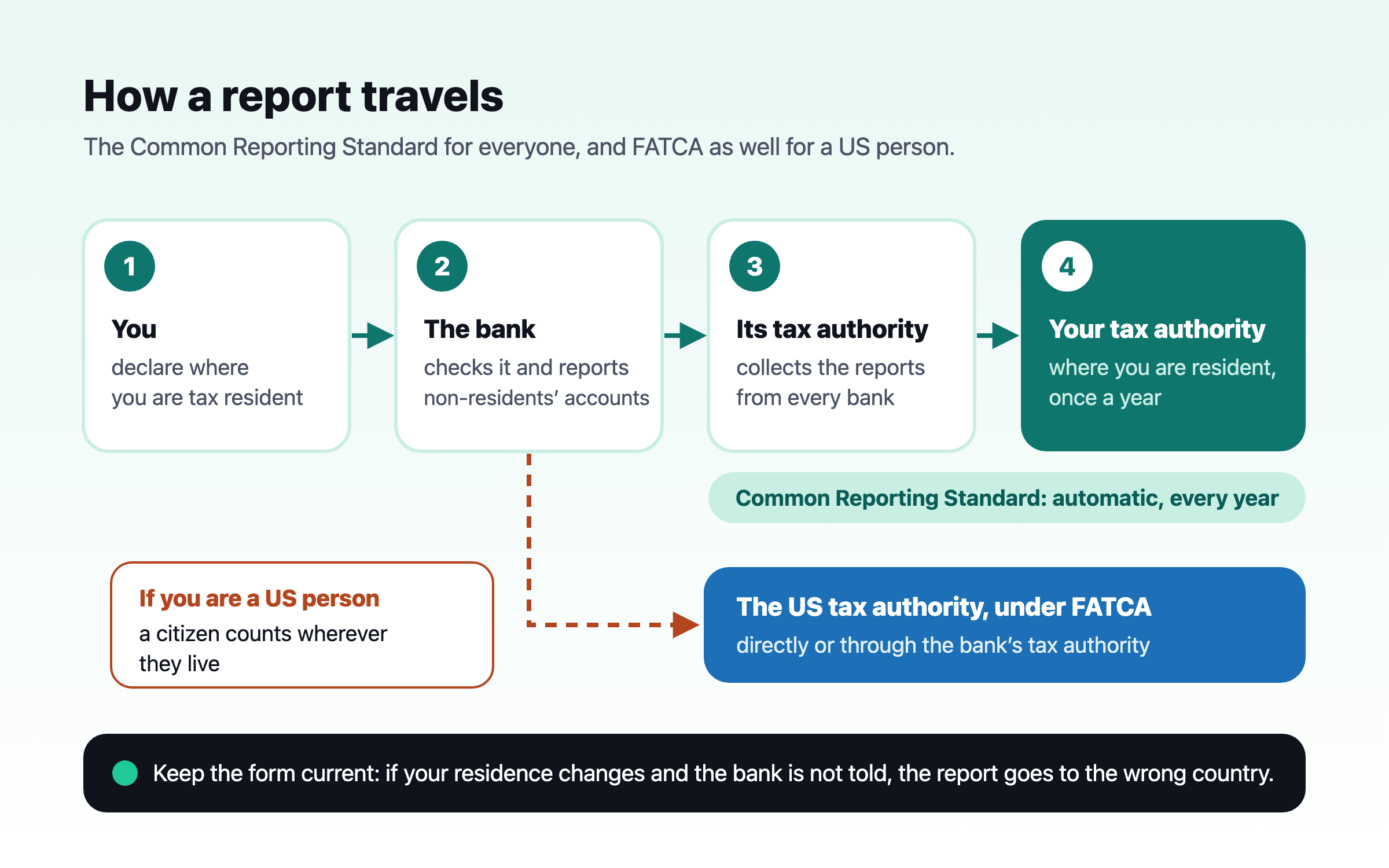
The CRS is the OECD’s standard for the automatic exchange of financial account information, developed with the G201. Each participating country requires its banks, custodians, some insurers and investment entities to find out where their account holders are tax resident, and to report the accounts of non-residents to the local tax authority. Once a year that authority sends the details to the authority of the country where the holder is resident. It covers most bank deposits, assets held in custody, life insurance contracts and financial investments, and in some cases accounts held by companies or trusts that a person controls1.
Members of the OECD Global Forum on tax transparency
The OECD reports that over EUR 135 billion in tax, interest and penalties has been raised through voluntary disclosure programmes and similar efforts since countries committed to the standard, and that financial investments held in international financial centres fell by 20% over the same period1. The Global Forum that oversees it, with 174 members, now also oversees a standard for crypto-asset transactions, the new Crypto-Asset Reporting Framework2. The practical point for a household is simple: an account abroad is no longer invisible to the tax authority at home, and was never meant to be.
What FATCA is, and why Americans are different
FATCA, the Foreign Account Tax Compliance Act, is a US law passed as part of the HIRE Act. It requires foreign financial institutions to report on assets held by US account holders, or face withholding on certain payments from the US3. Many countries put it into effect through an intergovernmental agreement: the US Treasury lists 114 jurisdictions with one signed, agreed or in force, 101 of them in force, including India, whose agreement entered into force on 31 August 2015, the UAE (19 February 2016) and the UK (11 August 2014), all three on the Model 1 pattern4. Under a Model 1 agreement, banks report to their own tax authority, which passes the information to the IRS; under a Model 2 agreement, they report to the IRS directly5.
The difference that matters is who counts. Most countries tax by residence. The US also taxes its citizens and resident aliens on their worldwide income wherever they live, and their filing duties are generally the same at home or abroad6. So a US citizen working in Dubai or Bengaluru is reported by their bank and still files a US return. A citizen whose tax home is abroad may exclude some foreign earnings if they are a bona fide resident of another country for a full tax year, or are physically present abroad for at least 330 full days in a 12-month period7.
How a report travels. You declare where you are tax resident; the bank reports to its own tax authority; that authority passes it to yours. A US person is also reported to the US.
Tax residency decides where the report goes
Every country decides residence by its own law, usually by counting days and sometimes by looking at your home, work and family. Your passport does not decide it, and neither does where you feel you live. Here is how four countries many Indian families move between set the line.
United Kingdom: the Statutory Residence Test
You are UK resident for a tax year (6 April to 5 April) if none of the automatic overseas tests below applies and you meet one of the automatic UK tests: you spend 183 days or more in the UK, your only home is in the UK for 91 days or more in a row and you are there on at least 30 days, or you work full-time in the UK over a period of 365 days that falls partly in that year. You are automatically non-resident if you spend fewer than 16 days in the UK, or fewer than 46 if you were not resident in any of the three previous tax years, or if you work full-time abroad and spend fewer than 91 days in the UK with no more than 30 of them working. Between those lines a “sufficient ties” test weighs days against ties such as family and work8.
India: days in the tax year, and two exceptions
You are resident in India for a tax year if you are there for 182 days or more, or for 60 days or more together with 365 days or more in the four years before. An Indian citizen who leaves to work abroad is resident only at 182 days. An Indian citizen or person of Indian origin visiting India is resident if they stay 182 days or more, or 120 days plus 365 in the previous four years where their income other than from foreign sources is above ₹15 lakh. A citizen with such income above ₹15 lakh who is not liable to tax in any other country is deemed resident regardless of days9. These tests carried over into the Income-tax Act, 2025, in force for tax years from 1 April 20269. What happens when you move back, including the “not ordinarily resident” years, is in our moving-back checklist.
United States: citizenship, a green card, or days
A US citizen is taxed as above wherever they live. A non-citizen becomes resident for tax with a green card or by the substantial presence test: at least 31 days in the US in the current year and 183 days over three years, counting all of this year’s days, a third of last year’s and a sixth of the year before’s10. Someone present for 120 days in each of three years scores 180 and does not meet it10.
UAE: no income tax, but a certificate when you need one
The UAE does not levy income tax on individuals11, but residents often need to prove where they are resident, to a bank completing a CRS form or to claim a treaty benefit elsewhere. The Federal Tax Authority issues a Tax Residency Certificate to a person present for 183 days or more, or for 90 to 182 days with UAE employment or business or a permanent place of residence, or who shows that their usual residence and centre of financial and personal interests are in the UAE. For a person without a tax registration number it costs AED 1,000 to review plus a AED 50 submission fee, and the electronic certificate is issued within 10 business days of a complete application12.
Days in a year that make someone tax resident: the headline test, and a lower line where other conditions decide.
Headline test, days
Lower line, where conditions decide, days
UK: below 16 days a person is automatically non-resident (46 if not resident in the previous three tax years); above that, unless another automatic test applies, a sufficient ties test weighs days against ties such as family and work. India: 60 days plus 365 in the previous four years (120 days for a visiting citizen with Indian income above ₹15 lakh). US: 31 days is the minimum, with 183 weighted days over three years. UAE: 90 days with UAE work, business or a permanent home. 8,9,10,12The figures in this chart
Headline test, days
Lower line, where conditions decide, days
United Kingdom
183 days
16 days
India
182 days
60 days
United States (non-citizens)
183 days
31 days
UAE (residency certificate)
183 days
90 days
The chart shows why the lower lines catch people out. Almost everyone knows about half a year; far fewer know about the second line. A person can also be resident in two countries at once under their separate laws, and that is settled by the tie-breaker rules in the treaty between them, which is exactly where a professional earns their fee.
Why US persons abroad face PFIC rules
For an American living outside the US, the most expensive surprise is often a fund. A foreign corporation is a passive foreign investment company (PFIC) if 75% or more of its gross income is passive, or if at least 50% of its assets produce passive income13. A mutual fund or ETF domiciled outside the US exists to hold investments, so it usually meets those tests. Without an election, a gain on sale or a large distribution is spread back over the years the fund was held, and the part that falls in earlier years carries a separate tax and an interest charge under section 1291; the alternatives are to elect to treat the fund as a qualified electing fund or, for listed shares, to mark it to market each year, and Form 8621 reports the holding13.
On top of that come two reports of foreign accounts. An FBAR is due if the combined value of a US person’s foreign financial accounts exceeds $10,000 at any time in the year, and Form 8938 has higher thresholds that depend on marital status and on whether you live in the US or abroad; one does not replace the other14. Failing to file Form 8938 can cost up to $10,000, plus $10,000 for each 30 days after an IRS notice, up to $60,00014.
When a US person must report foreign accounts and assets: the thresholds, in dollars.
Value on the last day of the year
Value at any time in the year
A filing is due once value goes over either threshold. The FBAR has only an any-time test, on the combined value of all foreign accounts. Living abroad raises the Form 8938 thresholds but does not remove them. 14The figures in this chart
Value on the last day of the year
Value at any time in the year
FBAR, any US person
—
$10,000
Form 8938, single, living in the US
$50,000
$75,000
Form 8938, married filing jointly, in the US
$100,000
$150,000
Form 8938, single, living abroad
$200,000
$300,000
Form 8938, married filing jointly, abroad
$400,000
$600,000
What NRIs need to do
Tell your bank in India when your status changes. When a resident becomes a person resident outside India, the existing resident account should be designated an NRO account15.
Know the two account types. Money in an NRE account can be sent abroad and its interest is exempt from Indian income tax; an NRO account holds income and dues arising in India, and its balance can be sent abroad by NRIs only up to USD 1 million, subject to the rules15.
Answer the self-certification honestly, everywhere. Banks and fund houses in India and abroad ask where you are tax resident for CRS and FATCA. Update them when it changes; a stale form means the report goes to the wrong country.
Count your days every year. India’s tests and the UK’s run on different tax years, April to March and 6 April to 5 April8, so one trip can count differently in each.
Get proof of residence where you live. If a treaty claim or a form asks you to show residence, a certificate from that country is the usual evidence; the UAE issues one for this purpose12.
The documents to keep
A record of days in each country, year by year: passport stamps, boarding passes, or an official entry and exit report. The UAE asks for that report with a certificate application12.
Proof of full-time work abroad, such as your contract and payslips, which the UK’s overseas test turns on8.
Every tax residency certificate you have been issued, and copies of the CRS and FATCA self-certifications you have signed.
Year-end and highest balances of every foreign account, because US reporting tests both the last day of the year and any time in it14.
Fund statements and purchase records, especially for a US person holding funds outside the US.
Letters redesignating Indian accounts as NRO, NRE or resident, with their dates.
None of this is a reason to avoid holding money in more than one country. It is a reason to keep the list complete and the paperwork current. Where the money will finally be spent is a separate question from where it is taxed today, and it decides which currency your savings should be judged in; see home bias and currency risk and what sending money home costs. Gulf earners can also read how gratuity and pensions behave when you move.
Questions people ask
What is the difference between FATCA and CRS?
FATCA is a US law under which foreign financial institutions report accounts held by US persons to the US3. CRS is the OECD’s standard under which participating countries exchange information on accounts held by each other’s residents every year1.
How many countries exchange information under CRS?
Tax authorities in 116 jurisdictions had begun exchanging under the standard by the OECD’s 2025 review, and in 2024 they exchanged information on over 171 million accounts1.
How many days make you tax resident in India?
182 days in the tax year, or 60 days plus 365 days in the previous four years. For a visiting Indian citizen or person of Indian origin the 60 becomes 120 where income other than from foreign sources is above ₹15 lakh, and otherwise only the 182-day test applies; it is also the only test for a citizen who has left to work abroad9.
What is a PFIC?
A passive foreign investment company: a foreign corporation with 75% or more passive income or at least 50% passive assets13. Most funds domiciled outside the US qualify, which brings special US tax rules and Form 8621 for US persons who hold them.
Do I need to tell my Indian bank that I have become an NRI?
Yes. When a resident becomes a person resident outside India, the existing resident account should be designated an NRO account15.
Does Nivritee do tax planning?
No. Nivritee does not model tax, prepare returns or give tax advice. It keeps a household’s money in one plan so you can share an accurate picture with a qualified professional.
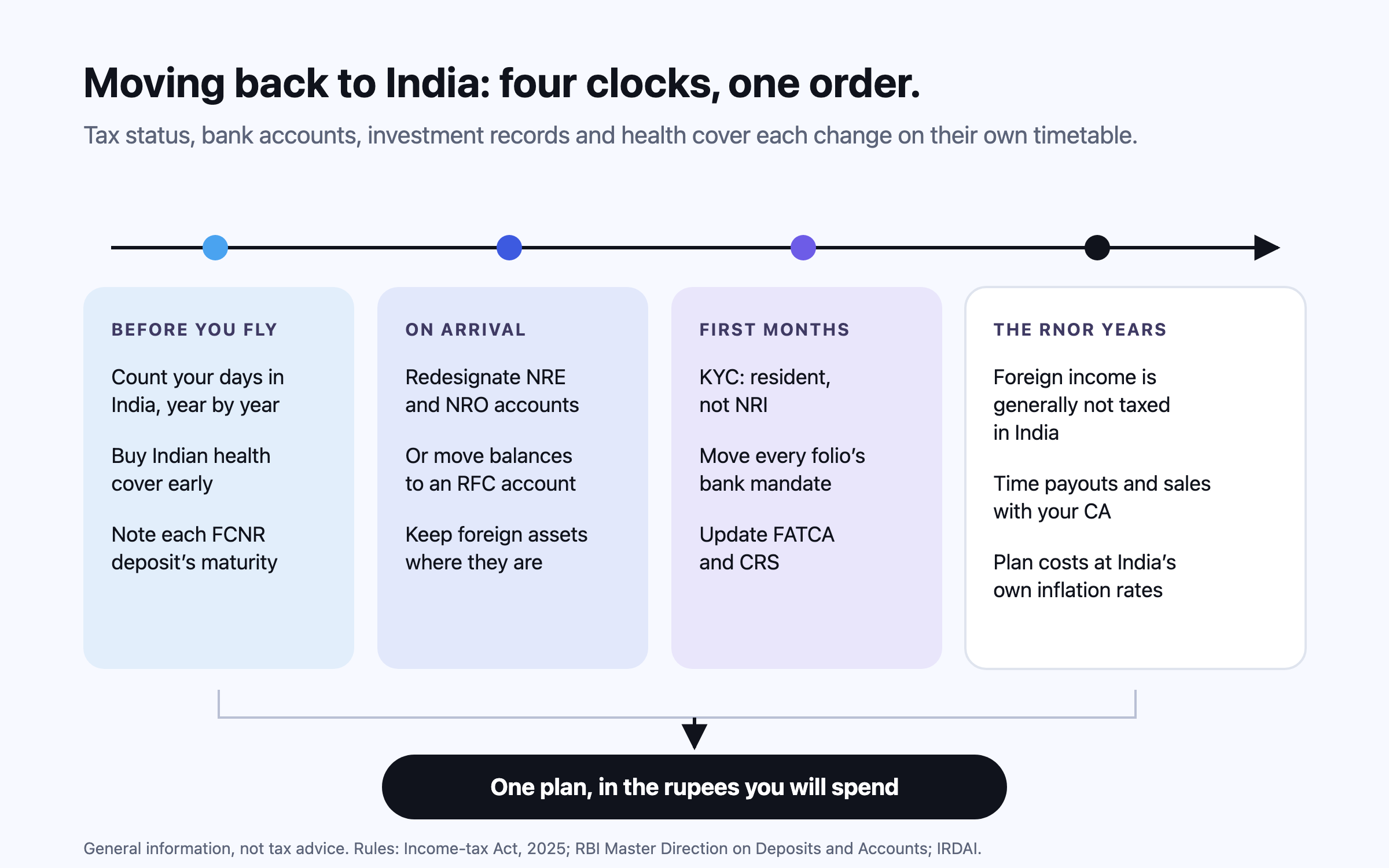
Coming home is several changes on different timetables. Your tax status follows day counts under the Income-tax Act, your bank accounts follow RBI rules under FEMA, and your investments, insurance and living costs each need their own step. This checklist explains each one in plain terms, with official sources — confirm the tax parts with a chartered accountant.
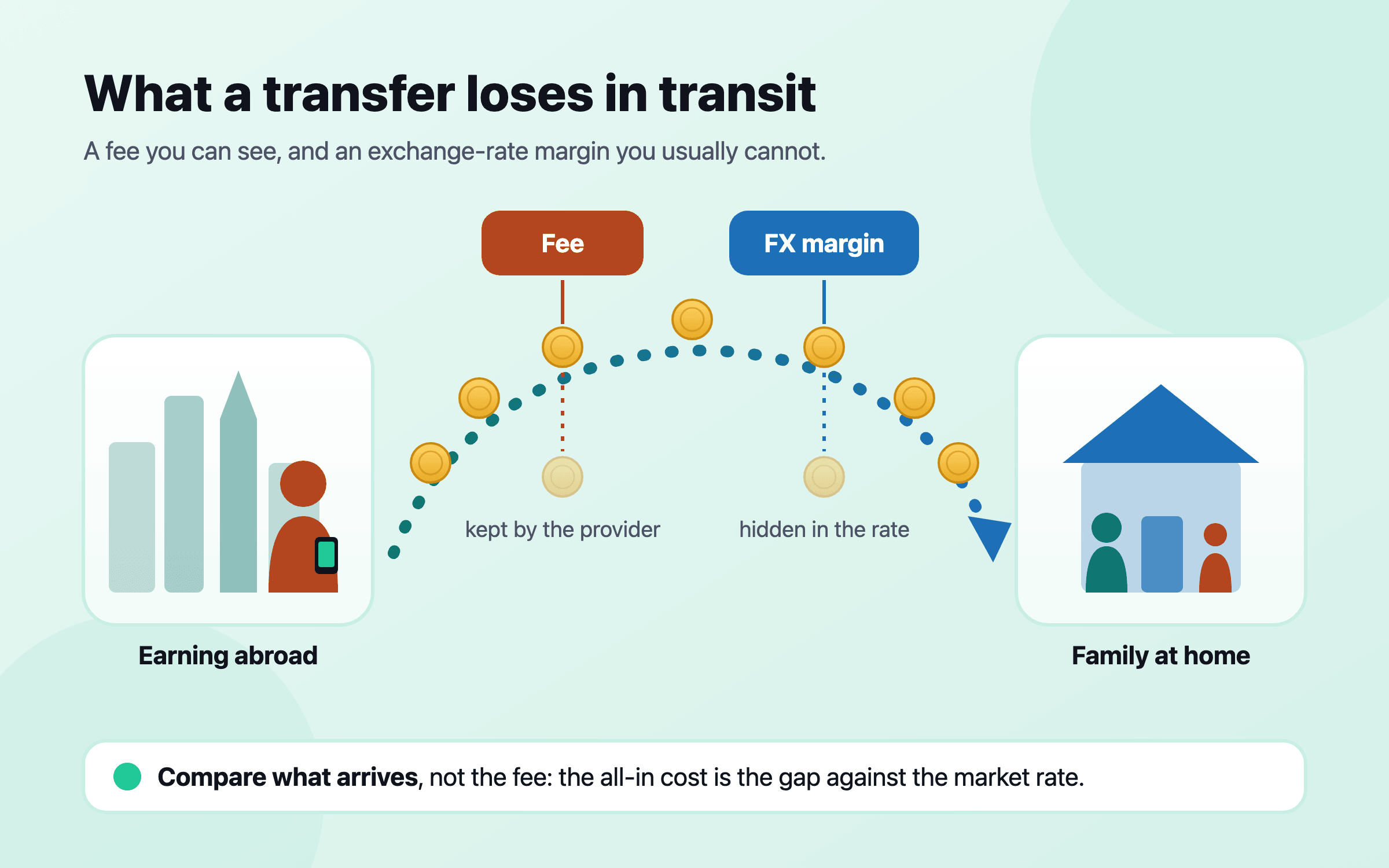
Sending the equivalent of $200 across a border cost 6.36% on average in the World Bank’s latest survey, more than twice the 3% the world has set as its 2030 target. Corridors into India are cheaper than that, but inside a single corridor quotes run from under 1% to over 20%. The fee you see is only part of the price, so compare the amount that arrives.
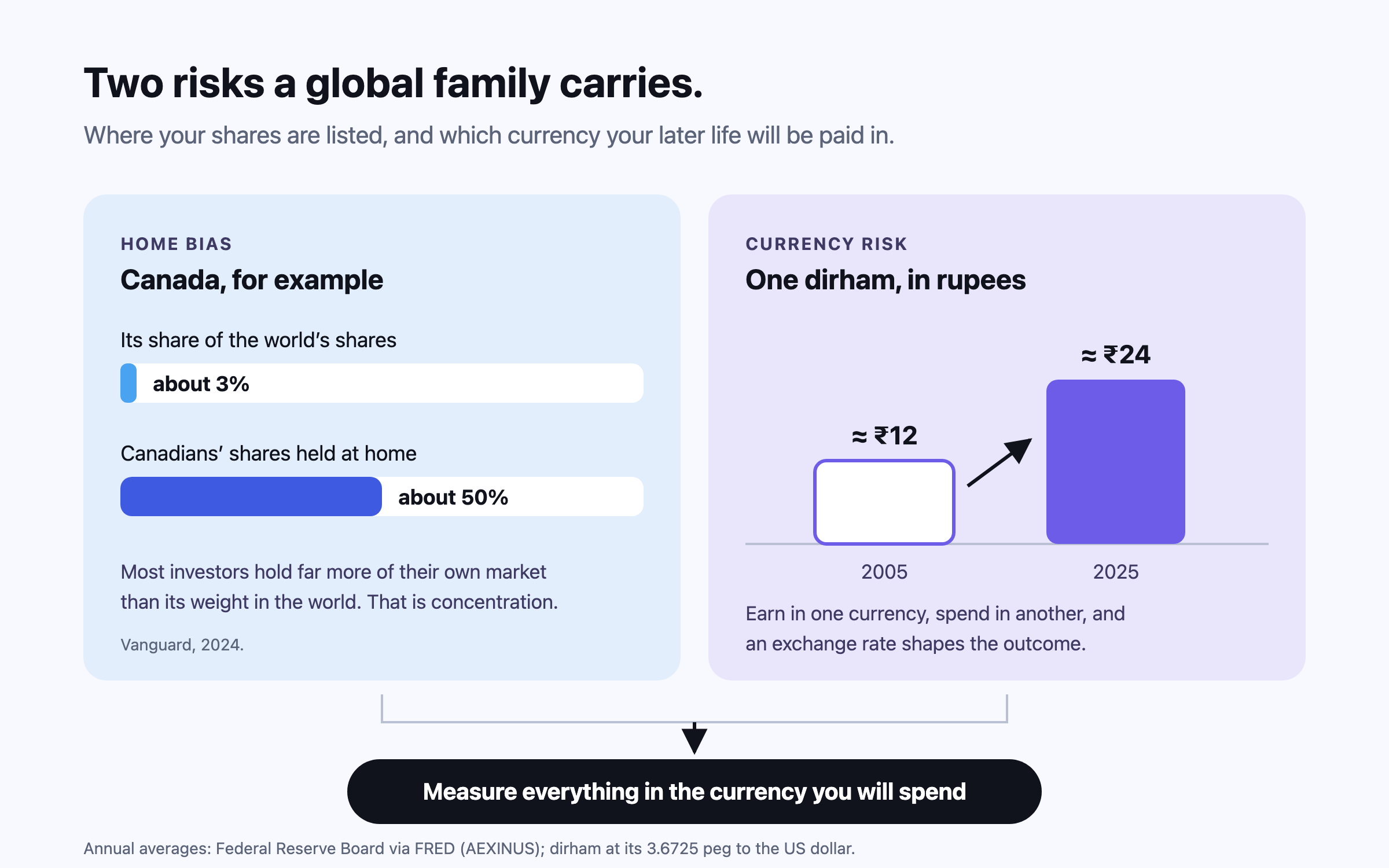
Investors everywhere hold far more of their own country’s shares than its weight in world markets, which concentrates risk. For a family earning in dirhams or dollars and planning to live on rupees or pounds, the bigger question is currency: measure every holding in the currency your future bills will be paid in, then diversify across markets from there.
This is general information, not financial, tax or legal advice for your circumstances. Rules and figures change; check the official source for your country, and consult a licensed professional before making financial decisions. Projections are estimates, not predictions.