Rates are rising again in 2026. How quickly that reaches your household depends on where you live and how your loan is priced.
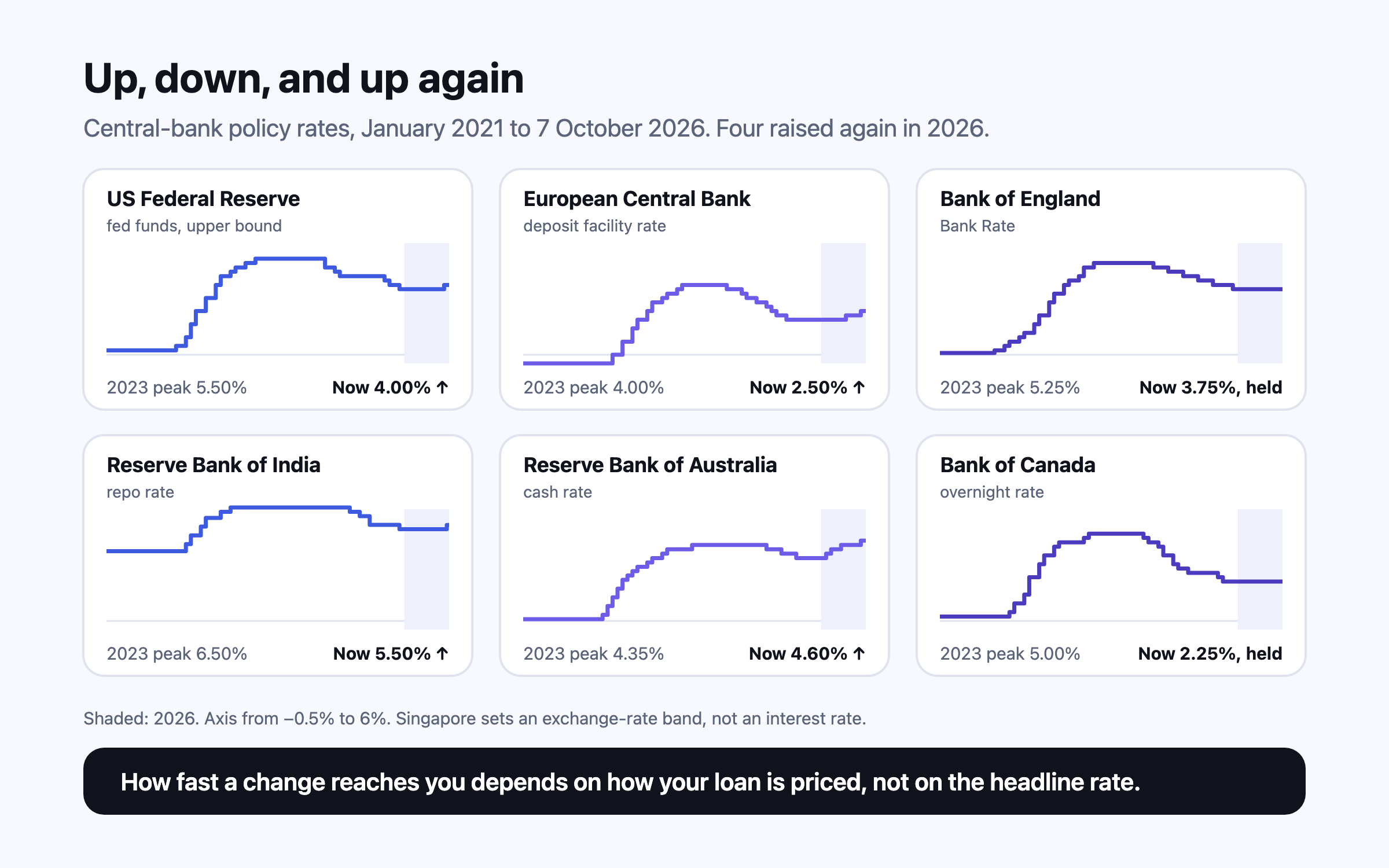
After cutting through 2024 and 2025, several central banks raised rates again in 2026 as energy prices, driven up by the conflict in the Middle East, pushed inflation back above target: the Fed to 3.75–4.00% in September, the RBA to 4.60%, the ECB to 2.50% and, on 7 October, the RBI to 5.50%. A rise reaches a US household with a 30-year fixed mortgage barely at all, an Australian or Indian floating-rate borrower within months, and a British or Canadian one when their fix ends. Savers gain, but more slowly than borrowers pay.
Nivritee Research · 6 October 2026 · 11 min read
For most households, interest rates arrive as a number on a statement: the mortgage payment, the EMI, the rate on a deposit. Those numbers follow a single rate set by a central bank, but with different delays and in different amounts in every country. As of early October 2026 that rate is rising again. On 16 September the US Federal Reserve raised its target range by a quarter-point to 3.75–4.00%, saying inflation remained elevated1; the Reserve Bank of Australia raised its cash rate to 4.60% on 29 September2; the ECB raised its deposit rate to 2.50% from 16 September, its second rise of the year3. The Bank of England held at 3.75%, with three of its nine members voting for a rise4.
This article sets out how rates moved from 2022 to now, then follows a rate change through to the things a family actually pays and earns — loans, savings, bond funds and house prices — country by country, with worked examples. It ends with what a household can do about it. For why fixed-income funds fall when rates rise, see bonds explained; for the inflation that drove all of this, the inflation shock and household budgets.
UK average five-year fixed mortgage, 5 October 2026
How rates moved: 2022 to October 2026
The story has three acts. In 2022 and 2023, as inflation reached its highest in four decades, central banks raised rates faster than at any time in a generation: the Fed from near zero to 5.25–5.50% by July 20238, the Bank of England from 0.10% to 5.25% by August 20239, the ECB’s deposit rate from −0.50% to 4.00%3. In 2024 and 2025 they cut as inflation fell. Then in 2026 the conflict in the Middle East pushed energy prices, and with them inflation, back up, and several banks reversed. The ECB said as much when it raised rates on 10 September: the conflict “continues to generate inflation pressures”10. The Bank of England, holding the same week, pointed to further rises in crude and refined energy prices, which it said remained higher than before the conflict4.
Policy rates from each central bank’s own records, as of 6 October 2026. New Zealand’s cash rate rose to 2.75% on 2 September 2026 and the Bank of Japan’s policy rate to around 1.25% on 18 September. Singapore has no policy interest rate (see below). 813941112135141516
Central bank (rate)
Before the 2021–22 rises
Peak
Low after cuts
Early October 2026
US Federal Reserve (fed funds target)
0–0.25%
5.25–5.50% (July 2023)
3.50–3.75% (December 2025)
3.75–4.00%, raised 16 September
ECB (deposit facility)
−0.50%
4.00% (September 2023)
2.00% (June 2025)
2.50%, raised in September
Bank of England (Bank Rate)
0.10%
5.25% (August 2023)
3.75% (December 2025)
3.75%, held 17 September (6–3)
Reserve Bank of India (repo)
4.00%
6.50% (February 2023)
5.25% (December 2025)
5.50%, raised 7 October
Reserve Bank of Australia (cash rate)
0.10%
4.35% (November 2023)
3.60% (August 2025)
4.60%, raised 29 September (above the 2023 peak)
Bank of Canada (overnight rate)
0.25%
5.00% (July 2023)
2.25% (October 2025)
2.25%, held 2 September
India’s path was gentler at both ends. The RBI raised the repo rate by 2.5 points from May 2022 to February 2023, and cut it by 1.25 points between February and December 202511. It held at 5.25% through August13, and on 7 October 2026 the Monetary Policy Committee voted unanimously to raise it by 0.25 points to 5.50% and changed its stance to calibrated tightening, citing the renewed conflict in West Asia and volatile crude prices12. The standing deposit facility rate moved to 5.25% and the marginal standing facility rate to 5.75%1217. Canada cut furthest, to 2.25%, and has held there through 202614. Japan, which kept rates below zero for years, has been raising: its policy rate reached around 1.25% in September 202616.
Singapore steers the currency, not a rate
The Monetary Authority of Singapore does not set an interest rate. It sets a path for the Singapore dollar’s trade-weighted exchange rate, the S$NEER, within a band whose slope, width and centre it adjusts18. A steeper slope lets the currency rise faster, which makes imports cheaper and cools inflation in an economy that imports most of what it consumes. MAS tightened four times in 2022, twice off-cycle, eased twice in 2025, and steepened the slope again in April and July 202618. Singapore’s interest rates are set largely by markets and by global rates instead, which is why a Singapore mortgage can move in the opposite direction to the rest of this article.
How a rate change reaches your mortgage or EMI
The single biggest difference between countries is how home loans are priced. Where loans are fixed for decades, a rate rise reaches only new borrowers. Where they float, it reaches everybody within months. Where they are fixed for two to five years, it arrives in waves as each fix ends.
How home loans are usually priced, from each country’s central bank or regulator. Individual loans vary. 192021222324
Country
Typical home loan
When a rate rise reaches an existing borrower
United States
30-year fixed
Not at all, until they move or refinance
United Kingdom
2- or 5-year fix, then refix
When the fix ends; about 3.6 million accounts expected to refix higher from mid-2025 to mid-2028
Canada
5-year fixed term on a 25-year amortisation
At renewal; about 60% of mortgages renew in 2025 or 2026
Australia
Mostly variable
Within weeks; fixed loans were almost 40% of housing credit in early 2022 and have mostly rolled off
India
Floating, linked to the repo rate (EBLR)
At the next reset, at least every three months
Singapore
SORA-linked floating, fixed packages, or an HDB loan at 2.6%
At the next reset for SORA loans; HDB rate tracks the CPF rate, not SORA
United States: the 30-year fix protects owners and traps movers
Freddie Mac’s survey put the average 30-year fixed rate at 2.65% in January 2021 and 7.79% at its October 2023 peak25. After easing, it rose again with the Fed: 7.28% on 1 October 2026, against 6.34% a year earlier6. The Garcias in Austin, who borrowed $400,000 over 30 years at 2.65% in 2021, pay about $1,612 a month in principal and interest. The same loan at today’s 7.28% would cost about $2,737, roughly $1,125 more. That gap is one reason many American owners with cheap loans have stayed put: a new house means giving up the old rate.
United Kingdom: the remortgage cliff
British borrowers fix for two or five years and then refix at whatever rates are on offer. The Bank of England’s average quoted rate on a two-year fix at 75% loan-to-value was 1.20% in September 2021 and 6.22% in July 202326. Hannah and Sam in Manchester took a £250,000, 25-year repayment mortgage on a two-year fix at that 1.20%, paying about £965 a month. Refixing what remained, about £232,600, at July 2023’s average would have taken their payment to about £1,587, a rise of roughly £622, or 64%.
The cliff has not gone away. In July 2025 the Bank of England expected 3.6 million mortgage accounts, 41% of the total, to refinance onto higher rates between June 2025 and mid-2028, and the typical owner-occupier coming off a fix in the following two years to see payments rise by about £107 a month, or 14%19. That was before the 2026 rise in market rates: by 5 October 2026 Moneyfacts’ average two-year fix had reached 5.98% and the five-year 6.00%, and the number of fixed deals under 5% fell from 1,494 to 9 between the start of September and 5 October7.
Canada: the five-year renewal
Canadians usually borrow over 25 years but fix the rate for five, then renew. The Bank of Canada calculated that about 60% of all outstanding mortgages would renew in 2025 or 2026, most of them five-year fixed loans taken at record-low pandemic rates, and that about 60% of those would face higher payments — though more than 90% of five-year fixed borrowers would face rises smaller than the stress test they passed when they borrowed20. Marc and Julie in Ottawa borrowed C$500,000 in 2021 at an illustrative five-year fixed rate of 2.0%, paying about C$2,117 a month. Renewing the remaining balance of about C$418,900 at an illustrative 4.5% over the 20 years left raises the payment to about C$2,640, roughly a quarter more. The figures follow the Canadian convention of compounding fixed-rate mortgage interest twice a year.
Australia: variable loans feel it within weeks
Most Australian home loans are variable, so a rise in the cash rate is usually passed on within weeks. The exception was the pandemic, when fixed loans grew to almost 40% of outstanding housing credit by early 2022; the RBA estimated that around 880,000 fixed loan facilities would expire in 2023, and that around 90% of the loans still to roll off would see scheduled payments rise by 30% or more21. In July 2026, before the September rise, the average outstanding variable rate for owner-occupiers was about 6.2%27. Liam and Chloe in Melbourne have A$600,000 and 25 years left at an illustrative 6.25%, close to that average, and pay about A$3,958 a month; if September’s quarter-point is passed on in full, about A$4,051, A$93 more. The RBA raised the cash rate by a full point across 2026, in four quarter-point steps5: had their rate been 5.50% in January and every rise passed on, their payment would have gone from about A$3,685 to about A$4,051 in nine months.
India: the repo-linked EMI, and why tenures balloon
Since 1 October 2019, every new floating-rate home loan from an Indian bank has had to be linked to an external benchmark, in practice usually the repo rate, and reset at least once every three months22. By December 2025, 65.4% of banks’ floating-rate loans were on such a benchmark, and the RBI found that external benchmark lending rates had fallen by the full 1.25 points of the 2025 repo cuts11. SBI’s external benchmark rate, for example, is the repo rate plus 2.65 points: 7.90% with the repo at 5.25% before the October rise, which at the same spread would carry it to 8.15% once SBI resets28. Older loans linked to MCLR or base rates move more slowly — the usual answer to “why did my EMI not fall after the repo cut?”.
When rates rise, Indian lenders have often kept the EMI the same and extended the loan instead, which can go badly wrong. Kavya and Siddharth in Pune borrowed ₹60 lakh over 20 years when the repo rate was 4.00%. Assume, for illustration, that their loan was priced at the repo plus 2.65 points, the spread on SBI’s external benchmark today28: they paid 6.65% and an EMI of about ₹45,266. After a year they owed about ₹58.5 lakh. When the repo reached 6.50% and their rate 9.15%, a month’s interest alone was about ₹44,616 — nearly the whole EMI. Keeping the EMI unchanged would have stretched the remaining 19 years to about 47. In August 2023 the RBI told lenders to give borrowers the choice of a higher EMI, a longer tenure, a mix of both, or prepayment, and said a longer tenure must not leave the loan growing29. In 2025 it made offering a switch to a fixed rate optional for lenders rather than required29. Even at 7.90%, SBI’s benchmark before the October rise, the unchanged EMI would leave their loan running about 24 more years instead of 19.
Singapore: SORA and the HDB loan
Singapore’s floating home loans now follow SORA, the average rate on overnight interbank borrowing in Singapore dollars, which MAS publishes daily; SORA has replaced SOR and SIBOR as the benchmark, and borrowers on the old loans have had to switch2330. On the first business day of each month, as published by DBS/POSB, three-month compounded SORA peaked at about 3.75% in November 2023 and stood at about 1.23% on 1 October 202631. HDB’s concessionary loan rate is pegged 0.1 point above the CPF Ordinary Account rate; with the OA rate at its 2.5% floor for October to December 2026, that makes it 2.6%2432. Daniel and Hui Min in Punggol, with S$500,000 over 25 years on a SORA loan at an illustrative spread of 0.3 points, would have paid about S$2,654 a month at the 2023 peak and about S$2,007 now — less than the S$2,268 an HDB loan at 2.6% costs. A SORA borrower gains when rates fall and loses when they rise; the HDB rate barely moves.
Savings and deposits: rates rise for savers too, more slowly
The Bank of England says plainly that when it raises Bank Rate, banks usually raise both loan and savings rates, but not necessarily by the same amount33. In August 2026, the average rate on new UK fixed-term deposits was 4.24% while existing instant-access (sight) deposits paid 1.65%, against 4.60% on new mortgages34. In the US, the FDIC’s national average was 0.37% on savings and 1.73% on a 12-month CD in September 2026, with the Fed’s range near 4%351. Averages hide a wide spread: the best accounts pay far more than the average one, so money left in a bank’s default account is often what costs a saver most.
In India, SBI paid 6.25% on a one-to-two-year fixed deposit and 6.75% for senior citizens, at rates set in December 202536. A fixed deposit locks the rate for its term, so when rates are rising, shorter terms leave room to reinvest higher, and when they are falling, longer terms keep a good rate longer. Nobody knows which way the next move goes. Laddering — splitting deposits across several maturities — is the usual answer to not knowing.
Bond funds: the fall nobody expected from the “safe” part
When rates rise, existing bonds paying the old, lower rate fall in price, and the longer a bond has to run, the further it falls. In 2022 the Bloomberg US Aggregate Bond Index lost 13.01%37 and the FTSE Actuaries UK Conventional Gilts All Stocks Index lost 23.83%38 — losses many households had never seen from the part of their portfolio meant to be steady. The other side is that a bond fund bought at higher yields earns more from then on: rising rates hurt a bond fund’s price now and raise its income later. Bonds explained works through duration and why it decides how much a fund moves.
House prices
Higher borrowing costs shrink what buyers can pay, so house prices usually fall or stall after rates rise. How far depends on how much debt the market carries and how quickly loans reprice. After 2022, the falls were largest where loans reset fastest or prices had run furthest.
Nominal house price indices from the BIS residential property price series (latest quarter: 2026 Q1) and the S&P CoreLogic Case-Shiller national index (not seasonally adjusted), via FRED; falls computed from the index values shown, to the lowest reading since each peak. Not adjusted for inflation, which made the real falls larger. 3940
Market
Peak (index)
Trough (index)
Fall
Canada
2022 Q1 (250.68)
2026 Q1 (200.24)
20.1%
New Zealand
2021 Q4 (267.78)
2023 Q2 (230.19)
14.0%
Australia
2022 Q2 (183.48)
2023 Q1 (171.70)
6.4%
United States (Case-Shiller, monthly)
June 2022 (308.055)
January 2023 (292.671)
5.0%
United Kingdom
2022 Q4 (168.74)
2024 Q1 (162.59)
3.6%
The RBA’s own reckoning was that national housing prices had fallen 8% from their April 2022 peak by early 202341. US prices were at new highs by mid-202340. Canada’s never recovered: its index fell again from 2024 and in the first quarter of 2026 was about 20% below its 2022 peak39. Whether to buy or keep renting with rates where they are is the subject of rent or buy.
What a household can do
Find out exactly how each loan is priced: fixed until when, linked to what benchmark, reset how often. That date is when a rate change reaches you.
Work out the payment at a rate one and two points higher than today’s. If that would break the budget, act before it happens: build a buffer, or overpay while the rate is low.
In the UK and Canada, start looking at a new deal well before the fix ends; many lenders let you reserve a rate months ahead and switch to a lower one if rates fall.
In India, if your rate rises, ask for a higher EMI rather than a longer tenure where you can afford it, and check whether an old MCLR or base-rate loan would be cheaper moved to the repo-linked benchmark.
Move savings out of accounts paying far below the market rate; the gap between the average and the best is often larger than the next central-bank move.
Match deposits and bond funds to when you need the money, so a rate change never forces a sale at a loss.
Compare the rate on each loan with what your investments can realistically earn after tax before deciding whether to prepay; pay off debt or invest sets out the comparison.
For background, Edward Chancellor’s *The Price of Time* is a history of interest and of what happens when money is cheap for a long time42. The central banks’ own explainers — the Bank of England’s on how Bank Rate reaches loans and savings, and the Fed’s on how the federal funds rate reaches short-term borrowing — are short and worth reading3343.
How Nivritee helps
Questions people ask
Why did my EMI not fall after the RBI cut the repo rate?
Usually because the loan is linked to MCLR or a base rate rather than the repo-linked external benchmark, or because the next reset date has not arrived; repo-linked loans must reset at least every three months22. Many banks also lower the tenure rather than the EMI.
Should I increase my EMI or extend the tenure when rates rise?
A higher EMI usually costs far less interest overall. The RBI requires banks to offer the choice and says a longer tenure must not leave the loan growing29; at a high enough rate an unchanged EMI barely covers the interest.
Should I fix or go variable?
A fix buys certainty for its term at a price; a variable rate is cheaper when rates fall and dearer when they rise. Nobody knows which is coming: in 2026 rates rose after two years of cuts12. Choose the one whose worst case your budget can carry.
Should I remortgage early before my fix ends?
In the UK, many lenders let you secure a new rate months before the old fix ends, which protects you if rates rise further. Average two- and five-year fixes were about 6% in early October 20267. Check any early repayment charge first.
What are mortgage rates now?
In early October 2026: about 7.28% for a US 30-year fixed6, about 6% for UK two- and five-year fixes7, 6.24% on Australian variable owner-occupier loans before September’s rise27, and 7.90% for SBI’s repo-linked benchmark (before the RBI’s 7 October rise, and before the lender’s spread for the borrower is added)28.
Why are savings rates so much lower than the central bank rate?
Banks pass rate rises to savers more slowly and less fully than to borrowers, and average accounts pay much less than the best. In September 2026 the US national average savings rate was 0.37%35; existing UK instant-access accounts averaged 1.65% in August34.
How does Singapore set interest rates?
It does not set one. MAS manages the Singapore dollar’s trade-weighted exchange rate within a band; interest rates such as SORA are set by markets1823.
Do rising interest rates make house prices fall?
Usually for a while. After 2022, nominal prices fell about 14% in New Zealand and about 5% in the US, on the BIS and Case-Shiller indices; Canada’s were still falling in early 2026, about 20% below their 2022 peak3940.
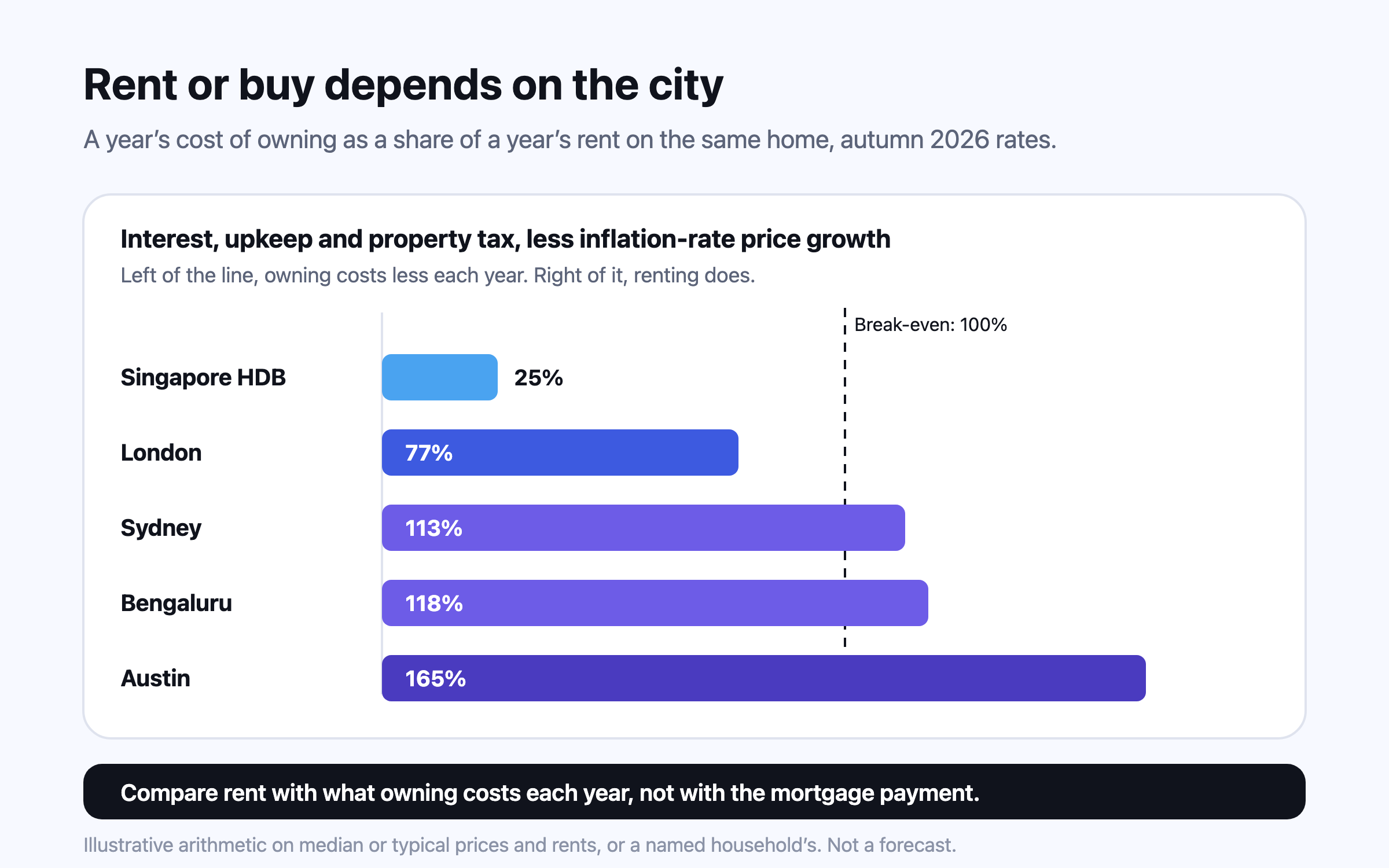
Compare rent with the unrecoverable cost of owning — interest, upkeep, property tax and the return your deposit gives up, less expected price growth — not with the mortgage payment. At autumn 2026 rates, owning the average London home costs somewhat less than renting it, an Austin home costs far more to own than to rent, and an HDB flat in Singapore costs far less. Transfer taxes then decide how long you must stay.
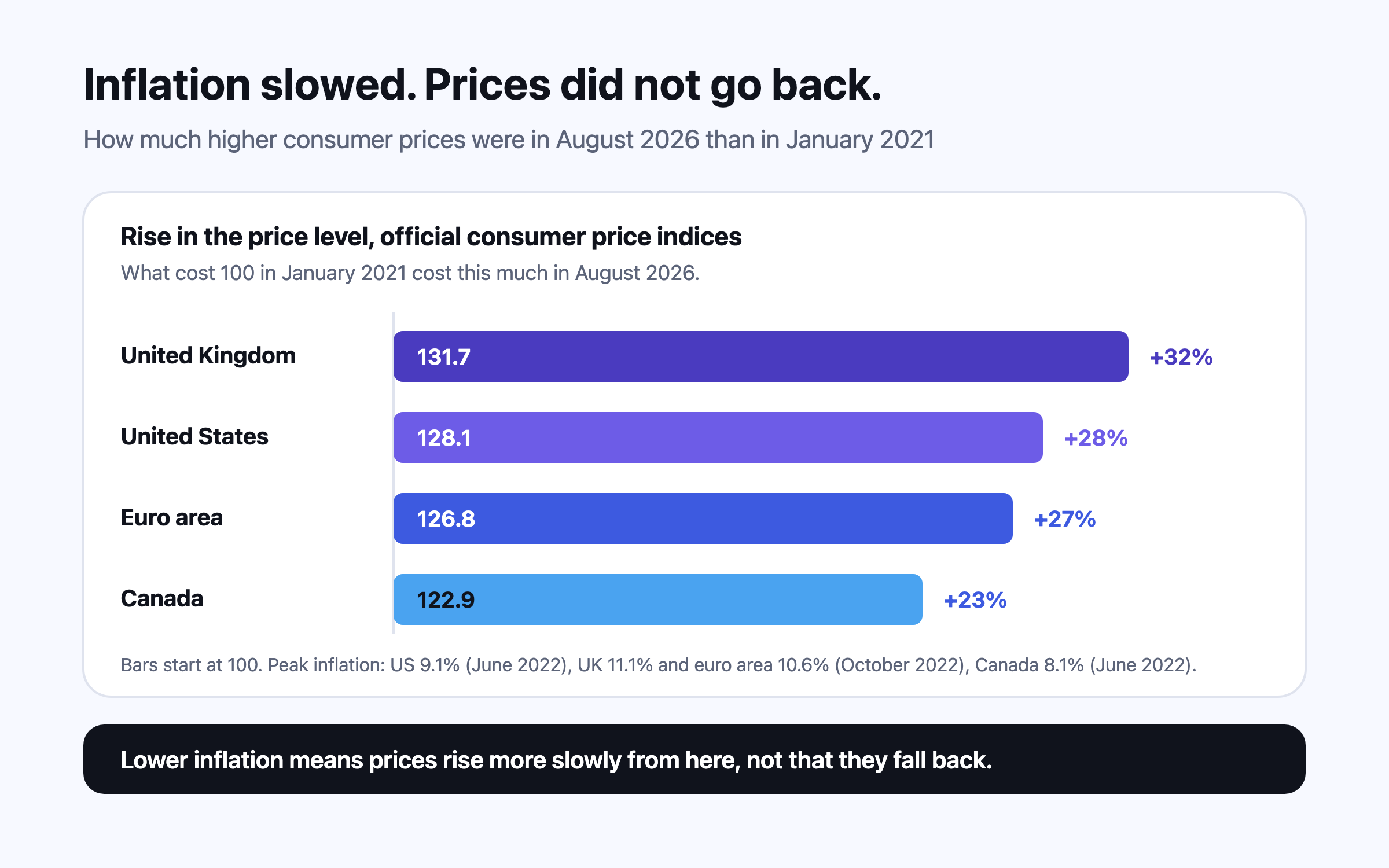
Inflation peaked at 9.1% in the US, 11.1% in the UK and 10.6% in the euro area in 2022, and pay fell behind prices almost everywhere. Inflation then slowed, but the price level never came back down: US consumer prices in August 2026 were about 28% above January 2021, UK prices about 32%. A 2026 energy shock has pushed inflation up again, to 3.8% in the euro area in September. Budgets, pay talks and long-term plans all have to work from the new price level.
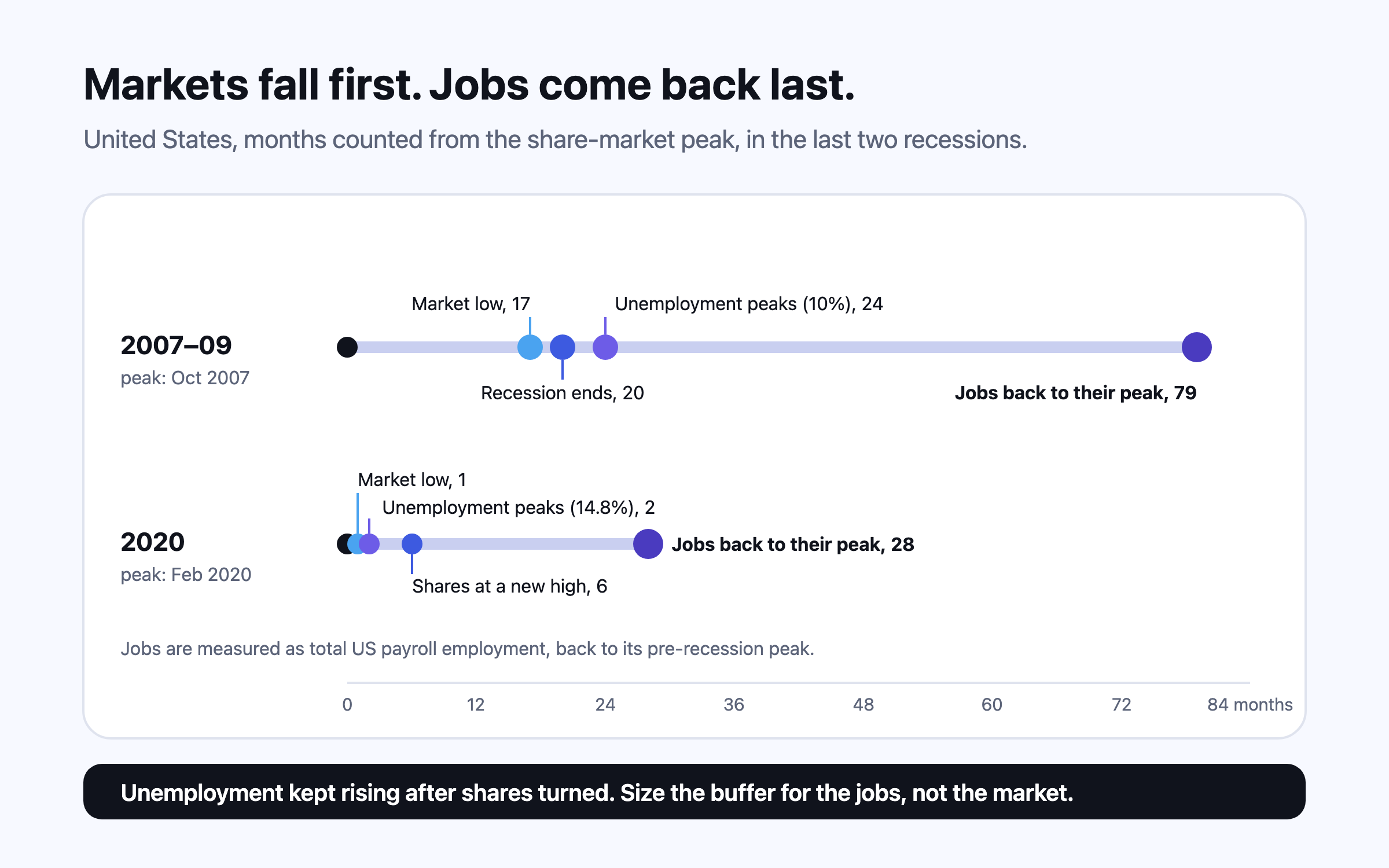
In the US the share market bottomed in March 2009, unemployment peaked seven months later at 10%, and payroll jobs did not regain their early-2008 level until May 2014. The cash that carries a household through is sized by how long a search can take in a bad year — the median reached 25 weeks in 2010 — and the portfolio is protected mostly by not being sold at the bottom.
This is general information, not financial, tax or legal advice for your circumstances. Rules and figures change; check the official source for your country, and consult a licensed professional before making financial decisions. Projections are estimates, not predictions.