A bond’s price falls when interest rates rise, by roughly its duration for each point, which is how “safe” bond funds lost 13% to 24% in 2022 and why they now pay around 5% in the US, UK and Australia.
A bond is a loan you can sell. Its coupon is fixed, so when market rates rise its price falls until its yield matches the new rate, by roughly its duration for each percentage point. That is why the US bond market index lost 13.01% in 2022 and UK gilts 23.8%. The same arithmetic now works in savers’ favour: in early October 2026 ten-year government bonds yielded 5.31% in the US, 5.33% in the UK and 7.22% in India.
Nivritee Research · 6 October 2026 · 10 min read
A bond is a loan that you can sell to somebody else. A government or company borrows money, promises a fixed interest payment (the coupon) every year or half-year, and promises to repay the face value on a set date. Nothing about that changes while you hold it. What changes is the price other people will pay for it, because new bonds are issued at whatever rates the market now demands. When rates rise, an older bond paying less is worth less, and its price falls until it offers the same return as a new one. The US Securities and Exchange Commission puts the rule in one line: when market interest rates rise, prices of fixed-rate bonds fall1.
That is the whole of why 2022 hurt. As central banks raised rates to fight inflation, the US ten-year Treasury yield went from 1.52% at the end of 2021 to 3.88% a year later2, the broad US bond market index lost 13.01%3 and the UK government bond index 23.8%4. It is also why bonds look different in October 2026: the same ten-year Treasury now yields 5.31%2.
Three numbers describe a bond. The face value is what is repaid at maturity, conventionally 100 or 1,000 units. The coupon is the fixed interest, quoted as a percentage of face value: a 4% coupon on a $1,000 bond pays $40 a year. The price is what the bond trades for today, quoted per 100 of face value. The yield joins them: what you earn on what you pay. A bond bought below face value yields more than its coupon, because you also gain the difference when it is repaid; one bought above face value yields less. The Reserve Bank of India’s primer on government securities states the same relationship for bonds sold at a discount6.
Yield to maturity is the single figure that accounts for all of it. The SEC defines it as the annual return on the bond if held to maturity, taking into account when you bought it and what you paid7. Take a bond with five years left, a 3% annual coupon, bought at 95. You collect 3 a year and then 100 at the end, 5 more than you paid. The yield to maturity, the rate at which those payments are worth exactly 95 today, works out at about 4.1% a year. It is the figure to compare with a deposit rate, not the coupon.
The SEC’s own example runs the other way. A $1,000 ten-year Treasury with a 3% coupon is bought at face value; a year later market rates for similar bonds are 4%. Its price drops to about $925, at which point a new buyer earns a yield of 4%1. The holder has lost nothing in cash, and still collects $30 a year and $1,000 at the end, but the bond is worth less today if sold. As the SEC notes, if you intend to hold a bond to maturity, day-to-day price moves may matter less to you1.
Duration: how far the price moves
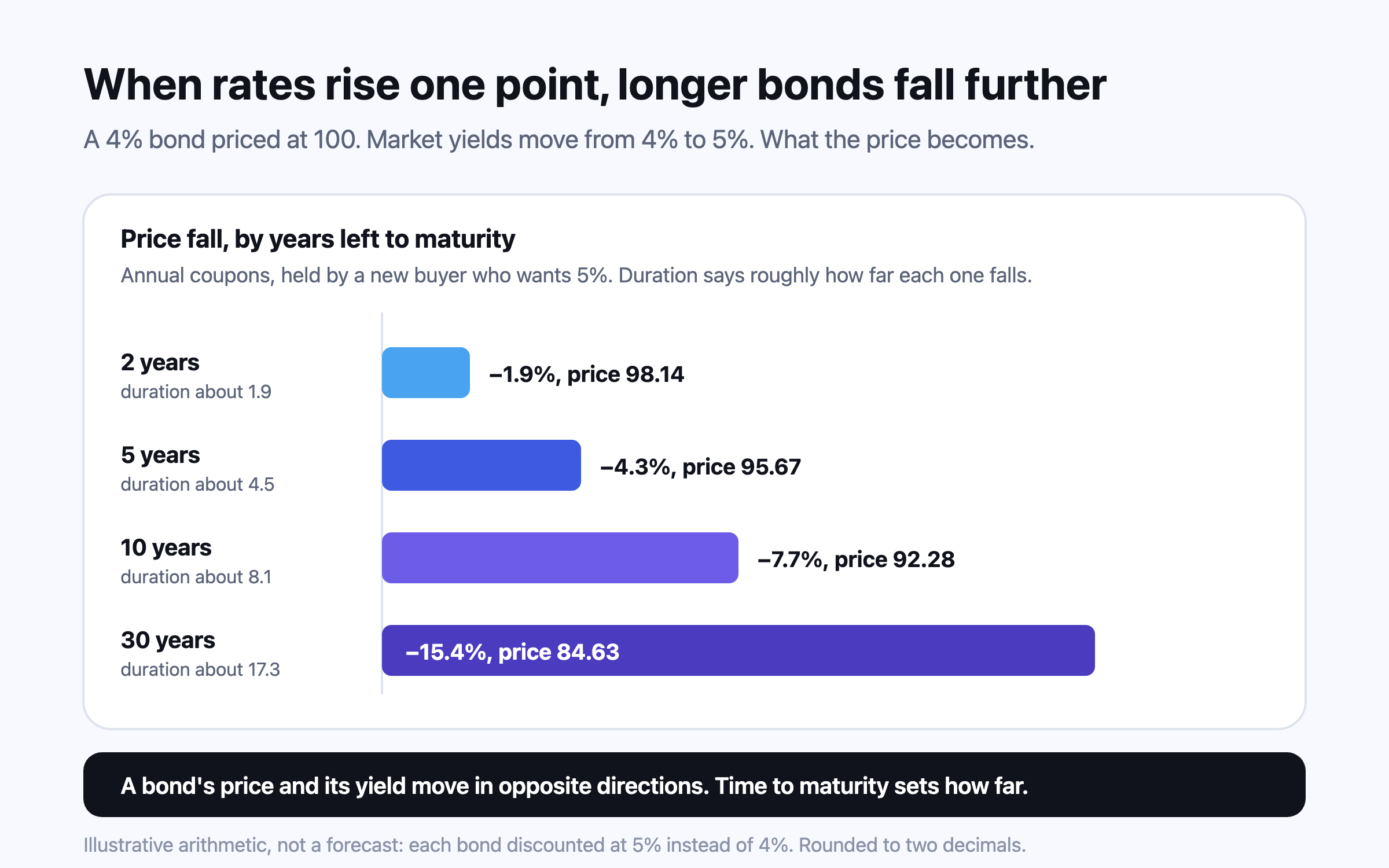
Duration measures how sensitive a bond’s price is to a change in interest rates. It is stated in years, but FINRA, the US brokerage regulator, is clear that it is not simply a measure of time; it signals how much the price is likely to move when rates move. FINRA’s rule of thumb: a bond fund with a duration of 10 years will lose about 10% of its value if rates rise one percentage point, and one with a duration of two years about 2%8. Longer maturities and lower coupons mean longer durations, because more of the money arrives far in the future.
Illustrative arithmetic, not a forecast: each bond’s remaining payments discounted at 5% instead of 4%. Duration here is modified duration at a 4% yield. The actual fall is slightly smaller than duration predicts because the price–yield curve bends (convexity), and the gap grows with maturity. 8
Bond with a 4% annual coupon, priced at 100
Duration (years)
Price if yields rise to 5%
Change
2 years to maturity
about 1.9
98.14
−1.9%
5 years
about 4.5
95.67
−4.3%
10 years
about 8.1
92.28
−7.7%
30 years
about 17.3
84.63
−15.4%
The table is worth reading row by row. A two-year bond barely notices a one-point rise in rates; a thirty-year bond loses about a seventh of its value. Duration is also roughly the break-even horizon: a holder whose bond falls 7.7% when yields jump from 4% to 5% earns an extra point a year from then on, which takes about the duration to make the fall back. FINRA quotes a Fitch example of the same arithmetic on a larger shock: if rates rose two points, a ten-year BBB bond with duration 8.4 could lose 15%, and a thirty-year one with duration 14.5 about 26%8.
Why “safe” bond funds fell in 2022
Bond funds in 2022 did exactly what the arithmetic says. Yields started from near record lows, so coupons provided almost no cushion, and they rose fast. The Bloomberg US Aggregate index, the broad measure of US investment-grade bonds, returned −13.01% for the year3, the worst result in the index’s history; before 2022 its worst twelve months, to March 1980, had been a 9.2% loss9. UK gilts fell further because the UK market is dominated by long maturities: the FTSE Actuaries all-stocks conventional gilt index returned −23.8%4.
Britain also had a crisis inside the fall. Between 1 August and their peak on 14 October 2022, thirty-year gilt yields rose more than 270 basis points, briefly exceeding 5%. Around the government’s fiscal announcement of 23 September they rose 140 basis points in the four days from 21 September, more than twice the largest such move since 200010. Pension funds using leveraged liability-driven strategies were forced to sell gilts into a falling market, and on 28 September the Bank of England began temporary purchases of long-dated gilts “on whatever scale is necessary” to restore orderly conditions11.
Graham and Helen Price, 61 and 59, in Bristol, moved £120,000 of their pension savings into a gilt fund in 2021 because it was “the safe part”. Had their fund matched the all-stocks index, 2022 would have cost them about £28,560, 23.8% of it4. Nothing defaulted; the British government has never missed a gilt payment12. Their loss was the duration risk nobody had explained to them. Gilts did what they promised; “safe from default” and “safe from price falls” are simply different properties, and a long-duration fund has only the first.
The Garcias in Phoenix, 52 and 50, held $150,000 in a total-bond-market index fund. A 13.01% fall cost them about $19,515 on paper in 20223. The index then returned 5.53% in 20233, as higher yields began to be paid. The reason a fall in bond prices is partly self-healing is the same arithmetic: once prices have fallen, every coupon reinvested buys bonds at the new, higher yield. Vanguard’s investor guidance draws the same distinction between 2022’s losses and the role bonds play over time13.
What bonds pay now, country by country
Ten-year yields from each country’s official source: the US Treasury par yield curve, the Bank of England’s ten-year nominal par yield, the RBI’s current-rates panel, the Bank of Canada benchmark, RBA table F2.1 (month-end) and MAS benchmark prices. The RBI raised its repo rate to 5.50% on 7 October 2026, after these yields were read. Yields move daily. 21451516171819202122
Market
10-year government bond yield
Policy rate
Date
United States
5.31%
3.75%–4.00% (raised 16 Sep 2026)
5 Oct 2026
United Kingdom
5.33%
3.75% (held 17 Sep 2026)
2 Oct 2026
India
7.22% (6.94% GS 2036)
Repo 5.50% (raised 7 Oct 2026)
5 Oct 2026
Canada
3.96%
2.25% (held 2 Sep 2026)
5 Oct 2026
Australia
5.28%
4.60% (raised 29 Sep 2026)
30 Sep 2026
Singapore
2.47%
MAS manages the exchange rate, not a policy rate
5 Oct 2026
Two things stand out. Long yields in the US and UK sit well above their policy rates, so investors are being paid for lending for longer, unlike the inverted curves of 2023. And yields differ hugely by country, mostly because expected inflation differs: India’s ten-year yield of 7.22% sits against a repo rate of 5.50%, raised on 7 October 202615, while Singapore’s ten-year bond yields 2.47%18. A yield is only high or low against the inflation of the currency it is paid in, which is why comparing a rupee bond with a Singapore dollar bond on yield alone is a mistake. See how interest rates reach your money for the household side.
Government, corporate and inflation-linked bonds
Bonds differ in who owes the money and what the payments are tied to. Government bonds in a country’s own currency carry the least default risk, because the issuer can tax and, in extremis, print: Treasuries, gilts, Canada and Australian government bonds, Indian G-secs, Singapore Government Securities. Corporate bonds pay more because the borrower can fail. Inflation-linked bonds adjust their principal with prices, so their yield is a real yield: US TIPS track the consumer price index, and at maturity you receive the adjusted principal or the original, whichever is greater23; UK index-linked gilts, first issued in 1981, adjust coupons and principal with the RPI12; India issued inflation-indexed bonds in 2013, first linked to wholesale prices and then to consumer prices6.
On 5 October 2026 the ten-year TIPS real yield was 2.95%, against 5.31% on the ordinary ten-year Treasury24. The gap, 2.36 percentage points, is roughly the inflation rate the market expects over the decade: an investor who thinks inflation will run higher prefers TIPS, one who thinks lower prefers the ordinary bond. Australia’s ten-year indexed bond yielded 2.893% at the end of September17. US savers also have I bonds, which paid 4.26%, including a fixed 0.90%, for bonds issued between May and October 2026, up to $10,000 a year per person25.
Credit ratings grade a borrower’s chance of default. Bonds rated BBB or better by S&P, or Baa or better by Moody’s, are investment grade26; those rated BB or Ba and below are high-yield, or “junk”27. Ratings are opinions, not guarantees, and some bonds carry risks the label hides. In March 2023, as UBS took over Credit Suisse with government support, the Swiss regulator FINMA announced the complete write-down of around CHF 16 billion of Credit Suisse’s AT1 bonds, a kind of bank bond built to absorb losses28. In India, in April 2020, the RBI opened a ₹50,000 crore special liquidity facility for mutual funds after redemption pressure that followed the closure of some debt funds, stress it described as confined to the high-risk segment29. Credit risk is where the extra yield comes from, and it arrives all at once.
A bond fund, a bond held to maturity, or a deposit?
A bond held to maturity by a solvent issuer returns exactly what it promised; price swings in between are only paper. A bond fund never matures: it keeps buying new bonds to hold its duration steady, so its value moves with rates indefinitely, but it also starts earning higher yields as soon as rates rise. Over a horizon about as long as the fund’s duration, the two tend to end up in a similar place. A fund buys diversification and ease; a single bond or a ladder of them buys a known date and amount. For money needed on a specific date, matching the bond’s maturity to the date removes the rate risk entirely.
A bank deposit is different again: no price that moves, and in most countries a government-backed protection scheme up to a limit. That limit is per person per bank, so large balances may need to be spread.
Each scheme’s own published limit. Bonds and bond funds are not covered by deposit insurance. 303132333435
Country
Deposit protection per person per institution
United States (FDIC)
$250,000 at least
United Kingdom (FSCS, from 1 December 2025)
£120,000
India (DICGC)
₹5 lakh, principal and interest
Canada (CDIC)
C$100,000 per insured category
Australia (Financial Claims Scheme)
A$250,000
Singapore (SDIC)
S$100,000
In India the choice between a fixed deposit and a debt fund changed in 2023. The Finance Act 2023 introduced section 50AA, under which gains on units of “specified mutual funds”, then those with no more than 35% in equity, bought on or after 1 April 2023, are taxed as short-term capital gains at the investor’s slab rate whatever the holding period3637. That removed the indexation benefit that used to make debt funds held over three years far more tax-efficient than deposits. From assessment year 2026-27 the definition was narrowed to funds with more than 65% in debt and money-market instruments, which took gold funds, many ETFs and some funds of funds out of the rule36; the Income-tax Act 2025, which applies from the 2026-27 tax year, carries the same treatment in its section 7637. What a debt fund still offers is deferral: deposit interest is taxed every year, a fund’s gain only when you sell.
Illustrative arithmetic, not a forecast: 6.30% is SBI’s card rate for deposits of three to five years, compounded once a year here for simplicity; a debt fund’s return is not fixed and may be higher or lower. Cess, surcharge and TDS timing are ignored. 383637
₹10 lakh for three years at 6.30% a year, 30% tax slab
Value after tax
Fixed deposit, interest taxed each year
about ₹11,38,220
Debt fund earning the same 6.30% after costs, gain taxed on sale
about ₹11,40,810
Difference in the fund’s favour
about ₹2,590
Sneha and Vikram Nair, 37 and 39, in Pune, both in the 30% slab, are choosing where to keep ₹10 lakh earmarked for a car in three years. At SBI’s 6.30% three-to-five-year rate38, the after-tax gap between a deposit and a debt fund earning the same return is about ₹2,590 over three years: deferral, nothing more. Since the deposit is insured up to ₹5 lakh per bank32 and its return is fixed, the deposit is the plainer choice for a dated goal; a debt fund earns its place only if it can reasonably be expected to return more after costs, which means taking some rate or credit risk.
Mei Ling Tan, 29, in Singapore, keeps S$30,000 as an emergency fund. The six-month Treasury bill auctioned on 24 September 2026 cut off at 1.92%39; the November 2026 Singapore Savings Bond averages 2.45% a year over ten years, starting at 1.67%40. Savings Bonds can be redeemed in any month without penalty and you always get your investment back in full41, which makes them unusually well suited to money that might be needed at short notice but probably will not be. For how big that buffer should be, see emergency funds: how much.
Where bonds fit in a household plan
Bonds do two jobs: they hold money that will be spent in the next few years with smaller swings than shares, and they usually cushion a portfolio when shares fall, although 2022, when both fell together, showed the cushion is not guaranteed. How much belongs in them depends far more on when the money is needed than on age alone; see asset allocation by age and the bucket strategy, explained. For bond funds specifically, read the fund’s duration and average credit rating on its factsheet before its past return. Mutual funds and ETFs explain the wrappers.
Questions people ask
Why do bond prices fall when interest rates rise?
A bond’s coupon is fixed, so when new bonds pay more, an existing one is worth less until its price falls far enough for its yield to match. In the SEC’s example a $1,000 3% bond is worth about $925 a year later if rates for similar bonds rise to 4%1.
What is bond duration in simple terms?
Duration is how sensitive a bond’s price is to rates. As a rule of thumb from FINRA, a fund with a duration of 10 years loses about 10% if rates rise one percentage point8.
Why did my bond fund lose money in 2022?
Rates rose sharply from very low levels: the US ten-year yield went from 1.52% to 3.88% in the year2. The broad US bond index fell 13.01%3 and UK gilts 23.8%4, a price effect of duration rather than defaults.
Are bonds worth owning now?
They pay far more than in 2021: in early October 2026 ten-year government bonds yielded 5.31% in the US and 5.33% in the UK214. Whether they suit you depends on when you need the money and what inflation does; a higher starting yield means a larger cushion against further rate rises.
What is yield to maturity?
It is the annual return on a bond if you hold it to maturity, taking into account what you paid and when7. It is the figure to compare with a deposit rate, not the coupon.
Is a fixed deposit better than a debt fund in India now?
Since the Finance Act 2023, gains on debt fund units bought from 1 April 2023 are taxed at your slab rate whatever the holding period3637, so the main tax difference left is deferral. For a dated goal a deposit insured up to ₹5 lakh per bank32 is often the plainer choice; a debt fund needs to earn more after costs to justify its extra risk.
Should I buy individual bonds or a bond fund?
An individual bond held to maturity returns what it promised if the issuer pays; a fund never matures but diversifies and reinvests at new yields. For money needed on a known date, a bond or deposit maturing then removes rate risk; for an ongoing allocation, a low-cost fund is simpler.
What is the difference between TIPS and I bonds?
Both protect against US inflation. TIPS are tradable Treasury bonds whose principal adjusts with CPI23; I bonds are non-tradable savings bonds limited to $10,000 a year per person, paying 4.26% for those issued May to October 202625.
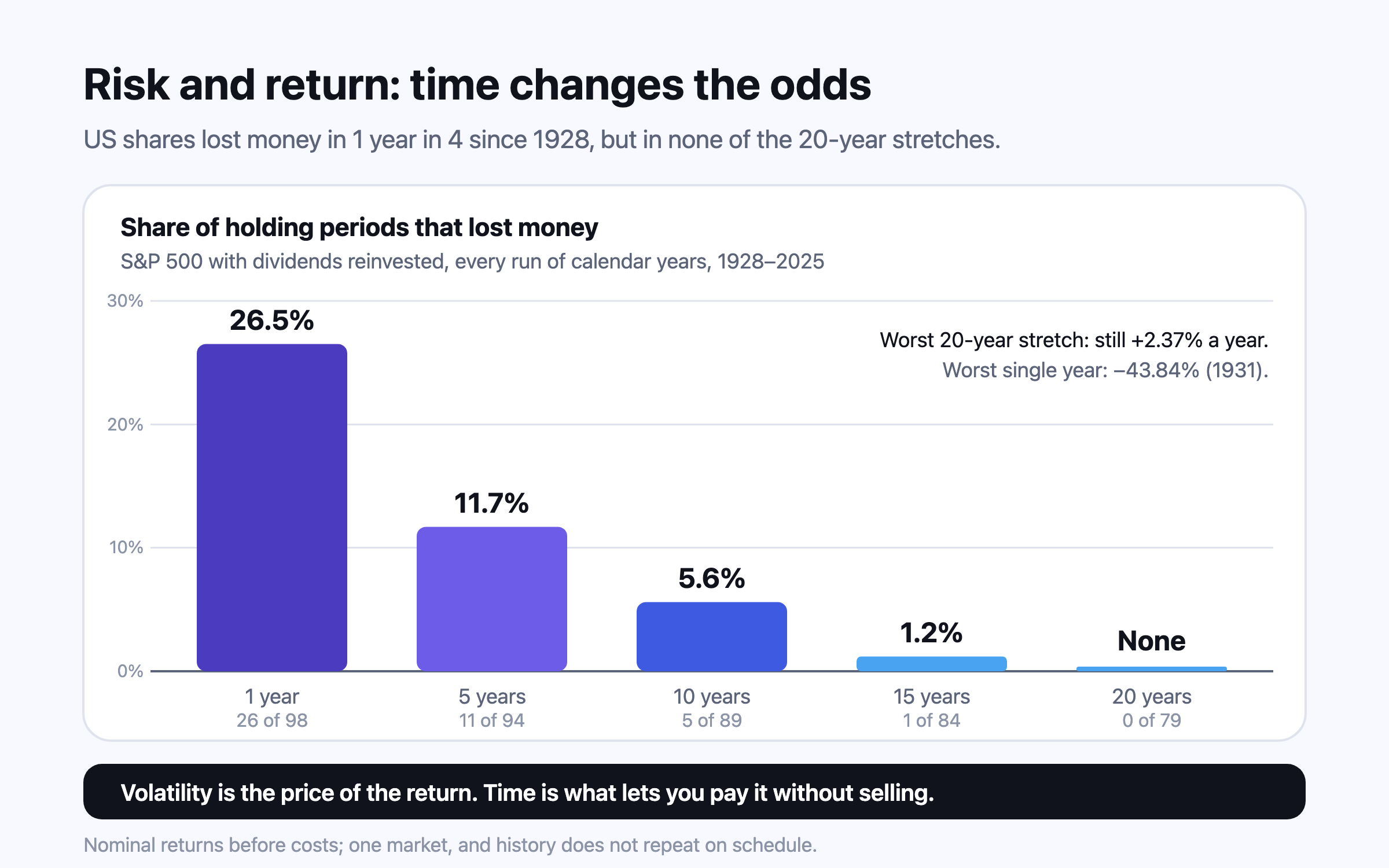
US shares returned about 10% a year from 1928 to 2025 against about 3.4% for Treasury bills, but lost money in 26 of those 98 years and fell 57% from peak to trough in 2007–09. Over every 20-year stretch in that record they still made money. Risk is the price of the extra return: what matters is whether you can afford to wait out a fall and whether you will.
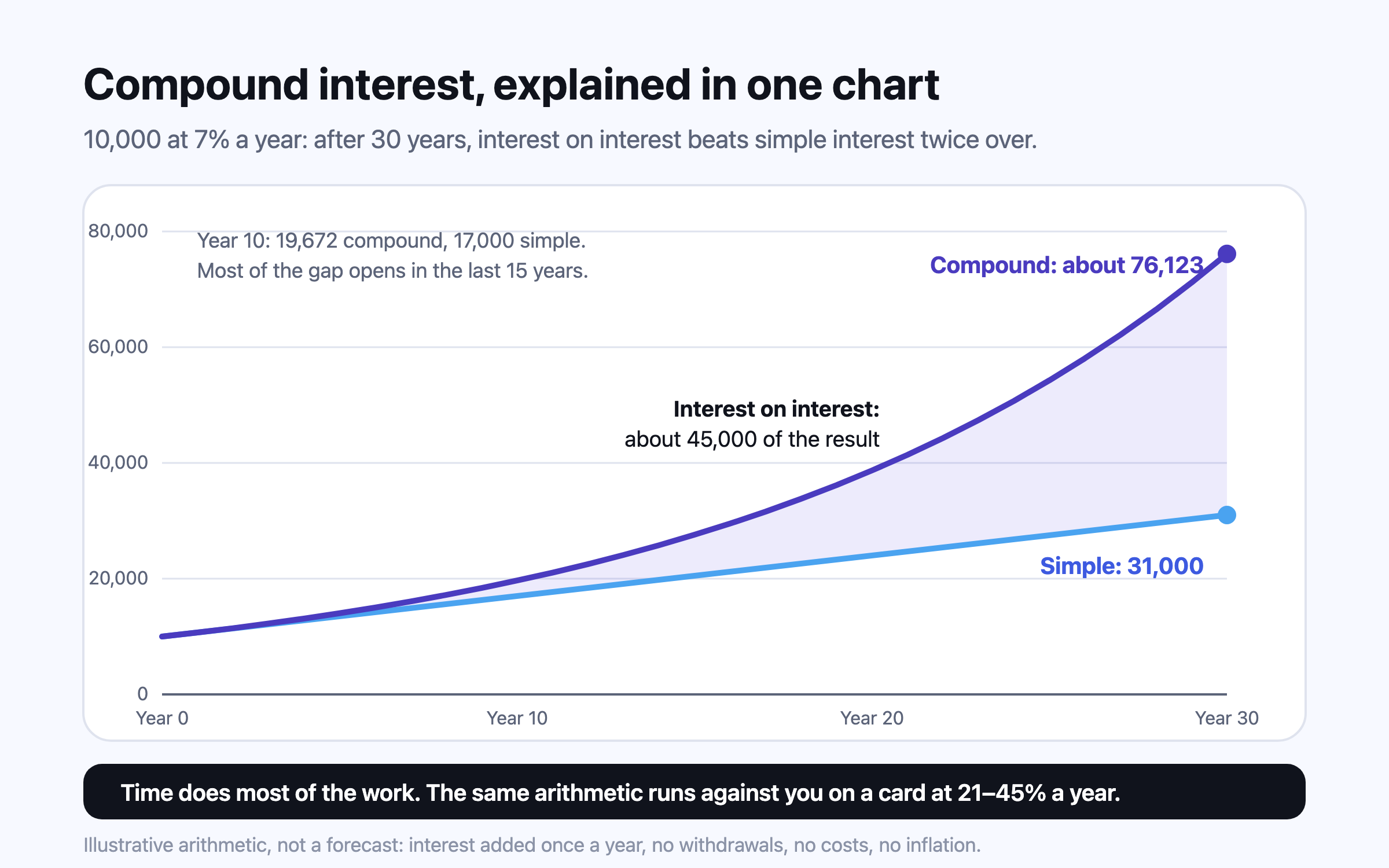
Compound interest is growth on growth: 10,000 at 7% a year becomes about 76,000 in 30 years, against 31,000 if only the original sum earned interest. The rule of 72 estimates doubling time well between about 4% and 12%. Fees and inflation slow compounding, and the same arithmetic on a card charging 21–45% a year doubles a debt in roughly one and a half to three and a half years.
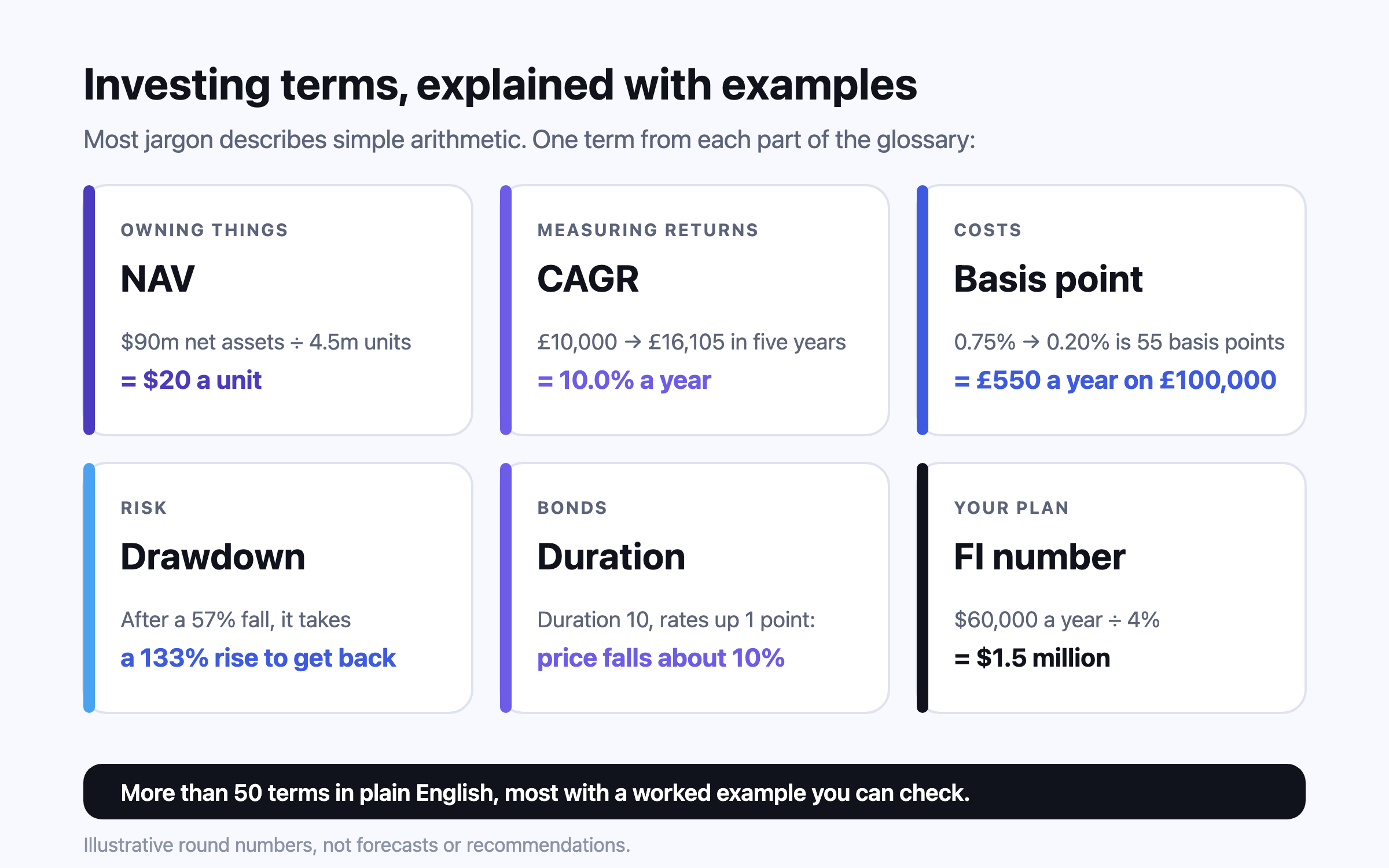
Most investing jargon describes something simple. A basis point is a hundredth of a percentage point; NAV is what one unit of a fund is worth; XIRR is your real yearly return when money went in at different times; duration says how far a bond falls when rates rise. This glossary gives each term a short definition, from a regulator or the original source where one exists, and most of them a worked example you can check.
This is general information, not financial, tax or legal advice for your circumstances. Rules and figures change; check the official source for your country, and consult a licensed professional before making financial decisions. Projections are estimates, not predictions.