An ETF is a fund you trade like a share; it usually costs little and tracks its index closely, but where it is domiciled and whether its price matches its holdings can matter more than its fee.
An exchange-traded fund holds a portfolio like a mutual fund but trades on a stock exchange all day. Large dealers create and redeem units to keep its price close to the value of its holdings; when that mechanism is blocked, as for India’s international ETFs in September 2026, prices can run far above value. For investors outside the US, the fund’s domicile decides how much dividend tax is withheld and whether US estate tax applies above US$60,000.
Nivritee Research · 6 October 2026 · 11 min read
An exchange-traded fund, or ETF, is a fund that lists on a stock exchange. Like a mutual fund it holds a portfolio, usually an index, and has a net asset value; unlike one, you buy and sell its units from other investors through a broker at whatever price the market sets during the day. The format has grown faster than any other: global ETF assets passed US$24 trillion for the first time at the end of August 2026, across 17,713 ETFs, with a record US$1.96 trillion of new money in the first eight months of the year1. In the US alone, ETFs held $13.4 trillion at the end of 2025, 70% of the world total at the time2.
For a beginner the useful way to think about an ETF is as a wrapper. The same S&P 500 or Nifty 50 portfolio can sit inside a mutual fund or an ETF; what differs is how you buy it, what it costs, how it is taxed and, for international investors, which country’s rules it lives under. Those differences, not the label, decide which is better for a given household.
premium over NAV reached by one Indian international ETF, 18 September 2026
How an ETF keeps its price near its value
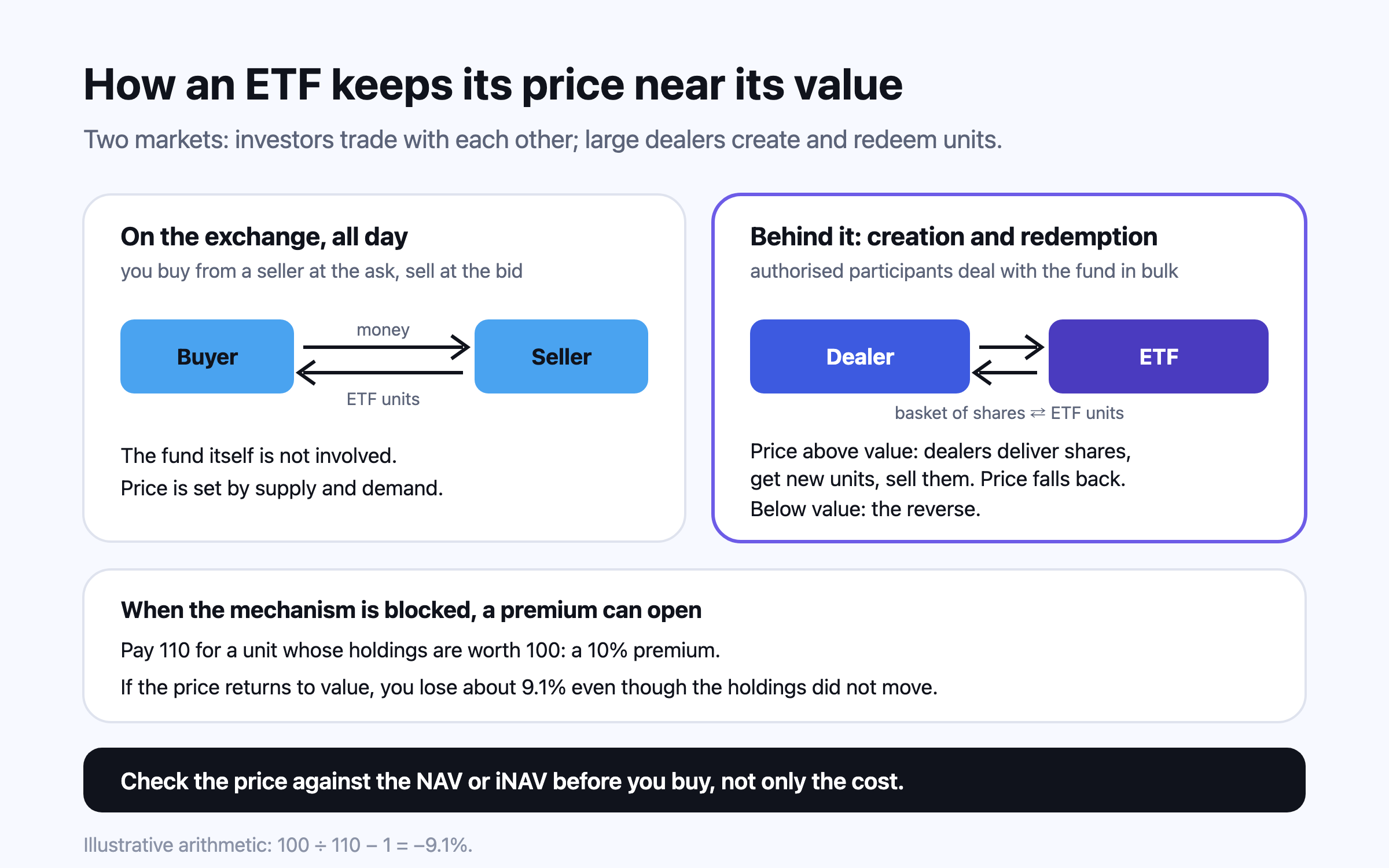
An ETF trades in two markets at once. In the one you see, investors trade units with each other on the exchange; the fund is not involved, and the price is whatever buyers and sellers agree. In 2025, 88% of all US ETF activity happened there, on the secondary market2. Behind it sits a primary market open only to large dealers called authorised participants. They can deliver a basket of the fund’s underlying securities and receive new ETF units in exchange, in large blocks the SEC gives as, for example, 50,000 units, or hand units back for the securities6.
That second market is what keeps the first honest. If the ETF’s price rises above the value of its holdings, a dealer can buy the holdings, swap them for new units and sell those units at the higher price, pocketing the gap and pushing the price back down; if the price falls below value, the reverse. The SEC describes these arbitrage opportunities as designed to keep the market price close to its underlying value, while noting that it will typically be somewhat more or less than NAV6. To help investors judge the gap during the day, many ETFs publish an estimated value as they trade, which the SEC’s 2012 bulletin describes as updated about every 15 seconds6; in India it is called the iNAV, and equity ETFs must publish it with a lag of no more than 15 seconds from the underlying market7.
Under the SEC’s 2019 ETF rule, US ETFs that rely on it must show on their websites their median bid-ask spread over the last 30 days, a history of premiums and discounts, and an explanation whenever a premium or discount above 2% lasts more than seven consecutive trading days8. These are the two numbers worth checking before buying an unfamiliar ETF anywhere.
When the mechanism breaks: India’s international ETFs
The arbitrage only works if new units can be created. Indian mutual funds face an industry-wide limit of US$7 billion on overseas securities and a separate US$1 billion limit on investment in overseas ETFs7. Both were reached in 2022 and have not been raised since, so fund houses cannot create new units of ETFs that hold foreign shares5. With demand strong and supply frozen, the exchange price floats free of the holdings. Over the previous year the average premium across India’s international ETFs ran at 15% to 20%; it rose sharply from early September 2026, and one Nasdaq ETF traded at a premium of 235% on 18 September5. A change to how exchanges set an ETF’s daily price band, in force from 7 September 20269, drew the band around the previous day’s traded price rather than the NAV, which removed what had been an accidental cap on the premium; SEBI intends to move the base back to the previous day’s NAV from 1 April 20271011.
On 10 September 2026 that ETF closed at ₹199.89 while the shares inside were worth ₹115.69, a premium of about 73%10. Karthik Mehta, 31, a software engineer in Bengaluru, who bought at that price to get US exposure, holds two bets: one on fifty Nasdaq-listed companies and one on the premium. If the premium went back to the roughly 20% it had run at for months with the holdings unchanged, the price would be about ₹138.83, a loss of about 30.5%; if it disappeared entirely, about 42.1%10. The holdings would not have moved at all. The same thing happened on a smaller scale in October 2025, when silver ETFs traded at premiums of 5.5% to more than 10% because physical silver to back new units was scarce12.
The general lesson applies everywhere: an ETF is only as good as its arbitrage. Before buying, compare the price you will pay with the iNAV or the last NAV. A premium of a fraction of a percent is normal; several percent means something is stopping dealers from creating units, and you are paying for a place in a queue. Indians who want US shares at the underlying price can remit up to US$250,000 a financial year under the Liberalised Remittance Scheme and buy US-listed funds directly13, which brings the domicile questions below.
What an ETF costs: fee, spread and tracking difference
The expense ratio is the visible cost, taken daily from the fund. In the US, index equity ETFs averaged 0.14% in 2025, asset-weighted, against 0.05% for index equity mutual funds; the simple average across all index equity ETFs was 0.45%, because many small, specialised ETFs charge far more than the giant ones that hold most of the money3. An ETF is not automatically cheaper than an index mutual fund: in the US, on that asset-weighted measure, the mutual funds were cheaper, and in India, the UK and Australia it depends on the fund and the platform.
The spread is the hidden one: you buy at the ask and sell at the bid. For a large ETF in a liquid market the gap is often a few hundredths of a percent; for a small one, or outside the hours when its underlying market is open, it can be far wider. If the spread is 0.20%, a A$10,000 purchase costs about A$10 against the midpoint, and a round trip about A$20, which is why the SEC asks US ETFs to publish their median spread8. Trading volume alone is a poor guide: because dealers can create units, an ETF holding liquid shares can be traded in size even if few people trade the ETF itself.
Tracking difference is the gap between the ETF’s return and its index’s over a period, usually close to the expense ratio and sometimes smaller where a fund earns income from lending securities. Tracking error is how much that gap wobbles from day to day. India caps the tracking error of ETFs and index funds other than debt funds at 2%, and requires tracking difference to be disclosed for one, three, five and ten years and since launch7. Read the tracking difference over several years: it is the real cost of owning the index through that fund.
Accumulating or distributing
Outside the US, many index ETFs come in two versions. A distributing ETF pays out the dividends it receives to unit holders; an accumulating ETF reinvests them inside the fund, so the price rises instead and you receive nothing in cash. For someone building wealth the accumulating version saves the work and cost of reinvesting. Tax decides more than convenience. In a UK ISA or SIPP, neither version is taxed. Outside one, income a UK fund reinvests is taxed as if it had been paid out14, and an offshore reporting fund’s retained income is reported to investors and taxed the same way15, so there is no tax saving and the record-keeping is harder. Distributing versions suit people who want the income to spend.
Sarah Okoye, 33, an NHS pharmacist in Manchester, holds a global index ETF in her stocks and shares ISA and chose the accumulating version so that nothing sits in cash. For an ETF domiciled outside the UK, she also checks that it appears on HMRC’s list of approved offshore reporting funds16, because outside a tax wrapper the offshore funds regime taxes gains on funds without that status as income rather than as capital gains17. Large UCITS ETFs sold to UK investors commonly have it, but it is a box worth ticking before it matters.
Domicile: Irish UCITS ETFs and US-listed ETFs
Where an ETF is legally based, its domicile, decides which country’s rules and tax treaties it uses. Most ETFs sold to investors in Europe, the UK and much of Asia are UCITS funds, the EU’s regulated framework for retail funds, which accounts for around 75% of collective investments by small investors in Europe18. Ireland dominates: Ireland-domiciled ETFs held US$1,617 billion at the end of 2024, 74.2% of European ETF assets4. For an investor outside the US, the choice between an Irish ETF and a US-listed ETF tracking the same index turns on two US taxes.
The first is dividend withholding. The US withholds tax on dividends paid to foreigners at 30% unless a treaty lowers it. The US–Ireland treaty rate on portfolio dividends is 15%, the same rate the UK, Canada and Australia have; India’s is 25%; Singapore has no income tax treaty with the US, so its residents bear the full 30%19. Many Irish ETFs holding US shares can claim the US–Ireland treaty rate on the dividends they receive, and Ireland does not withhold tax on payments to investors who are not Irish residents4.
The second is US estate tax. A non-resident who is not a US citizen must file a US estate tax return if their US-situated assets at death exceed $60,00020, and, unless an estate tax treaty says otherwise, shares in US corporations count as US-situated wherever the certificates are held21. A US-listed ETF is a US fund. The IRS rule is that stock of corporations organised under US law is located in the US and all other corporate stock is not21, so an ETF organised as an Irish company sits outside it; check the fund’s legal form in its prospectus. The contrast with Americans is stark: a US citizen’s estate exemption for 2026 is $15,000,00022, while a non-resident’s unified credit is generally $13,000, which is what makes the filing threshold so low21.
Illustrative arithmetic, not tax advice: the S&P 500’s published dividend yield in early October 2026, the IRS treaty rates (no US–Singapore treaty) and the IRS estate-tax threshold for non-residents. Irish ETFs often carry a slightly higher expense ratio than their US equivalents, which offsets part of the saving. 231942021
Arun and Kavitha Raman, Singapore: US$300,000 in an S&P 500 ETF
US-listed ETF
Ireland-domiciled UCITS ETF
Dividends a year at the index yield of 1.10%
about US$3,300
about US$3,300
US tax withheld on those dividends
30%: about US$990
15% at fund level: about US$495
Yearly drag from withholding
about 0.330%
about 0.165%
Exposed to US estate tax above US$60,000
Yes: US$240,000 over the threshold
No, if organised as an Irish company
Arun and Kavitha Raman, 39 and 37, Indian citizens working in Singapore, hold US$300,000 in a US-listed S&P 500 ETF through a local broker. On the table’s figures the withholding costs them about US$495 a year more than an Irish-domiciled equivalent, and if either died holding it, their heirs would face a US estate tax return on everything above US$60,00020. Neither problem shows up in the expense ratio, which is why domicile matters more than a few hundredths of a percent in fees for many investors outside the US. Switching is not free: selling to rebuy may trigger tax where they are resident, so the time to choose domicile is before buying. Theirs is the simple case: neither India nor Singapore is on the IRS list of countries with an estate tax treaty with the US, while the UK, Canada, Australia, Japan and eleven others are, and their residents should check what the treaty changes24. For how currency and home bias interact with this, see home bias and currency risk.
ETFs around the world, and the ones to treat with care
The market looks different in each country. Canada had C$924.2 billion in ETFs at the end of August 2026, beside C$2.797 trillion in mutual funds25, and since June 2022 funds held in self-directed accounts can no longer pay trailing commissions to discount brokers26. On the ASX, exchange-traded products were worth A$371.54 billion across 468 products at the end of August 2026, up 28.0% in a year27. Europe’s ETF assets reached US$3.97 trillion28. In India, passive funds, index funds and ETFs together, held 18.6% of mutual fund assets in March 202629. In Singapore, ETFs can be bought with CPF Ordinary Account savings under the CPF Investment Scheme, with higher-risk ETFs excluded30.
Some products wear the ETF label but behave differently. Leveraged and inverse ETFs reset their exposure every day, and FINRA warns that this can make them risky long-term, or even medium-term, investments31. FINRA’s own example: an index goes from 100 to 90 and back to 99, a 1% loss, while a fund promising twice the daily return goes from $100 to $80 to $96, a 4% loss31. Narrow thematic ETFs can close: 224 US ETFs were liquidated or merged in 2025 while 1,099 were launched2. A closure is not a fraud, since holders are paid out the fund’s value, but it can crystallise a loss and a tax bill on someone else’s schedule.
What about the ETF provider going bust? An ETF’s assets are held by a custodian separately from the manager, as with mutual funds; see mutual funds, explained for how that separation works in each country, and how the stock market works for the shares inside.
ETF or mutual fund: when each fits
A monthly SIP in India: an index mutual fund usually fits better. It buys fractional units at NAV with no demat account, no spread and no risk of paying a premium; an ETF needs a broker order each month.
A lump sum in the US: either works; index equity mutual funds averaged 0.05% a year in 2025, asset-weighted3, and ETFs can be more tax-efficient in taxable accounts because redemptions in kind let a fund hand over shares instead of selling them and realising gains6.
Investors outside the US buying US shares: an Ireland-domiciled UCITS ETF often wins on dividend withholding and estate tax, provided its expense ratio and spread are reasonable.
UK, Australian and Canadian platforms: compare the total of fund fee, platform fee and dealing charges; on some platforms ETFs cost less to hold, on others funds do.
Anyone: avoid paying more than a small premium to NAV, and avoid leveraged or inverse products unless you understand the daily reset.
The deeper point, which John Bogle made for decades, is that the wrapper matters less than owning a broad, low-cost portfolio and leaving it alone32. An ETF that is traded often is a worse investment than the same ETF held for twenty years. For choosing between specific funds, see how to choose a fund.
Tracking ETFs across countries
Questions people ask
What is the difference between an ETF and a mutual fund?
Both pool money into a portfolio. A mutual fund is bought from the fund at that day’s NAV; an ETF is bought from other investors on an exchange at the market price during the day, and dealers create and redeem units to keep that price near NAV6.
Are ETFs cheaper than index mutual funds?
Not always. In the US, index equity ETFs averaged 0.14% in 2025 against 0.05% for index equity mutual funds, asset-weighted3. Add the spread and any dealing charges for an ETF before comparing.
Why do some ETFs trade at a premium to NAV?
When dealers cannot create new units, the price can rise above the holdings’ value. India’s international ETFs cannot create units because the overseas investment limits are full, and in September 2026 one traded at a 235% premium5.
What is iNAV?
The indicative NAV, an estimate of the ETF’s holdings’ value published during trading. In India equity ETFs must publish it with no more than a 15-second lag from the underlying market7; compare it with the price before you buy.
Should I choose an accumulating or a distributing ETF?
Accumulating funds reinvest dividends inside the fund; distributing funds pay them out. Inside a tax wrapper such as an ISA, accumulating saves reinvesting; outside one, you may be taxed on the income either way, so choose on convenience and record-keeping.
Do non-US residents pay US estate tax on US ETFs?
They can. A non-resident non-citizen’s estate must file a US return if US-situated assets exceed $60,000, and shares in US corporations count20. Stock of non-US corporations, such as an ETF organised as an Irish company, is not US-situated21.
Is an Irish-domiciled ETF better than a US-listed one?
For many investors outside the US, yes: such funds can often claim the 15% US–Ireland treaty rate on US dividends194, and shares of a non-US company are not US-situated for estate tax21. US citizens and residents face different rules: a fund organised outside the US will usually meet the IRS tests for a passive foreign investment company, with its own tax treatment and an annual Form 862135.
What happens if an ETF closes?
The fund sells its holdings and pays holders the value, so you are not wiped out, but you may realise a gain or loss when you did not choose to. In 2025, 224 US ETFs were liquidated or merged2.
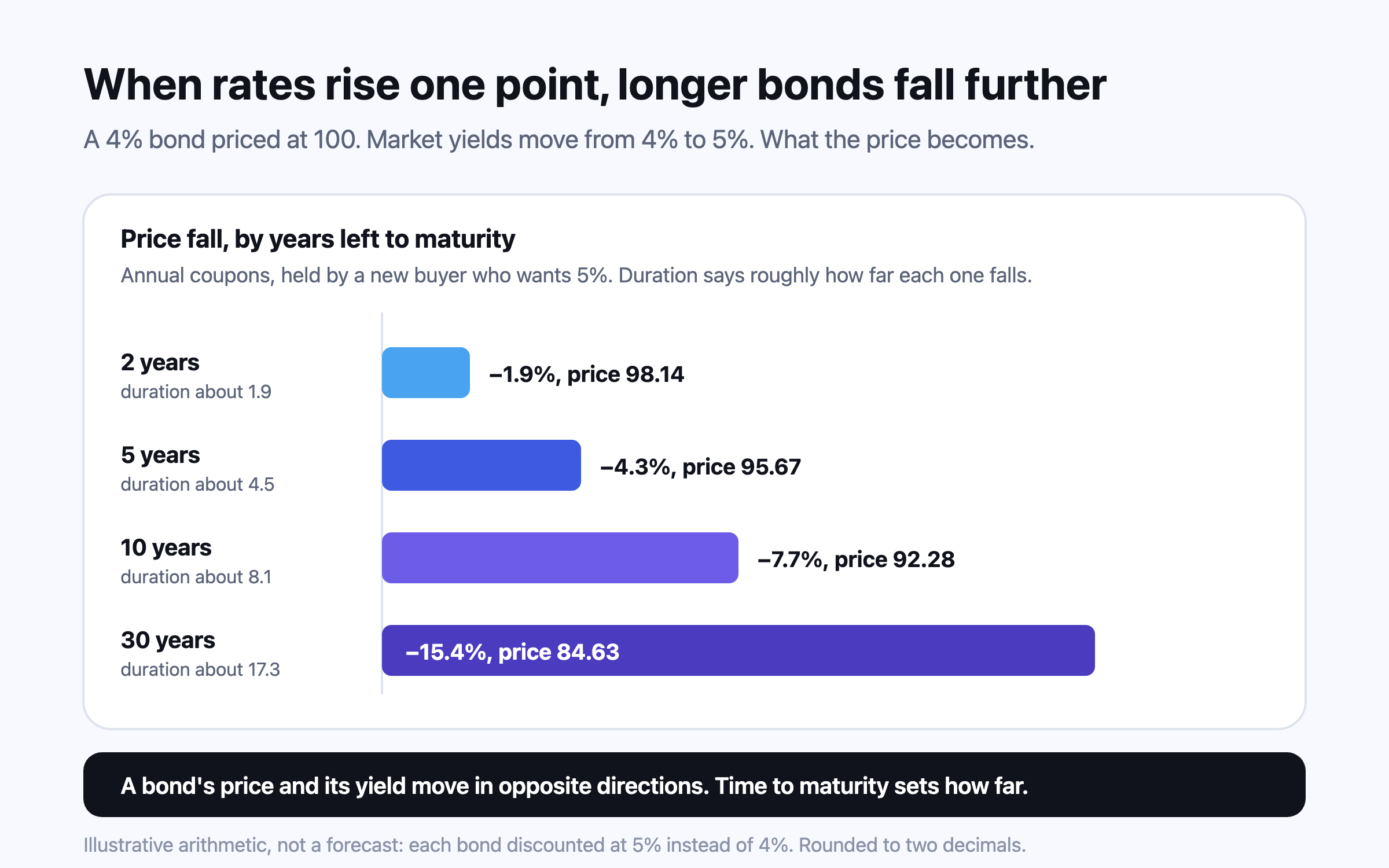
A bond is a loan you can sell. Its coupon is fixed, so when market rates rise its price falls until its yield matches the new rate, by roughly its duration for each percentage point. That is why the US bond market index lost 13.01% in 2022 and UK gilts 23.8%. The same arithmetic now works in savers’ favour: in early October 2026 ten-year government bonds yielded 5.31% in the US, 5.33% in the UK and 7.22% in India.
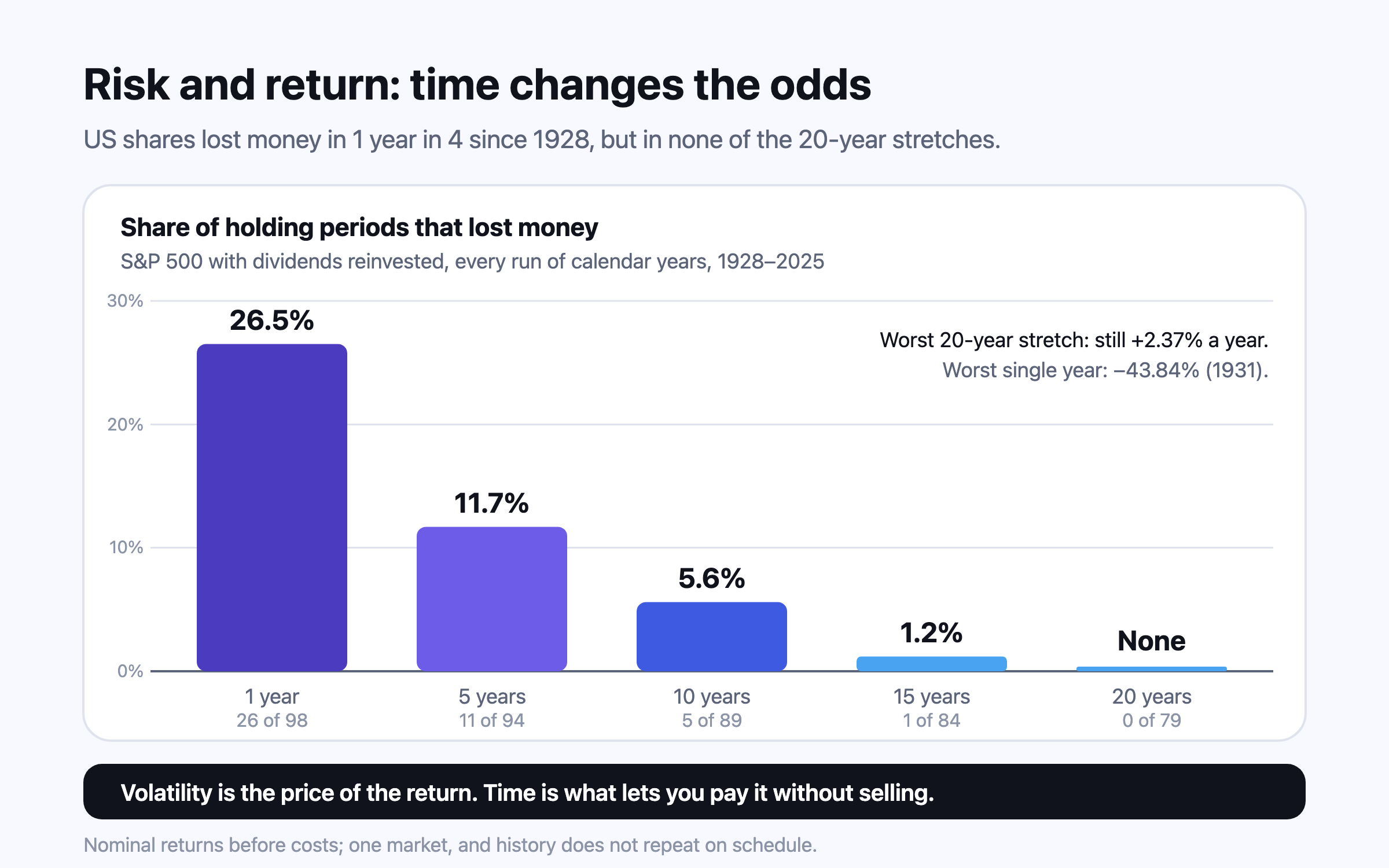
US shares returned about 10% a year from 1928 to 2025 against about 3.4% for Treasury bills, but lost money in 26 of those 98 years and fell 57% from peak to trough in 2007–09. Over every 20-year stretch in that record they still made money. Risk is the price of the extra return: what matters is whether you can afford to wait out a fall and whether you will.
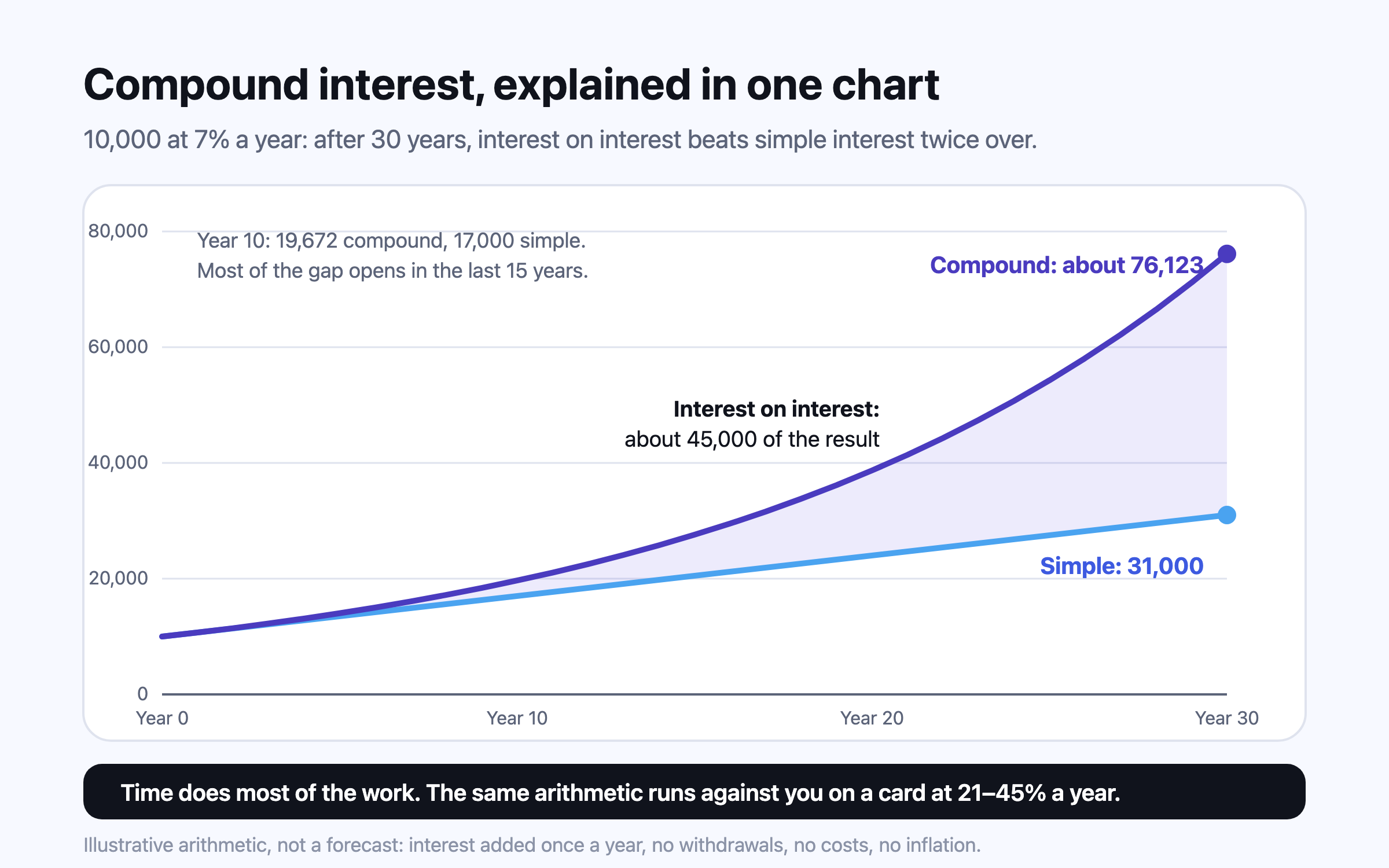
Compound interest is growth on growth: 10,000 at 7% a year becomes about 76,000 in 30 years, against 31,000 if only the original sum earned interest. The rule of 72 estimates doubling time well between about 4% and 12%. Fees and inflation slow compounding, and the same arithmetic on a card charging 21–45% a year doubles a debt in roughly one and a half to three and a half years.
This is general information, not financial, tax or legal advice for your circumstances. Rules and figures change; check the official source for your country, and consult a licensed professional before making financial decisions. Projections are estimates, not predictions.