Choose a fund on what it owns, what it costs and how well it tracks — not on last year’s ranking or its stars.
Start with what the fund owns and what it charges; those two decide most of the result. The evidence on past performance is discouraging: almost no US equity fund that was in the top quarter in 2021 stayed there every year to 2025, while Morningstar has called the expense ratio the most proven predictor of future fund returns. For index funds, compare tracking difference, size and, if you live outside the US, where the fund is domiciled.
Nivritee Research · 6 October 2026 · 13 min read
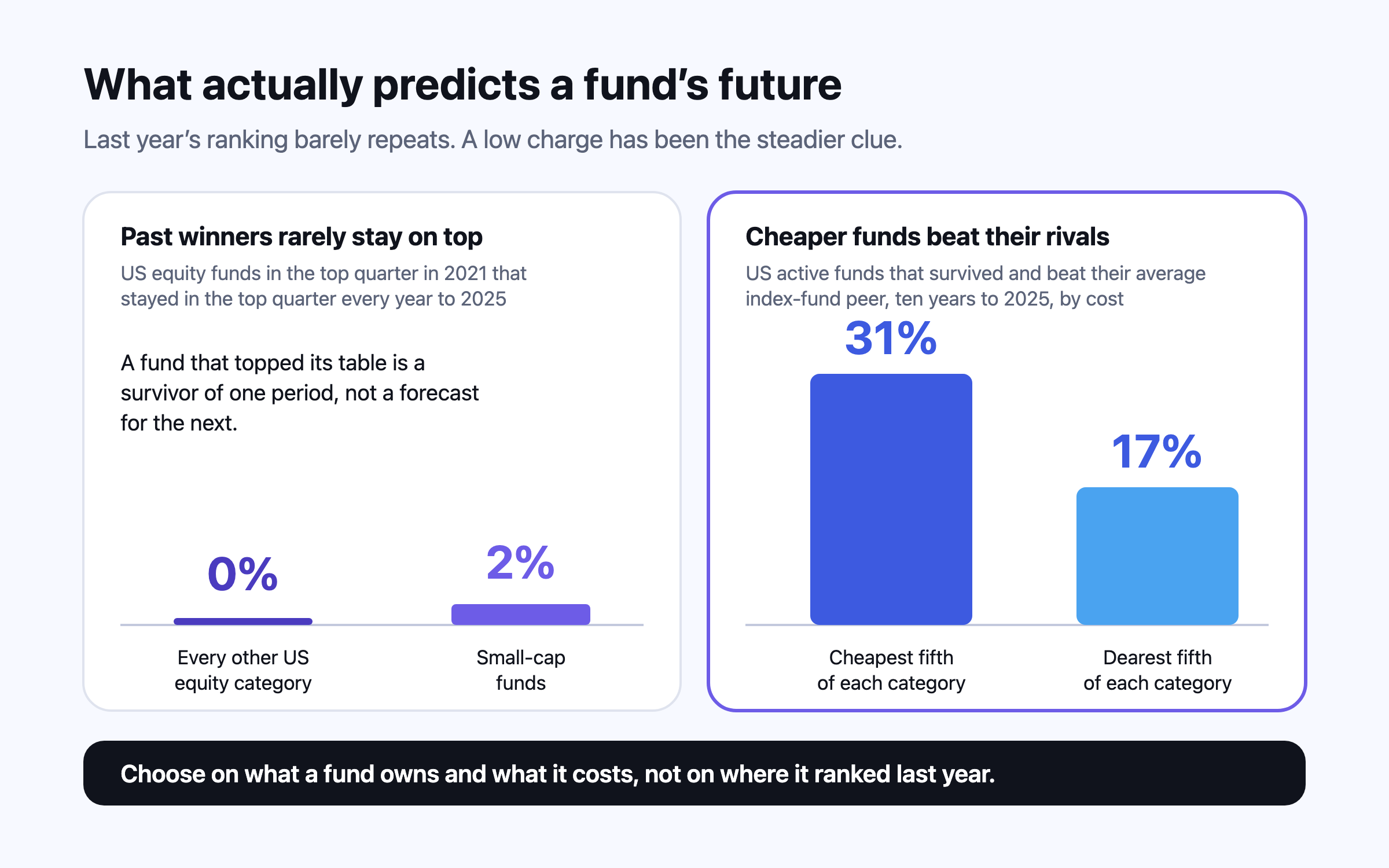
Most people choose a fund the way they would choose a restaurant: by its reviews and how busy it was last year. For funds that is close to the wrong way round. S&P’s Persistence Scorecard found that, apart from small-cap funds, none of the US equity funds in the top quarter of their category in 2021 stayed in the top quarter in each year to 2025, and only about 2% of small-cap funds did1. Morningstar, which publishes the best-known star ratings, has written that the expense ratio is the most proven predictor of future fund returns2.
So the checklist below runs in order of what the evidence says matters: what the fund owns, what it costs, how faithfully it does what it says, whether it will still exist, and the tax and currency questions that depend on where you live. It ends with worked comparisons for households in India, the UK and Singapore. It names no fund and recommends none; the point is to know which questions to ask of any fund you are offered. If the vocabulary is new, start with mutual funds explained and ETFs explained.
Average US fund expense ratio paid in 2025, asset-weighted
1. What the fund owns
Before cost, before ratings, read what the fund actually holds. For an index fund this means the index: the S&P 500 is about 500 large US companies; an all-world index holds thousands of companies across developed and emerging markets; India’s Nifty 50 holds 50 large Indian companies. Two funds can both be called “global” and hold very different things — one may leave out emerging markets or smaller companies, another may hold only a few dozen “quality” shares chosen by a rule. The fund’s factsheet names the index and the top holdings; the index provider’s own page explains how it is built.
For an active fund, read its stated objective and then check whether the holdings match it. In the US, a fund whose name suggests a focus must invest at least 80% of its assets in that kind of investment6. In India, SEBI’s 2017 categorisation rules permit only one scheme per category at each fund house, with exceptions for index funds, funds of funds and sector or thematic funds7 — which is why a “flexi cap” or “large cap” label tells you more in India than a fund name does in many other markets.
The question that matters most is how a fund fits with what you already own. A second fund that holds the same large companies as the first adds cost and paperwork, not diversification. Ontario’s regulator puts it first on its list of questions: what is the fund’s goal, and does it fit your own goals and your other investments8? How the pieces should add up for your age is covered in asset allocation by age.
2. What it costs, all the layers
A fund’s yearly charge has different names — expense ratio in the US, total expense ratio (TER) in India, ongoing charges figure (OCF) in the UK and Europe, management expense ratio (MER) in Canada — but it is the same thing: a percentage taken from the fund’s assets every year, already inside its daily price. Morningstar’s 2016 study found that, measured over 2010 to 2015, 62% of the cheapest fifth of US equity funds in each category survived and outperformed their category, against 20% of the dearest fifth — the cheapest three times as likely to succeed2. Its 2025 update found the same direction over ten years: 31% of the cheapest active funds beat their average index-fund rival, against 17% of the dearest3.
Academic work explains why. Mark Carhart’s 1997 study found that common market factors and investment expenses almost completely explain why some funds seem to keep winning, and that the only strong persistence was among the worst funds, which kept losing9. Eugene Fama and Kenneth French concluded in 2010 that few active funds produce returns sufficient to cover their costs10. Cost is the one thing about a fund’s future you know for certain in advance.
The fund’s charge is only one layer. Add the platform or account fee, any adviser or distributor fee, and dealing costs. In India, every scheme has had to offer a direct plan without a distributor’s commission since 1 January 2013, at a lower expense ratio than its regular plan11; and from 1 April 2026 SEBI caps an index fund’s or ETF’s base expense ratio at 0.90%, against up to 2.10% for an equity scheme managing less than ₹500 crore, both before statutory levies12. In Canada, the Ontario Securities Commission reminds investors that the MER is charged whether or not the fund does well, and that trailing commissions are paid for as long as you hold the fund13. How these layers compound over 30 years is worked through in what fees cost over 30 years.
3. For index funds: tracking difference, not just the fee
An index fund promises the index return minus costs. Two measures tell you how well it keeps that promise. Tracking difference is the gap between the fund’s return and the index’s over a period — the number that shows up in your money. Tracking error is how much that gap wobbles from day to day. India’s SEBI requires equity index funds and ETFs to keep tracking error, measured on daily returns over a rolling year, below 2%, and to publish both measures, with tracking difference disclosed monthly for one, three, five and ten years and since launch14.
Tracking difference can be smaller than the fee (a fund that lends out its shares, or is taxed less on dividends than the index assumes, can claw some back) or larger (cash drag, trading costs, sampling the index rather than buying all of it). Compare it over three and five years, not one. Between two index funds on the same index, a consistently smaller tracking difference is worth more than a slightly lower headline fee.
4. Size, age and whether it will still exist
Funds close more often than people expect. Of 2,373 US domestic equity funds alive twenty years earlier, only 37.29% were still running in mid-2025; over ten years, 63.81% survived4. Morningstar found that higher-cost funds are much more likely to fail and be merged away2. A closure is rarely a disaster — the money is returned or moved — but it can trigger tax on gains and leaves you choosing again.
The SEC warns that new or small funds sometimes post excellent short-term records that are hard to sustain as they grow6. For an index fund or ETF, size also matters for a practical reason: a larger fund usually trades with narrower spreads and is less likely to be shut. There is no magic threshold. A fund with a few years of history, enough assets to be worth running, and a sponsor that runs similar funds is a reasonable bar.
5. Domicile, tax and the US estate-tax trap
Where a fund is legally based can matter as much as its fee, and the right answer depends on where you live. Most funds sold to individuals in Europe are UCITS funds, a common EU framework that the European Commission says accounts for around 75% of collective investments by small investors in Europe15. Many UCITS ETFs are domiciled in Ireland, which matters for anyone investing in US shares from outside the US.
The US withholds tax on dividends paid to foreign investors at 30% unless a tax treaty sets a lower rate16. The US–Ireland treaty generally caps it at 15%17, so an Irish-domiciled fund holding US shares usually suffers less withholding inside the fund than a non-treaty investor holding a US-domiciled ETF directly. Neither Singapore nor the United Arab Emirates appears on the IRS’s list of US income tax treaty countries18. The second issue is estate tax: the estate of a non-US person must file a US estate tax return if their US-situated assets exceed $60,000 at death, and the IRS lists shares of US corporations among those assets19. US-domiciled funds are widely treated the same way, which is a large part of why many investors in Asia, the Gulf and Europe choose Irish-domiciled funds for US exposure. This is general information; check your own position with a tax professional.
Home-country rules matter too. In the UK, an offshore fund without HMRC reporting fund status can turn a gain that would have been taxed as capital into one taxed as income, so British investors check HMRC’s list before buying a non-UK fund20. In Canada, the OSC tells investors weighing foreign-listed ETFs to consider currency, foreign withholding taxes, account type, foreign-exchange costs and potential foreign estate tax21. In India, gains on “specified mutual funds” bought since April 2023 are taxed as short-term gains whatever the holding period; from the 2025-26 tax year the term means funds investing more than 65% in debt and money-market instruments, or funds investing mostly in such funds22. More on the trade-offs between fund wrappers is in ETFs explained.
6. Currency: hedged or not
A fund holding foreign shares exposes you to the currency as well as the shares. A hedged share class removes most of that currency movement, at a cost; an unhedged one leaves it in. The usual reasoning is that bonds are held for stability, so currency swings, which can be as large as the bond returns themselves, defeat their purpose and are often hedged; equities are volatile anyway, and over long periods the currency effect on a global share fund tends to matter less. What matters most is the currency you will spend. An Indian family planning to live in India, a British couple settling in Spain and a Singapore household all have different answers, set out in home bias and currency risk.
What past performance and star ratings actually predict
Past returns are the first thing on every factsheet and the least useful. Only 4.5% of US large-cap funds in the top half of their category in 2021 stayed above the median in each of the next four years — fewer than the 6.25% that pure chance would produce1. The SEC’s guide for investors makes the point bluntly: this year’s top fund can easily be next year’s below-average one6.
Star ratings are past performance after costs and risk, ranked. When Morningstar tested its own stars over 2003 to 2015, it found moderate predictive power: five-star equity funds beat one-star funds in the following month by a margin worth about 1.03% a year, and five-star funds were far more likely to survive23. That is a real but modest edge, measured one month ahead, and it says nothing about which of today’s five-star funds will be among the few that stay on top. A high rating is a reason to look closer, not a reason to buy.
Morningstar’s mid-2026 update found that just over 40% of active funds survived and beat their average passive peer in the twelve months to June 2026, and that an investor picking an active manager at random would still face a 60% probability of underperforming; in 16 of 20 categories, the cheapest fifth of funds had better odds24. The longer record is in index vs active funds: the SPIVA data.
Red flags worth walking away from
Closet indexing: an “active” fund that mostly hugs its index while charging active fees. The FCA estimated about £109 billion sat in such funds in the UK25, and ESMA flagged between 5% and 15% of the EU equity funds it examined as potential closet trackers, depending on the test26.
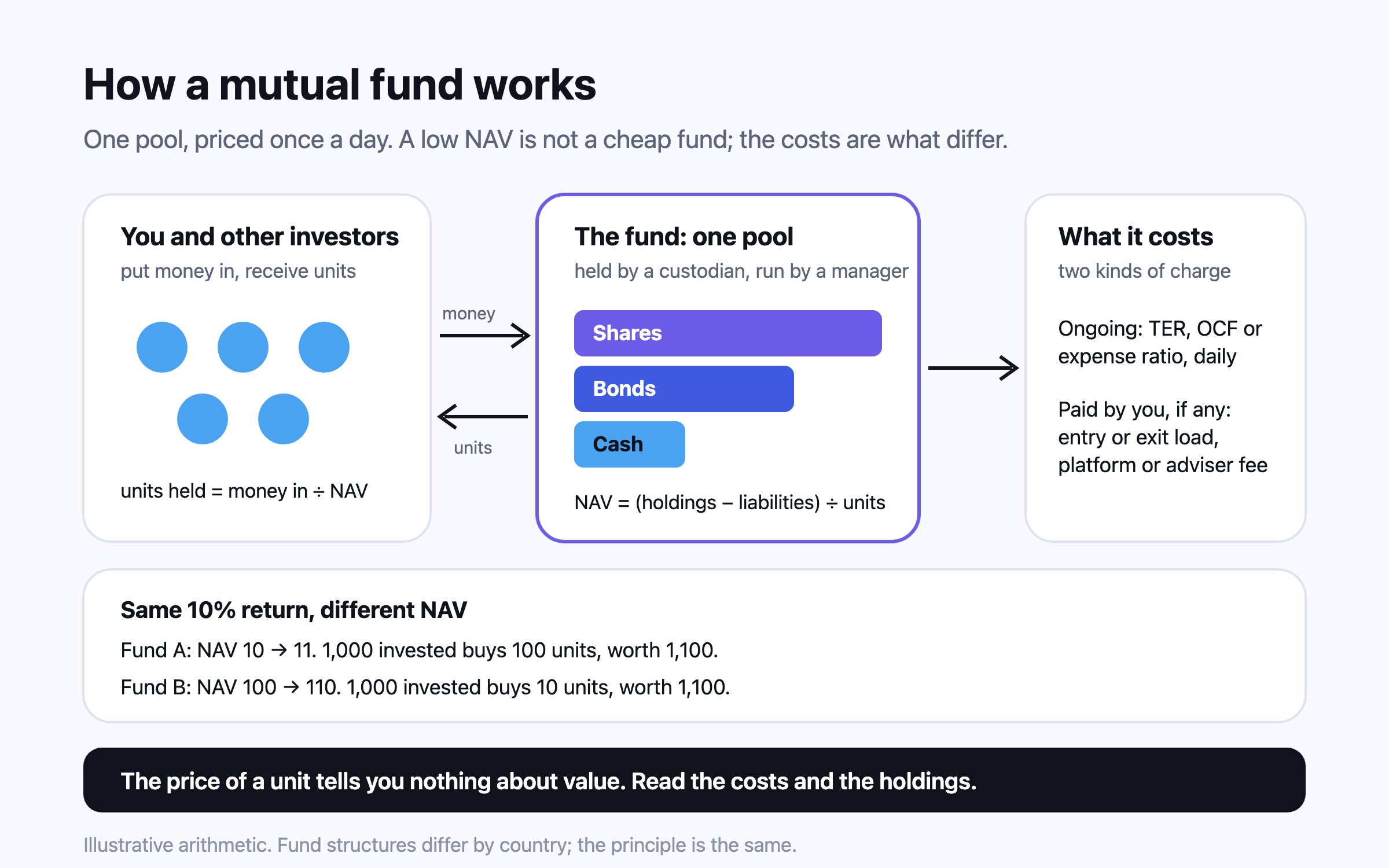
A new fund offer sold on its launch price. An Indian NFO at ₹10 a unit is not cheaper than an existing fund at ₹200: the price per unit says nothing about value. AMFI’s own factbook credits enthusiasm for thematic NFOs, along with strong markets, for FY25’s surge in new-fund collections, about ₹1.08 lakh crore, 79% of it into equity funds27.
A narrow theme bought after a strong run. Sector and thematic funds have the widest gap between what the fund earned and what its investors earned, because money tends to arrive after the run28. See common investing mistakes.
A commission you cannot see. A regular plan in India, or a trailing commission in Canada, is not wrong in itself, but you should know what you are paying and for what1113.
A fund you cannot explain in a sentence. Structured products, leveraged or inverse ETFs and funds with complex fee structures are built for purposes other than a household’s long-term savings.
Worked comparisons: three households, two funds each
Ishita, 33, Hyderabad, is starting a ₹25,000 monthly SIP for twenty years — ₹60 lakh paid in. She is choosing between two funds tracking the same large-cap index: Fund A, a direct plan whose total drag (expense ratio plus tracking difference) is 0.2% a year, and Fund B, a regular plan of a similar fund at 0.8%. If the index earned 11% a year, Fund A’s 10.8% would grow her SIP to about ₹2.11 crore and Fund B’s 10.2% to about ₹1.95 crore, a gap of about ₹16 lakh, computed as SEBI’s SIP calculator does29. The returns are illustrative; the gap is the point. She also checks that both stay within SEBI’s 0.90% cap for index funds12 and compares their published tracking difference over five years.
Daniel, 41, a Leeds teacher, has £20,000 to put in a stocks and shares ISA for twenty years. Option A is a global index fund at 0.12% plus a 0.25% platform fee; option B, recommended by a friend, is an active global fund at 0.85% on the same platform. At 6% a year before costs, A leaves about £59,800 and B about £52,100 — roughly £7,700 less for the active fund, which would need to beat its index by about three-quarters of a point every year just to draw level. The FCA’s finding that a large slice of “active” money hugs the index anyway is a reason to check B’s holdings before paying for them25.
Kelvin and Aditya, in their late thirties in Singapore, want US shares and are choosing between a US-domiciled S&P 500 ETF and an Irish-domiciled UCITS ETF on the same index. Singapore has no income tax treaty with the US, so a US-domiciled ETF’s dividends to them are withheld at 30%1618; the Irish fund suffers about 15% inside the fund under the US–Ireland treaty17. On a US$200,000 holding yielding an illustrative 1.5%, that is US$900 a year withheld against US$450 — a difference of about 0.2 points a year, which can outweigh a small difference in fees. Above US$60,000 of US-situated assets, their estates could also face a US estate tax filing19. A household in Dubai faces the same arithmetic, because the UAE is not on the IRS treaty list either18.
Emma and Ben, 45, in Brisbane, already hold an Australian shares index ETF and are adding international shares. Two candidate ETFs track the same developed-markets index at near-identical fees; one is currency-hedged to the Australian dollar. They pick on three questions from this checklist: tracking difference over five years, size and spread, and whether they want the currency exposure — they will spend in Australian dollars, but their super already holds a lot of Australian assets, so some unhedged foreign currency is diversification. In Canada, Ravi, 50, in Mississauga, used the OSC’s list of questions to ask his bank adviser what the fund’s MER and trailing commission were813; the answer, not the fund’s star rating, decided the conversation.
The worked comparisons above. Returns and yields are illustrative assumptions, not forecasts; the rules quoted are each regulator’s own. 29161713
Household
Choice
What decided it
Ishita, Hyderabad
Direct vs regular index fund
Total cost and tracking difference; about ₹16 lakh over 20 years
Daniel, Leeds
Index vs active global fund
Ongoing charge plus platform fee; about £7,700 over 20 years
Kelvin and Aditya, Singapore
US- vs Irish-domiciled ETF
Dividend withholding and US estate tax
Emma and Ben, Brisbane
Hedged vs unhedged
The currency they will spend and what they already hold
Ravi, Mississauga
Bank mutual fund
The MER and the trailing commission
The checklist
Write down what you want the fund to do in your portfolio, and for how long.
Read the factsheet: the index or objective, the top holdings, how much overlaps with what you already own.
Add up every layer of cost: the fund’s own charge, the platform, any adviser or distributor, and dealing costs.
For an index fund, compare three- and five-year tracking difference with the index, not just the fee.
Check size, age and the sponsor: a fund with a few years’ history and enough assets to be kept running.
Check domicile and tax for where you live: withholding on dividends, estate tax on foreign assets, and home-country rules.
Decide on currency: hedged or unhedged, against the currency you will spend.
Read past returns and ratings last, as a check that nothing is badly wrong, not as the reason to buy.
Three books cover this ground better than any factsheet. John Bogle’s *The Little Book of Common Sense Investing* argues that owning the whole market at the lowest cost is the reliable way to get the market’s return30. Burton Malkiel’s *A Random Walk Down Wall Street* explains why prices are so hard to predict and why most managers fail to beat broad index funds31. For Indian households, Monika Halan’s *Let’s Talk Money* sets out a simple system that leans on low-cost funds32. Singapore’s MoneySense adds a regulator’s version of the same advice: read the key documents and compare a product with its alternatives on risk, return, fees and flexibility before buying33.
After you choose: checking it does its job
Questions people ask
What is the most important thing when choosing a fund?
What it owns and what it costs. Morningstar found the expense ratio the most proven predictor of future fund returns, with the cheapest US equity funds three times as likely to succeed as the dearest2.
Do Morningstar star ratings predict future performance?
Only modestly. Morningstar’s own test found five-star equity funds beat one-star funds by about 1.03% a year afterwards, and survived more often23; but top-ranked funds rarely stay on top for long1.
What is the difference between tracking error and tracking difference?
Tracking difference is how far a fund’s return fell short of (or beat) its index over a period; tracking error is how much that gap varied day to day. SEBI requires Indian index funds and ETFs to publish both and caps an equity index fund’s tracking error at 2%14.
Does a fund’s size (AUM) matter?
Somewhat. Small and new funds close more often — only 37.29% of US domestic equity funds survived twenty years to mid-20254 — and larger index funds usually trade more cheaply. Beyond a reasonable size, cost and tracking matter more.
Should a non-US investor buy US-domiciled or Irish-domiciled ETFs?
Many choose Irish-domiciled UCITS funds because US dividend withholding is generally 15% under the US–Ireland treaty against 30% without a treaty, and because US-situated assets above $60,000 can bring a US estate tax filing171619. Your own treaty position decides it.
Is a direct plan better than a regular plan?
It holds the same portfolio at a lower expense ratio, because it carries no distributor commission; SEBI has required every scheme to offer one since 1 January 201311. A regular plan is worth it only if the distributor’s help is worth the difference to you.
Should I buy a new fund offer (NFO)?
Not because its units cost ₹10. Price per unit says nothing about value, a new fund has no record to judge, and AMFI’s factbook ties FY25’s rush of new-fund money partly to enthusiasm for thematic launches27. Ask what it offers that an existing fund does not.
How many funds should I own?
Usually fewer than people hold. One or two broad index funds can cover most of the world’s shares; each extra fund should add something the others lack. Check overlap in the top holdings before adding one, and ask, as Ontario’s regulator suggests, whether it works with your other investments8.
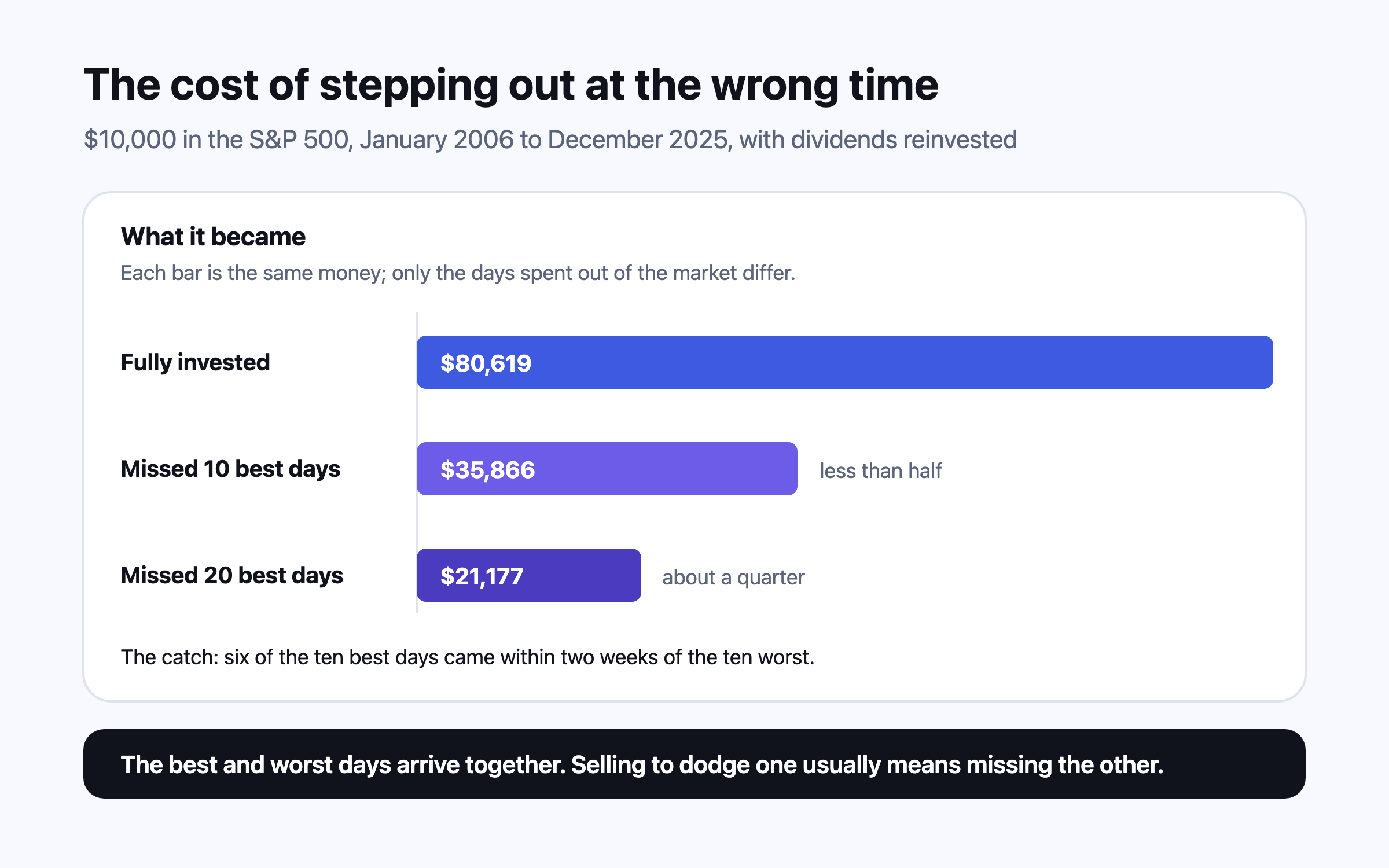
Over the ten years to 2025, the average dollar in US funds earned about 1.2 points a year less than the funds themselves, because of when money went in and out — though a 2026 study argues timing explains far less of that. Better evidenced are the costs of heavy trading, leverage and concentration: 87.7% of individual Indian F&O traders lost money in FY26, and the most active US households in one classic study trailed the market by over six points a year.
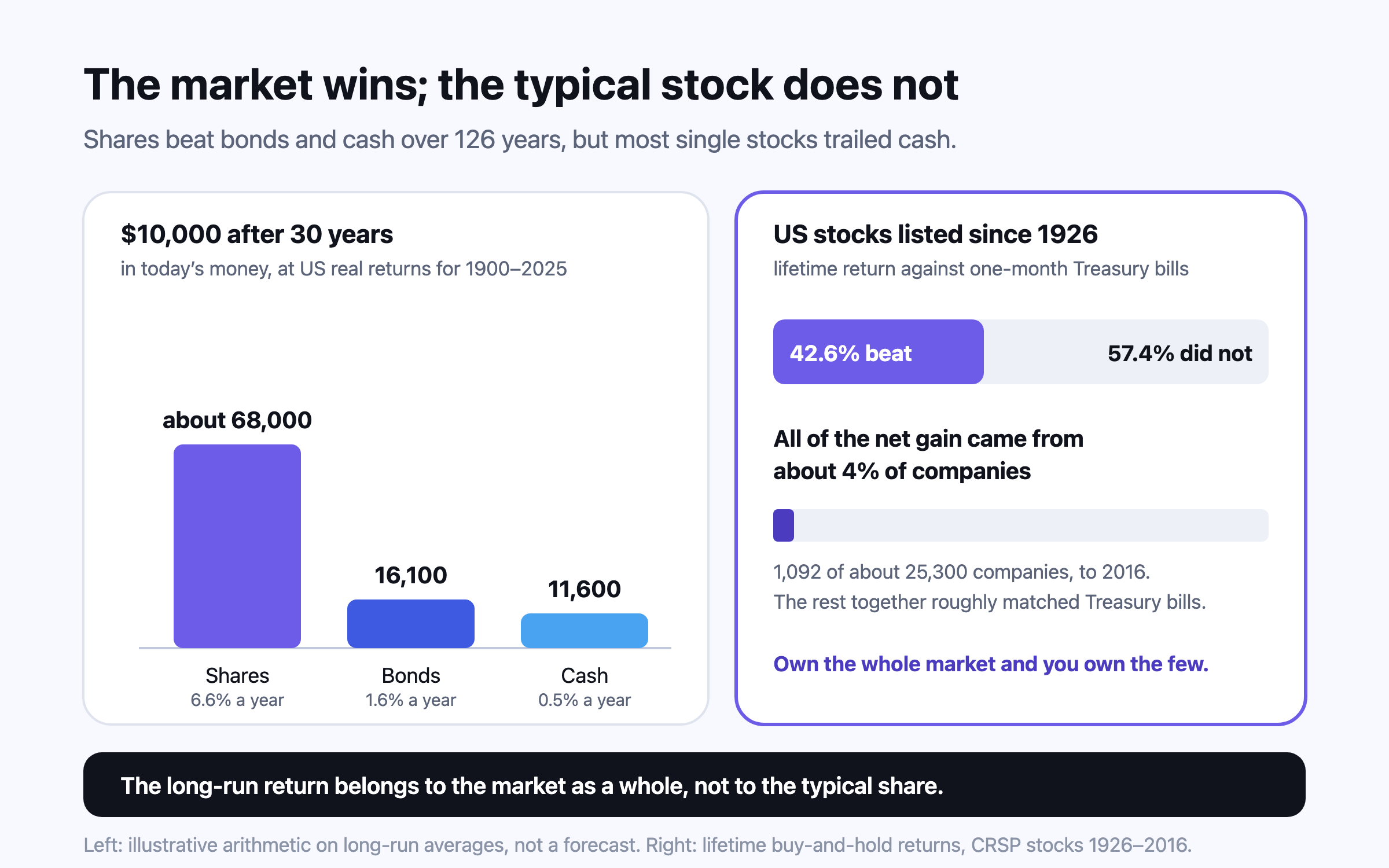
A share is a small part-ownership of a company, bought and sold on an exchange between investors. Over 1900–2025, US shares returned about 6.6% a year after inflation against 1.6% for bonds and 0.5% for cash, and shares were the best asset in every market with a continuous record. But most individual US stocks since 1926 did worse than Treasury bills over their listed lives, and about 4% of companies produced all of the market’s net gain, so the long-run return belongs to the whole market, not to the typical stock.
A mutual fund pools many investors’ money into one portfolio and issues units priced at the net asset value (NAV) once a day. The NAV itself says nothing about value; the costs and the holdings do. A yearly charge of 0.9% instead of 0.1% leaves about 17% less after 25 years, most active funds trail their index over long periods, and index mutual funds and index ETFs together held 52% of US long-term fund assets at the end of 2025.
This is general information, not financial, tax or legal advice for your circumstances. Rules and figures change; check the official source for your country, and consult a licensed professional before making financial decisions. Projections are estimates, not predictions.