Compounding pays you interest on your interest, so time matters more than the amount — and a credit card runs the same arithmetic against you.
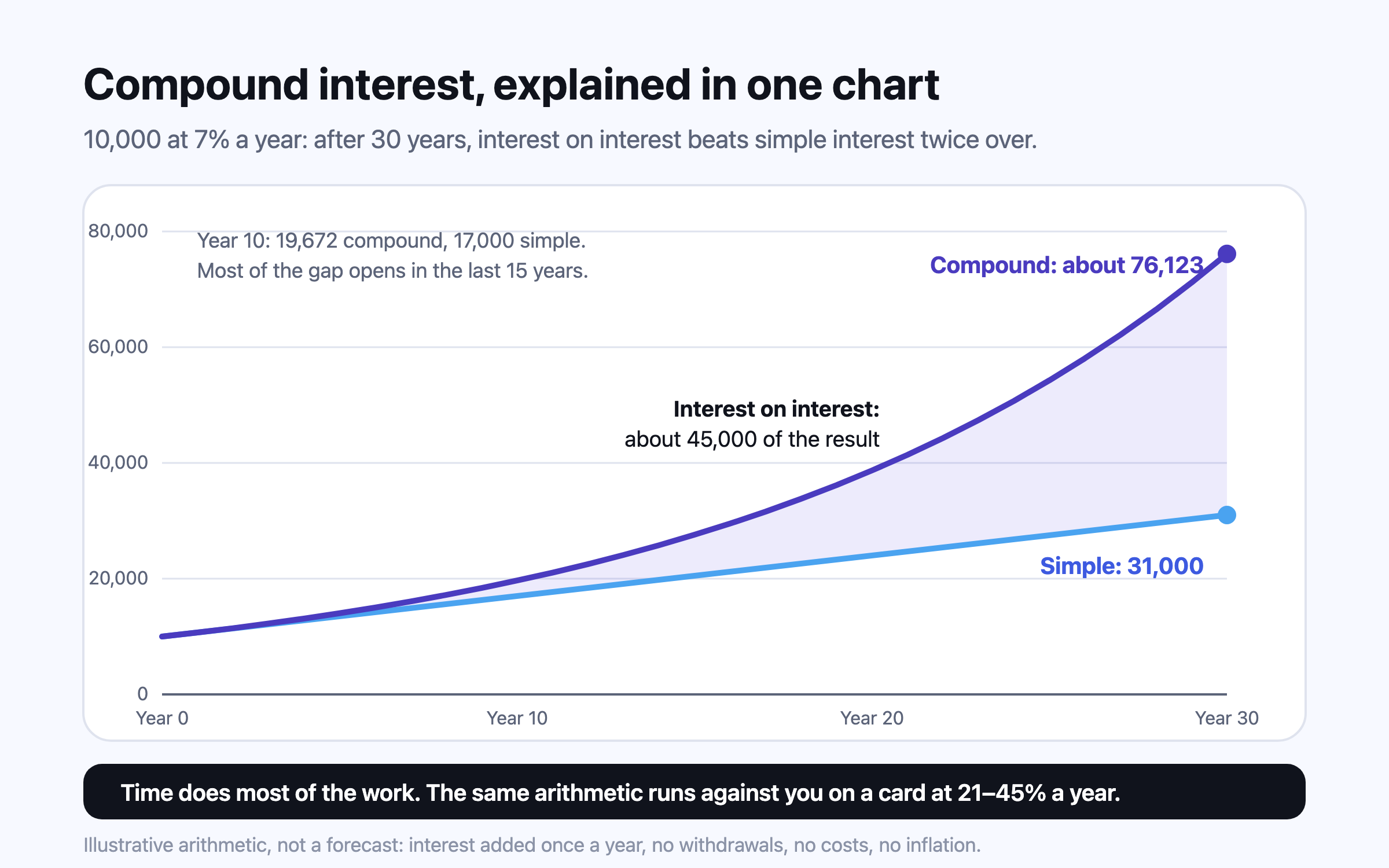
Compound interest is growth on growth: 10,000 at 7% a year becomes about 76,000 in 30 years, against 31,000 if only the original sum earned interest. The rule of 72 estimates doubling time well between about 4% and 12%. Fees and inflation slow compounding, and the same arithmetic on a card charging 21–45% a year doubles a debt in roughly one and a half to three and a half years.
Nivritee Research · 6 October 2026 · 9 min read
Compound interest is interest paid on the original sum and on the interest it has already earned1. That one sentence explains most of personal finance. Put 10,000 away at 7% a year and leave it alone: after 30 years it is worth about 76,123. If only the original 10,000 had earned interest — simple interest — it would be 31,000. The extra 45,000 or so is interest on interest, and almost all of it arrives in the second half of the period.
a year: the standard finance charge on most HDFC Bank credit cards, before GST (September 2026)
How compounding works, year by year
Each year’s interest is worked out on a slightly bigger balance than the year before. At 7%, 10,000 earns 700 in the first year. The second year’s interest is 7% of 10,700, which is 749. By year 10 the balance has grown enough that one year’s interest is about 1,287; by year 30 it is about 4,980 — nearly half the original sum, earned in a single year without anything new being added1.
Illustrative arithmetic, not a forecast: 10,000 left to compound at 7% a year, interest added once a year, rounded to whole units. Any currency; the shape is the point. 1
Year
Balance at the start
Interest that year at 7%
Balance at the end
1
10,000
700
10,700
2
10,700
749
11,449
10
18,385
1,287
19,672
20
36,165
2,532
38,697
30
71,143
4,980
76,123
Two things follow. First, compounding is slow and then fast: in this example the balance takes about ten years to double the first time, and the last ten years add more than the first twenty. Second, the main input is time, not cleverness. Studies of how people estimate growth find that most of us picture it as a straight line. Victor Stango and Jonathan Zinman called this exponential growth bias. They found it explains why people underestimate the interest rate on a loan and the future value of savings, and that households with more of it borrowed more and saved less6.
Monthly, quarterly or yearly compounding
The more often interest is added, the faster the balance grows, but the difference is smaller than people expect. A nominal 7% compounded monthly is an effective 7.23% a year, against 7% compounded annually1. When comparing two savings products, compare the effective annual rate (the AER in the UK, the annual percentage yield in the US). The compounding frequency matters far more on debt, where rates are higher, as the credit card section below shows.
Does compounding work on shares and funds, which pay no interest?
Strictly, shares do not pay interest. They compound in two other ways: the companies reinvest profits and grow, and dividends, if reinvested, buy more shares that pay their own dividends. Aswath Damodaran’s data at NYU Stern show $100 put into the S&P 500 at the start of 1928, with dividends reinvested, growing to about $1,157,599 by the end of 2025 — about 10.02% a year compounded. The same $100 in three-month Treasury bills became about $2,578 (3.37% a year) and in ten-year Treasury bonds about $7,753 (4.54% a year)3.
That 10.02% is a compound (geometric) average. The simple average of the 98 yearly returns is higher, about 11.86%, because losses hurt compounding more than gains help it: a 50% fall needs a 100% rise to get back to where you were3. Shares also lost money in 26 of those 98 calendar years, including 36.55% in 20083. Compounding in shares is real but bumpy; risk and return explained covers how bumpy and for how long.
In a fund, the choice that keeps the compounding going is reinvesting income. Accumulation units in the UK, “growth” options in India and dividend reinvestment plans in the US and Australia all do this automatically; a payout option sends the income to your bank account instead, where it compounds only if you reinvest it yourself.
The rule of 72, and how accurate it is
Divide 72 by the yearly rate and you get roughly how many years money takes to double. The SEC’s investor-education site gives the standard example: at 9% a year, money doubles about every eight years1. The table compares the shortcut with the exact answer, which is the logarithm of 2 divided by the logarithm of one plus the rate.
Years to double at a constant rate, compounded once a year. Exact = ln 2 ÷ ln(1 + rate), rounded to one decimal place. Illustrative; no return is constant. 135
Yearly rate
Rule of 72: years to double
Exact: years to double
Where you might meet this rate
2%
36.0
35.0
An inflation target
4%
18.0
17.7
A cash deposit in a higher-rate year
6%
12.0
11.9
A balanced portfolio, before inflation
8%
9.0
9.0
A long-run equity assumption
10%
7.2
7.3
Long-run US shares, 1928–2025
12%
6.0
6.1
A hopeful equity assumption
20%
3.6
3.8
A typical credit card
45%
1.6
1.9
An Indian credit card, before GST
The rule is closest around 8% and good enough between about 4% and 12%, which covers most savings and investment rates. At very low rates it slightly overstates the time; at credit card rates it understates it, though not by enough to change the conclusion. A related trick: divide 72 by the inflation rate and you get how long it takes prices to double. At the 4% inflation the Reserve Bank of India targets, that is about 18 years7; at the 2% target of the Bank of England and the US Federal Reserve, about 3689.
One more thing the rule shows: most people underrate it. In the 2004 US Health and Retirement Study, 67.1% of adults over 50 answered a simple compound-interest question correctly; in separate surveys by Lusardi and Peter Tufano, only about a third of respondents knew how long a debt at 20% interest takes to double10. Across 39 countries and economies the OECD found just 42% of adults answered its compound-interest question correctly, and only 46% even among people who held savings products2.
Starting at 25 or at 35: what ten years is worth
The most-asked question about compounding is whether starting late can be made up. It can, but it costs more each month than people expect. The four households below are illustrative; the returns are assumptions after costs, not forecasts, and each figure is worked out the same way as SEBI’s investor-education SIP calculator, with a fixed sum invested at the end of every month11.
Ananya, 25, a software engineer in Bengaluru, starts a ₹15,000 monthly SIP and keeps it going to 60. At an assumed 10% a year, she pays in ₹63 lakh and ends with about ₹5.69 crore. Her cousin Rohan starts the same SIP at 35. He pays in ₹45 lakh and ends with about ₹1.99 crore. To reach Ananya’s figure by 60 he would need about ₹43,000 a month — nearly three times as much, for 25 years11.
Twins Jess and Mark Garcia, in Austin, show the extreme version. Jess puts $5,000 a year into a retirement account from 25 to 34, then stops: $50,000 in total. Mark starts at 35 and puts in $5,000 every year until 64: $150,000 in total. At an assumed 7% a year, with each deposit made at the start of the year, Jess has about $563,000 at 65 and Mark about $505,0001. Ten years of early money beat thirty years of later money. This is the arithmetic the SEC’s own compound-interest calculator lets you reproduce1.
Xin Yi, 29, an HDB owner in Singapore, invests S$1,000 a month until 55. At an assumed 5% a year she is projected to have about S$638,000, from S$312,000 paid in. Had she waited until 34, the figure would be about S$444,000 from S$252,000 paid in: S$60,000 less contributed, and about S$194,000 less at the end1.
What slows compounding: fees, inflation and interruptions
Fees compound against you exactly as returns compound for you, because they are taken from the whole balance every year. Sophie, 34, a nurse in Leeds, puts £300 a month into a stocks and shares ISA for 30 years. At 6% a year after costs she is projected to have about £301,000; if an extra percentage point of charges cuts that to 5%, about £250,000 — roughly £52,000 less from one point a year1. The detail, country by country, is in what investment fees cost over 30 years.
Inflation compounds too, on prices. A 7% return with 3% inflation is a real return of about 3.9%, not 4%, because the two compound separately: 1.07 ÷ 1.03 is 1.0388. The 76,123 from the first example would buy roughly what 31,361 buys today if prices rose 3% a year for 30 years12. Prices are currently rising faster than the 2% targets in the US and UK: US consumer prices were 3.4% higher in August 2026 than a year earlier, and UK prices 3.1% higher1314.
That is why money left in a low-paying account loses ground even though its balance rises. The FDIC’s national average rate on US savings accounts was 0.37% in September 202615. $10,000 earning 0.37% for ten years becomes about $10,376; if prices rose 3.4% a year for those ten years, it would buy what about $7,427 buys now1513. Better-paying cash narrows the gap: new fixed-term deposits in the UK paid an effective 4.24% in August 202616, and the State Bank of India’s card rate for a one-year deposit was 6.25% (page last updated June 2026)17, against the RBI’s 4% target7. Cash is still the right home for an emergency fund; it is the wrong home for money meant to compound for 20 years.
Interruptions are the third drag and the most personal one: withdrawing early, stopping contributions in a downturn, or selling after a fall and buying back later. Morgan Housel, in *The Psychology of Money*, argues that good investing is less about earning the highest returns than about earning decent ones you can stick with for the longest time, and that most of what compounding delivers comes from not stopping18. The cost of stopping and starting is measurable: Morningstar found that the average dollar invested in US funds earned about 7.0% a year over the ten years to 2024, against 8.2% for the funds themselves, because money went in and out at the wrong times19.
the first rule of compounding: Never interrupt it unnecessarily.
Everything above runs backwards on a debt you do not pay off, and card rates are several times any return a saver can expect. The table shows what a revolving balance typically costs in each country, from the central bank where one is published and from the banks’ own terms where it is not.
Rates differ by card and borrower; these are the published reference points. Doubling time by the rule of 72 assumes nothing is repaid and nothing more is spent, and is rounded to one decimal place. 41621522232425
Country
Typical credit card rate
What the figure is
Rule of 72: debt doubles in about
United States
22.15% a year
Average on accounts charged interest, Q2 2026 (Federal Reserve)
3.3 years
United Kingdom
21.55% a year
Effective rate on interest-charging cards, August 2026 (Bank of England)
3.3 years
United Kingdom
35.9% APR
Average card APR, May 2026 (Moneyfacts, reported by Which?)
2.0 years
India
3.75% a month, 45% a year
Standard finance charge on most HDFC Bank cards, plus GST (September 2026)
1.6 years
Canada
19.99%–22.99% a year
A large bank’s typical card rates (RBC, 2026)
about 3.1–3.6 years
Australia
20.99% a year
Standard card rate, August 2026 (Reserve Bank of Australia)
3.4 years
Singapore
27.80%–27.90% a year
Finance charge at two large banks (DBS, Standard Chartered, 2026)
2.6 years
Monthly compounding makes the Indian figure worse than it looks. 3.75% a month compounded for twelve months is an effective 55.5% a year, so ₹1 lakh left unpaid for a year becomes about ₹1,55,545 before GST, and doubles in about 19 months5. In December 2024 the Supreme Court of India set aside a 2008 consumer-commission ruling that had treated card interest above 30% a year as unfair, leaving rates to the banks’ contracts and RBI oversight26.
Paying only the minimum keeps the debt compounding for years. Canada’s Financial Consumer Agency works an example: a $2,000 balance at 18%, repaid with a $60 minimum payment each month, takes 3 years and 11 months to clear and costs $793 in interest27. US card statements must carry a minimum-payment warning showing how long the minimum would take and the total cost, beside the monthly payment that would clear the balance in three years28.
Liam, 31, an electrician in Brisbane, carries A$6,000 on a card at the standard 20.99%. That is about A$1,259 a year in interest while the balance stays put — money that is not compounding for him23. No investment he can reasonably expect pays 21% a year after tax, so clearing the card is the best risk-free return available to him. Pay off debt or invest sets out where the line falls for cheaper debts such as a mortgage.
Did Einstein call compound interest the eighth wonder of the world?
Almost certainly not. Quote Investigator, which traces quotations to their earliest printed source, looked at the closely related claim that Einstein called compound interest man’s greatest invention and found no significant evidence that he said it. Praise of compound interest as a great invention appears in investment advertising as early as 1916, and the first Einstein attribution it found was in 1976, more than 20 years after his death29. The arithmetic stands up without a famous name attached.
Making compounding work for your household
Clear any card or other debt costing more than your investments can reasonably earn before investing beyond an emergency fund. At 21–45% a year it compounds faster than anything you can buy45.
Start a fixed monthly amount now, even a small one, and set it to rise with your pay. Time does more of the work than the amount.
Choose the reinvesting version of every fund (accumulation, growth, dividend reinvestment), so income buys more units.
Keep total costs low: every point of yearly charges compounds against you for as long as you hold the money (what fees cost).
Judge growth in real terms: subtract inflation before deciding whether a return is good (inflation is not one number).
Do not interrupt it. Withdrawals and pauses in a downturn cost far more than they appear to at the time.
Questions people ask
What is compound interest in simple terms?
It is interest earned on your original money and on the interest already added to it1. At 7% a year, 10,000 becomes about 76,123 in 30 years, against 31,000 if only the original sum earned interest.
How accurate is the rule of 72?
Very close between about 4% and 12%: at 8% it gives 9.0 years to double and the exact answer is 9.01. At 2% it says 36 years against an exact 35, and at 45% it says 1.6 against an exact 1.9.
Does compound interest work with stocks and index funds?
Not as interest, but the effect is the same when dividends are reinvested and companies grow. $100 in the S&P 500 at the start of 1928, with dividends reinvested, was worth about $1.16 million at the end of 2025, about 10% a year compounded, with losses in 26 of the 98 years3.
Is it better to compound monthly or yearly?
Monthly is slightly better for a saver: 7% compounded monthly is an effective 7.23% a year1. On debt the effect is larger — 3.75% a month on an Indian card is an effective 55.5% a year5.
Is it too late to start investing at 35 or 40?
No, but it costs more each month. In this article’s example, a ₹15,000 monthly SIP from 35 reaches about a third of what the same SIP from 25 reaches by 60 at an assumed 10%, and matching it takes about ₹43,000 a month11.
Did Einstein say compound interest is the eighth wonder of the world?
There is no good evidence he did. Quote Investigator found the praise in advertising long before it was attached to Einstein, and the attribution only in the 1970s29.
Why is credit card debt so hard to pay off?
Because the rate compounds faster than almost any saving can: about 22% in the US and 21.55% in the UK on average, and 45% a year on many Indian cards4165. Paying only the minimum on $2,000 at 18% takes nearly four years and costs $793 in interest27.
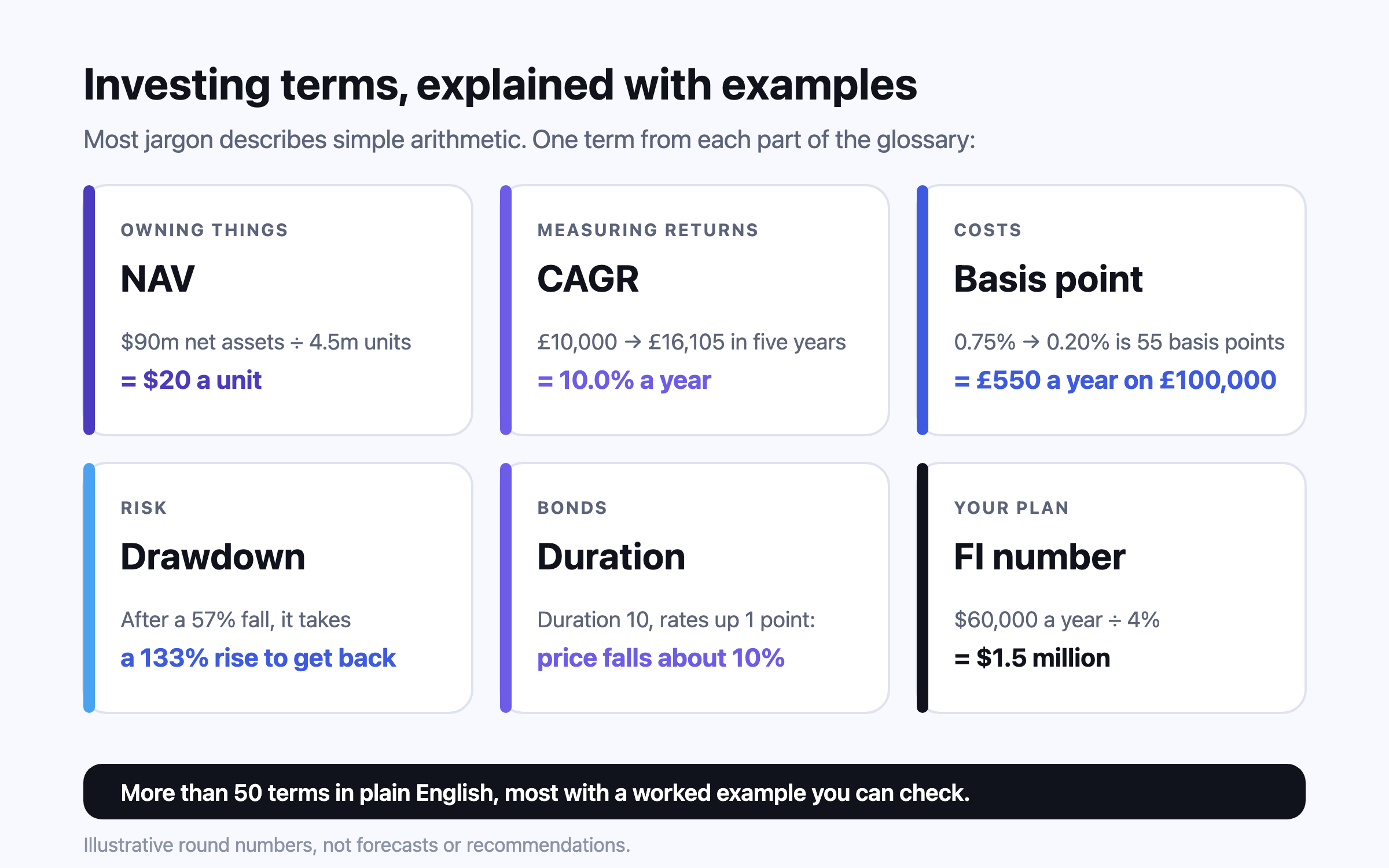
Most investing jargon describes something simple. A basis point is a hundredth of a percentage point; NAV is what one unit of a fund is worth; XIRR is your real yearly return when money went in at different times; duration says how far a bond falls when rates rise. This glossary gives each term a short definition, from a regulator or the original source where one exists, and most of them a worked example you can check.
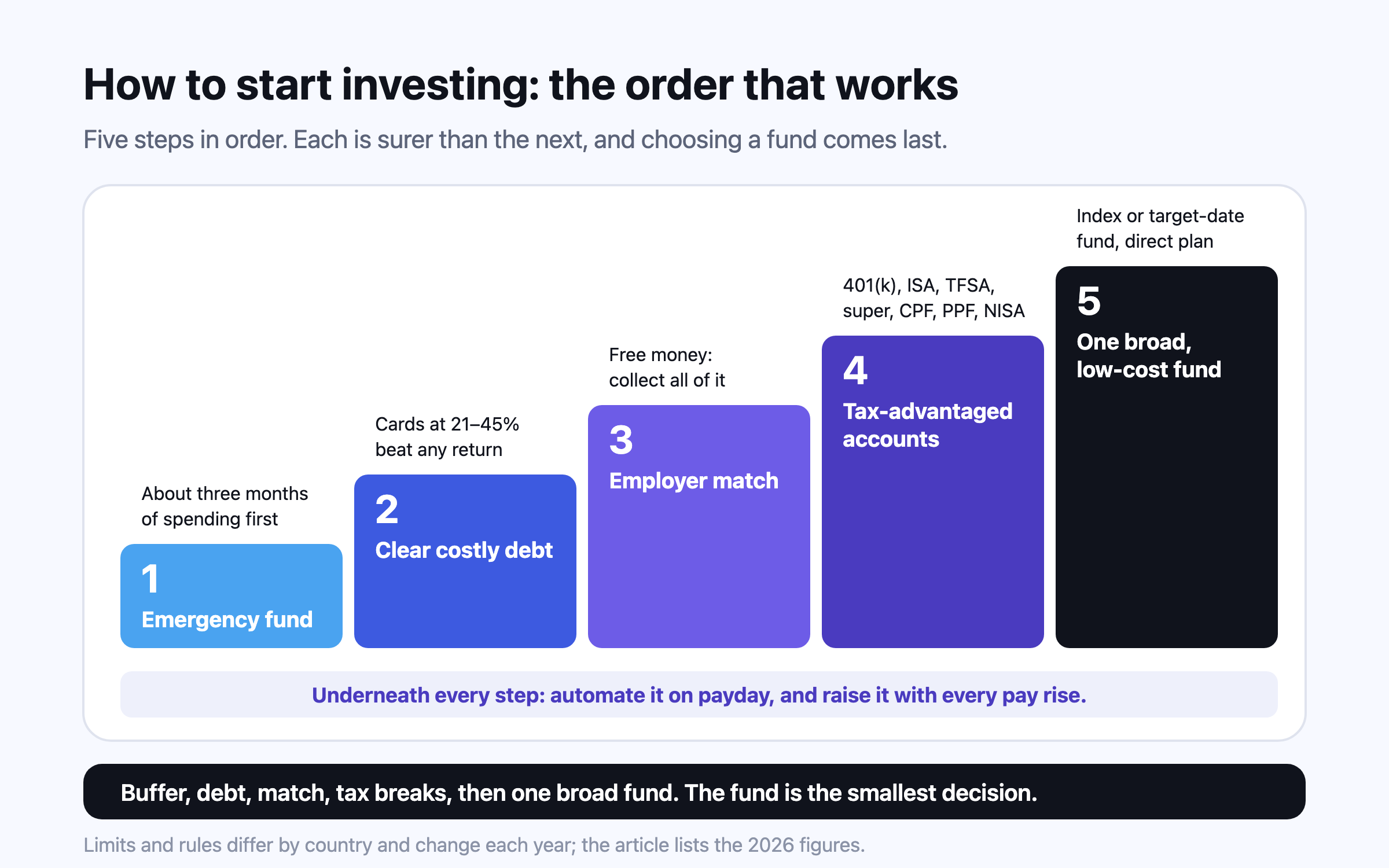
The order matters more than the product: an emergency fund first, then any debt costing more than investments can earn, then free money from an employer and the tax breaks your country offers, then a broad, low-cost index fund. In 2026 that means, for example, up to $24,500 in a US 401(k), £20,000 in a UK ISA, C$7,000 in a TFSA and a 12% employer super contribution in Australia. Automating it does more than picking the perfect fund.
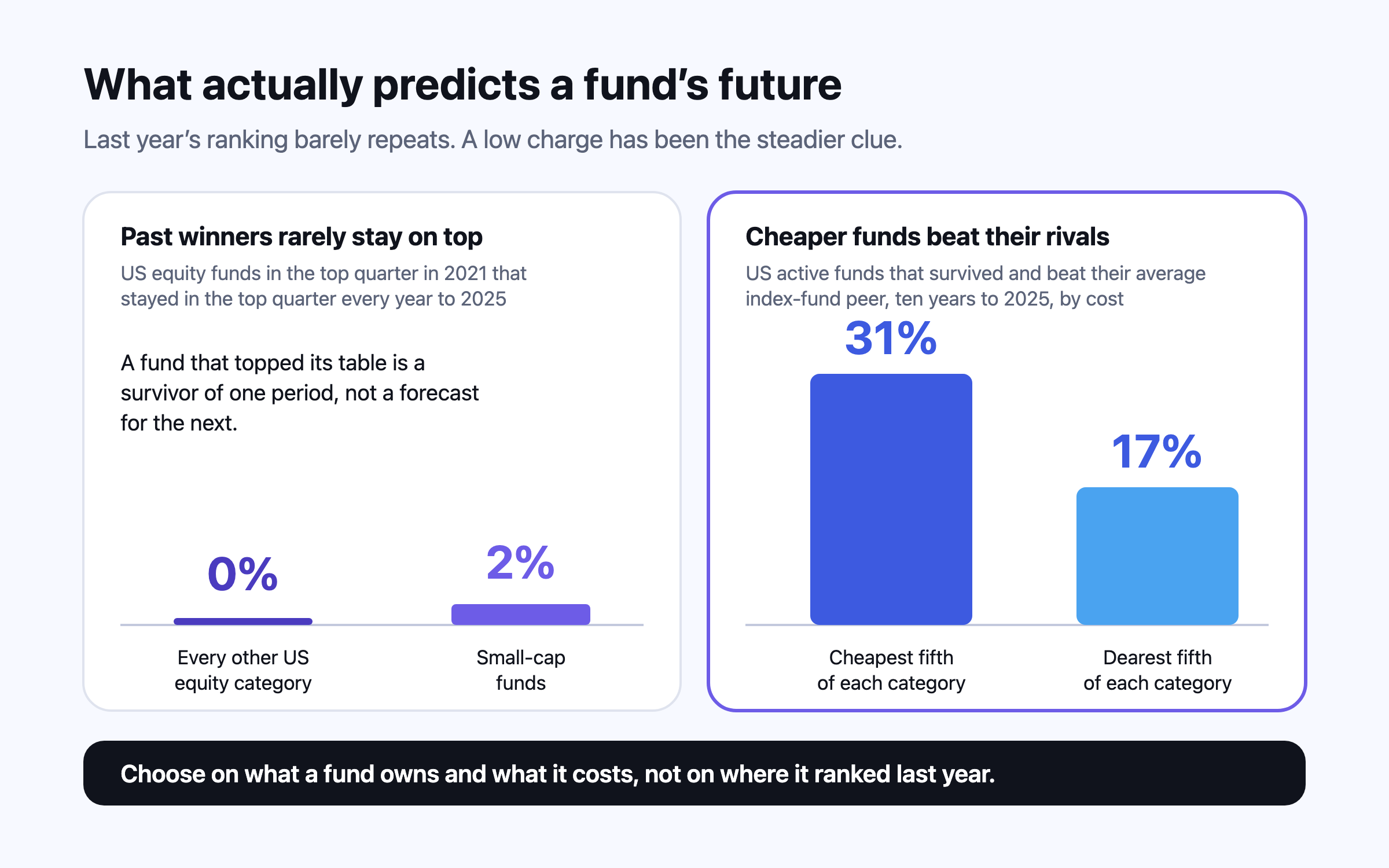
Start with what the fund owns and what it charges; those two decide most of the result. The evidence on past performance is discouraging: almost no US equity fund that was in the top quarter in 2021 stayed there every year to 2025, while Morningstar has called the expense ratio the most proven predictor of future fund returns. For index funds, compare tracking difference, size and, if you live outside the US, where the fund is domiciled.
This is general information, not financial, tax or legal advice for your circumstances. Rules and figures change; check the official source for your country, and consult a licensed professional before making financial decisions. Projections are estimates, not predictions.