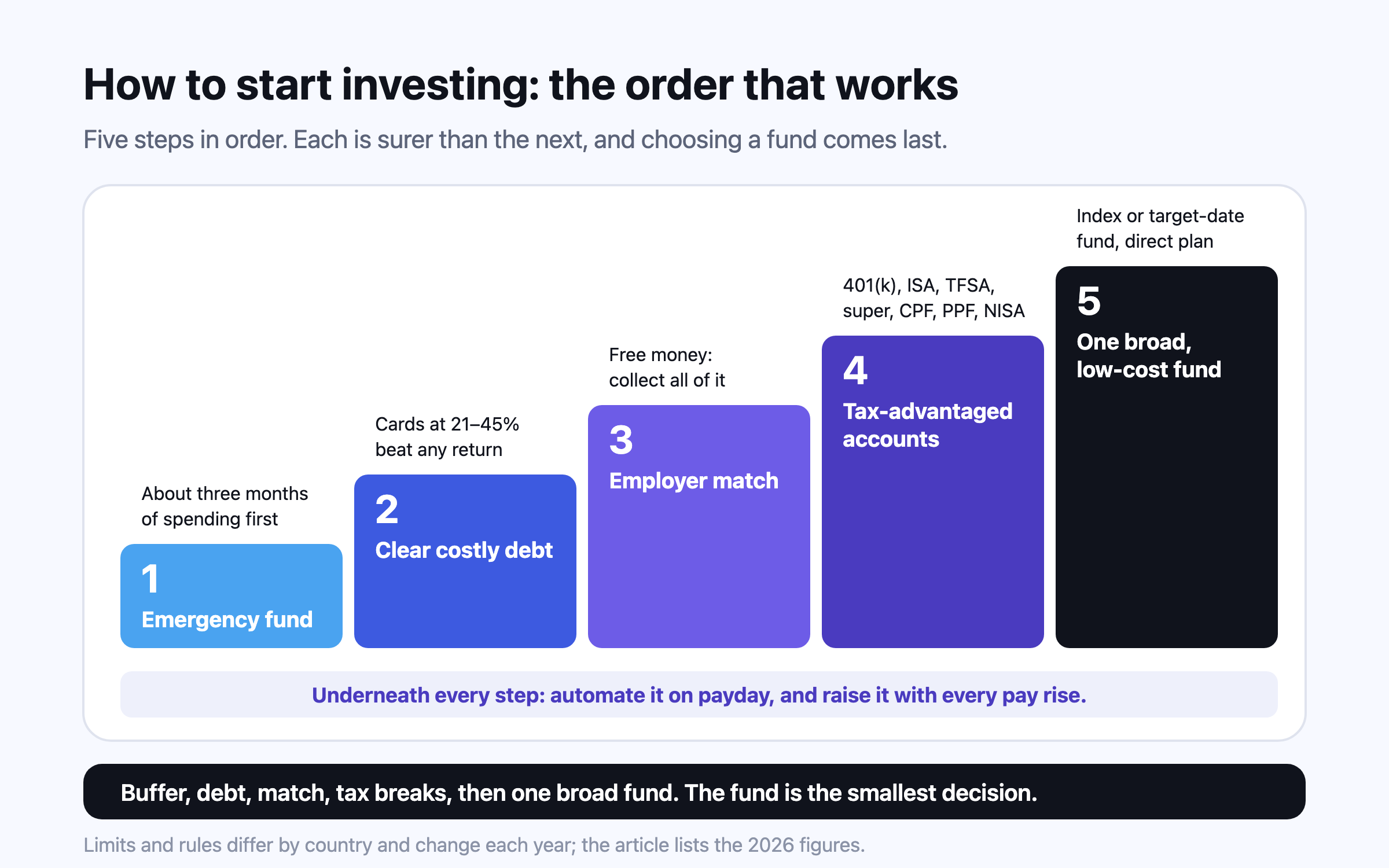
Build a cash buffer, clear expensive debt, take every employer match and tax break, then put the rest in one broad, low-cost fund — and automate it.
The order matters more than the product: an emergency fund first, then any debt costing more than investments can earn, then free money from an employer and the tax breaks your country offers, then a broad, low-cost index fund. In 2026 that means, for example, up to $24,500 in a US 401(k), £20,000 in a UK ISA, C$7,000 in a TFSA and a 12% employer super contribution in Australia. Automating it does more than picking the perfect fund.
Nivritee Research · 6 October 2026 · 10 min read
Most beginners start with the wrong question — which fund? — when the decision that matters more is the order in which money goes to work. Five steps cover almost every household: a cash buffer, then expensive debt, then free money from an employer, then the tax-advantaged accounts your country offers, then a broad, low-cost fund. Do them in that order and automate each one, and the choice of fund becomes a small decision rather than the whole problem. The 2026 limits below come from each country’s tax authority or regulator1234.
An emergency fund is what stops a lost job, a medical bill or a car repair from forcing you to sell investments at a bad moment or borrow on a card. Australia’s regulator, ASIC, suggests three months of expenses as a good target6; the US Consumer Financial Protection Bureau declines to name a number, saying the right amount depends on your situation and that even a small sum provides some security7. Households with one income, irregular pay or dependants usually hold more. Keep it in an instant-access savings account or a sweep deposit, not in shares. Emergency fund: how much covers sizing in detail.
The buffer does not have to be complete before you invest a single rupee or dollar. A common, sensible compromise is to build one month first, take any employer match (step 3) at the same time, then finish the buffer before investing beyond the match.
Step 2: clear debt that costs more than investing earns
Paying off a debt earns its interest rate with certainty, which no investment can promise. No mainstream investment reliably beats a credit card: the average US rate on card accounts charged interest was 22.15% in the second quarter of 2026, the UK effective rate 21.55% in August 2026, and the standard rate on most HDFC Bank cards in India is 3.75% a month, 45% a year before GST8910. Clear those, and any personal loan or buy-now-pay-later balance at similar rates, before investing beyond an employer match. Cheaper debts — a home loan at a single-digit rate, a government student loan — are a closer call; pay off debt or invest sets out where the line falls and compound interest explained shows how fast card debt grows.
Step 3: take the free money from your employer
An employer contribution is the only return that is certain on the day it arrives, once any vesting period has passed. In the US, 96% of the 401(k) plans Vanguard administers made an employer contribution in 2025; the average promised match was worth 4.7% of pay, and the single most common formula was 50 cents on each dollar of the first 6% of pay11. Contributing too little to collect the whole match turns down part of your salary.
Elsewhere the employer contribution is usually compulsory rather than matched, but it is still worth knowing what you receive. In the UK, automatic enrolment requires at least 8% of qualifying earnings — earnings between £6,240 and £50,270 — of which the employer pays at least 3%12. Australian employers pay a super guarantee of 12% of earnings5. In Singapore an employee aged 55 or under pays 20% of wages into CPF and the employer 17%, on wages up to the S$8,000 monthly ceiling1314. Hong Kong’s MPF takes 5% from employee and employer each, on relevant income up to HK$30,000 a month15. New Zealand’s KiwiSaver default rose to 3.5% from employee and employer from 1 April 2026, and the government adds 25 cents per dollar up to NZ$260.72 a year16. Many employers offer more than the minimum when you contribute more; ask HR.
Step 4: use the tax-advantaged accounts your country offers
Every country covered here offers at least one account that lets investments grow with less tax, and the saving compounds for decades. The table sets out the main ones with their 2026 limits. The rules have conditions, exceptions and lock-ins that matter; follow the link to the official page before you open one.
Main limits for 2026 and the 2026–27 UK and Australian tax years; Indian deductions as the Income Tax Department publishes them for 2025–26 (assessment year 2026–27). From each tax authority or scheme operator. Not exhaustive; each account has conditions and lock-ins not shown. 1217181920321413142223242526272829
Country
Account
2026 limit
Worth knowing
United States
401(k), 403(b), 457 plans
$24,500; plus $8,000 from 50, or $11,250 at 60–63
Through your employer; match usually goes here
United States
IRA (traditional or Roth)
$7,500; plus $1,100 from 50
Roth contributions phase out at $153,000–$168,000 (single) and $242,000–$252,000 (married filing jointly)
United Kingdom
ISA (stocks and shares, cash, Lifetime)
£20,000 a year in total, 2026–27
Cash ISAs to be limited to £12,000 for under-65s from 6 April 2027
United Kingdom
Lifetime ISA
£4,000 a year (inside the £20,000)
Government adds 25%, up to £1,000 a year; open before 40
United Kingdom
Workplace pension, SIPP
£60,000 annual allowance; relief up to 100% of earnings
Allowance tapers when adjusted income is over £260,000 and threshold income over £200,000
Canada
RRSP
18% of last year’s earned income, up to $33,810
Deduction now, taxed on withdrawal
Canada
TFSA
$7,000; unused room carries forward
$109,000 in total for someone eligible since 2009
Canada
FHSA
$8,000 a year, $40,000 lifetime
For a first home
Australia
Super: concessional (before-tax)
$32,500 from 1 July 2026 (was $30,000)
Employer’s 12% counts towards it
Australia
Super: non-concessional (after-tax)
$130,000 from 1 July 2026
Extra 15% tax on concessional contributions above $250,000 of income (Division 293)
Singapore
CPF
37% of wages up to S$8,000 a month (age 55 and under)
Ordinary Account 2.5%, Special and MediSave 4% (October–December 2026)
Singapore
SRS
S$15,300 (citizens and PRs), S$35,700 (foreigners)
All personal reliefs capped at S$80,000 a year
India
PPF
₹500 to ₹1.5 lakh a financial year
15-year account; 7.1% for October–December 2026
India
ELSS, PPF, EPF (section 80C)
₹1.5 lakh deduction
Old tax regime only
India
NPS
Own: extra ₹50,000 (old regime); employer’s: up to 14% of salary (new regime)
Employer contribution is the deduction that survives the new regime
Japan
NISA
¥3.6 million a year (¥1.2m tsumitate + ¥2.4m growth); ¥18 million lifetime
Tax-free, no time limit, since January 2024
Japan
iDeCo
¥23,000 a month (employee with no company pension)
Rises to ¥62,000 a month from 1 December 2026
The questions people ask most
Pension or ISA first (UK)? Take the workplace pension up to the full employer contribution first, since that money is added to yours. Beyond it, a pension gets tax relief at your marginal rate when you pay in but is locked until pension age; an ISA has no relief when you pay in but can be reached at any time302. Many households split the two. Roth or traditional (US)? A traditional account gives the tax break now and taxes withdrawals; a Roth does the reverse, and is limited by income1. If you expect a higher tax rate later, the Roth tends to come out ahead; if lower, the traditional.
Old or new tax regime (India)? Since the Finance Act 2023 the new regime is the default. For 2025–26 (assessment year 2026–27), no tax is due under it on income up to ₹12 lakh — ₹12.75 lakh for salaried people after the ₹75,000 standard deduction2731. The new regime removes most deductions, including the ₹1.5 lakh under section 80C for ELSS, PPF and EPF contributions and the extra ₹50,000 for your own NPS contribution; an employer’s NPS contribution of up to 14% of salary remains deductible27. So ELSS and PPF are worth choosing in the new regime for what they are as investments, not for a tax break that no longer applies to you. From 1 April 2026 income tax is charged under the new Income-tax Act, 202532, so check the department’s current rules and calculator against your own deductions before choosing33.
RRSP or TFSA (Canada)? The RRSP gives a deduction now and taxes withdrawals; the TFSA does neither, which suits lower earners and money you may need before retirement. A first-time buyer usually fills the FHSA first, since it gives both a deduction and tax-free withdrawals for a qualifying home2134.
Step 5: a first fund that is broad and cheap
With the order settled, the first investment for most beginners is a fund that tracks a broad index: a whole-market or global share index, or a single fund that holds shares and bonds in a fixed mix. An index fund aims to match an index before fees rather than beat it35, and over long periods most actively managed funds have trailed their index after costs — the evidence is in index vs active funds: the SPIVA data. A target-date fund goes one step further, shifting from shares to bonds as its target year approaches, so that one fund makes the allocation and rebalancing decisions for you36.
Three things decide a fund more than its name: what it holds (one country or the world), what it costs every year, and, in India, whether you are in the direct plan, which carries no distributor commission37. How to choose a fund, mutual funds explained and ETFs explained take each in turn, and asset allocation by age covers how much to hold in shares rather than bonds.
Choosing a platform or broker
The platform is where your money sits and what it costs to hold it. Two checks matter most. Cost: platform charges can vary as much as fund charges; in its 2019 market study the UK regulator found the yearly charge on £5,000 in a stocks and shares ISA ranged from 0.20% to 2.40% depending on the platform38. A flat fee suits a large balance, a percentage fee a small one. Regulation: the firm should be authorised by your country’s regulator, and you can check that yourself on the regulator’s public register.
Investor protection covers a broker going bust with your assets missing, not a fall in the market. In the US, SIPC protects up to $500,000 per customer, including up to $250,000 in cash39. In the UK the Financial Services Compensation Scheme covers up to £85,000 per person per firm for investment firms that fail40. In Canada, CIPF covers up to $1 million across general accounts, a further $1 million across registered retirement accounts and another $1 million across education savings plans41. None of these schemes pays out because a fund has fallen in value394041.
Find the firm on the regulator’s register: FINRA BrokerCheck in the US, the FCA register in the UK, SEBI’s list of registered intermediaries in India, ASIC’s professional registers in Australia, and MAS’s Financial Institutions Directory in Singapore.
Add up every charge: platform or account fee, dealing commission, foreign-exchange spread for overseas funds, and the fund’s own expense ratio.
Check that it offers the account you need (ISA, Roth IRA, TFSA, NISA) and the funds you want inside it, including direct plans in India.
Check how easily you can transfer out later, and what that costs.
Be wary of anything that pays you to trade often or offers leverage to beginners; the product is your activity, not your returns.
How much to start with, and how to make it automatic
You do not need a lump sum. Most funds and platforms accept modest regular amounts, and the right first amount is whatever you can keep going through a bad month. For a sense of scale, the average US 401(k) participant in Vanguard’s plans put in 7.6% of pay in 2025, and with employer money the average total contribution was 12.1%11. How much do you need to retire and the FIRE Planner turn your own figures into a target.
Automation matters more than the amount. When employers enrol staff automatically unless they opt out, participation jumps: Brigitte Madrian and Dennis Shea showed it in a US company in 200142, and after the UK made automatic enrolment law, participation among eligible employees rose from 55% in 2012 to 90% in 2025 (provisional)4344. Richard Thaler and Shlomo Benartzi’s Save More Tomorrow programme, in which employees committed part of each future pay rise to saving, lifted average saving from 3.5% to 13.6% of income over 40 months45. Set the transfer for payday, and set it to rise with each raise. SIP vs lump sum covers what to do with a sum you already have.
Six starting plans, worked through
These households are illustrative, the returns are assumptions, and none of this is a recommendation of any product; each plan simply applies the order above to a real set of 2026 rules.
Maya, 27, a product designer in Chicago, $85,000 salary. Her employer matches 50% of the first 6% of pay. She spends about $4,500 a month, so she builds a $13,500 buffer, three months, in a high-yield savings account. She contributes 6% to the 401(k), $5,100 a year, and collects $2,550 of match. Her income is well under the $153,000 where Roth IRA eligibility starts to phase out, so she adds $7,500 a year to a Roth IRA in a global index fund1. That is $12,600 of her own money, about 14.8% of salary, before the match.
Aisha, 31, a pharmacist in Manchester, £48,000 salary. Auto-enrolment minimums on her qualifying earnings of £41,760 are £2,088 a year from her (5%) and £1,252.80 from her employer (3%), £3,340.80 in all12. She asks whether her employer matches more if she pays more, then pays off her card. Saving for a first flat, she opens a Lifetime ISA, where £4,000 a year attracts a £1,000 government bonus, and adds a stocks and shares ISA for longer-term money; both sit inside her £20,000 allowance192.
Ravi and Neha, both 32, in Hyderabad, ₹30 lakh a year between them. They are on the new tax regime, so 80C deductions do not apply to them, and both already pay into EPF through work27. EPF interest for 2025–26 was set at 8.25%, recommended by the EPF board in March 2026 and notified in July 20264647. They keep six months of spending in a sweep deposit, then start a ₹40,000 monthly SIP into the direct plan of a broad index fund. At an assumed 10% a year that is projected to reach about ₹3.04 crore in 20 years, from ₹96 lakh paid in48. For a safe portion they use Neha’s PPF account: ₹1.5 lakh at the start of each year for 15 years, ₹22.5 lakh in total, would grow to about ₹40.68 lakh if the current 7.1% held throughout, though the rate is reviewed every quarter242526.
Jason, 29, a nurse in Toronto, C$75,000 salary. He turned 18 in 2015 and has never used his TFSA, so he has C$78,000 of room, the sum of each year’s limit from 2015 to 20263. He plans to buy a home, so he opens an FHSA first, C$8,000 a year with a deduction, then directs further savings to the TFSA. His RRSP room is 18% of last year’s earned income, about C$13,500, which he leaves for later years when his tax rate is higher3421.
Chloe, 26, an engineer in Melbourne, A$90,000 salary. Her employer pays 12% super, A$10,800 a year, which counts towards the A$32,500 concessional cap for 2026–27, leaving A$21,700 she could add before tax by salary sacrifice54. She checks her super fund’s investment option and fees first, since that is the largest investment she owns, then sets up a monthly purchase of a broad index ETF in her own name for money she may want before preservation age.
Wei Jie, 30, an analyst in Singapore, S$7,000 a month. Below the S$8,000 ceiling, he pays 20% into CPF, S$1,400 a month, and his employer 17%, S$1,190 — S$2,590 in all1314. The Special Account earns 4% for October–December 2026, with an extra 1% on the first S$60,000 of combined balances22. He tops up SRS by up to S$15,300 a year for the tax relief once his marginal rate makes it worthwhile, and invests monthly in a global index fund outside CPF23.
Keeping track once you have started
Once money is going in, the questions change: is it enough, is it in the right places, and is it earning what you assumed? Those need your whole picture — every account, in every country, against the plan it is meant to fund.
Questions people ask
How much money do I need to start investing?
Very little: most funds and platforms accept modest monthly amounts. Build a cash buffer first; ASIC suggests three months of expenses as a good target6.
Should I pay off debt or invest first?
Clear expensive debt first. With US card rates averaging 22.15% and the standard rate on most HDFC Bank cards at 45% a year, repaying is a better return than investing can reliably offer810. Take any employer match at the same time, because that is money you would otherwise lose.
What are the 401(k) and IRA limits for 2026?
$24,500 for a 401(k), plus $8,000 from age 50 or $11,250 at 60–63; $7,500 for an IRA, plus $1,100 from age 501.
What is the ISA allowance for 2026–27?
£20,000 across all your ISAs2. Under regulations made in September 2026, from 6 April 2027 no more than £12,000 of it may go into cash ISAs for people under 651718.
How much TFSA room do I have in 2026?
The 2026 limit is $7,000, and unused room carries forward; somebody eligible every year since 2009 has $109,000 in total, less what they have used3.
Is ELSS or PPF still worth it in the new tax regime?
Not for the tax deduction, which the new regime removes; for 2025–26 no tax was due under it on income up to ₹12 lakh2731. PPF can still suit the safe part of a portfolio at 7.1% for October–December 20262526, and ELSS is simply an equity fund with a lock-in.
What happens to my investments if my broker goes bust?
Your holdings should be kept separately from the firm’s own money, and compensation schemes cover shortfalls: up to $500,000 with SIPC in the US, £85,000 with the FSCS in the UK and $1 million per account category with CIPF in Canada394041. None covers a fall in the market.
What should my first investment be?
For most beginners, a low-cost fund that tracks a broad index, or a target-date fund that does the mixing for you3536. The account it sits in, and the order, matter more than which of several similar funds you choose.
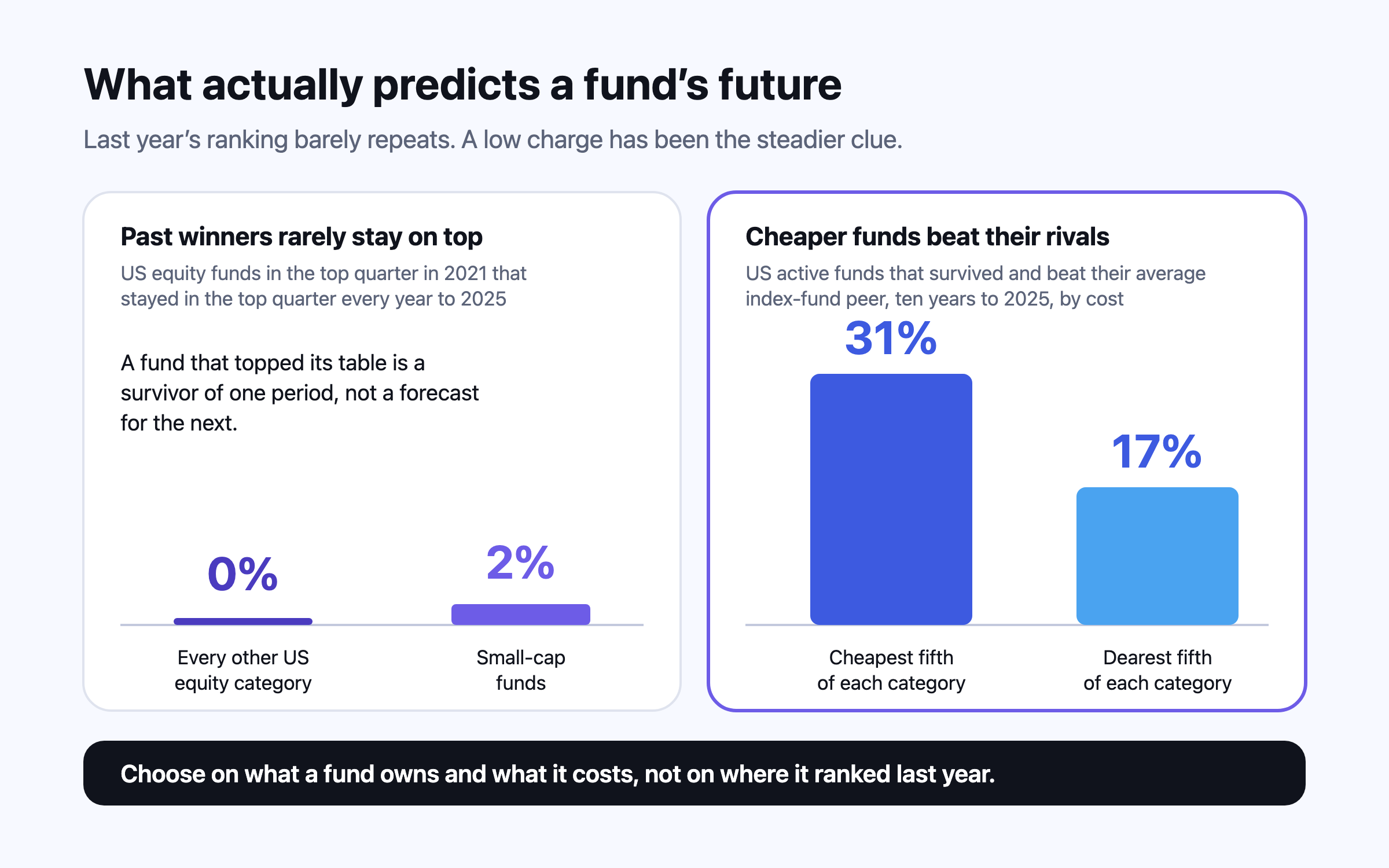
Start with what the fund owns and what it charges; those two decide most of the result. The evidence on past performance is discouraging: almost no US equity fund that was in the top quarter in 2021 stayed there every year to 2025, while Morningstar has called the expense ratio the most proven predictor of future fund returns. For index funds, compare tracking difference, size and, if you live outside the US, where the fund is domiciled.
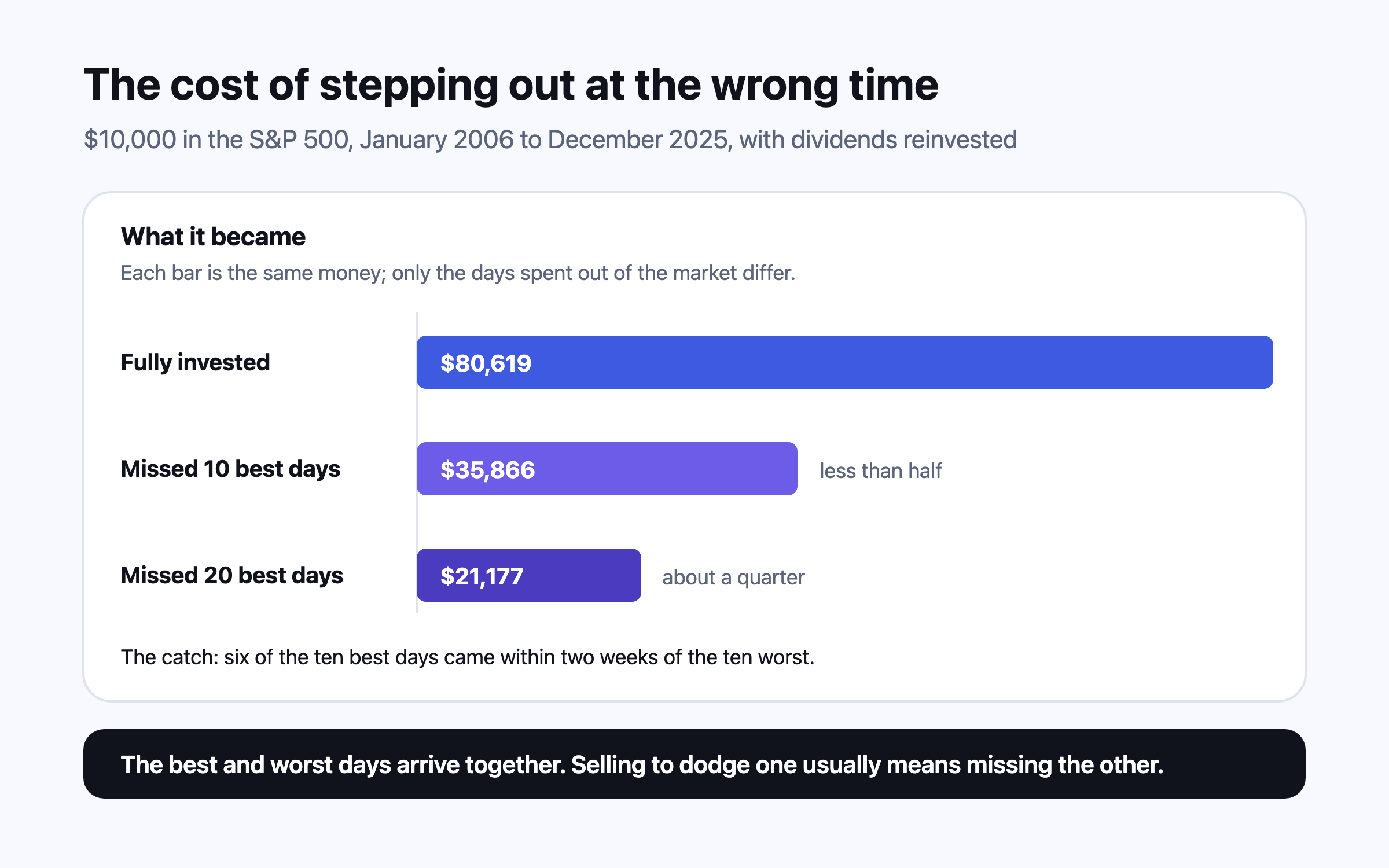
Over the ten years to 2025, the average dollar in US funds earned about 1.2 points a year less than the funds themselves, because of when money went in and out — though a 2026 study argues timing explains far less of that. Better evidenced are the costs of heavy trading, leverage and concentration: 87.7% of individual Indian F&O traders lost money in FY26, and the most active US households in one classic study trailed the market by over six points a year.
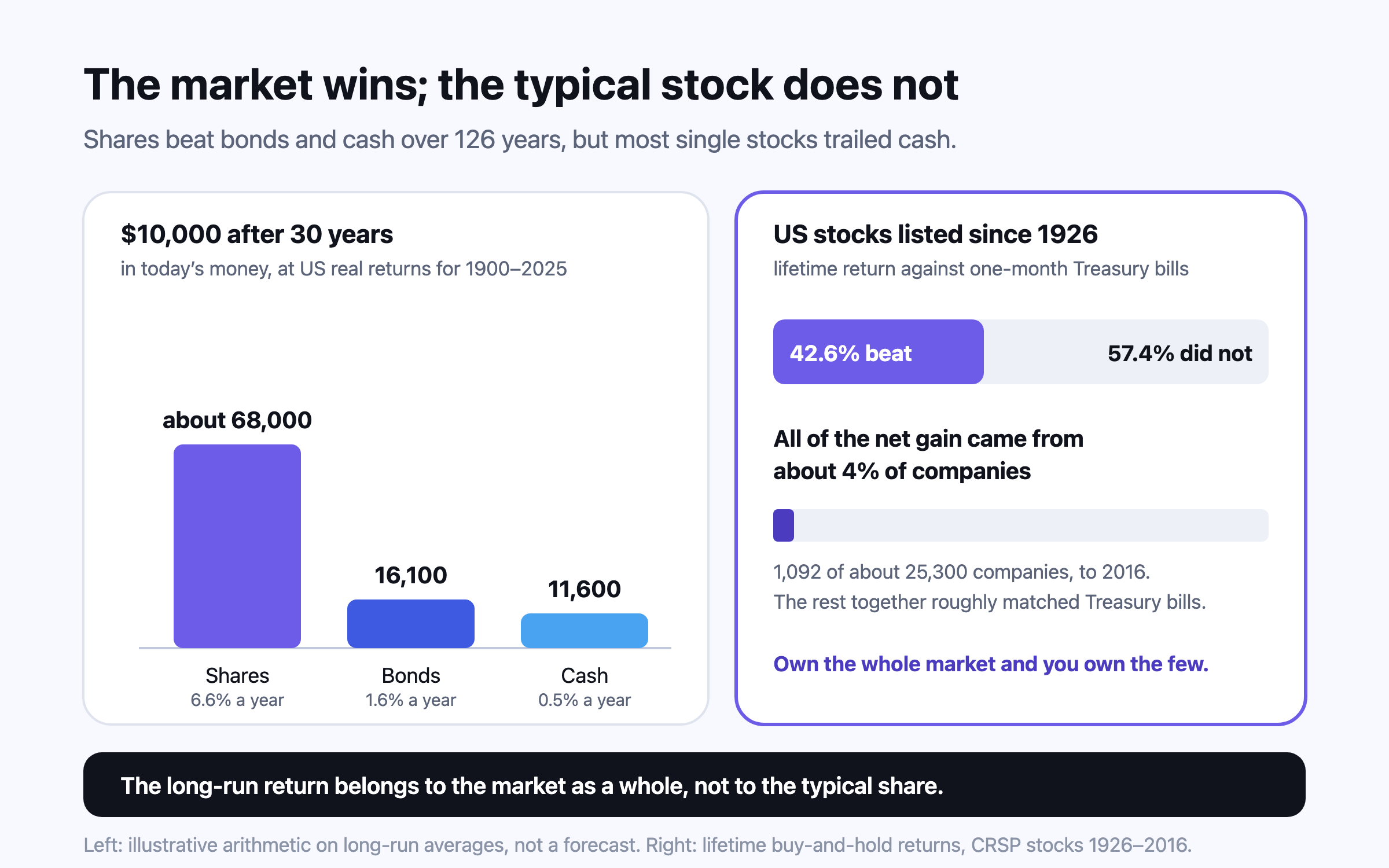
A share is a small part-ownership of a company, bought and sold on an exchange between investors. Over 1900–2025, US shares returned about 6.6% a year after inflation against 1.6% for bonds and 0.5% for cash, and shares were the best asset in every market with a continuous record. But most individual US stocks since 1926 did worse than Treasury bills over their listed lives, and about 4% of companies produced all of the market’s net gain, so the long-run return belongs to the whole market, not to the typical stock.
This is general information, not financial, tax or legal advice for your circumstances. Rules and figures change; check the official source for your country, and consult a licensed professional before making financial decisions. Projections are estimates, not predictions.