Couples who pool more of their money tend to stay happier, but most keep some apart. The fair answer is usually a joint pot for shared costs, filled in proportion to income.
There are three ways to hold money as a couple: all joint, all separate, or a joint pot for shared costs with personal money beside it. Experiments and large surveys link more pooling with happier, longer relationships, especially when money is tight. When incomes differ, splitting shared costs in proportion to income — or so both keep the same amount — is usually fairer than halves.
Nivritee Research · 11 August 2026 · 8 min read
Every couple who lives together answers the same question, whether or not they ever say it out loud: whose money is this? Some put everything in one account the week they move in. Some never share a bank account at all. Most end up somewhere in between, often by accident. This guide sets out the three models, what the research says about each, a fair way to split costs when one partner earns more, and the legal differences that matter by country — so the arrangement you have is one you chose.
The three models
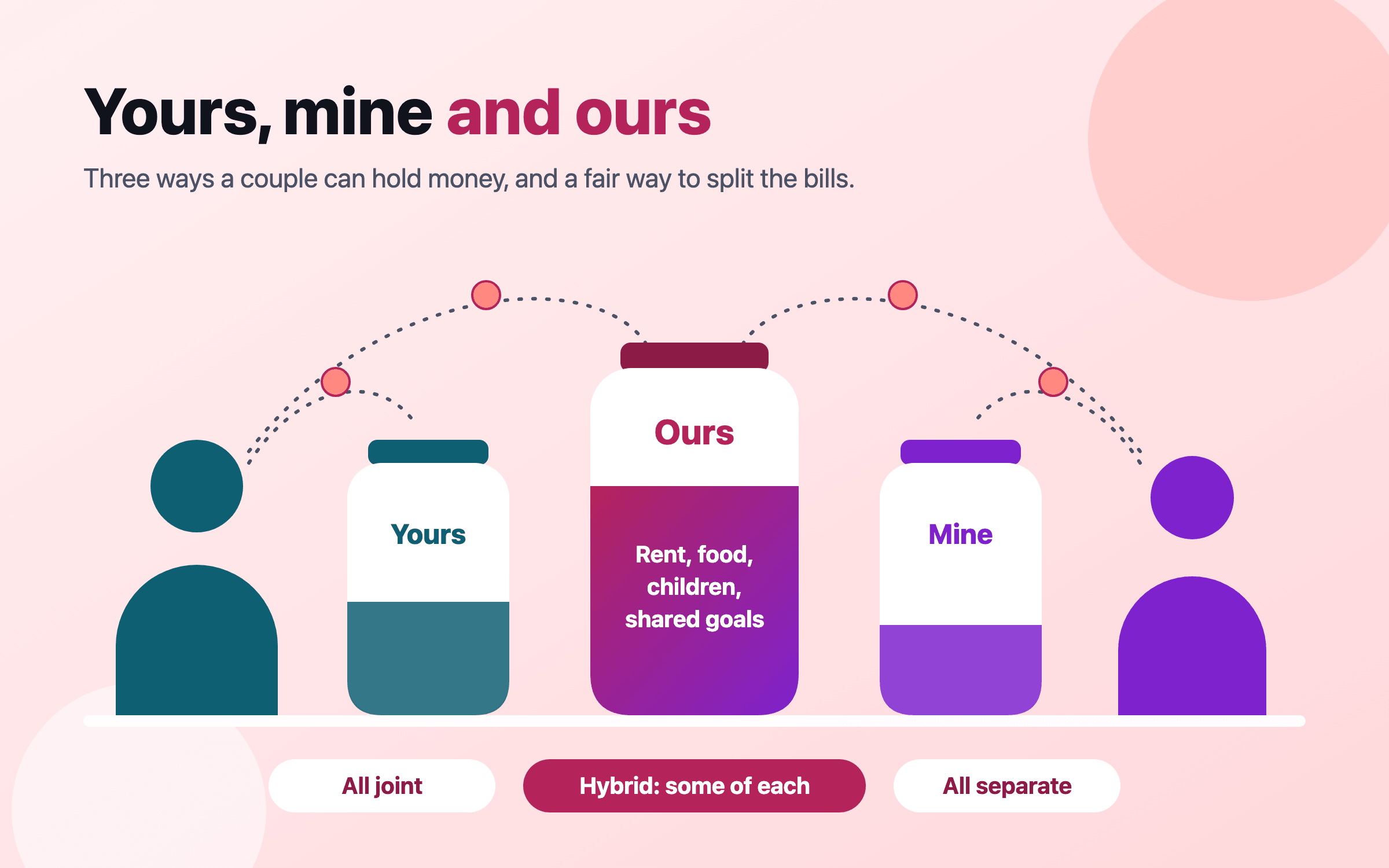
Australia’s government money guide, Moneysmart, describes the choices plainly: joint accounts make shared bills easier but both people are responsible for every transaction; separate accounts keep each person’s independence while both still contribute to shared costs; and a mix keeps a joint account for shared bills beside separate accounts for personal spending.1 In practice:
Fully joint. Both incomes land in one place and every cost comes out of it. Simple to run and fully transparent; the trade is that neither partner has money that is only theirs.
Fully separate. Each keeps their own accounts and the couple divides bills between them — by item, by half, or by transfer. Independent, but every shared cost becomes a small negotiation.
Hybrid: yours, mine and ours. A joint account pays the household’s costs and shared goals; each partner keeps a personal account for everything else. This is the most common answer once couples think about it.
How couples actually hold money varies a great deal by age. In Bankrate’s survey of 1,208 US adults living with a partner, conducted by YouGov in December 2025, 38% had completely combined their money, 36% kept a mix, and 26% kept it completely separate. Among couples aged 18 to 29, more than half kept everything separate; among those aged 62 and over, only 15% did.2
How US couples hold their money, by generation, December 2025
Completely combined
A mix of joint and separate
Completely separate
Share of US adults who are married, in a civil partnership or living with a partner. Bankrate/YouGov online survey, 2–8 December 2025; rows may not add to 100 because of rounding. Younger couples are also less likely to be married, which accounts for part of the gap. 2The figures in this chart
Completely combined
A mix of joint and separate
Completely separate
All couples
38%
36%
26%
Gen Z (18–29)
22%
26%
51%
Millennials (30–45)
32%
34%
34%
Gen X (46–61)
40%
37%
23%
Boomers (62–80)
45%
39%
15%
The UK looks similar. In a February 2026 OnePoll survey of 2,000 adults in relationships for Confused.com, 63% had a joint account with their partner and 37% had none; of those with a joint account, 41% paid all of their income into it.3
What the research says about pooling
Three strands of evidence point the same way. The first is large surveys. Joe Gladstone, Emily Garbinsky and Cassie Mogilner ran six studies covering 38,534 people, drawing on both their own and existing data, and found that couples who pool all their money report greater relationship satisfaction and are less likely to break up than those who keep some or all of it apart.4 The effect was strongest among couples with scarce financial resources: low household income or self-reported money worries.4
An earlier version of that work put numbers on it. Among more than 1,000 married US adults, median relationship satisfaction on a seven-point scale was 6.10 for couples who pooled everything, 5.82 for partial poolers and 5.46 for those who kept their money separate. In the British Cohort Study, which followed more than 7,500 people in relationships at ages 30 to 32 for ten years, 30% of the fully separate had split up by the end, against 24% of full poolers.5
Surveys cannot rule out that happier couples simply choose to pool. The second strand deals with that. Jenny Olson, Scott Rick, Deborah Small and Eli Finkel randomly assigned 230 engaged or newly married couples, all of whom started with separate accounts, to open a joint account, keep separate accounts, or do as they liked, and followed them for two years.6 The joint-account couples kept strong relationship quality throughout, while the others showed the usual decline.6 They also stayed more “communal” — responding to each other’s needs without keeping score — where separate-account couples tended to treat money as a tit-for-tat exchange.7
They frequently told us they felt more like they were ‘in this together.’
— Jenny Olson, Indiana University, on couples given a joint account7
The third strand is the caveat. The researchers found the pattern in individualistic and collectivist cultures alike4, but none of this says a joint account repairs a relationship in which one person controls the other’s money; it says that where trust exists, sharing more of the money tends to reinforce it. The structure that works for most couples keeps the benefit — a shared pot that makes the household feel like one team — without asking either partner to give up every bit of independence.
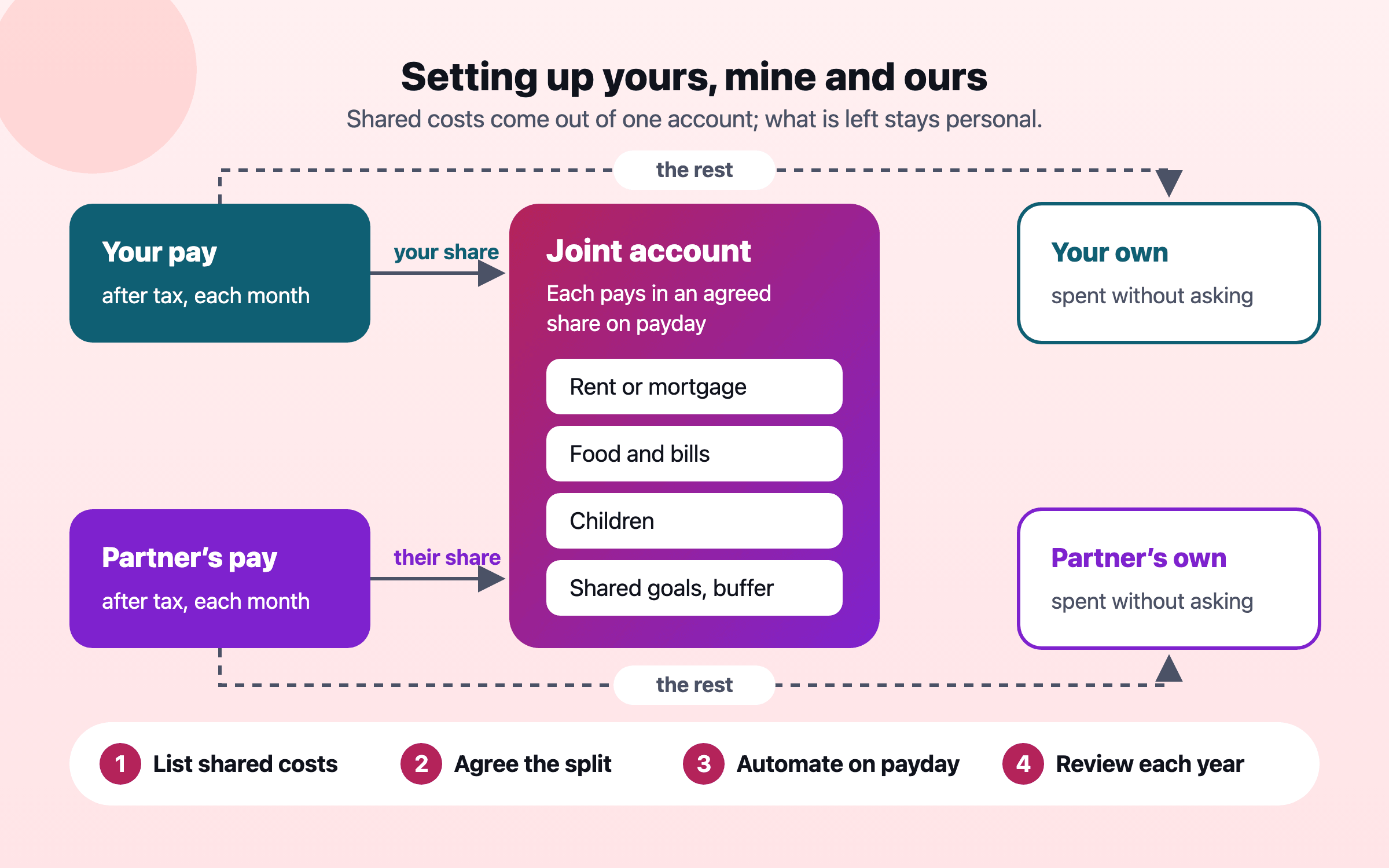
The hybrid model: shared costs come out of one account, and what is left stays personal. The split is the only number the couple has to agree.
Splitting shared costs when incomes differ
Unequal incomes are the norm, not the exception. In 2022, in 55% of opposite-sex US marriages the husband was the primary or sole earner and in 16% the wife was; only 29% were egalitarian, with each spouse earning between 40% and 60% of the couple’s combined income.8 So the question of how to divide shared costs is really the question of what is fair when one person brings home more.
Take an illustrative couple, in any currency. Partner A brings home 6,000 a month after tax; partner B brings home 3,000. Their shared costs — rent, food, bills, the children — come to 4,500 a month. Three common ways to divide them:
Equal halves. Each pays 2,250 each month. A keeps 3,750 for themselves; B keeps 750. It looks fair on the bill and is not fair in life: B spends three-quarters of their pay on the household, A well under half.
In proportion to income. A earns two-thirds of the household’s pay, so A pays 3,000 and B pays 1,500. Each puts half their pay into the household. A still keeps more, because A earns more.
Equal money left over. After the 4,500 of shared costs, the couple has 4,500 left between them, so each keeps 2,250 each month: A pays 3,750 and B pays 750. This is the fully joint model in all but name.
Who pays the illustrative couple’s 4,500 of shared costs under each method
Partner A pays (earns 6,000)
Partner B pays (earns 3,000)
Illustrative arithmetic: monthly amounts, any currency. The bill is the same in every column; what changes is how much of it each partner carries and so how much each has left. The figures in this chart
Partner A pays (earns 6,000)
Partner B pays (earns 3,000)
Equal halves
2,250
2,250
In proportion to income
3,000
1,500
Equal money left over
3,750
750
The illustrative couple: take-home pay 6,000 and 3,000 a month, shared costs 4,500 a month, any currency.
Method
Partner A pays
Partner B pays
A has left
B has left
Share of each pay on shared costs (A / B)
Equal halves
2,250
2,250
3,750
750
38% / 75%
In proportion to income
3,000
1,500
3,000
1,500
50% / 50%
Equal money left over
3,750
750
2,250
2,250
63% / 25%
Most couples who think it through settle on the proportional split for the shared pot, and many add one rule beside it: each partner gets the same personal amount, however much they earn, with anything above it going to shared goals. That keeps independence without one partner having far more freedom than the other. The split also needs revisiting when life changes it: a career break for a baby or for care turns a 2:1 income split into 1:0, and an arrangement nobody revisits quietly becomes unfair. Work done at home counts too — a partner on part-time hours to look after children is contributing, just not in cash.
Debts brought into a relationship
A student loan, a credit card balance or a car loan from before the relationship is one of the most common surprises. In most places, marrying someone does not make you liable for debts in their name. In the UK, Citizens Advice says you are liable for debts in your own name only, but may be responsible for the whole of a debt in joint names — not just half of it.9 In the US, the CFPB says that when a spouse dies the survivor is generally not responsible for their debts, with exceptions: in community property states for certain debts taken on during the marriage, a loan the survivor co-signed, and a card on which they were a joint holder rather than an authorised user.10 California goes further: its family code makes the couple’s shared property liable for a debt either spouse took on before or during the marriage.11
Credit records stay individual. In the UK, marrying or sharing an address does not link two credit files; a joint account or joint loan does, and a lender may then look at your partner’s history when you apply.12
Keep old debts in the name they were taken out in. Paying them from the shared pot is a choice; moving them into joint names makes both of you liable for the whole.9
Decide together how fast to clear them. A high-rate balance is usually worth clearing before the couple saves for shared goals. Pay off debt or invest sets out the order.
What the law says, by country
Bank accounts are one thing; who owns what in law is another, and it differs sharply between countries. A few examples:
United States. Nine states use community property — Arizona, California, Idaho, Louisiana, Nevada, New Mexico, Texas, Washington and Wisconsin — under which most of what either spouse earns during the marriage belongs to both. Alaska, South Dakota and Tennessee let couples opt in.13 Everywhere else, property generally belongs to whoever holds title, with courts dividing it on divorce.
England and Wales. There is no community property, but on divorce the courts share matrimonial assets, usually but not always equally; property brought into the marriage or inherited is treated differently.14 Unmarried partners have far fewer rights, which the government proposed in June 2026 to change with a new, more limited framework for cohabitants.15
Australia. A joint account makes both holders responsible for all its transactions, and marriage can revoke a will made before it.1
India, Singapore, Hong Kong and elsewhere. Ownership generally follows whose name an asset is in, but inheritance and divorce rules depend on the country and, in some, on religion. Check locally before assuming a joint account means joint ownership.
The practical point is the same everywhere: write down which assets and debts are whose, and whose name each account and loan is in. It costs nothing on an ordinary day and saves a great deal if something changes. What your partner needs to know has the checklist.
How to set it up
List what is shared. Housing, food, utilities, children, insurance, the holiday, the long-term goals. Anything not on the list is personal.
Agree the split. Equal, in proportion to income, or equal money left over. Write the percentages down.
Agree the personal amount each of you spends without explaining, and the size of purchase either of you mentions first.
Automate it. Each partner transfers their share into the joint account on payday, and the bills come out of it.
Decide about debts and savings brought in: whose they stay, and whether the shared pot helps with either.
Review once a year, and whenever an income changes — a promotion, a career break, a baby, a move.
Research links more pooling with happier, longer relationships: in six studies of 38,534 people, couples who pooled all their money were more satisfied and less likely to break up, especially when money was tight.4 Many couples keep a joint pot for shared costs and personal money beside it.
What percentage of couples have joint bank accounts?
In a December 2025 survey, 38% of US couples had completely combined their money, 36% kept a mix and 26% kept it separate.2 In the UK, 63% of people in relationships had a joint account in a February 2026 survey.3
How do you split bills fairly when one partner earns more?
Splitting in proportion to income is a common answer: if one partner earns two-thirds of the household’s pay, they pay two-thirds of the shared costs, so both put the same share of their pay into the household. Splitting so both keep the same amount left over is the other fair option.
Am I responsible for my partner’s debts from before we married?
Generally not for debts in their name alone, in the UK or most US states.9,10 In some community property states, such as California, shared marital property can be reached for either spouse’s debts, including ones from before the marriage.11
Which US states are community property states?
Arizona, California, Idaho, Louisiana, Nevada, New Mexico, Texas, Washington and Wisconsin; Alaska, South Dakota and Tennessee let couples opt in.13
Sources
Marriage and money — Moneysmart, Australian Securities and Investments Commission, 2026-06.
In the US, the UK, Canada, Singapore and Australia, roughly half of adults have no will. Money then moves by three routes: joint ownership, a name on the account, or a will — and where there is no will, a fixed legal order that may not match your wishes. Families with assets in more than one country need a plan for each, and everyone needs a family file that says what exists and where.
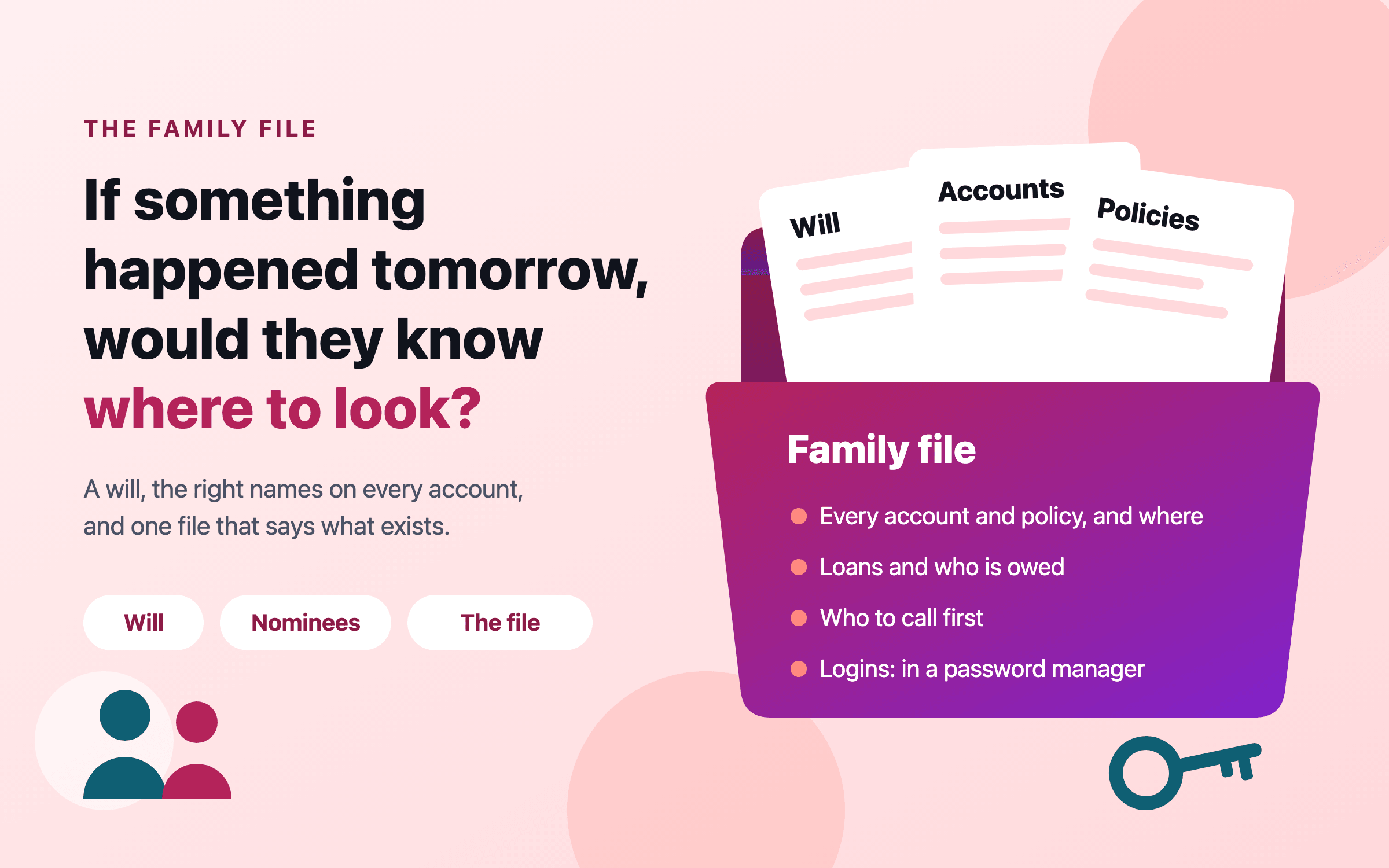
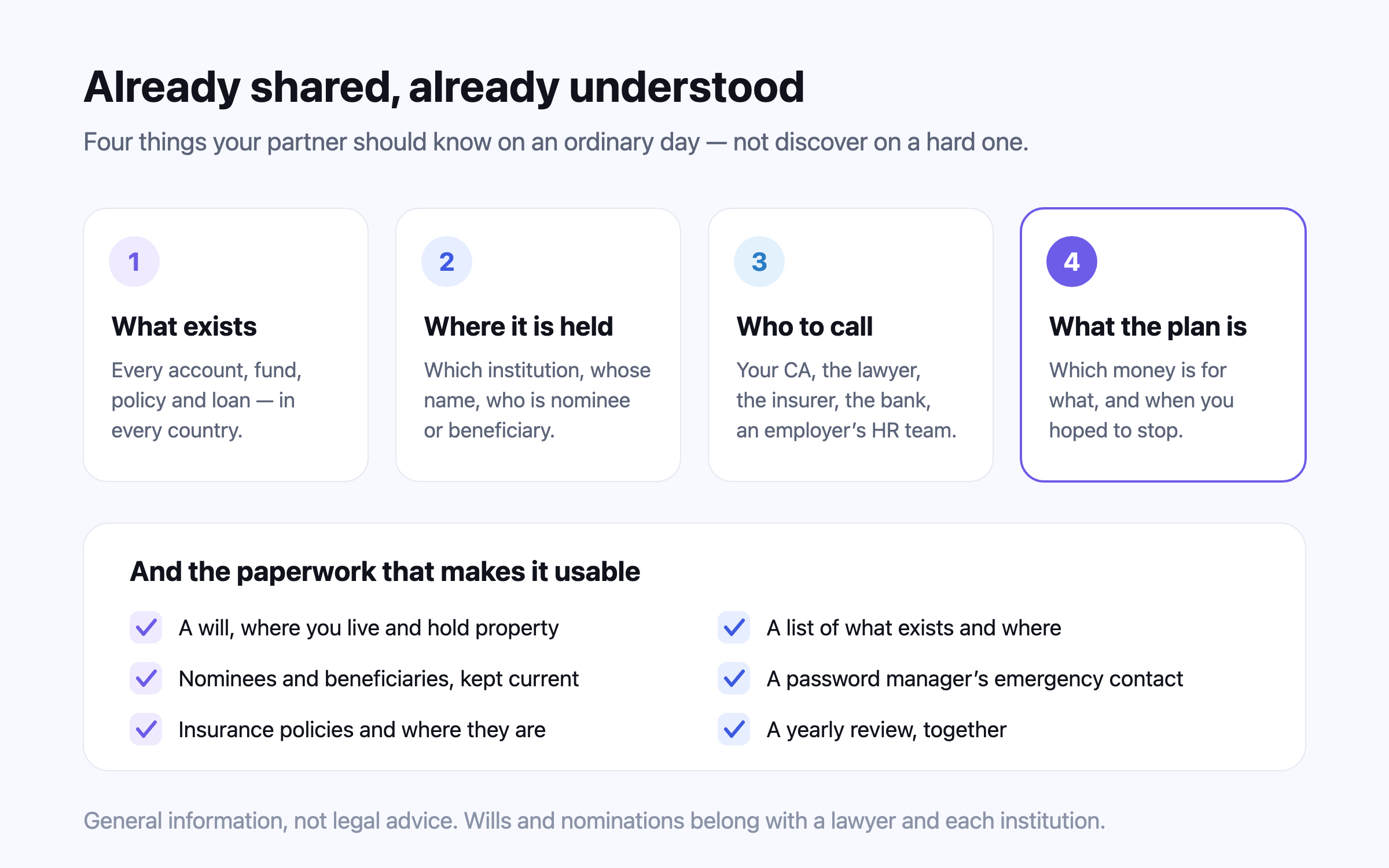
In most households one person knows where everything is. Readiness means your partner knows four things too — what you own and owe, where each is held, who to call, and what the plan is — plus the paperwork that makes it usable: a will, up-to-date nominations or beneficiaries, insurance details and a way into the accounts. The easiest time to share all of it is now, when nothing is wrong.
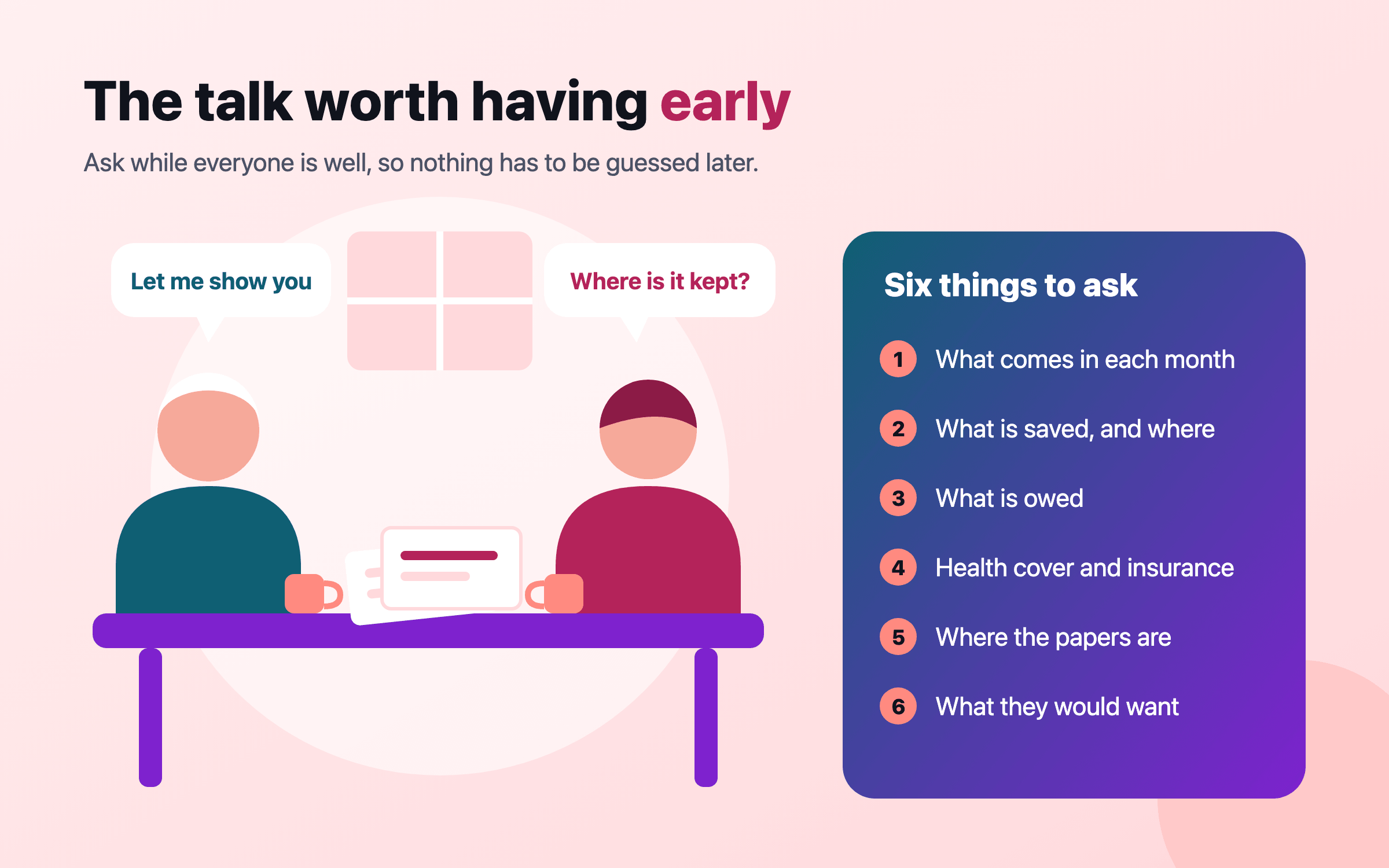
Most families have this conversation too late, in a hospital corridor. Asked early, it comes down to six things — what comes in, what is saved, what is owed, what cover exists, where the papers are and what your parents would want — plus a power of attorney signed while they are well, a watch for scams, and an agreed split of support between siblings that also fits inside your own plan.
This is general information, not financial, tax or legal advice for your circumstances. Rules and figures change; check the official source for your country, and consult a licensed professional before making financial decisions. Projections are estimates, not predictions.