Rebalancing does not make you richer; it keeps you holding the amount of risk you chose.
Left alone, a 60/40 portfolio drifts toward shares in good years — to about 75% after 2021–2025. Vanguard’s research found rebalancing controls risk rather than raising return, with no best frequency: checking once or twice a year and acting at a 5-point band is reasonable. New money and withdrawals do most of the work at least cost.
Nivritee Research · 9 August 2026 · updated 15 October 2026 · 6 min read
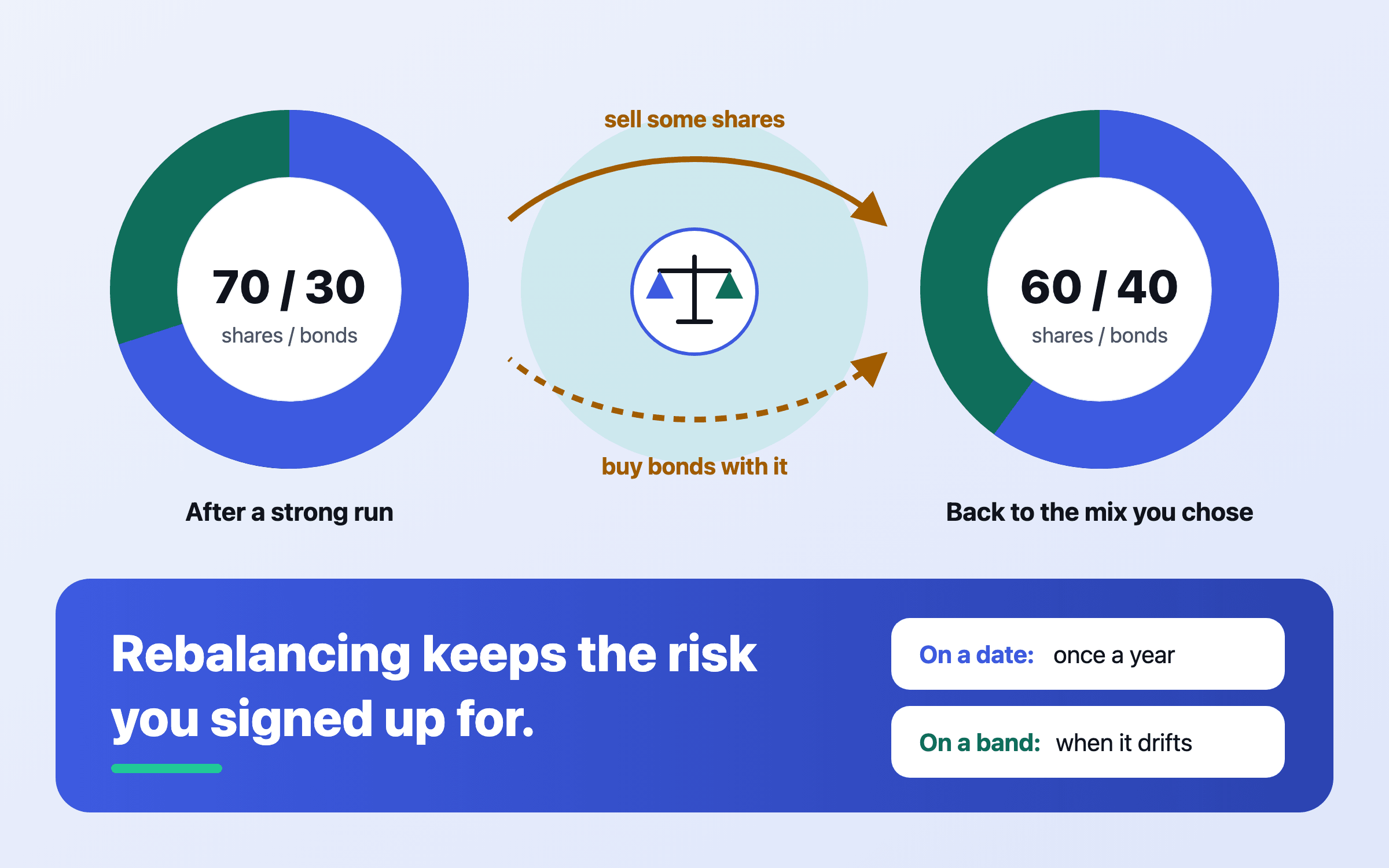
Rebalancing means putting your mix of investments back to the proportions you chose. If you chose six parts shares to four parts bonds, and a good run for shares has carried that to seven parts in ten, rebalancing sells some shares and buys bonds until you are back at six in ten. Nobody has to decide anything for the mix to drift: it happens because the two parts grow at different speeds.
The primary goal of a rebalancing strategy is to minimize risk relative to a target asset allocation, rather than to maximize returns.
— Colleen Jaconetti, Francis Kinniry and Yan Zilbering, Vanguard1
What happens if you never rebalance
Vanguard’s study of a 60/40 US portfolio from 1926 to 2009 is the clearest picture. Rebalanced every year, it averaged 60.5% in shares, returned 8.6% a year and had a volatility of 11.9%. Never rebalanced, it drifted to an average of 84.1% in shares — at one point about 99% — and returned 9.1% with a volatility of 14.4%1. The untouched portfolio earned more, because shares earned more. But it was no longer a 60/40 portfolio: it had quietly become an all-share one, with the falls to match.
A 60/40 portfolio, 1926–2009: rebalancing barely changed the return but held the risk down
Annualised return
Volatility
Vanguard’s simulation with no contributions or withdrawals, income reinvested and no taxes or costs. The three schedules are almost identical; the gap is between rebalancing at all and not. 1The figures in this chart
Annualised return
Volatility
Monthly
8.5%
12.1%
Quarterly
8.6%
12.2%
Annually
8.6%
11.9%
Never
9.1%
14.4%
That is the honest case for rebalancing. It is not a way to earn more; over long periods in which shares beat bonds, it usually earns a little less. It is a way to keep the portfolio’s risk at the level you decided you could live with — which matters most just before and after you start drawing on it, when a fall that a 60/40 portfolio would shrug off can do lasting damage to one that has drifted to 80/20.
A worked 60/40: 2021 to 2025
Take an illustrative 100,000 — in any currency — split 60/40 at the start of 2021 between the S&P 500 and the Bloomberg US Aggregate bond index, using each index’s calendar-year return2,3. One version is never touched. The other is put back to 60/40 every January.
Illustrative arithmetic on index returns, before costs and taxes. The rebalanced version starts each year back at 60%. 2,3
Year
S&P 500
US Aggregate bonds
Shares, never rebalanced
Shares at year end, rebalanced each January
2021
28.71%
−1.54%
66.2%
66.2%
2022
−18.11%
−13.01%
64.9%
58.5%
2023
26.29%
5.53%
68.8%
64.2%
2024
25.02%
1.25%
73.2%
64.9%
2025
17.88%
7.30%
75.0%
62.2%
Share of the portfolio in shares at each year end: never rebalanced against rebalanced each January
Never rebalanced
Rebalanced each January
Four strong years out of five for shares carried the untouched portfolio from 60% to 75%. The rebalanced one drifts within each year and is put back every January. 2,3The figures in this chart
Never rebalanced
Rebalanced each January
Start 2021
60.0%
60.0%
2021
66.2%
66.2%
2022
64.9%
58.5%
2023
68.8%
64.2%
2024
73.2%
64.9%
2025
75.0%
62.2%
By the end of 2025 the untouched portfolio was worth 156,981 and held 75.0% in shares; the rebalanced one was worth 151,5912,3. Rebalancing cost 5,390 over five bull-market years — the price of selling shares that kept rising. Now suppose shares fall 25%, the size of the dot-com style slump in Nivritee’s stress tests4. Back at 60/40 in January, the rebalanced portfolio would lose 22,739, or 15.0%. The untouched one, at 75/25, would lose 29,425, or 18.7% — 6,687 more, which is more than the 5,390 it had gained by not rebalancing, given back in one bad year. Morningstar’s Amy Arnott found the same drift in real time: a 60/40 test portfolio left alone for the five years to November 2024 had grown to 73.4% in equities5.
How often: calendar, threshold, or both
There are two ways to decide when, and they combine well.
By the calendar. Look once a year — a birthday, the start of the tax year — and rebalance whatever you find. Vanguard found no optimal frequency, and that annual rebalancing is likely to be preferred where taxes or time are involved1. William Bernstein, testing a four-asset portfolio over 24 overlapping 28-year periods, found the differences between monthly, quarterly, yearly and longer schedules small, and monthly too frequent6.
By a band. Act only when an asset class has drifted by more than a set amount. Vanguard’s 2010 conclusion was that annual or semi-annual monitoring, rebalancing at 5% thresholds, strikes a reasonable balance between risk control and cost1. Its 2024 paper on target-date funds found threshold rebalancing added 15–22 basis points a year over monthly rebalancing while saving, and 22–25 while drawing down7.
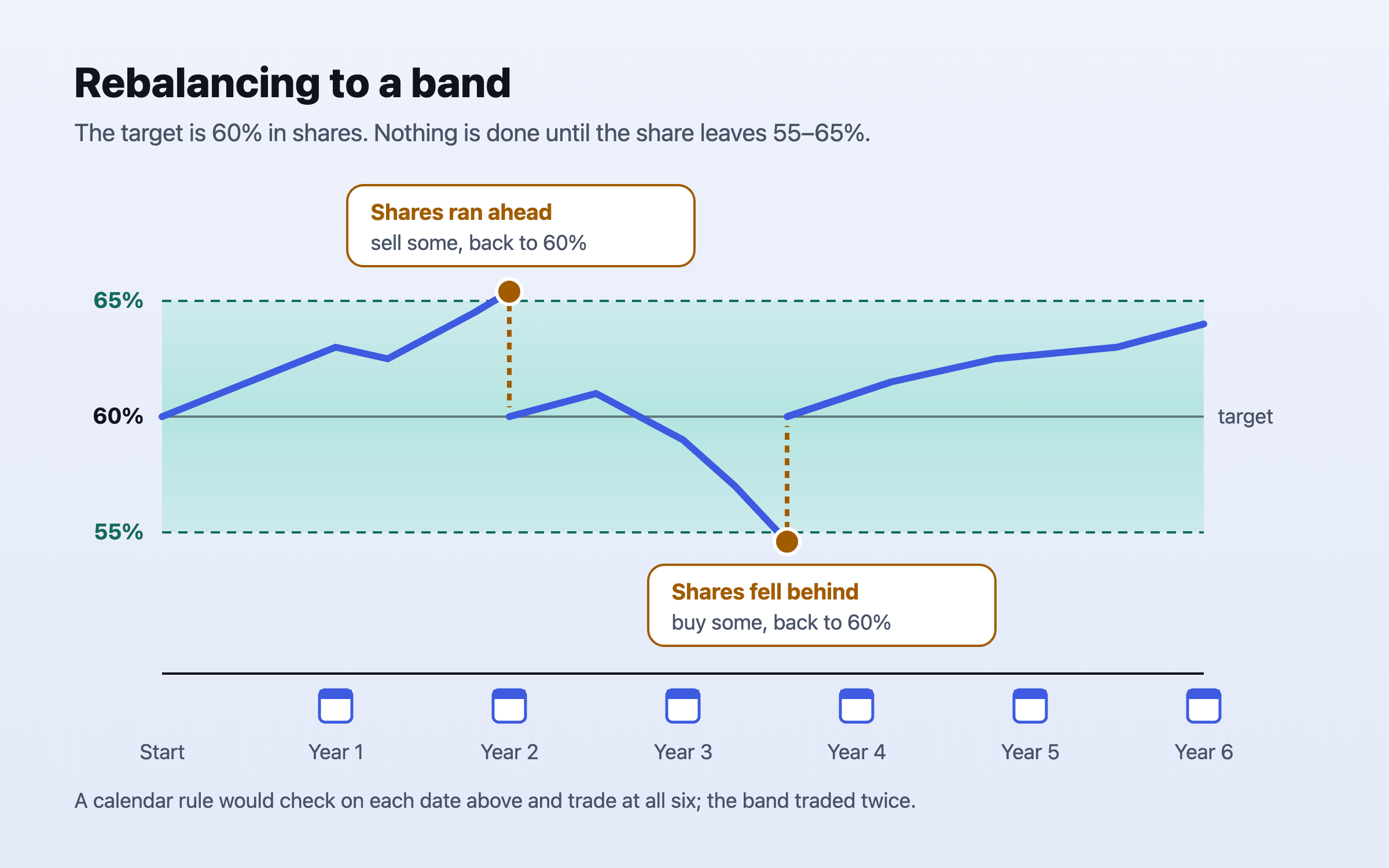
The 5/25 rule. Larry Swedroe’s version, as Ben Carlson summarises it: rebalance when an asset class moves more than 5 percentage points from its target, or 25% of its target, whichever is smaller. A 60% share holding is rebalanced outside 55–65%; a 10% holding outside 7.5–12.5%8.
A band trades only when the drift is big enough to matter. A calendar rule checks on fixed dates whatever has happened. Checking on a date, and acting only outside the band, takes the best of both.
Where you rebalance to matters as well as when. When the cost is your time, going all the way back to the target makes sense; when the cost is proportional — commissions, taxes — Vanguard found it better to trade only back to the edge of the band1. Its 2024 paper uses the same idea for its target-date funds: trade when an allocation drifts 2 percentage points from target, and move it back to 1.75 points away rather than all the way — so a 60/40 portfolio breaching 62% in shares would go back to 61.75%, not 60%, which keeps each trade small7.
Is there a rebalancing bonus?
Sometimes, and it is smaller than it sounds. Bernstein found that from 1926 to 1994, a 50/50 mix of shares and long-term corporate bonds rebalanced every year returned 8.34%, against 7.85% for the simple average of the two assets’ returns — a “bonus” of 0.49% a year9. The bonus is real when two assets are both volatile and poorly correlated: selling what has risen and buying what has fallen harvests their swings. Willenbrock showed that this diversification return comes from the rebalancing itself, not from lower variance10.
The catch is in Bernstein’s own figures. The same 50/50 portfolio never rebalanced returned 9.17% — more than the rebalanced one — because it drifted into shares, which earned more9. The bonus is measured against an average, not against letting it ride. Between two assets of very different expected returns, such as shares and bonds, expect rebalancing to cost a little return and buy a lot of steadiness. Between similar assets — markets in two countries, say — the bonus is more likely to be a true gain.
Rebalance with new money first, and mind the tax
The cheapest rebalancing involves no selling. Vanguard’s 1926–2009 simulation also tested a portfolio rebalanced only by sending its dividends and interest to whichever asset was underweight: it averaged 61.0% in shares, with a volatility of 11.3%, without a single sale1. The same works with monthly contributions while saving, and with withdrawals once you are drawing down — take them from whatever is overweight first, as Vanguard’s own guidance suggests11. A regular investment plan that is pointed at the lagging asset each month is a rebalancing rule that never triggers a tax bill.
When you must sell, where you sell matters more than when:
India. Since the July 2024 Budget, long-term gains on listed equity and equity funds held over a year are taxed at 12.5% above ₹1.25 lakh a year, and short-term gains at 20%12. Switching between two mutual fund schemes, or from a regular to a direct plan, is treated as a redemption and a purchase, so it can create a taxable gain13. Using the yearly exemption to rebalance a little each year is one common approach.
United Kingdom. Nothing in an ISA is subject to capital gains tax, and nor are gilts14; outside a shelter, gains above the £3,000 annual allowance are taxed15. Rebalance inside the ISA or pension first.
United States and elsewhere. The same principle: Vanguard’s study notes that taxes come into it when rebalancing within taxable accounts1, so do the selling inside retirement accounts where you can and use new money in the taxable ones.
Glide paths: rebalancing toward a moving target
A target-date fund rebalances to a target that changes with age. Vanguard’s glide path holds 90% in shares at 20, begins reducing in midcareer around 40, reaches 50% at 65 and settles at 30% shares and 70% bonds by 7216. You can follow the same shape yourself: rebalance as usual, but move the target a few points toward bonds every few years as independence approaches. See asset allocation by age for how far apart the common rules of thumb are.
A routine that takes an hour a year
Write the target down — what share goes to shares, to bonds and deposits, and to anything else such as gold — and a band either side, such as the 5% thresholds Vanguard found reasonable1.
Point every contribution at whatever is furthest below target, every month. Most years this alone keeps you inside the band.
Check once a year on a fixed date. If nothing is outside its band, do nothing.
If something is outside, trade back toward the target — inside tax shelters first, and in India using the yearly gains exemption where you can.
Once you are drawing down, take withdrawals from what is overweight, and keep a runway in cash and bonds so you never sell shares after a fall to pay the bills (sequence of returns risk).
Questions people ask
How often should I rebalance my portfolio?
Vanguard found no optimal frequency; checking once or twice a year and rebalancing when an asset class is more than about 5 points off target balances risk control against cost1. Monthly is generally too often.
What is the 5/25 rule for rebalancing?
Rebalance when an asset class drifts more than 5 percentage points from its target or 25% of its target, whichever is smaller. A 60% holding is rebalanced outside 55–65%8.
Does rebalancing increase returns?
Usually not between shares and bonds: in Vanguard’s 1926–2009 study the never-rebalanced 60/40 returned 9.1% against 8.6%, but with volatility of 14.4% against 11.9%1. Rebalancing is for risk control.
Can I rebalance without selling?
Yes. Direct new contributions, dividends and interest to whatever is underweight, and take withdrawals from what is overweight. In Vanguard’s simulation that alone kept a 60/40 portfolio near 61% in shares1.
Is switching mutual funds to rebalance taxable in India?
Usually yes: a switch is treated as redeeming one scheme and buying another, so a gain can be taxed13. Equity gains over a year are taxed at 12.5% above ₹1.25 lakh a year12.
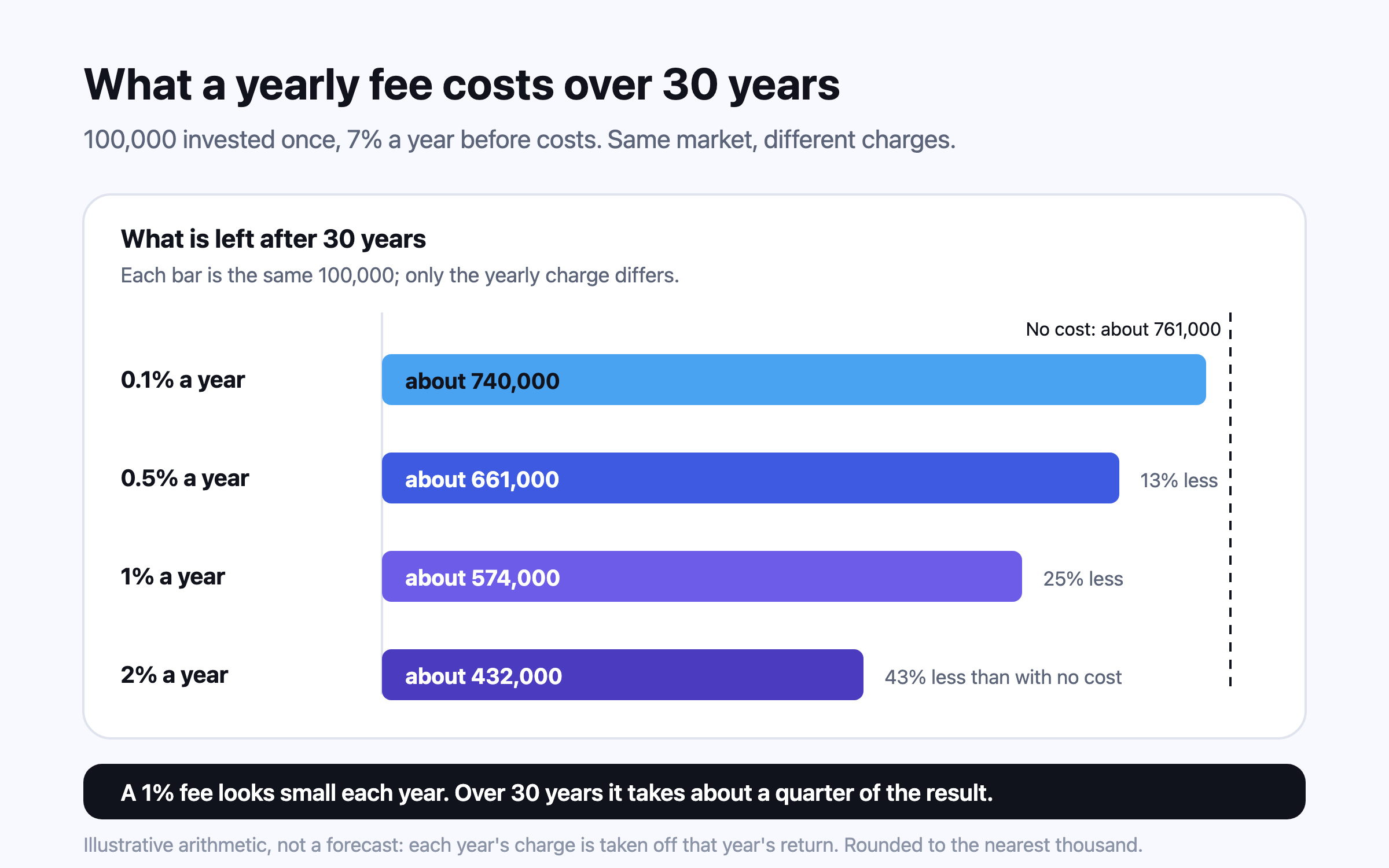
A fee is charged every year on the whole balance, so it compounds against you. On 7% a year before costs, a 1% yearly charge leaves about a quarter less after 30 years than no charge at all, and 2% leaves over 40% less. Fund costs have fallen sharply — US equity funds averaged 0.40% in 2025 against 1.04% in 1996 — but platform and adviser layers sit on top, and in India a regular plan carries a distributor’s commission that a direct plan does not.
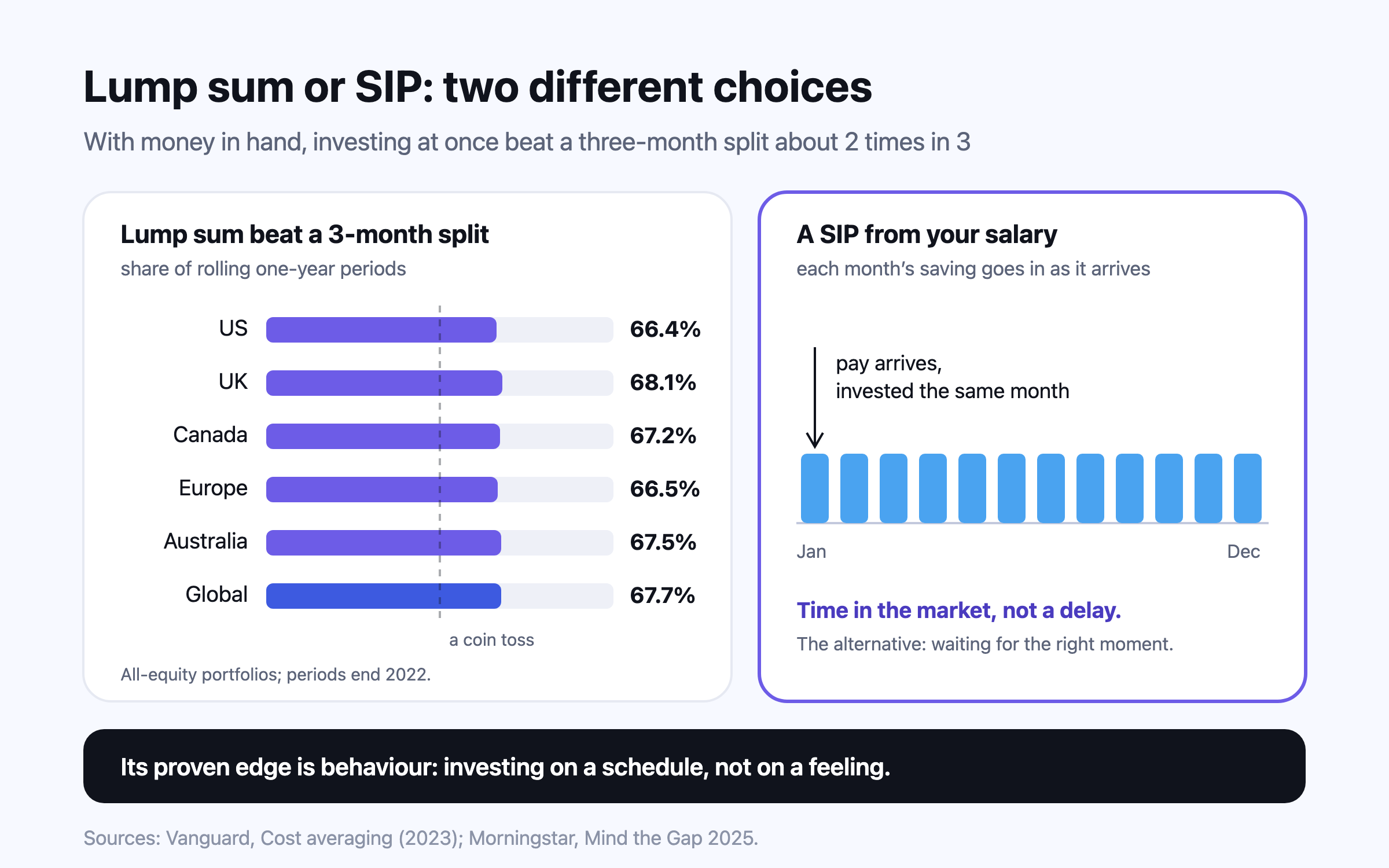
With money already in hand, investing it at once has beaten feeding it in over a few months roughly two-thirds of the time, by about 2% after a year for an all-equity portfolio, because markets rise more often than they fall. A SIP from each month’s salary is not that choice: it invests money as soon as it exists. Its real advantage is behavioural: automatic, regular investing takes the stop-start timing decisions out of investors’ hands.
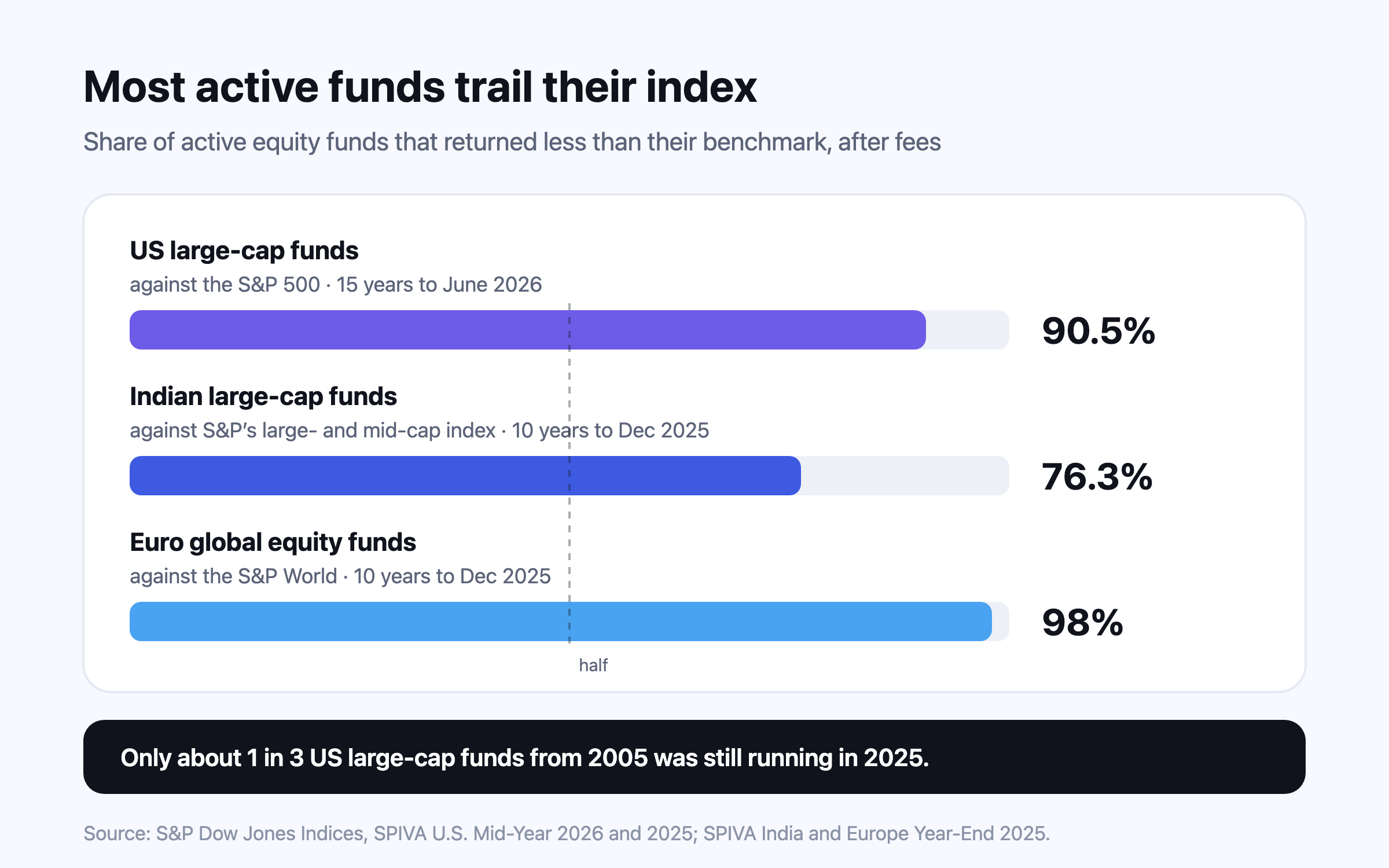
Most actively managed equity funds trail their benchmark after fees, and the share grows with time: to June 2026, 90.5% of US large-cap funds lagged the S&P 500 over 15 years. India and Europe show the same long-run pattern, with real exceptions — Indian mid- and small-cap funds had their best year against the index since 2014 in 2025. Winners rarely stay winners, and the cheapest funds succeed most often.
This is general information, not financial, tax or legal advice for your circumstances. Rules and figures change; check the official source for your country, and consult a licensed professional before making financial decisions. Projections are estimates, not predictions.