The dollar had its worst first half since 1973, yet the rupee hit record lows. What a currency move does to families who earn, save and spend in different currencies.
The US dollar index fell 10.8% in the first half of 2025, its worst start to a year since 1973, and the Fed’s broad dollar index ended 2025 down 7.4%. In 2026 the dollar steadied, and the rupee fell to record lows near 97 as oil surged. The same S&P 500 returned 16.4% in dollars in 2025, 2.7% in euros and 22.2% in rupees. What matters for a family is not which way the dollar moves but whether its savings are in the currency it will spend.
Nivritee Research · 10 October 2026 · updated 15 October 2026 · 6 min read
In the first six months of 2025 the US dollar index, which measures the dollar against a basket of major currencies, fell 10.8%, its worst first half since 19731. On the Federal Reserve’s broader measure, against the currencies of all major US trading partners, the dollar ended 2025 down 7.4%2. Then the fall stopped. By 9 October 2026 the broad index had risen 1.6% for the year2, and the Indian rupee, which had weakened even while the dollar fell, reached record lows near 97 to the dollar3.
For a family that earns, saves and spends in one currency, none of this matters much. For the many that do not, such as an Indian family working in Dubai, a British household with an American index fund, or a Singapore saver planning to settle in Kerala, a currency move changes what their money is worth in the place they will use it. This article explains what happened, why currencies move, what it did to the same investment in six currencies, and how to arrange savings so that a move in either direction does less harm.
More rupees per UAE dirham, 2 January 2025 to 9 October 2026
What happened to the dollar, and to everybody else
Measured from the January 2025 monthly average to September 2026, the euro gained 11.1% against the dollar, the pound 8.5% and the Singapore dollar 6.9%; the yen ended where it began; and the rupee lost 9.7%4. Most of the euro’s and pound’s gains came in the first half of 2025. The rupee’s fall came mostly afterwards, through late 2025 and the oil shock of 2026.
What each currency was worth in US dollars, January 2025 = 100
Euro
Pound
Singapore dollar
Yen
Rupee
Monthly averages of the Federal Reserve’s noon buying rates in New York, each currency’s value in dollars set to 100 in January 2025. Above 100 the currency bought more dollars than at the start; the rupee is the one that bought fewer. The UAE dirham, fixed to the dollar, would be a flat line at 100. 4The figures in this chart
Euro
Pound
Singapore dollar
Yen
Rupee
Jan 2025
100.0
100.0
100.0
100.0
100.0
Apr 2025
108.5
106.4
102.8
108.6
100.8
Jul 2025
112.7
109.2
106.2
106.3
100.1
Oct 2025
112.4
108.1
105.0
103.4
97.6
Jan 2026
113.4
109.6
106.3
99.9
94.9
Apr 2026
112.9
108.9
106.6
98.3
92.3
Jul 2026
110.3
108.3
105.4
96.4
90.0
Sep 2026
111.1
108.5
106.9
100.0
90.3
Why currencies move
Interest rates. Money flows towards higher returns. The Federal Reserve cut its policy rate three times in late 2025, to 3.50–3.75%, which made dollar deposits less attractive; on 16 September 2026 it raised rates for the first time in three years, to 3.75–4.00%5,6.
Hedging by foreign investors. The Bank for International Settlements found that non-US investors hedging the currency risk on their US securities made an important contribution to the dollar’s slide in April 2025, with the largest falls during Asian trading hours7. Before 2025, high hedging costs had discouraged them; when sentiment turned, many hedged at once.
Confidence and reserves. Central banks still hold most of their reserves in dollars, but less than before: 56.70% in the second quarter of 2026, down from 57.18% the quarter before8.
Trade and oil. A country that imports most of its oil needs more dollars when oil rises. On 15 May 2026 the rupee traded past 96 to the dollar for the first time, as the war involving Iran kept crude prices high9. That is why the rupee fell in 2026 while the euro held its gains; see oil shocks and household budgets.
None of these can be forecast with any reliability over the months that matter to a household. The rupee had already set a record low of 87.57 in February 202510; by May 2026 it was more than nine rupees weaker still3. A plan that depends on guessing the next move is a plan that depends on luck.
Same fund, six different returns
The S&P 500 rose from 5,881.63 at the end of 2024 to 6,845.50 at the end of 2025, a price gain of 16.4% for anybody counting in dollars11. Converted at each day’s exchange rate, the same holding gained 2.7% for an investor counting in euros, 8.4% in pounds, 9.5% in Singapore dollars, 16.0% in yen and 22.2% in rupees11,3. The shares were identical; the currency the investor measured in was not.
The S&P 500’s 2025 price return, measured in six home currencies
The index level at the end of 2024 and 2025 divided by the exchange rate on each date. Price only, before dividends and fund costs. A weaker dollar shrinks an American holding for a European; a weaker rupee enlarges it for an Indian. 11,3The figures in this chart
Price return in 2025
US dollar
16.4%
Euro
2.7%
Pound
8.4%
Singapore dollar
9.5%
Yen
16.0%
Rupee
22.2%
An illustrative investor in Pune with ₹10 lakh in an S&P 500 fund at the end of 2024 held about ₹12.22 lakh a year later, before dividends and costs; an investor in Munich with €10,000 in the same index held about €10,27011,3. Neither did anything different. This is why the Portfolio Tracker reports every holding in one plan currency: a return in dollars is not the return you will spend.
What it meant for five kinds of family
An Indian family earning in the Gulf. The UAE dirham has been fixed at 3.6725 to the US dollar since 199712, so a Dubai salary moves with the dollar against the rupee. A dirham bought 23.35 rupees on 2 January 2025 and 26.34 on 9 October 20263. An illustrative AED 10,000 sent home each month bought about ₹2.33 lakh at the start of 2025 and about ₹2.63 lakh in October 2026. India received $150.7 billion in remittances in 2025, up from $137.7 billion in 202413.
A family in India with US funds. A weaker rupee lifted the rupee value of US holdings, on top of whatever the shares did. It also raised the rupee cost of anything priced in dollars: a US university fee, a foreign holiday, imported oil.
A UK or European household with a global fund. A world index fund is mostly American (see market concentration and your index fund), so the dollar’s 2025 fall cut into its returns in pounds and euros, as the chart above shows.
A Singapore household. The Singapore dollar strengthened 6.9% against the US dollar from January 2025 to September 20264. US holdings were worth less in Singapore dollars; imports priced in dollars were cheaper.
A Japanese household. The yen ended September 2026 where it started 2025 against the dollar, after rising and falling in between4. Over the whole period, the currency neither helped nor hurt.
Match your savings to where you will spend them
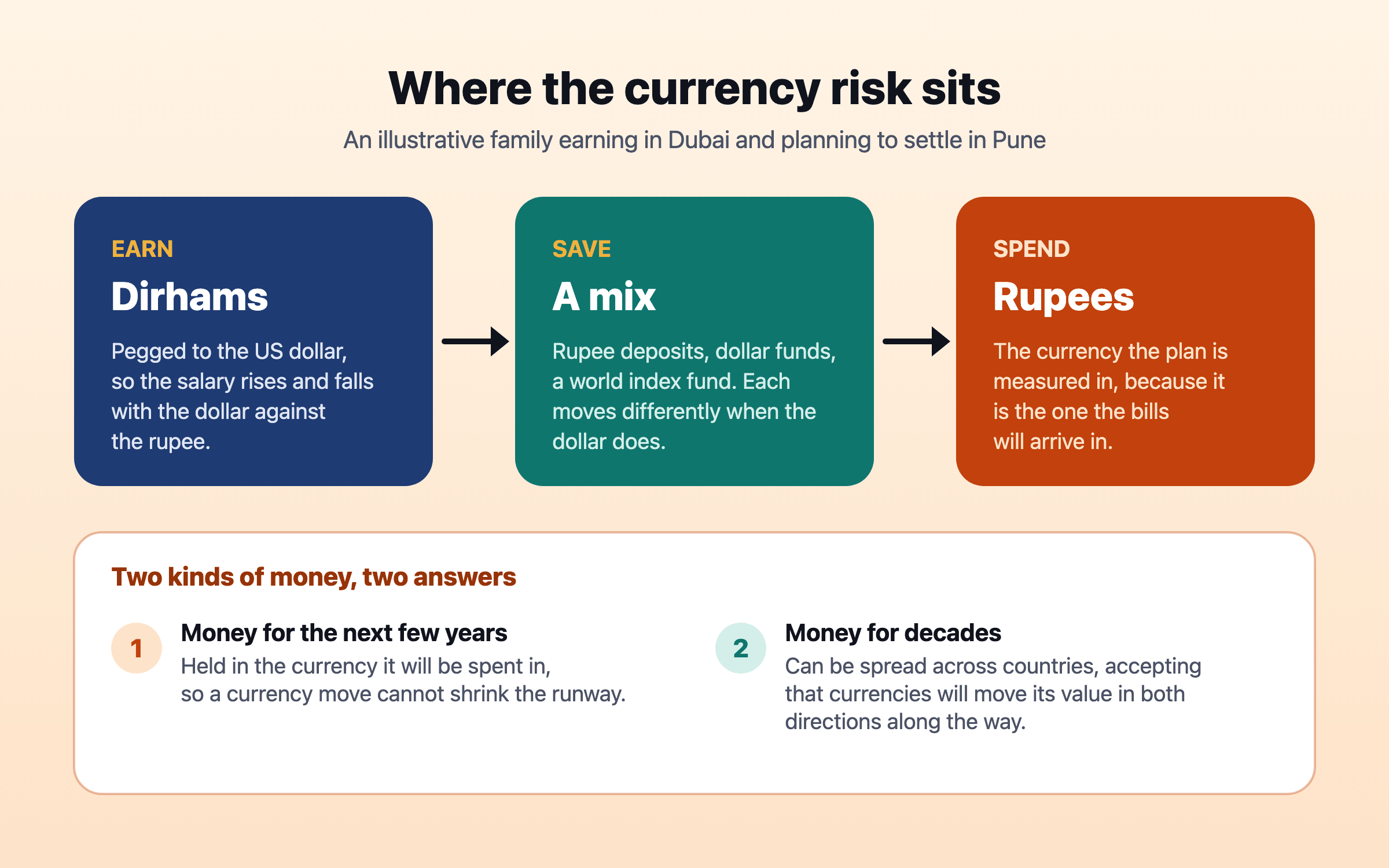
Currency risk is the gap between the currency your money is in and the currency your bills will be in. The answer differs for money needed soon and money needed in decades.
The currency that matters is the one your future bills will arrive in. For a family planning to settle in India, that is the rupee, whatever they earn in today. Two kinds of money call for two answers. Money for the next few years, an emergency fund, a house deposit, the first years of spending after you stop work, is safest in the currency it will be spent in, so that no currency move can shrink it when you need it. Money for decades can be spread across countries, accepting that currencies will move its value in both directions along the way; home bias and currency risk sets out the evidence on how much.
It is also worth knowing how large a move is plausible. After the 2016 referendum the pound fell from an average of $1.4524 in May to $1.2330 in October, about 15% fewer dollars per pound in five months4. Nivritee’s currency stress test is modelled on moves like that one: when you stop working, everything you hold, earn, pay or expect in another currency loses that much value in your plan’s currency, and stays there.
What to do about it
Name your spending currency. Write down where you expect to live in ten and twenty years. That currency is the one your plan should be measured in.
Count what you hold in each currency. Salary, deposits, funds, property and loans. Most families who live abroad are surprised by how much sits in the currency they will not spend.
Hold near-term money where it will be spent. Emergency savings and the first years of spending after work stops are the money a currency move can hurt most.
Let long-term money be global, on purpose. A world fund spreads company and country risk, at the cost of currency swings. Decide how much of that you want rather than drifting into it.
Do not move money to chase a currency. Converting everything after a move has happened is buying high and selling low in another form. If you send money home regularly, sending on a fixed schedule averages the rate out.
Test the plan against a currency fall. If your plan only works if the rupee, the pound or the dollar goes your way, it is a bet, not a plan.
How Nivritee helps
This explains how currency moves reach household finances, using published data to October 2026. It does not forecast exchange rates or recommend any currency, fund or transfer. This is information, not financial advice.
Questions people ask
Why did the US dollar fall in 2025?
A mix of Federal Reserve rate cuts, uncertainty over US policy and foreign investors hedging their dollar holdings. The dollar index fell 10.8% in the first half, its worst first half since 19731,7.
Why did the rupee fall when the dollar was weak?
The rupee has its own drivers, above all India’s oil import bill. It passed 96 to the dollar for the first time in May 2026 as the war involving Iran kept crude prices high9,3, while the euro and pound held most of their 2025 gains4.
Is the UAE dirham pegged to the dollar?
Yes, at 3.6725 dirhams to the dollar since 199712. A dirham salary therefore rises and falls against the rupee exactly as the dollar does.
Does a weaker dollar help or hurt my US investments?
It depends on your home currency. In 2025 the S&P 500 gained 16.4% in dollars but only 2.7% in euros, and 22.2% in rupees because the rupee fell too11,3.
Which currency should my savings be in?
Money you need in the next few years is safest in the currency you will spend it in. Long-term money can be spread across countries if you accept currency swings; see which currency your savings should be in.
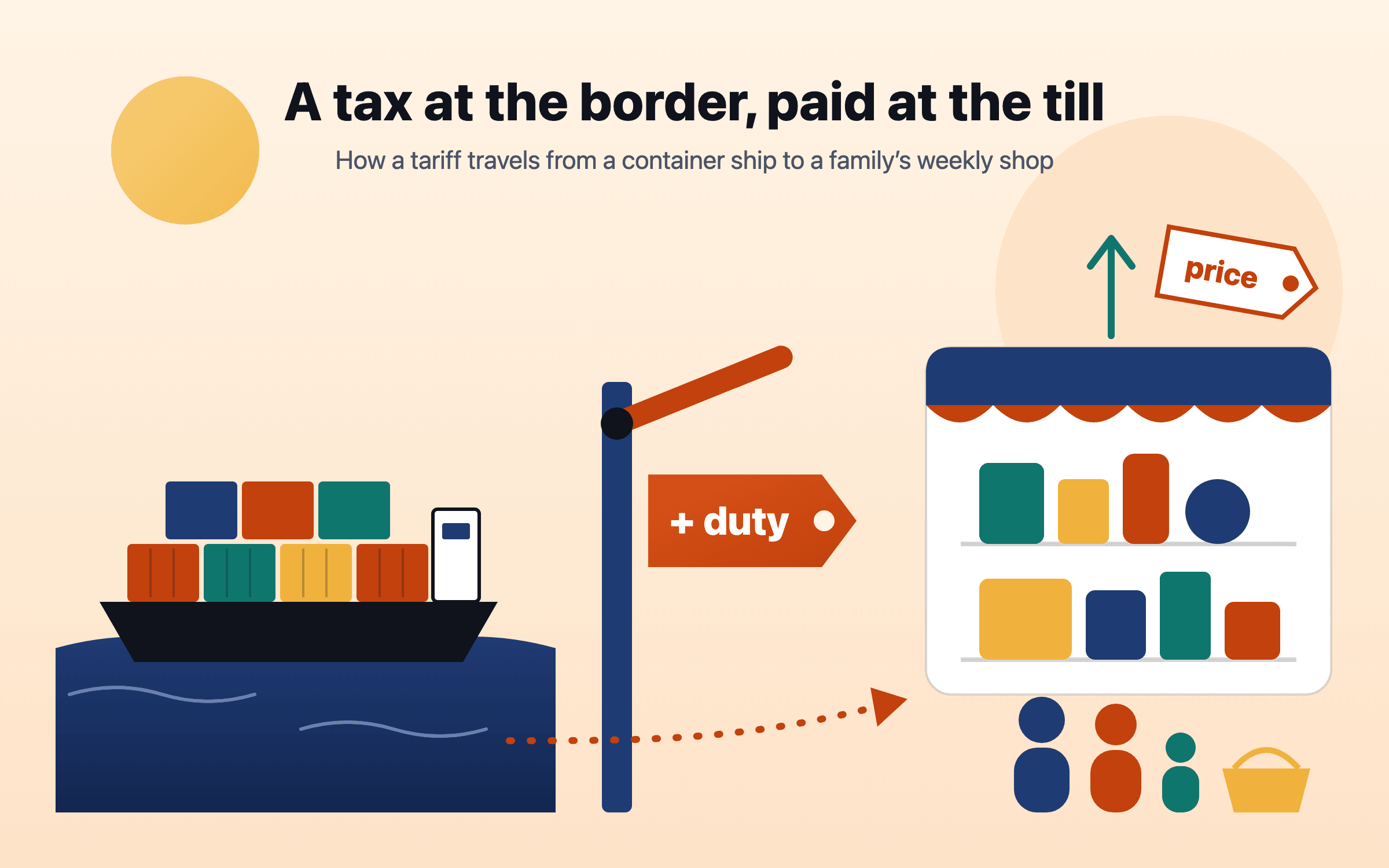
US tariffs rose in 2025 to their highest average level in about ninety years, were cut back by a Supreme Court ruling in February 2026, and were rebuilt under other laws. Research finds the cost lands mostly on buyers in the importing country, spread across importers, shops and households; Yale’s Budget Lab puts it at about $1,100 a year for the average US household. Elsewhere the effect arrives through export orders, jobs, markets and interest rates. The useful response is a budget that knows which costs are rising, a cash buffer sized to your job’s exposure, and no trading on headlines.
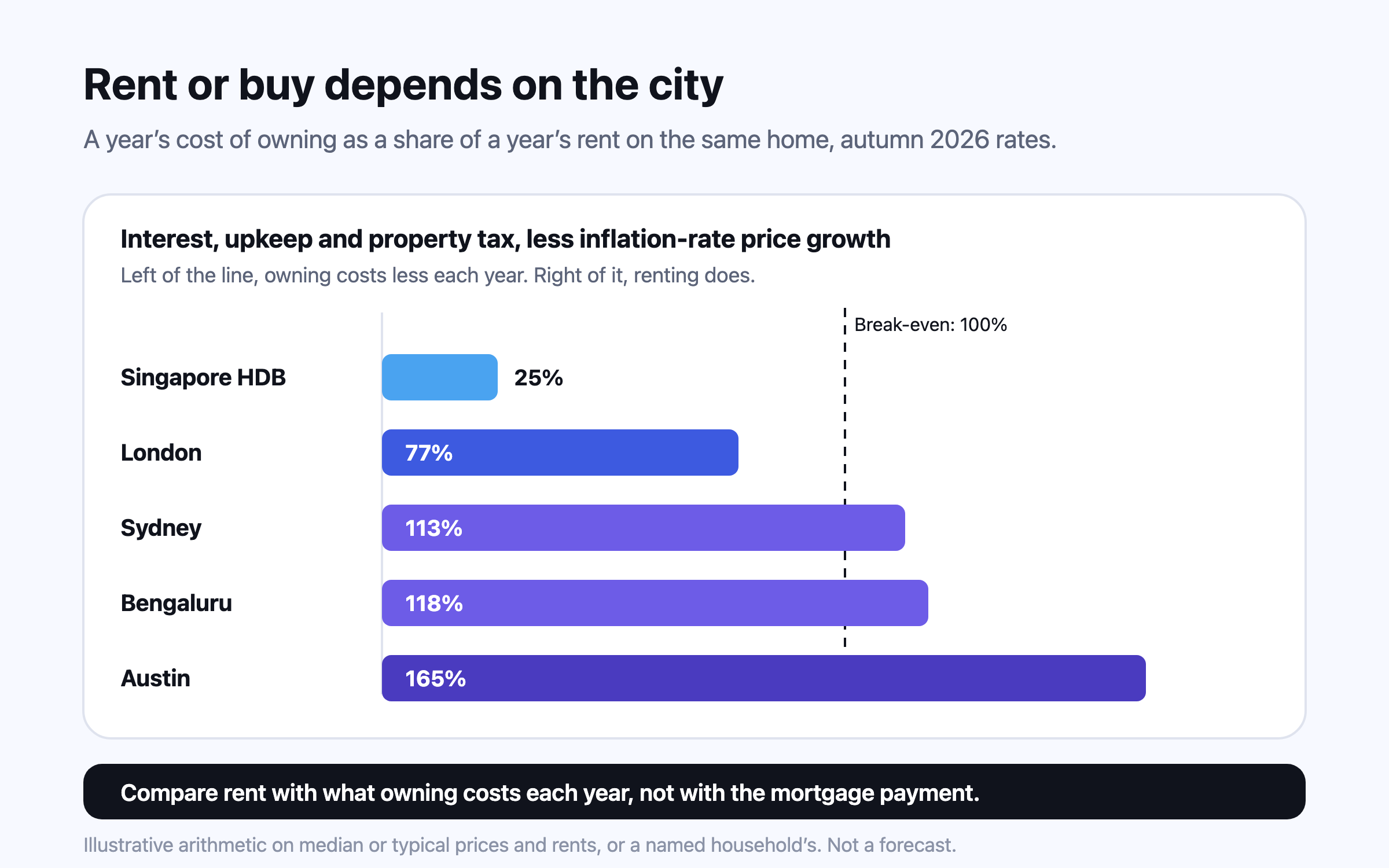
Compare rent with the unrecoverable cost of owning — interest, upkeep, property tax and the return your deposit gives up, less expected price growth — not with the mortgage payment. At autumn 2026 rates, owning the average London home costs somewhat less than renting it, an Austin home costs far more to own than to rent, and an HDB flat in Singapore costs far less. Transfer taxes then decide how long you must stay.
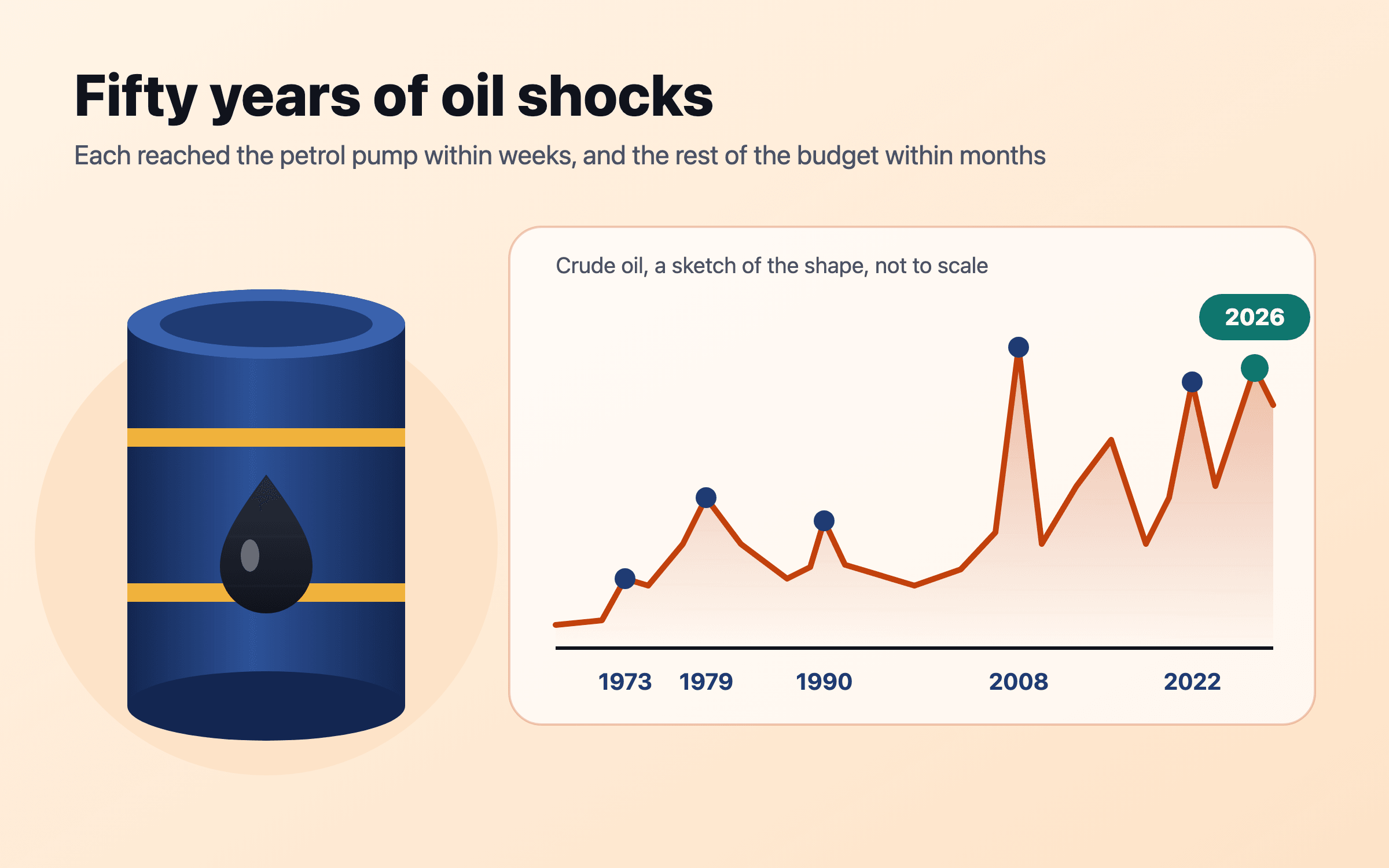
When conflict closed the Strait of Hormuz in 2026, Brent crude rose from $71 to a daily high of $138 within six weeks. Oil reaches a household in three rounds: at the pump within weeks, through transport and food over months, and through wages and interest rates over a year or more. The IMF’s rule of thumb is that each 10% rise adds about 0.4 points to global inflation. Importers such as India, Japan and most of Europe feel it most; the household response is a budget that separates fuel from everything else, a buffer, and a plan tested against inflation that stays higher for longer.
This is general information, not financial, tax or legal advice for your circumstances. Rules and figures change; check the official source for your country, and consult a licensed professional before making financial decisions. Projections are estimates, not predictions.