A household can be worth a great deal and still be unable to pay next month’s bills. Liquidity — how fast an asset becomes cash, and at what cost — is the difference.
Liquidity is how quickly an asset becomes cash and how much you lose doing it. Cash is instant, listed shares settle in a day or two, a home takes months, and pensions are locked for years by law. In a crisis the middle of that range gets slower and dearer. The fix is to hold each pound, rupee or dollar in something whose speed matches when it will be needed.
Nivritee Research · 4 August 2026 · updated 15 October 2026 · 7 min read
Ask a household what it is worth and you get one number. Ask how much it could spend by Friday and you get a much smaller one. The gap between them is liquidity: how quickly an asset can be turned into cash, and how much of its value is lost in the turning. Most money problems that look sudden — a job loss, a medical bill, a market crash in the year somebody stops working — are liquidity problems in households that had plenty on paper.
This article measures the speed and cost of each kind of asset, shows how pension rules lock money away in different countries, looks at what happened to liquidity in three recent crises, and ends with a worked household that is rich on paper and short of cash — and what it can do about it.
Two questions: how fast, and at what cost
Every asset can be turned into cash eventually. What differs is the time it takes and the cost of doing it in a hurry. A savings account scores perfectly on both. A house scores badly on both: months to sell, and a large bill for agents, taxes and lawyers. Listed shares are fast but carry a hidden cost — you sell at today’s price, and the day you need the money may be a day the price is down.
So the useful question is never “is this liquid?” but “if I needed this money in a week, in a bad month, how much of it would I actually get?”
Asset by asset: days to cash
Cash — current and savings accounts, money market funds. Same day, nothing lost.
Fixed and term deposits — usually breakable, at a price. At State Bank of India, a deposit closed early earns 0.5 percentage points less than the contracted rate if it is up to ₹5 lakh and 1 point less above that, and a deposit held under seven days earns nothing.1 Some deposits elsewhere cannot be broken at all until they mature.
Listed shares and ETFs — a trade settles in a day or two. US trades have settled one business day after the trade (T+1) since 28 May 2024;2 UK trades settle in two and move to one from 11 October 2027.3 Fast, but at whatever the market says that day.
Mutual funds — Indian funds must pay redemption proceeds within three working days of accepting the request, outside a short list of exceptional situations, and owe investors interest, currently 15% a year, for any delay.4 Funds holding assets that are slow to sell can be slower, or can stop paying out altogether (see below).
Bonds — government bonds in major markets normally trade easily; corporate and smaller issues can take longer and sell at a discount in a hurry.
Property — months. In England a home purchase takes an average of 120 days to complete, and around one in three agreed sales fall through.5 Then come the costs of selling.
Pensions and provident funds — years. The law locks them until an access age in return for their tax treatment, with only narrow exceptions.
How long it takes for the cash to arrive after you decide to sell
Shares are counted in business days and the Indian fund rule in working days; the home sale is an average from the agreed sale to completion. A pension locked until an access age would not fit on this scale at all: it is measured in years. 2,3,4,5The figures in this chart
Days until the cash arrives
US shares and ETFs (T+1)
1 days
UK shares (T+2 until October 2027)
2 days
Indian mutual fund (usual limit)
3 days
Home sale in England (average)
120 days
Pensions: locked by law, differently in each country
Retirement accounts are the largest asset many households own after their home, and the least liquid by design. The rules differ widely:
United States — withdrawals from a 401(k) or IRA before 59½ generally carry an additional 10% tax on top of income tax, unless an exception applies.6
United Kingdom — the normal minimum pension age is 55, rising to 57 on 6 April 2028.7
Australia — super is preserved until a condition of release; the preservation age is 60 for anyone born on or after 1 July 1964.8
Singapore — CPF savings can be withdrawn from 55: at least S$5,000, more once the Full Retirement Sum is set aside, and online withdrawals are capped by a daily limit.9
New Zealand — KiwiSaver opens at the NZ Super age, currently 65; before that only for a first home, a permanent move overseas, serious illness or significant financial hardship.10,8
India — the PPF matures after 15 complete financial years with partial withdrawals from the seventh; EPF partial withdrawals were simplified in October 2025, but a quarter of contributions stays as a minimum balance.8
The practical consequence is a bridge. Anyone hoping to stop work before their access age needs enough reachable money to cover the years in between, however large the pension. Our help article on reaching pension savings covers Canada, Japan, Hong Kong, Malaysia and Europe as well.
Liquidity disappears exactly when you need it
The speeds above are for ordinary days. In a crisis everyone wants cash at once, and the middle of the range — bonds, funds, anything that needs a buyer — gets slower and dearer.
March 2020. As the pandemic spread, investors everywhere rushed for safe, liquid assets. The Financial Stability Board found that heavy selling disrupted even the US Treasury market, that dealers struggled to absorb the sales, and that without central bank intervention the stress would very likely have worsened significantly.11
The UK gilt crisis, 2022. Between 1 August and a peak on 14 October 2022, 30-year UK government bond yields rose by more than 270 basis points and briefly exceeded 5%, a move the Bank of England said was more than twice the size of March 2020’s. Pension funds using liability-driven investment strategies faced collateral calls and were forced to sell gilts into a falling market — a spiral the Bank described in exactly those terms.12 On 28 September it began buying long-dated gilts “on whatever scale is necessary” until 14 October.13
Property funds that stop paying out. An open-ended fund that owns buildings promises daily dealing on assets that take months to sell. When too many investors ask for their money, such funds can suspend redemptions. The UK regulator wrote rules in 2019 specifically for open-ended funds holding these inherently illiquid assets.14
The lesson for a household is not that markets are dangerous. It is that money you may need soon should not depend on someone else wanting to buy at the moment you want to sell.
Match money to when it is needed
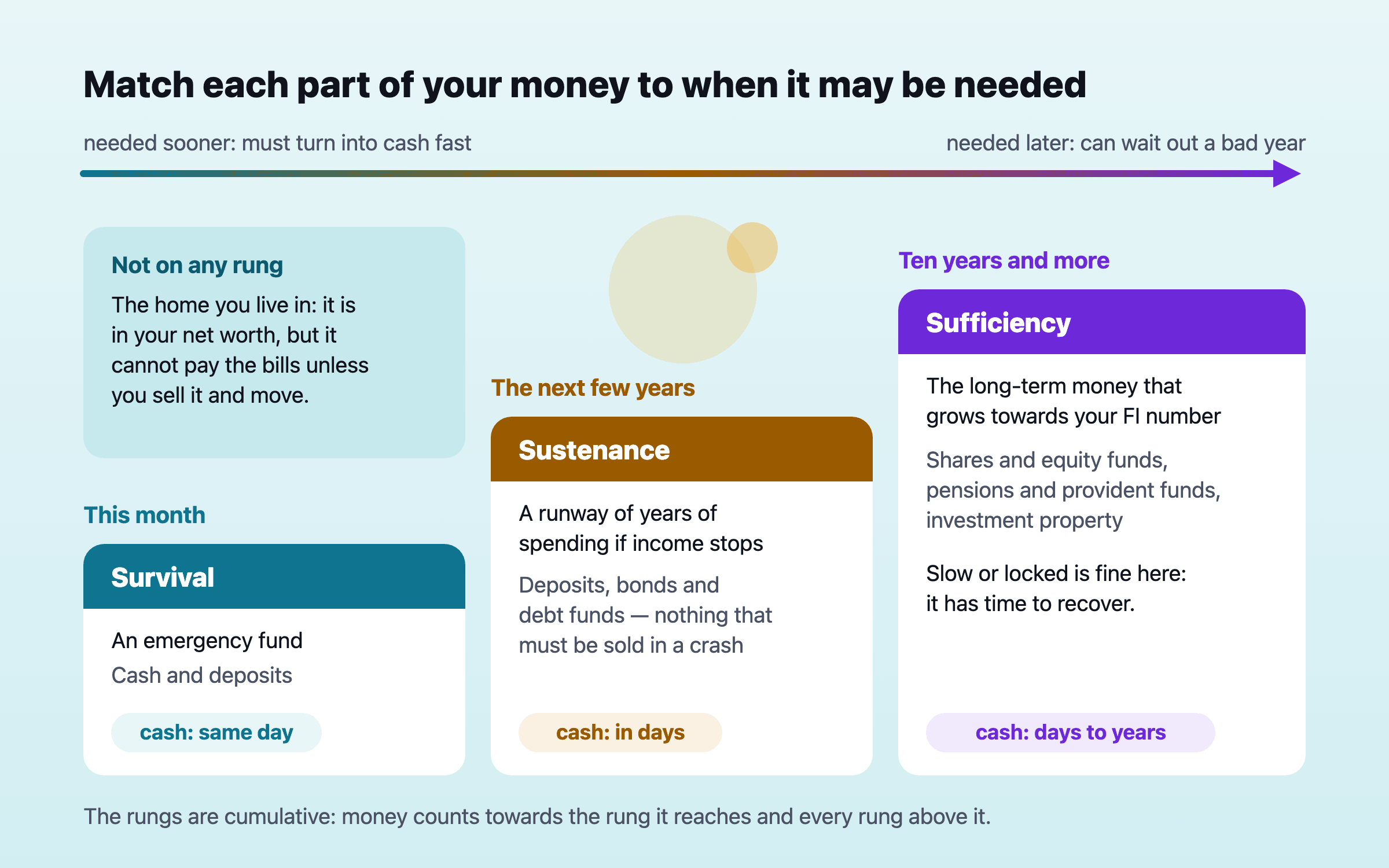
The answer is old and simple: decide when each part of your money might be needed, and hold it in something whose speed and cost fit that date. Nivritee’s Freedom Ladder does this with four cumulative rungs:
Survival — an emergency fund in cash and deposits you can reach the same day, sized in months of essential spending.
Sustenance — a runway of years of full spending if income stops, held in deposits, bonds and debt funds so that nothing has to be sold in a crash.
Sufficiency — the long-term money that grows towards your FI number: equities, pensions and provident funds, investment property.
Surplus — what sits beyond independence.
The ladder checks two things on each rung: whether there is enough money, and whether it is in instruments that fit. Equities and statutory pension schemes count towards Sufficiency but never towards Survival or Sustenance, because neither can be relied on for cash at a fair price in a bad month; the home you live in counts on no rung at all.15
Liquidity matched to need: the sooner money may be spent, the faster and cheaper it must be to reach. Long-term money can be slow because it has time to wait out a bad year.
A worked example: rich on paper, short of cash
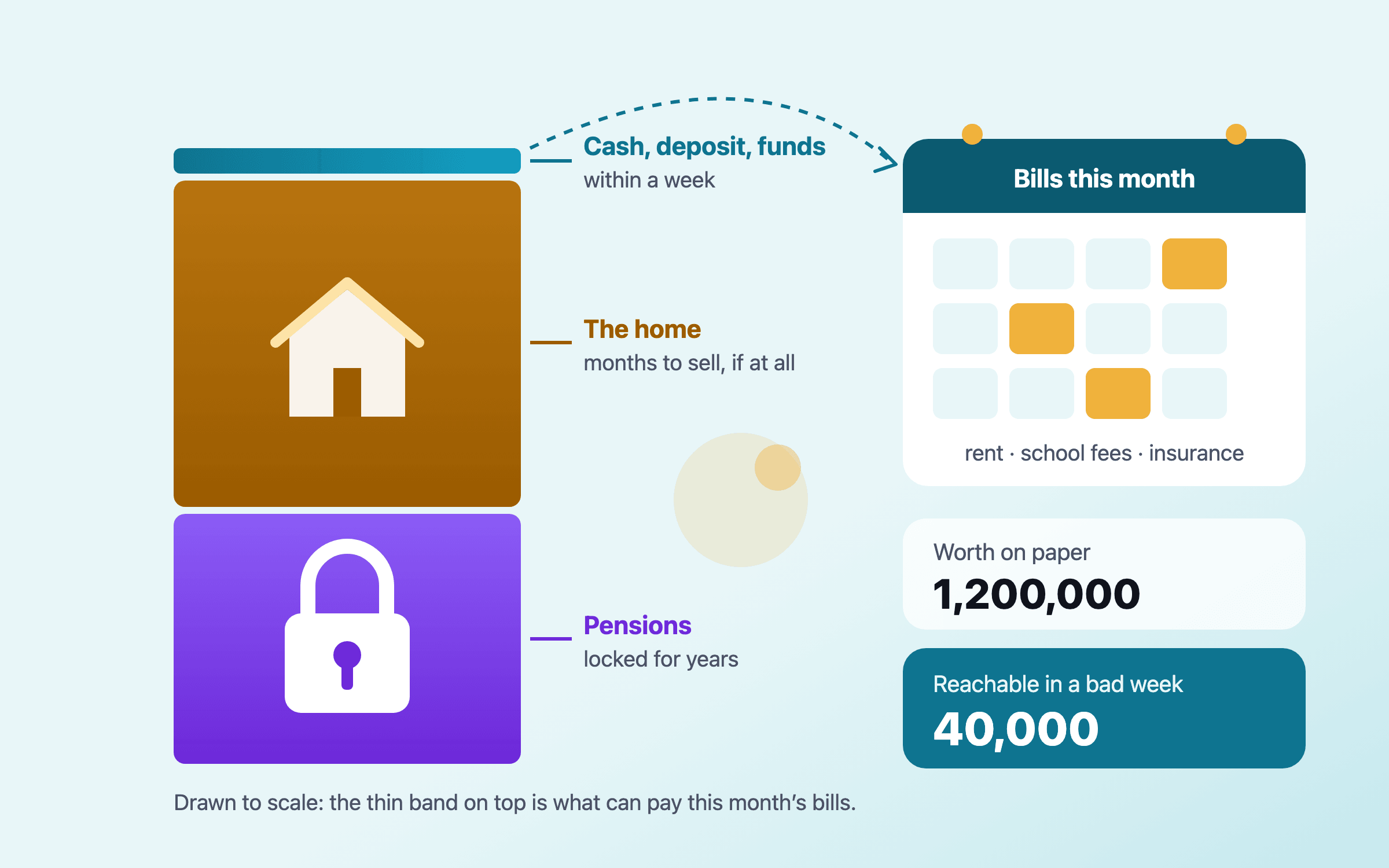
An illustrative household headed by a 45-year-old, in round numbers in any currency. Net worth is 1,200,000: home equity of 650,000, retirement accounts of 500,000, index funds of 30,000, a fixed deposit of 12,000 and 8,000 in a current account. Essential spending is 6,000 a month and full spending 9,000.
Now the main earner loses their job, in a recession, in a month when shares have fallen by a third. Here is what the household can actually reach:
Today: the current account, 8,000.
Tomorrow: break the deposit, at the cost of a lower rate, bringing the total to 20,000.
Within a week: sell the index funds — worth 20,000 after the fall rather than 30,000 — bringing the total to 40,000.
In months, if at all: the home. Selling means moving, and in England an average sale takes 120 days and one in three fall through.5
In years: the retirement accounts. In the United States, money taken before 59½ — fourteen and a half years away — generally carries an extra 10% tax on top of income tax.6
So a household worth 1,200,000 can reach 40,000 within a week in a bad market — one-thirtieth of its net worth. That covers essential spending for between six and seven months, or full spending for about four and a half. And it got there only by selling its index funds at the bottom, turning a fall on paper into a permanent loss of 10,000.
The fix does not need a windfall. If for one year the household sends 36,000 of its saving — six months of essentials — into deposits instead of voluntary pension contributions, its reachable money becomes 86,000 at today’s values with no sale required. Nothing about its net worth changes; its position in a crisis changes completely.
The illustrative household’s wealth by how quickly it becomes cash, today and after a year of rebuilding
Within a week
Months: the home
Years: locked until access age
Values before any market fall, holding the home and pensions at the same figures for simplicity. A year of saving into deposits takes the reachable band from 50,000 to 86,000 without changing anything else. 5,6The figures in this chart
Within a week
Months: the home
Years: locked until access age
Today
50,000
650,000
500,000
After a year of rebuilding
86,000
650,000
500,000
Five rules for a liquid household
Write down, for every asset, how many days it takes to become cash and what it costs to do it in a hurry.
If stopping work is within sight, hold a runway of a few years’ spending in deposits and bonds, so a crash never forces a sale. The bucket strategy and sequence of returns risk explain why the first years matter most.
Stagger fixed deposits so one matures every few months, and you rarely need to break one.
Never count locked pension money towards a bridge before its access age, and treat a credit limit as something the lender can withdraw, not as savings.
It is how quickly an asset can be turned into cash and how much value is lost doing it. Cash is perfectly liquid; shares are fast but sold at whatever the market pays that day; property takes months; pensions are locked until an access age.
Why can’t I spend my net worth?
Because most of it is usually in a home you live in and retirement accounts locked until an access age. Only cash, deposits and ordinary investments can be reached quickly, and investments may have to be sold at a loss in a bad month.
How long does it take to get money from selling shares?
A trade in US shares and ETFs settles one business day after it is made, since 28 May 2024.2 UK trades settle in two business days until 11 October 2027, when they move to one.3
Can I withdraw a fixed deposit early?
Usually yes, at a lower rate. At State Bank of India, for example, the rate is cut by 0.5 percentage points on deposits up to ₹5 lakh and 1 point above that.1 Some deposits elsewhere cannot be broken before maturity, so check the terms.
What percentage of my wealth should be liquid?
There is no single percentage. Hold enough in cash for an emergency fund of some months of essential spending, and — if you are close to stopping work — a runway of a few years in deposits and bonds. The rest can be long-term.
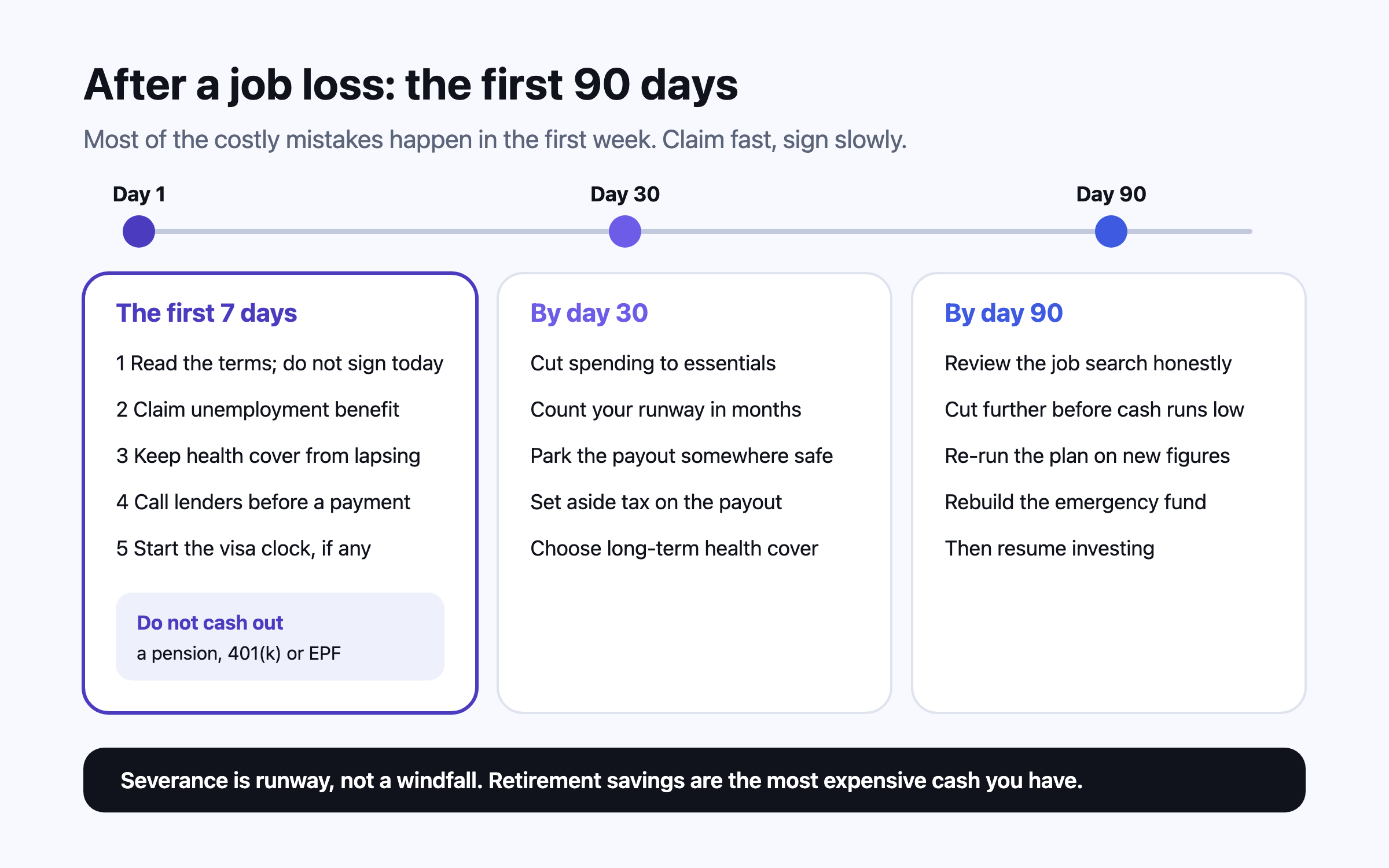
Most of the expensive mistakes after a layoff happen in the first fortnight: signing a severance agreement unread, claiming benefits late, letting health cover lapse, missing a loan payment without calling the lender, and cashing out retirement savings. This is the order to do things in, with the 2026 rules for the US, UK, India, Canada, Australia, Singapore and the UAE.
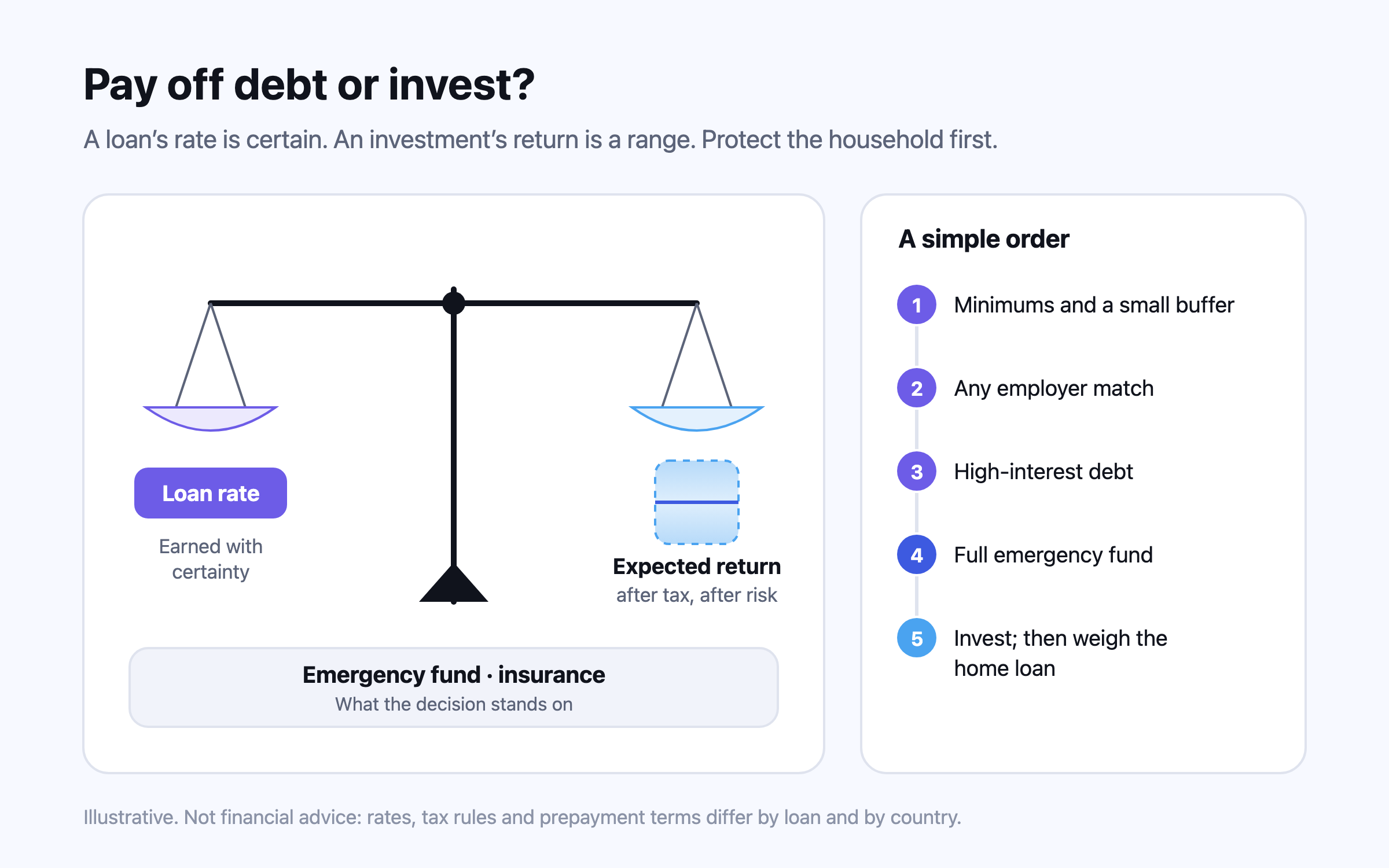
Repaying a loan earns its interest rate with certainty; investing earns an uncertain return, after tax. So costly debt goes first, a low-rate mortgage can sit beside investing, and an emergency fund and the right insurance come before both.
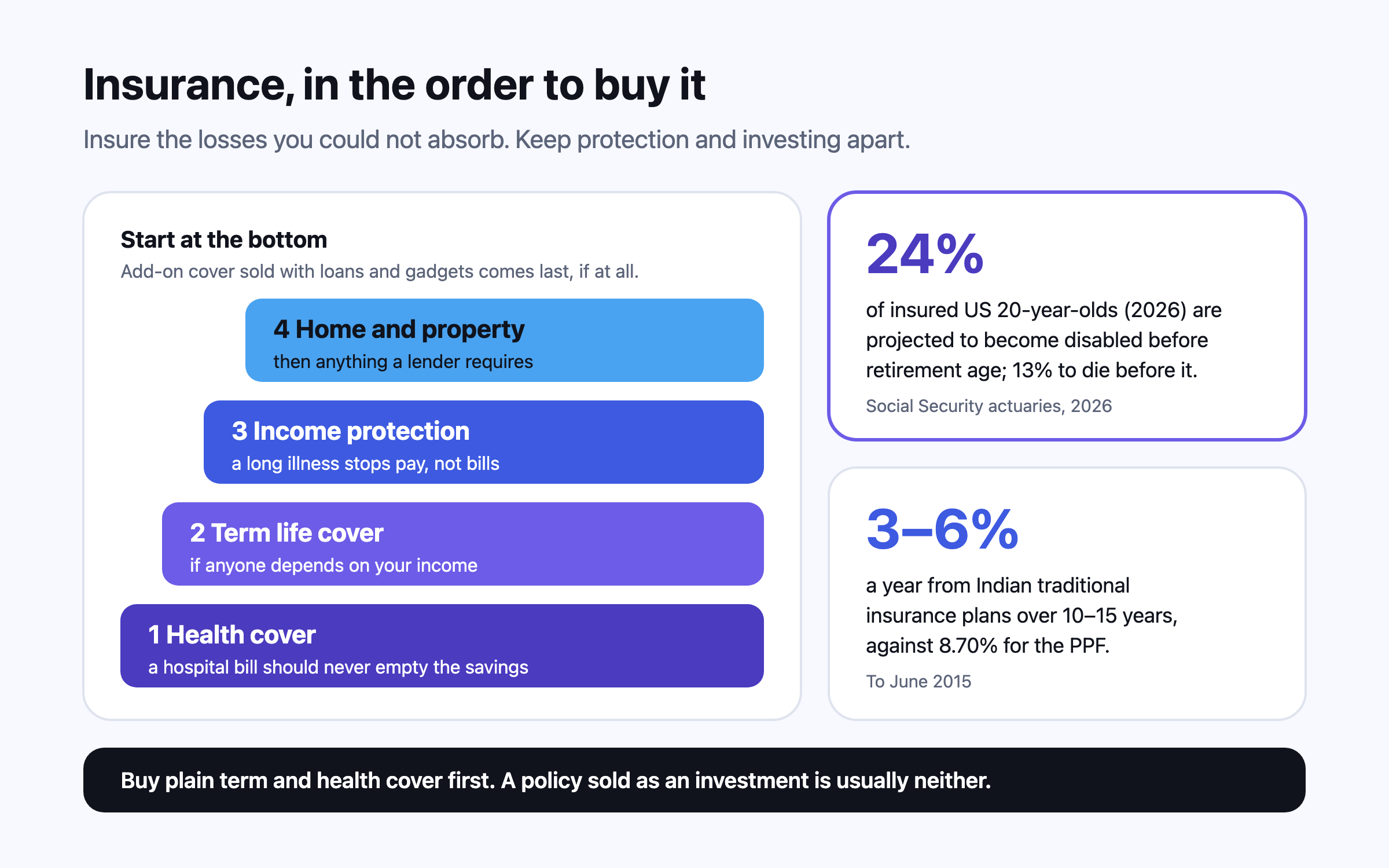
Insurance is for losses a household could not pay for itself: a large medical bill, the death of an earner somebody depends on, or years without income after an illness. Buy cover for those first, in that order, as plain term and health policies; size life cover to what dependants would need rather than to a multiple of salary; and be wary of policies that mix insurance with investment, which in India have returned 3–6% a year over 10 to 15 years.
This is general information, not financial, tax or legal advice for your circumstances. Rules and figures change; check the official source for your country, and consult a licensed professional before making financial decisions. Projections are estimates, not predictions.