Households that save well rarely rely on discipline. They set up accounts and automatic transfers once, then spend an hour a month checking that the system did its job.
The strongest finding in household finance is that people save what they are set up to save. So design the system once: one account where income lands, separate places for bills, spending, the emergency fund, goals and investing, and transfers that move money on payday before anyone decides anything. Then check it for an hour a month and rethink it once a year.
Nivritee Research · 2 September 2026 · updated 15 October 2026 · 7 min read
Most advice about money is advice about willpower: spend less, save more, invest regularly, check your statements. It fails for the same reason diets fail. Every month brings thirty small decisions, each made when tired, and saving loses to whatever is more urgent that day. A money system replaces those decisions with a structure you set up once. Money arrives, is divided, and goes where it belongs before anyone has to choose.
This article covers the evidence for designing rather than deciding, the accounts a household needs, what to automate on payday, the hour a month that keeps the system honest, and the review once a year that keeps it pointed at the right goals. It builds on how to save more, which covers the behavioural research in more depth.
Why a system beats discipline
The evidence comes mostly from workplace pensions, because that is where defaults were first tested at scale. In Vanguard’s data for 2024, plans that enrolled employees automatically had 94% of eligible staff taking part, against 64% in plans where people had to sign up. Counting everyone, including those not in the plan, employees in automatic plans saved an average of 12.1% of pay with their employer’s contribution, against 7.6% where enrolment was voluntary.1 By the end of that year 61% of Vanguard’s plans enrolled people automatically.1
Automatic enrolment against signing up: who takes part and how much they save, US workplace plans in 2024
Eligible employees taking part
Average saved, with employer money, counting everyone
The same kind of plan, a different default. Where saving happened unless somebody opted out, almost everyone took part and the average employee put aside about 60% more. 1The figures in this chart
Eligible employees taking part
Average saved, with employer money, counting everyone
Plans that enrol automatically
94.0%
12.1%
Plans where employees sign up
64.0%
7.6%
Raj Chetty and colleagues, studying 41 million observations of Danish savers, put a number on why. They estimated that about 85% of people are passive savers: they do not adjust to incentives, so a tax subsidy barely moves them — each unit of government spending on subsidies raised total saving by about one cent in the dollar — but automatic contributions made on their behalf raise their wealth substantially.2 Most of us are in that 85% most of the time.
Automation also works on the future. Richard Thaler and Shlomo Benartzi’s Save More Tomorrow asked employees to commit in advance part of each future pay rise to saving. At the first company to use it, average saving among those who joined rose from 3.5% to 13.6% of pay over 40 months, without anybody ever seeing their take-home pay fall.3
Countries already automate part of it
Many governments have built a default into payroll, which is why most households already run a small money system without having designed it:
United Kingdom — employers must enrol eligible staff in a workplace pension, with at least 8% of qualifying earnings going in, of which the employer pays at least 3%.4 Participation among eligible employees reached 89% in 2024;5 in the private sector it had already risen by 44 percentage points between 2012 and 2021, to 86%.6
Singapore — CPF takes 37% of wages for employees aged 55 and below from 1 January 2026: 20% from the employee and 17% from the employer.7
New Zealand — the KiwiSaver default rose from 3% to 3.5% of pay for employees, with a matching employer contribution, on 1 April 2026, and rises to 4% on 1 April 2028.8
United States, India and others — the default depends on the employer, or on schemes such as a provident fund that cover salaried staff only. Self-employed people usually have no default at all and must build one.
Share of pay set aside automatically before it reaches the household, by country’s default
Employee and employer contributions together. The US figure is what employees in automatic plans actually saved, not a legal minimum. Each is a floor for long-term saving, not a whole money system: none of it pays for an emergency or a goal five years away. 7,1,4,8The figures in this chart
Employee and employer together
Singapore CPF, aged 55 and below (2026)
37.0%
US plans with automatic enrolment, average (2024)
12.1%
UK automatic enrolment minimum
8.0%
New Zealand KiwiSaver default (from April 2026)
7.0%
These defaults are a floor. They fund the long term, often in accounts locked until an access age, and they do nothing for next year’s school fees, a car or a lost job. The rest of the system is yours to design.
The accounts: one hub and five places to send money
A household money system needs about six places for money to sit. Some can be sub-accounts or labelled pots within one bank; what matters is that each has one job and one rule.
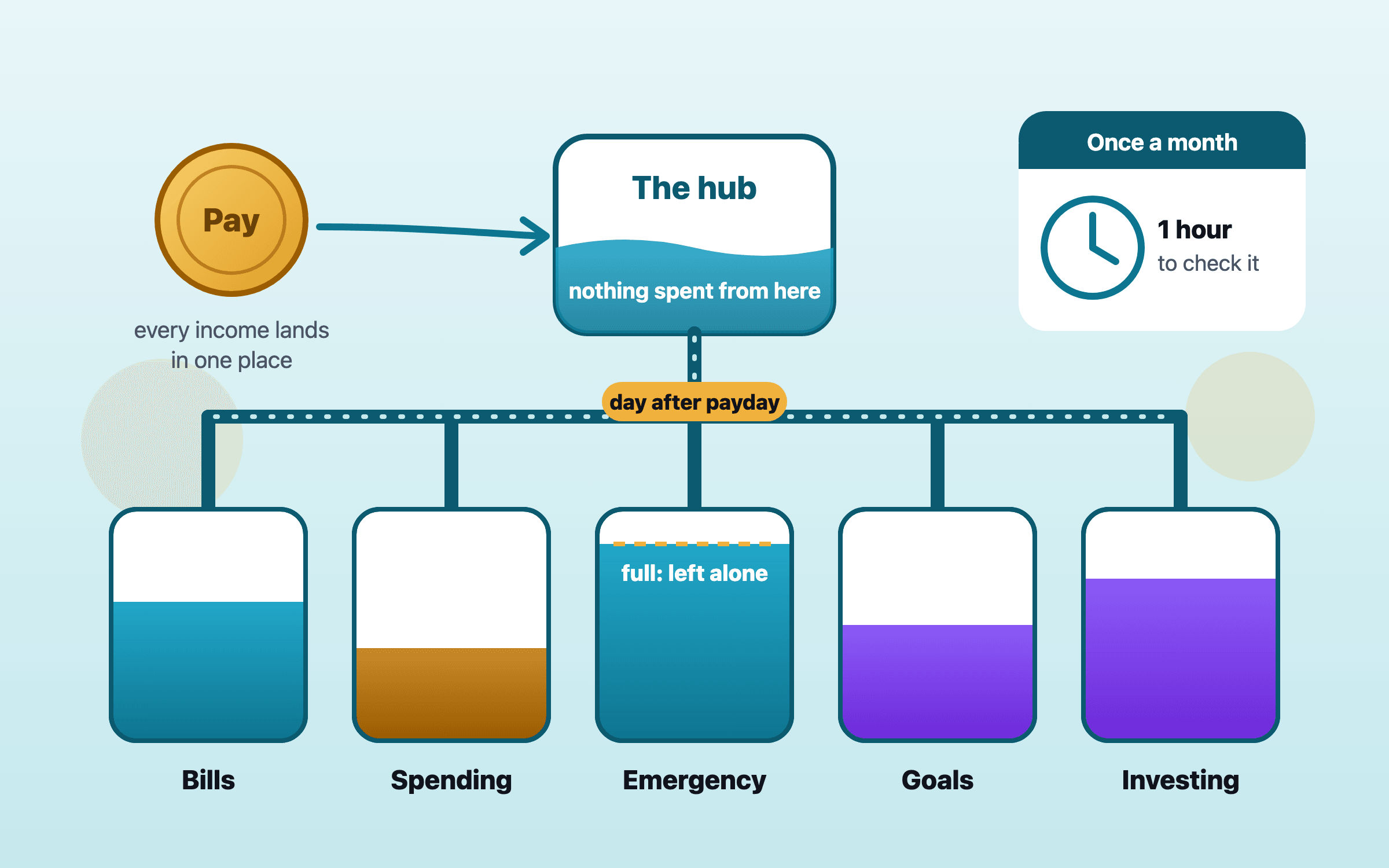
The hub — where every income lands: salaries, rent received, freelance payments. Nothing is spent from it directly. Its only job is to receive and then send.
Bills — rent or mortgage, utilities, insurance, school fees, loan payments, subscriptions. Fixed amounts that leave on known dates. Keep one month of bills in it as a float so a late salary never bounces a payment.
Spending — groceries, transport, eating out, everything variable. A fixed amount arrives each payday; when it is gone, it is gone. In a couple, a shared spending account plus a small personal one each works well.
Emergency fund — instant-access cash, sized in months of essential spending. Topped up automatically until it is full, then left alone. See how big it should be.
Goals — money for dated things a few years out: a car, a deposit, a wedding, the next education payment. Separate pots with names make it harder to raid one for another.
Investing — the long-term money, beyond what any payroll default already sends: a fund bought by monthly instalment (a SIP in India), an ISA or brokerage account, an IRA.
One hub, five destinations, transfers on a schedule. The household’s decisions are made when the system is set up and when it is reviewed, not every month.
Automate payday: pay yourself first
“Pay yourself first” means that saving leaves the hub before spending does, not out of whatever is left at the end of the month. In practice:
Set every transfer for the day after the main salary usually lands, so a late payment delays the transfers rather than bouncing them.
Send the fixed amounts first: bills, then the emergency top-up, goals and investing.
Send spending money last, as a fixed amount — not whatever remains.
Pay every credit card in full by automatic debit, so it is a convenience and never a loan.
Put investing on a standing instruction or a monthly fund purchase, so it happens in good months and bad months alike.
Decide now what happens to the next pay rise: a set share goes straight to investing before the household gets used to having it.
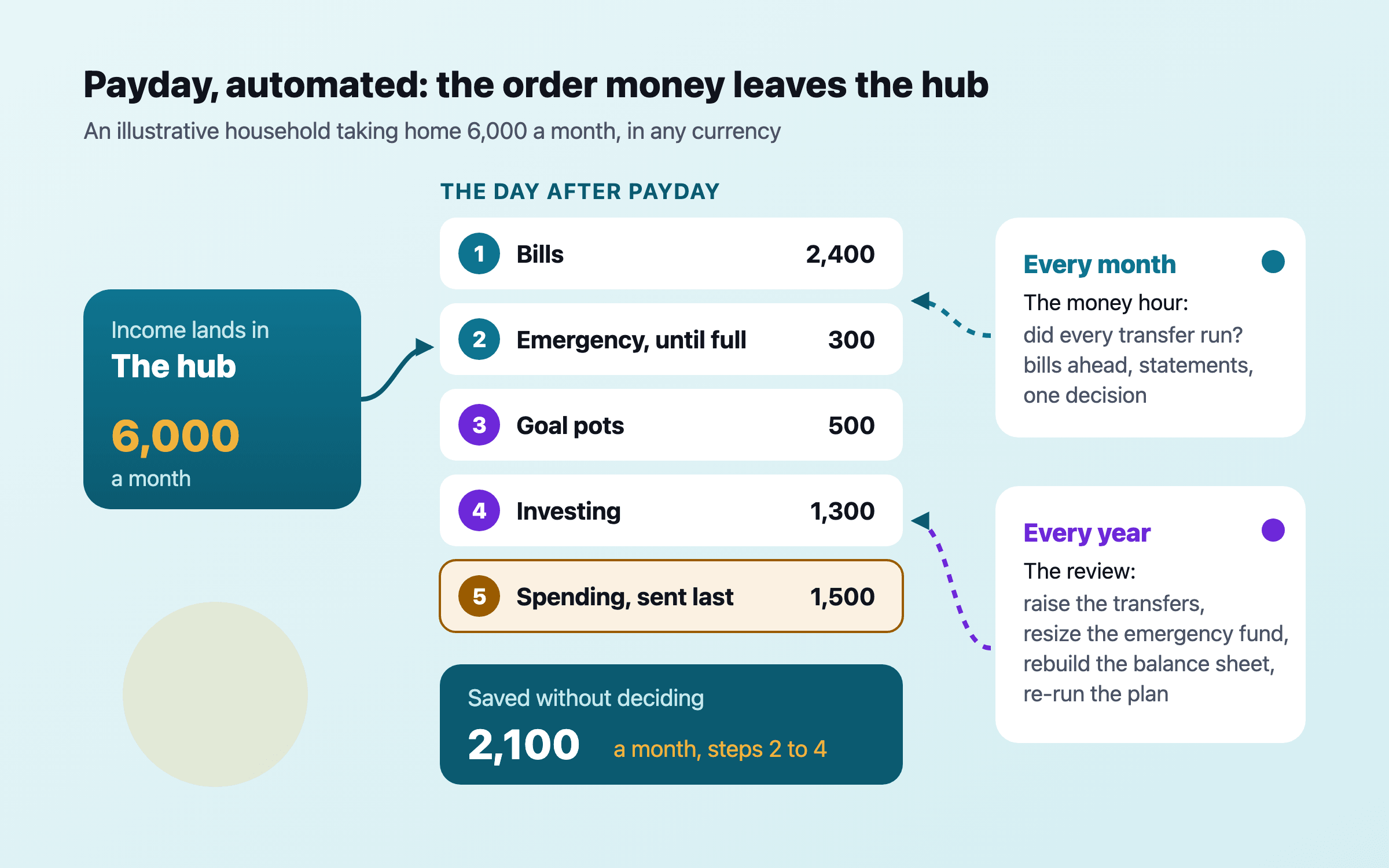
An illustrative household in round numbers takes home 6,000 a month. The day after payday it sends 2,400 to bills, 300 to the emergency fund until it is full, 500 to goal pots and 1,300 to investing, and the last 1,500 to spending. That uses all 6,000. It is saving 2,100 a month — just over a third of take-home pay — and has not decided to save anything since the day it set the transfers up. When its pay rises by 400 a month, half the rise goes to investing, which takes saving to 2,300 while spending still grows.
Two cautions. First, an automated system can also automate mistakes: a subscription nobody uses, a transfer that no longer matches a goal. That is what the monthly hour is for. Second, Nivritee does not move money; the transfers themselves are set up with your bank, broker or employer.
The monthly money hour
Once a month, at the same time — the first weekend after payday is common — spend an hour on the system, not on individual purchases. A checklist keeps it short:
Did every automatic transfer and investment run, for the right amount, on the right day?
Is the bills account holding its float? If it dipped, something cost more than the plan assumed.
Read last month’s spending by category against the amount sent. Note one line to watch, not ten.
Scan card statements for charges you do not recognise and subscriptions you no longer use.
List irregular bills due in the next three months — insurance, school fees, tax, a festival or a wedding — and check the goal pots cover them.
Check the emergency fund is full; if it was used, the top-up transfer restarts.
Update the balance sheet lines that move on their own: balances, fund values, loan principal. Do not trade because of what you see.
Make one decision for the coming month, and write down who will do it.
For a couple this is the natural money date: the same figures in front of both of you, at a time when nothing is going wrong. How couples can talk about money covers how to keep it from becoming an argument.
The annual review
Once a year, take longer, ideally on a fixed date such as the start of the tax year. The monthly hour checks that the system ran; the annual review asks whether it is still the right system.
Raise the transfers for pay rises, inflation and any goal that has moved closer.
Resize the emergency fund for a change in essential spending, a new dependant or less secure work.
Rebuild the balance sheet in full — revalue the home, gold and anything that does not price itself. How to make a family balance sheet shows how.
Check the investments against the mix you chose, rebalance if they have drifted far, and look at what each fund costs.
Review insurance and nominations — life and health cover, beneficiaries and nominees on every account.
Use the year’s tax-advantaged allowances that apply in your country, if you have not already.
Re-run the plan for financial independence with this year’s figures, and change the system if the answer has moved.
When the system needs to change
A system built for one salary breaks quietly when life changes: a second earner, a child, a move abroad, irregular freelance income, a parent who needs support. Irregular income needs a larger hub that pays a steady “salary” to the rest of the system each month. A move between countries needs a hub in each currency and a plan for when money crosses. A new dependant means a bigger emergency fund and a goal pot for their education. None of this needs more willpower — only a redesign, then back to the hour a month.
How Nivritee helps
Questions people ask
How many bank accounts should a family have?
Enough that each kind of money has one place and one rule: an account where income lands, one for bills, one for everyday spending, an emergency fund and pots for goals and investing. Several can be labelled sub-accounts within one bank.
What does pay yourself first mean?
It means saving and investing leave your account on payday, by automatic transfer, before any spending — rather than saving whatever is left at the end of the month.
Does automating savings actually work?
Yes. In Vanguard’s 2024 data, workplace plans that enrolled people automatically had 94% taking part against 64% where people had to sign up.1 Defaults work because most people are passive savers who stay wherever they are put.2
What should I do in a monthly money meeting?
Check that every automatic transfer ran, read last month’s spending against the plan, scan statements for unfamiliar charges and unused subscriptions, look ahead three months for irregular bills, top up the emergency fund if it was used, and make one decision.
What should an annual financial review include?
Raise transfers for pay rises and inflation, resize the emergency fund, rebuild the balance sheet in full, rebalance and check fund costs, review insurance and nominees, use the year’s tax-advantaged allowances, and re-run your plan for financial independence.
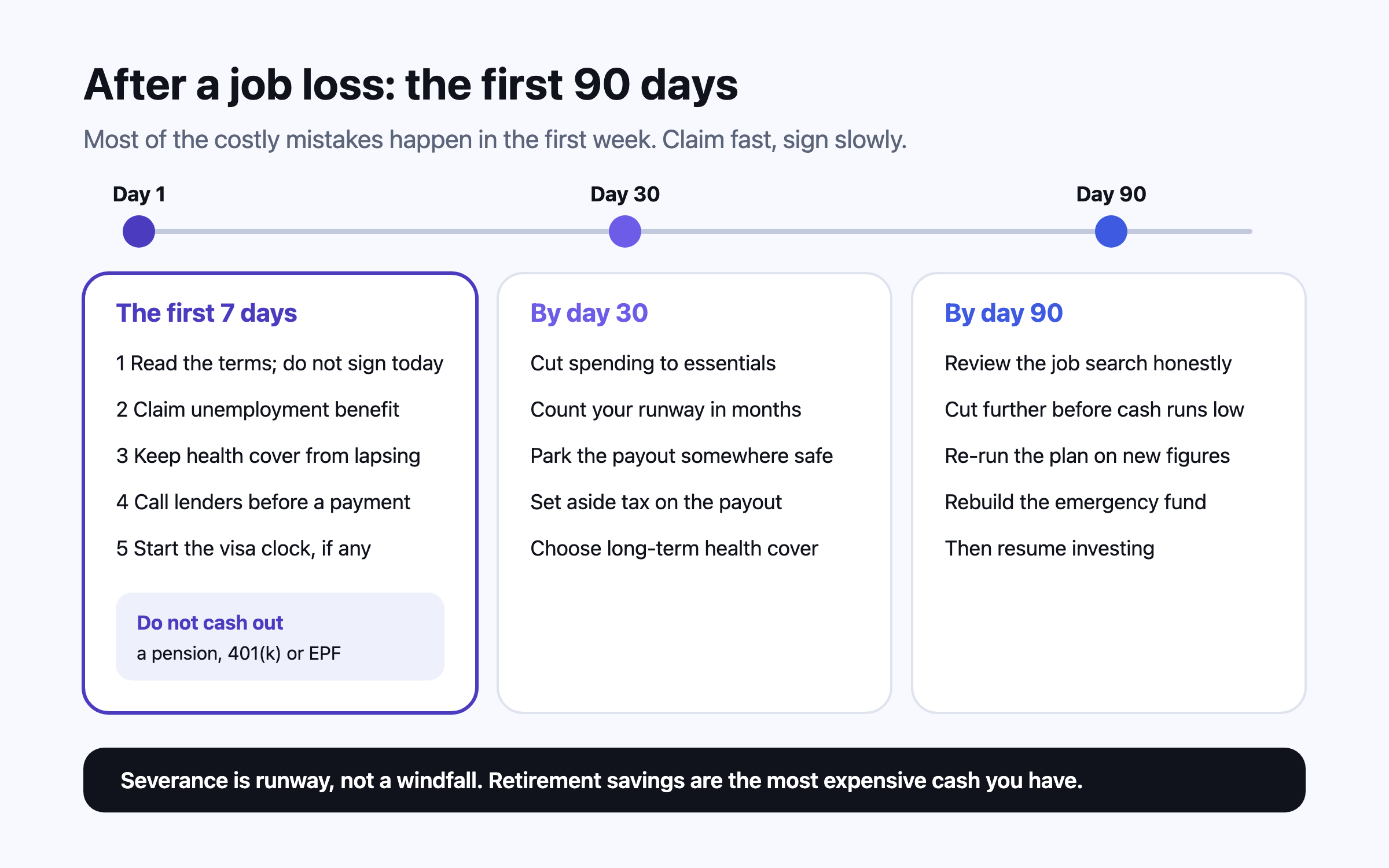
Most of the expensive mistakes after a layoff happen in the first fortnight: signing a severance agreement unread, claiming benefits late, letting health cover lapse, missing a loan payment without calling the lender, and cashing out retirement savings. This is the order to do things in, with the 2026 rules for the US, UK, India, Canada, Australia, Singapore and the UAE.
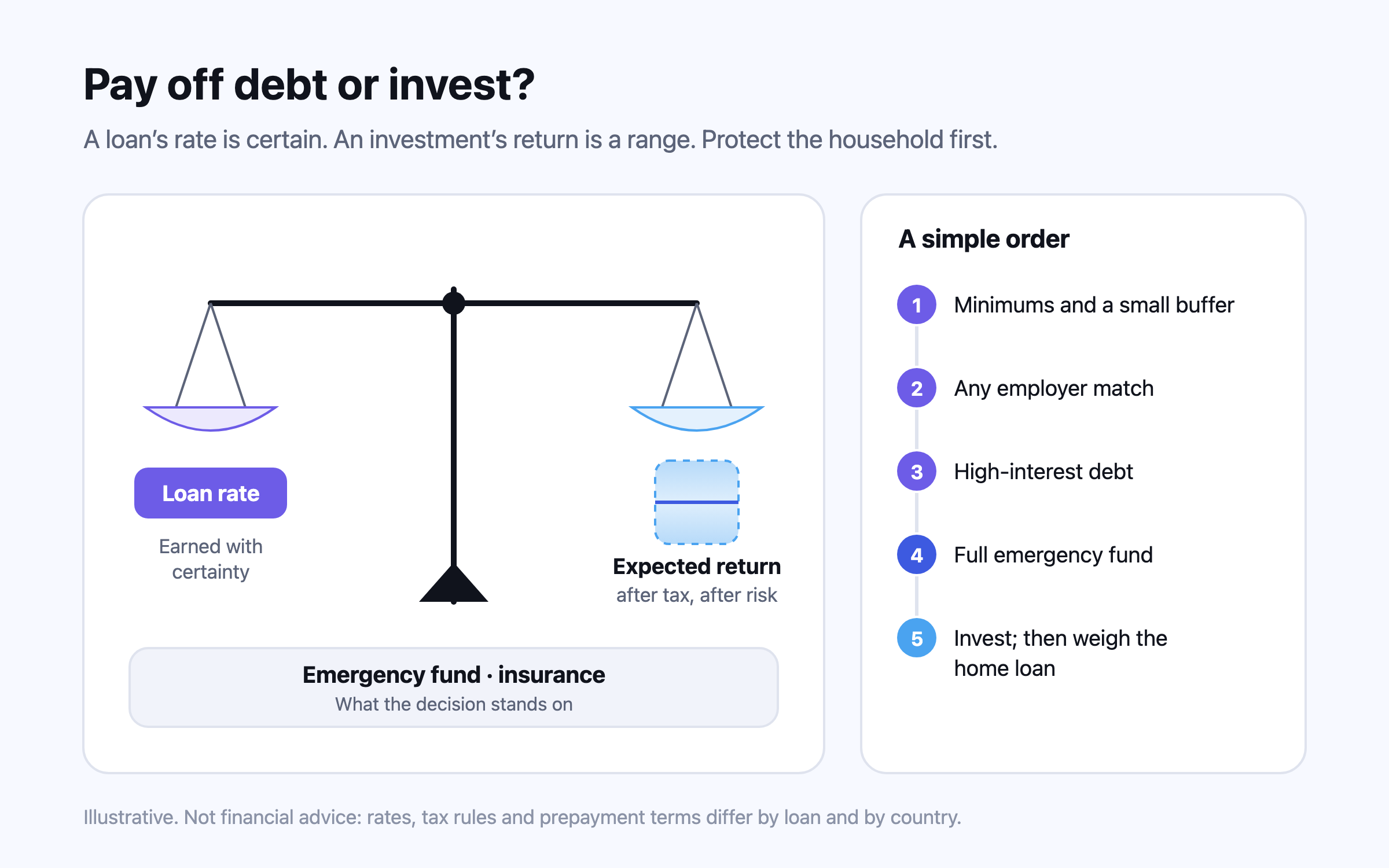
Repaying a loan earns its interest rate with certainty; investing earns an uncertain return, after tax. So costly debt goes first, a low-rate mortgage can sit beside investing, and an emergency fund and the right insurance come before both.
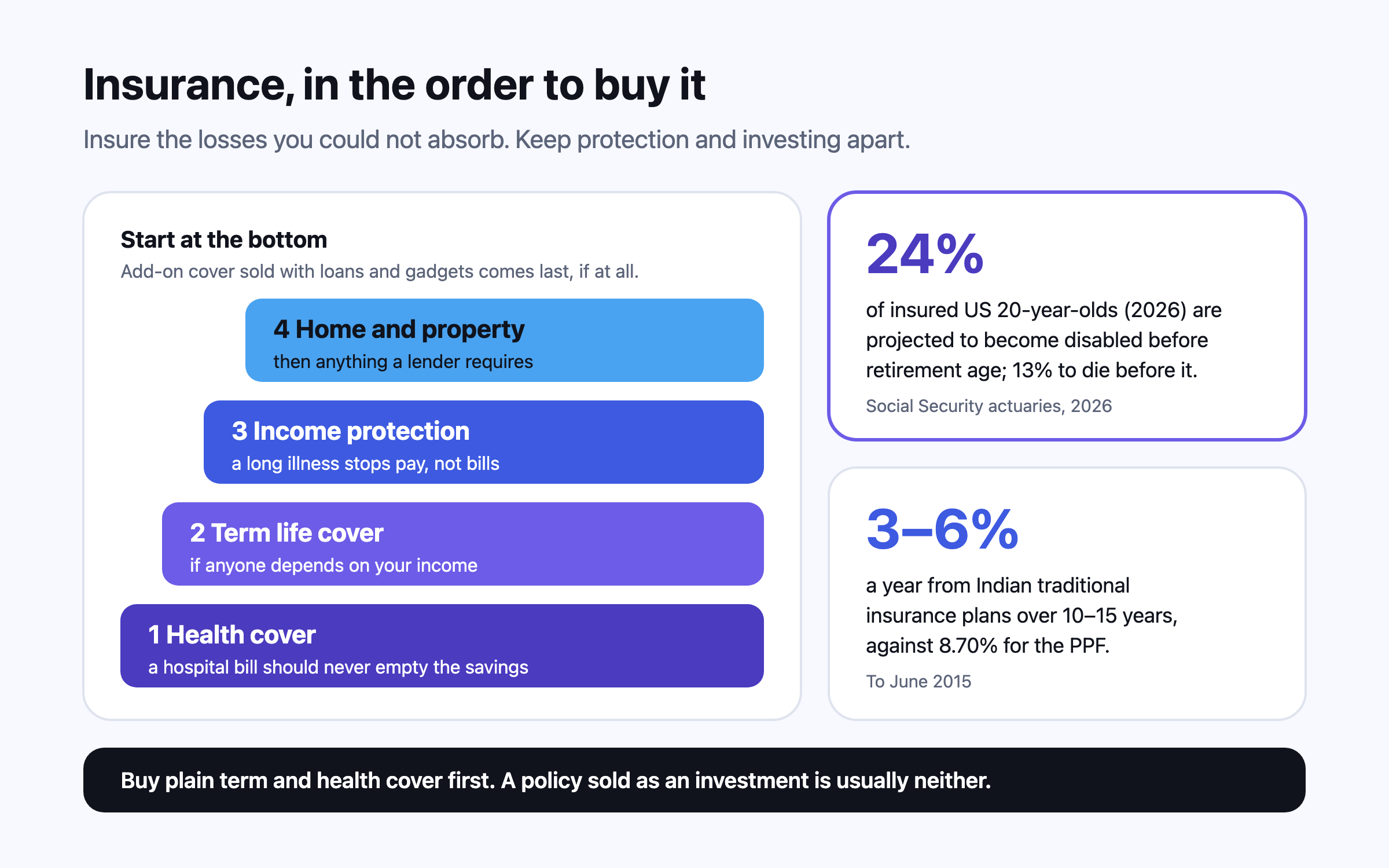
Insurance is for losses a household could not pay for itself: a large medical bill, the death of an earner somebody depends on, or years without income after an illness. Buy cover for those first, in that order, as plain term and health policies; size life cover to what dependants would need rather than to a multiple of salary; and be wary of policies that mix insurance with investment, which in India have returned 3–6% a year over 10 to 15 years.
This is general information, not financial, tax or legal advice for your circumstances. Rules and figures change; check the official source for your country, and consult a licensed professional before making financial decisions. Projections are estimates, not predictions.