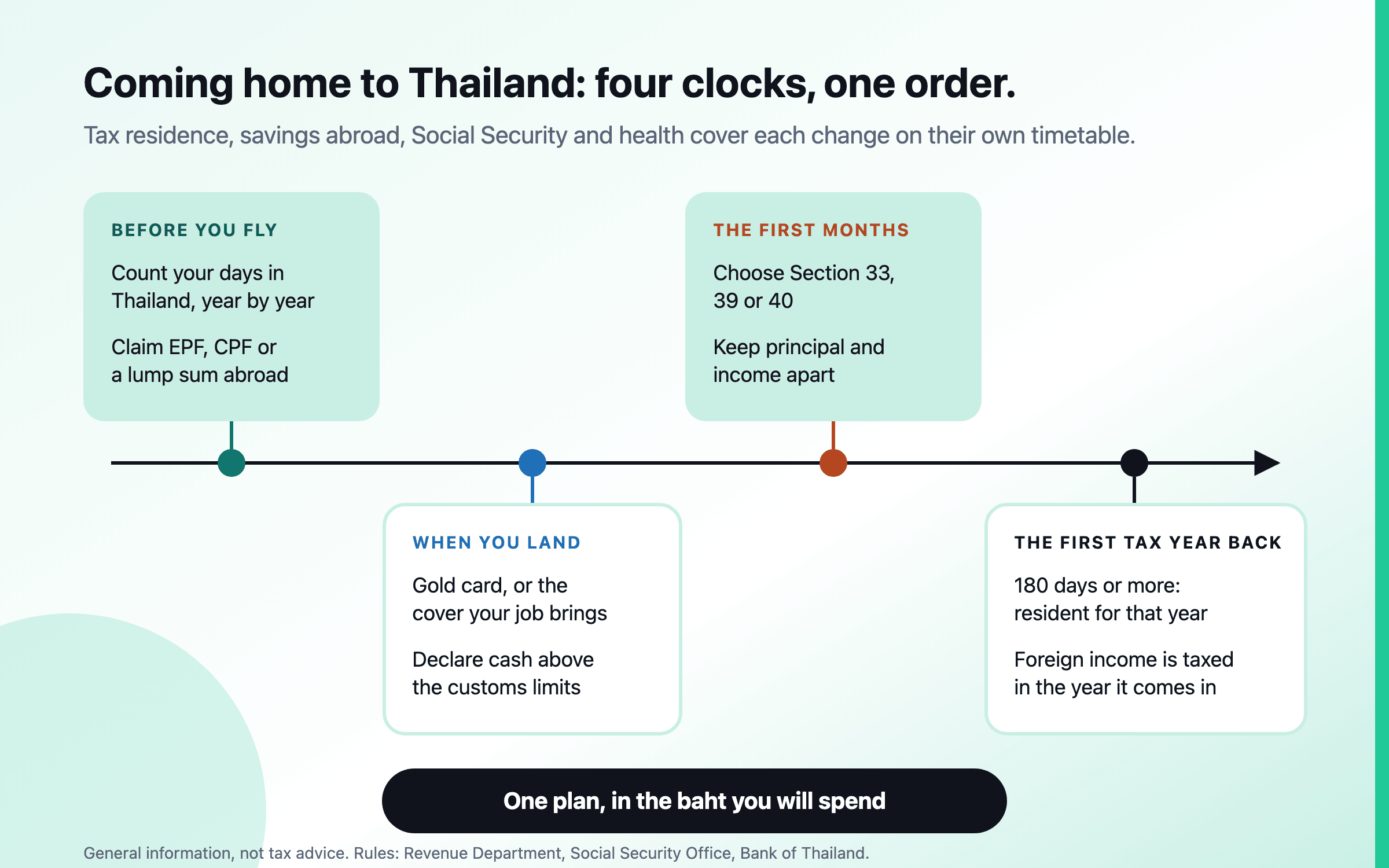
Coming home to Thailand changes your tax residence, your savings abroad, your Social Security and your health cover, each on its own clock
Moving home is several changes on different timetables. Tax residence follows a 180-day count in each calendar year, and since 2024 foreign income you bring in can be taxed, though savings from years you lived abroad are not. Schemes abroad, Thai Social Security and health cover each need their own step. This checklist sets out the rules from official sources; how they apply to you depends on your circumstances.
Nivritee Research · 26 October 2026 · updated 29 October 2026 · 9 min read
Thais work all over the region — in Malaysia and Singapore, in Japan and Taiwan, in the Gulf — and most plan to come home. When they do, the move is a family decision first and a paperwork exercise second, but the paperwork has an order. Tax residence, money held abroad, savings schemes in the country you leave, Thai Social Security and health cover each change on their own timetable, and getting the order wrong can cost tax, benefits or cover. This guide sets out the rule behind each step from official sources. It is general information, not tax advice: rules change, and how they apply depends on your own history, so confirm the tax parts with the Revenue Department or a tax professional.
Your tax residence: the 180-day count
Thailand decides whether you are resident for tax one calendar year at a time, and the test is a day count, not your nationality or your plans. The Revenue Department’s questions and answers on the rule say you are a resident for a year if you are in Thailand for 180 days or more between 1 January and 31 December, whether in one stay or several added together, whatever your nationality1. Each year stands alone: in the Department’s own example, somebody who stays 250 days in a row, 100 of them in one year and 150 in the next, is resident in neither year1.
So the date you land matters. Arrive early in a year and you will probably pass 180 days in it; arrive late and that first year may not count at all. Keep a record of every entry and exit for each year — passport stamps fade, and the count is yours to prove.
Money earned abroad: the 2024 rule
The rule that matters most to a returning Thai is recent. Departmental Order Por. 161/2566, signed on 15 September 2023, says that a resident with income from work, business or property abroad must add it to their taxable income in whichever year they bring it into Thailand, and cancels any earlier ruling or practice that conflicts with it2. It applies to income brought in from 1 January 2024, and Por. 162/2566, signed on 20 November 2023, excludes income that arose before that date2.
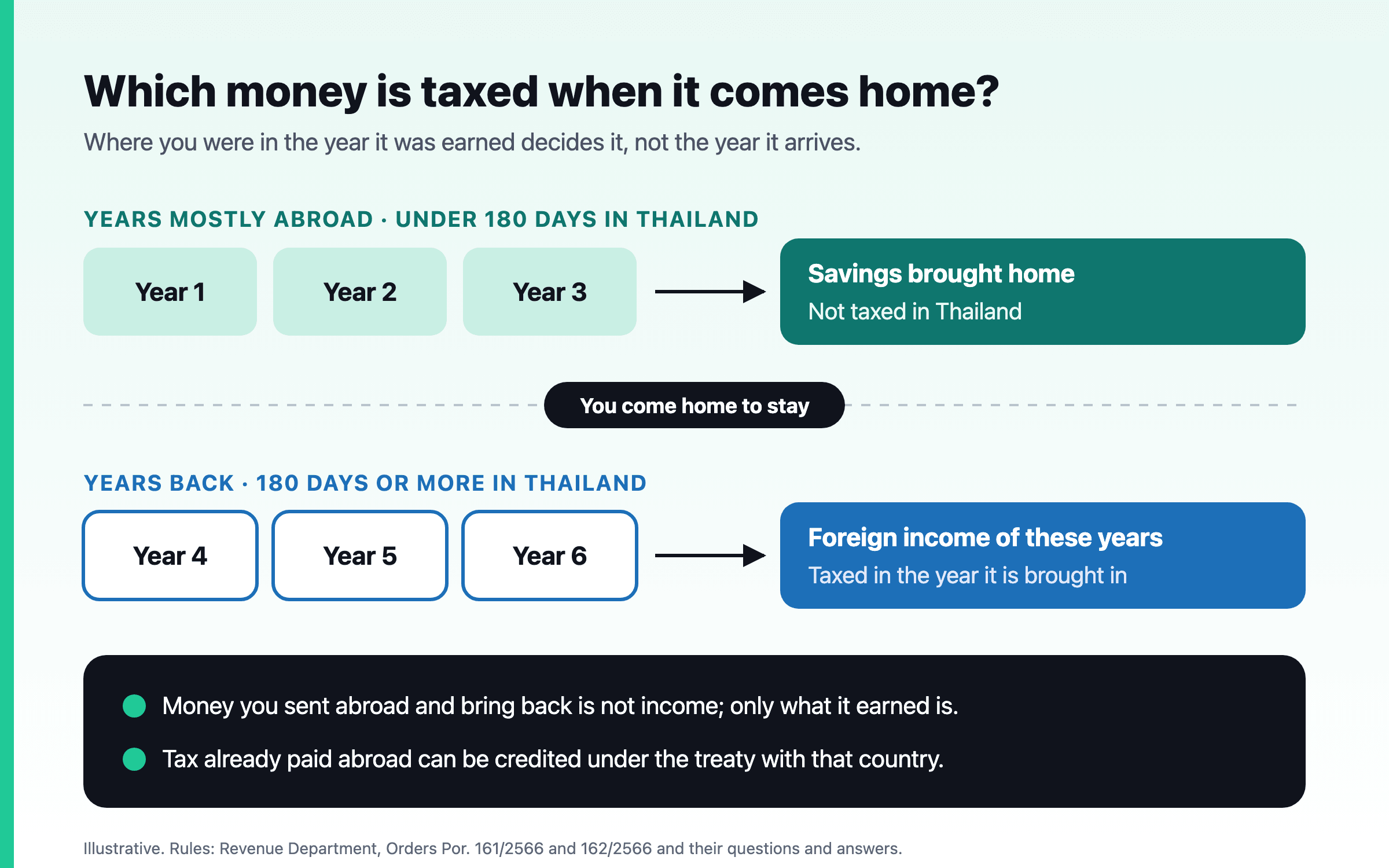
The Department’s questions and answers read the rule as two conditions, both of which must be met before tax is due: the income arose on or after 1 January 2024, in a year in which you were in Thailand for 180 days or more; and you then brought it into Thailand, in that year or any later one1. For somebody who has lived abroad, the second answer that matters most is about savings. The Department’s own example is a Thai national who moved to China in 2007 and came home to stay in 2024, bringing all her savings from her business there: she owes no tax on them, because they came from income earned in years when she was not resident in Thailand1.
Illustrative: the two conditions in the Revenue Department’s questions and answers. What decides it is where you were in the year the money was earned, not the year it arrives.
Principal is not income. Money you sent abroad and bring back is not income; only what it earned is. Interest on a foreign deposit counts, and only the interest1.
Bringing it in means any route — a bank transfer, an online transfer, or carrying it with you1.
The exchange rate is the one on the day the income is brought into Thailand1.
You decide which part is which. Where a transfer mixes principal and earnings, the Department expects the taxpayer to assess it from the facts — so keep statements that show what you sent, what it earned and when1.
Tax paid abroad can be credited. A resident can credit foreign tax against the Thai tax on the same income under the double tax agreement with that country1. The Department’s leaflet on foreign income — written for foreigners living in Thailand, under the same section of the Revenue Code — says the credit cannot exceed the Thai tax on that income, recommends a tax payment certificate from the foreign authority as evidence, and asks for documents in English or Thai3.
Savings schemes in the country you leave
Most countries Thais work in run a compulsory savings or pension scheme, and each has its own rule for a member who leaves for good. Find out before your last day at work, because several of them need a document from your employer or the immigration authorities, or a claim made within a deadline.
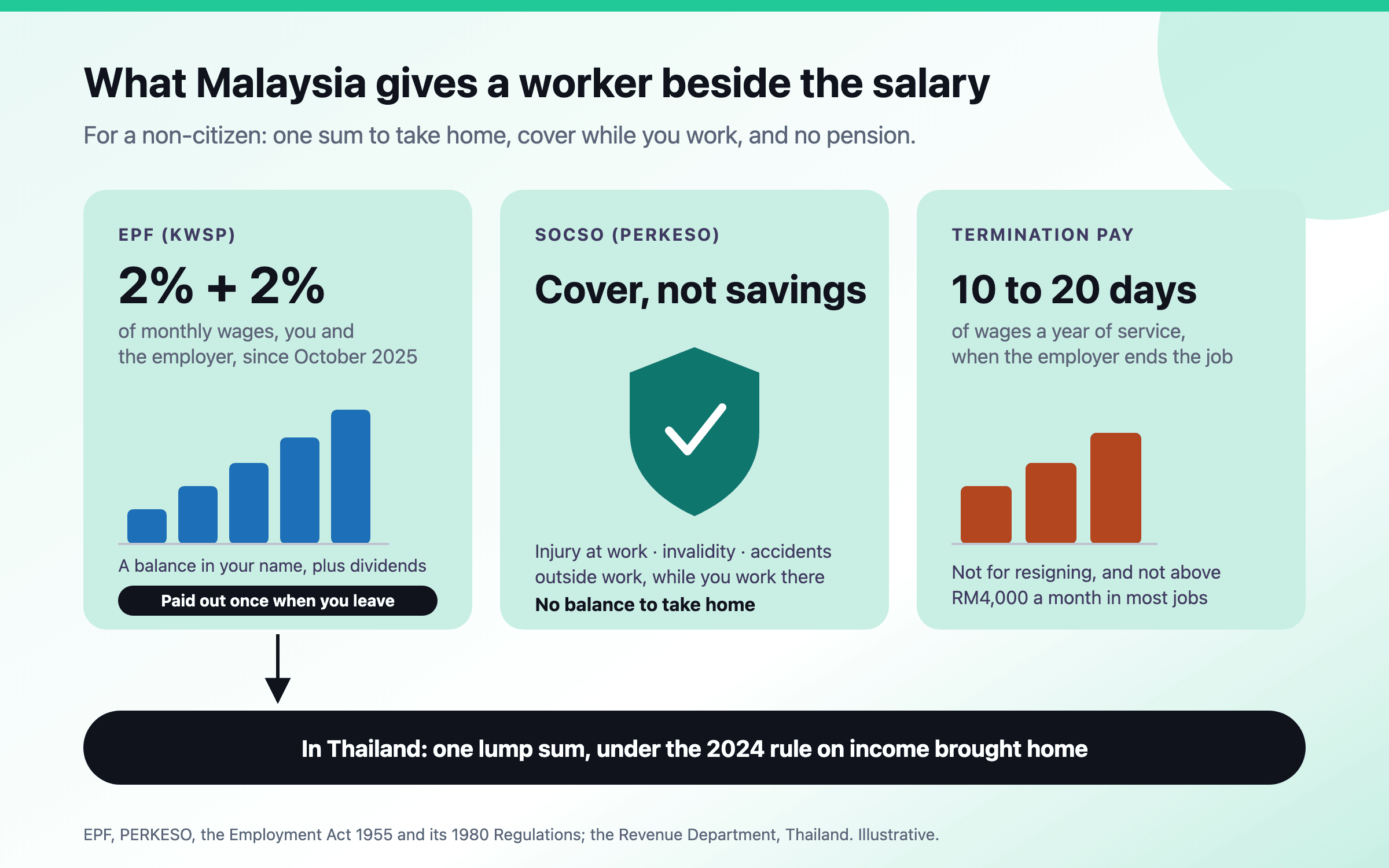
Malaysia (EPF, or KWSP). The EPF’s Leaving the Country Withdrawal lets a non-Malaysian member who is no longer employed in Malaysia, or is leaving it, withdraw their savings; once the payment is made the account is closed4.
Singapore (CPF). CPF contributions are payable for Singapore citizens and permanent residents5, so the scheme matters to a Thai who became a permanent resident. A Thai who became a permanent resident and later gives that up must close the account: from 1 April 2024 you can close it and transfer the savings once the renunciation is complete, and otherwise it is closed automatically the following month. What remains stops earning CPF interest, and membership of schemes such as CPF LIFE and MediShield Life ends6.
Japan (the national pension systems). A member who is not a Japanese national, has contributed for at least six months and no longer has an address in Japan can claim the Lump-sum Withdrawal Payment, within two years of leaving7,8. For a member whose last month of contributions was April 2021 or later, the months counted in the payment are capped at 60, up from 368.
The Gulf. An end-of-service gratuity is usually paid as one sum when you leave. Our guide to Gulf gratuity and pensions explains how it is calculated and how to plan around it.
A payout that arrives after you are resident again raises the 2024 rule’s question: was it income of a year in which you were resident, and when did you bring it in? The answer depends on when it arose and what it is, so ask before you transfer it rather than after. Our Help Centre explains what happens to a pension when you move countries.
Thai Social Security when you come back
Which part of Social Security you join on return depends on what you do next. A job with a Thai employer puts you in Section 33, the scheme for employees. If you are not employed, there are two voluntary routes, and they are not open to the same people.
Section 39 is for people who have paid into Section 33 for at least 12 months and apply within six months of leaving that job. Everybody contributes 9% of a fixed wage base of ฿4,800, or ฿432 a month, for cover in six cases: sickness, maternity, disability, death, child support and old age. Membership ends if you miss three months in a row, or pay fewer than nine months in any twelve9. If you left a Thai job years ago, the six-month window has usually long closed.
Section 40 is for Thai nationals aged 15 to 65 who are not insured under Section 33 or 39. You choose one of three options: ฿70 a month for three cases (injury or sickness, disability and death), ฿100 for four (adding old age), or ฿300 for five (adding child support), and the government adds up to half as much again as you pay10.
What each voluntary route into Thai Social Security costs a month, in baht.
What the insured person pays, as published by the Social Security Office. Section 39 covers six cases and the three Section 40 options three, four and five; the government’s share under Section 40 is not included. 9,10The figures in this chart
Your contribution a month, baht
Section 39
฿432
Section 40, option 1
฿70
Section 40, option 2
฿100
Section 40, option 3
฿300
Over a year that is ฿5,184 under Section 39, against ฿840, ฿1,200 or ฿3,600 for the three Section 40 options9,10. The cheaper routes cover less, so compare what each one pays out, not only what it costs.
If your new employer runs a provident fund, joining it is part of the job’s terms. The Revenue Department’s filing guide for the 2025 tax year lets a member’s own contributions reduce taxable income, up to 15% of wages and within a ฿500,000 limit shared with other retirement savings such as retirement mutual funds11.
Health cover from the day you land
Cover from an employer abroad usually ends with the job, so decide what replaces it before you fly. Thailand’s Universal Coverage Scheme — the gold card — is the state cover for people outside the other schemes. The National Health Security Office’s guidance, as relayed by the Public Relations Department, names among those entitled the self-employed who are not Social Security members and former members who stopped paying contributions, and says the Office registers people on their behalf in some cases where Social Security or civil service medical cover ends12. To register yourself you need your national ID card, and a certificate of residence if you live somewhere other than the address on it12. Whenever one kind of cover ends and another begins, check which scheme you are registered under before you need a hospital, not at the admissions desk.
State cover is a floor, not the whole answer. If you want a private policy, compare its waiting periods and exclusions for conditions you already have, and buy it early enough that those clocks start before you need it.
Bringing money home
The Bank of Thailand’s exchange rules allow foreign banknotes to be brought in without a limit, but amounts over USD 15,000, or Thai baht over ฿450,000, must be declared to customs when you arrive13. Anyone who receives USD 1 million or more from abroad must bring it into Thailand and sell it to a bank, or deposit it in a foreign currency account, within 360 days13. Residents can keep a foreign currency deposit account at a Thai bank and pay in money received from abroad without limit, so savings can arrive in dollars or ringgit and be changed into baht when you choose13.
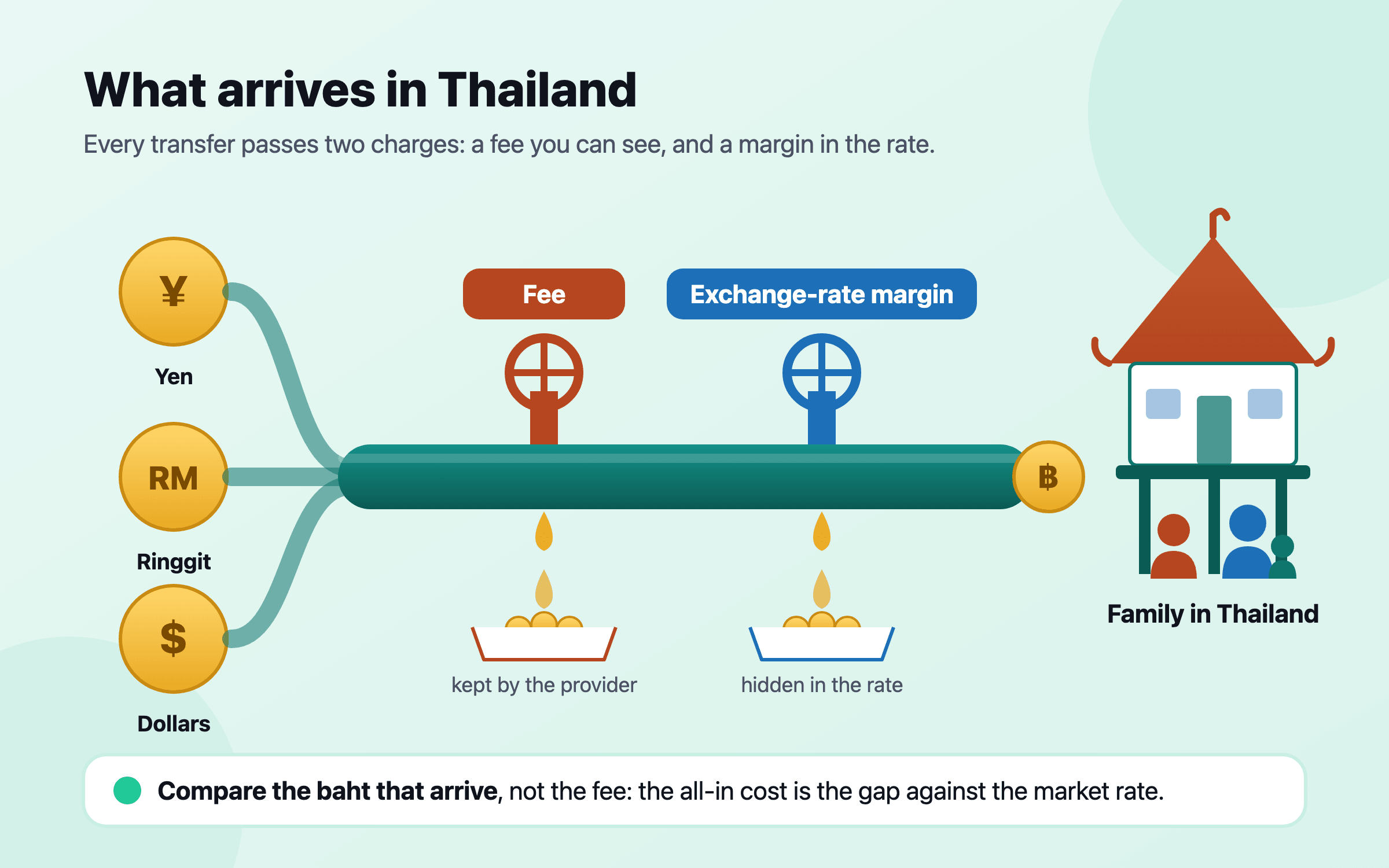
Two things are worth doing before the money moves. Keep the paper trail that shows where it came from and when it was earned, because that is what the 2024 rule turns on1. And compare transfers on what arrives, not on the fee: our report on what sending money home costs shows how the exchange-rate margin can cost more than the fee.
What changes in your plan
Converting today’s spending at today’s exchange rate is the most common planning mistake. Rent, schooling and healthcare cost different amounts in Chiang Mai than in Kuala Lumpur or Tokyo, and they rise at different speeds once you are there. Nivritee’s Thailand defaults project general prices at 2.0% a year — the midpoint of the Bank of Thailand’s 1–3% target — school fees at 1.31% and medical costs at 10.8%14. Over fifteen years at those rates, a cost of ฿100,000 today grows to about ฿134,587, ฿121,558 and ฿465,689 respectively14.
What ฿100,000 of today’s costs becomes in fifteen years at Nivritee’s Thailand defaults.
Each bar compounds ฿100,000 for fifteen years at Nivritee’s default rate for Thailand. Arithmetic on assumptions, not a forecast: medical costs are the one line that more than quadruples. 14The figures in this chart
Cost in fifteen years, baht
General prices (2.0%)
฿134,587
School fees (1.31%)
฿121,558
Medical costs (10.8%)
฿465,689
Write down what each line will cost after the move rather than converting what it costs now: rent that stops or starts, school fees in a Thai or international school, health cover you will now arrange yourself, and the support for parents that a family home often brings. Then add what you will still hold abroad — an EPF balance you keep, a brokerage account, a foreign deposit — in its own currency, so that a move in the ringgit or the yen shows up as what it is.
Count your days in Thailand for each year you plan around, and choose your return date with the 180-day line in mind.
Gather payslips, tax certificates and statements from abroad, in English or Thai, before you leave the country that issued them.
Settle each scheme abroad: the EPF, CPF, Japan’s lump sum or a Gulf gratuity, each by its own deadline.
Decide your Social Security route, and register for the gold card or private cover before the old cover ends.
Move money through a route you have priced, and keep the records of what is principal and what is income.
Questions people ask
How many days make me a Thai tax resident?
180 days or more in Thailand within one calendar year, in one stay or several added together, whatever your nationality. Each year is counted on its own1.
Do I pay Thai tax on savings I bring home after working abroad?
Not on savings built from income earned in years when you were in Thailand for fewer than 180 days, according to the Revenue Department’s questions and answers. Foreign income earned from 2024 in a year you were resident is taxed in the year you bring it in, with a credit for tax paid abroad under a treaty1.
What did Por. 161/2566 and Por. 162/2566 change?
Por. 161/2566 requires a resident to add foreign income to taxable income in whichever year it is brought into Thailand, for income brought in from 1 January 2024; Por. 162/2566 excludes income that arose before that date2.
Can I withdraw my EPF when I leave Malaysia?
A non-Malaysian member who is no longer employed in Malaysia, or is leaving, can apply for the EPF’s Leaving the Country Withdrawal; the account is closed once it is paid4.
Can I join Social Security Section 39 after coming back to Thailand?
Only if you paid into Section 33 for at least 12 months and apply within six months of leaving that job. Otherwise Section 40 is open to Thai nationals aged 15 to 65 who are not insured under Section 33 or 399,10.
Sending the equivalent of $200 to Thailand cost 5.82% on average in the third quarter of 2025, down from 9.17% in 2017 and now below the world average of 6.36%. The seven corridors the World Bank prices run from 4.20% from Australia to 8.33% from Japan, while the three cheapest services in each cost between 1.31% and 4.68%. Compare the baht that arrive, not the fee.
Since October 2025 every non-citizen employee in Malaysia pays 2% of wages into the EPF and the employer adds 2%, and the whole balance can be withdrawn on leaving the country for good. SOCSO covers injury and invalidity while you work but builds no balance, and the statutory termination benefit does not reach most professionals. What arrives in Thailand is a lump sum that Thailand’s 2024 rule on foreign income may tax.
Coming home is several changes on different timetables. Your tax status follows day counts under the Income-tax Act, your bank accounts follow RBI rules under FEMA, and your investments, insurance and living costs each need their own step. This checklist explains each one in plain terms, with official sources — confirm the tax parts with a chartered accountant.
This is general information, not financial, tax or legal advice for your circumstances. Rules and figures change; check the official source for your country, and consult a licensed professional before making financial decisions. Projections are estimates, not predictions.