Sending money to Thailand costs less than it did, yet on every route the cheapest services charge a fraction of the average quote.
Sending the equivalent of $200 to Thailand cost 5.82% on average in the third quarter of 2025, down from 9.17% in 2017 and now below the world average of 6.36%. The seven corridors the World Bank prices run from 4.20% from Australia to 8.33% from Japan, while the three cheapest services in each cost between 1.31% and 4.68%. Compare the baht that arrive, not the fee.
Nivritee Research · 28 October 2026 · updated 29 October 2026 · 6 min read
For many Thai families, part of the money that pays for school fees, a parent’s medicines or a house being built is earned abroad and sent home. Thailand received $11.9 billion in personal remittances in 2025, about twice the $5.9 billion of 20151, and equal to about 2.1% of the economy2. The World Bank prices those transfers in its Remittance Prices Worldwide survey, by mystery shopping the services that send the equivalent of $200 along each route3. This article sets out what the routes into Thailand cost, what that price is made of, and the Thai rules that apply once the money lands.
What a transfer to Thailand costs
The World Bank’s measure is the total cost of a transfer: the fee charged to the sender plus the margin by which the exchange rate applied sits above the interbank rate, as a share of the amount sent3. On that measure, sending $200 to Thailand cost 5.82% on average in the third quarter of 20254. It was 9.17% in 2017 and has fallen in every year since4. The world average in the same quarter was 6.36%, so a transfer to Thailand now costs a little less than the typical one; as late as 2023 it cost a little more, 6.26% against 6.18%4.
The average cost of sending $200 to Thailand has fallen every year since 2017, and is now below the world average.
To Thailand, % of the amount sent
World average, % of the amount sent
SDG target for 2030, %
Each point is the third quarter of the year: the average total cost (fee plus exchange-rate margin) of every transparent service the World Bank priced for sending the equivalent of $200. The flat line is the 2030 target, not a price. 4,3The figures in this chart
To Thailand, % of the amount sent
World average, % of the amount sent
SDG target for 2030, %
2017
9.17%
7.21%
3.00%
2018
8.29%
6.94%
3.00%
2019
7.88%
6.85%
3.00%
2020
7.70%
6.75%
3.00%
2021
7.35%
6.30%
3.00%
2022
6.54%
6.30%
3.00%
2023
6.26%
6.18%
3.00%
2024
6.16%
6.62%
3.00%
2025
5.82%
6.36%
3.00%
The world’s target is lower still. Sustainable Development Goal 10.c aims, by 2030, to bring the cost of migrant remittances below 3% and to eliminate corridors costing more than 5%3. The World Bank reads the second half as a test of what a well-informed sender can find: a corridor passes when the three cheapest qualifying services average 5% or less3.
Seven routes into Thailand
The World Bank’s public series prices seven corridors into Thailand: from Australia, Germany, Japan, Malaysia, Singapore, the United Kingdom and the United States4. Routes from other countries, such as Taiwan or South Korea, are not priced. In the third quarter of 2025 the average quote ran from 4.20% from Australia, 4.49% from Singapore and 4.67% from Malaysia, through 5.03% from the UK and 6.65% from Germany, to 7.47% from the US and 8.33% from Japan4. Four of the seven averages sit above the 5% line.
The average cost of sending $200 to Thailand from seven countries, against the three cheapest services in each, Q3 2025.
Average of all services, %
Average of the three cheapest, %
Both figures are for the equivalent of $200 sent in the July to September 2025 collection, fee plus exchange-rate margin. “The three cheapest” is the World Bank’s SmaRT measure: services that disclose their rate, arrive within five days and are open to an ordinary sender. 4,3The figures in this chart
Average of all services, %
Average of the three cheapest, %
Australia
4.20%
1.53%
Singapore
4.49%
1.31%
Malaysia
4.67%
2.64%
United Kingdom
5.03%
2.83%
Germany
6.65%
2.51%
United States
7.47%
1.34%
Japan
8.33%
4.68%
The second bar in each pair is the one that matters to a sender. The World Bank’s SmaRT figure averages the three cheapest services in a corridor that disclose their exchange rate, arrive within five days and are within an ordinary sender’s reach3. Into Thailand it was below 5% on every route: 1.31% from Singapore, 1.34% from the US, 1.53% from Australia, 2.51% from Germany, 2.64% from Malaysia, 2.83% from the UK and 4.68% from Japan4. From the US, the gap is widest. On $200, the average quote costs about $14.94 and the cheapest three about $2.684. The price that meets the target already exists on every route; it is simply not what the average transfer pays.
Japan is the route to watch. It is the dearest on average, and its cheapest services became dearer: the three cheapest averaged 2.36% in 2023 and 4.68% in 20254. Singapore’s low figures sit beside a newer rail. Since 29 April 2021 Thailand’s PromptPay and Singapore’s PayNow have been linked, so customers of participating banks can send up to S$1,000 or ฿25,000 a day using a mobile number, completed within minutes rather than the one to two working days of most cross-border services; those were the terms at launch5. The participating banks undertook to show the fee and the exchange rate before a sender confirms5.
Money leaving Thailand costs more than money arriving. Sending $200 from Thailand cost 11.58% on average in the same quarter, with 9.87% to Cambodia, 11.49% to Laos and 10.38% to Myanmar4. Households that both receive money from a child abroad and send support to relatives across a border pay two very different prices.
The fee is only part of the price
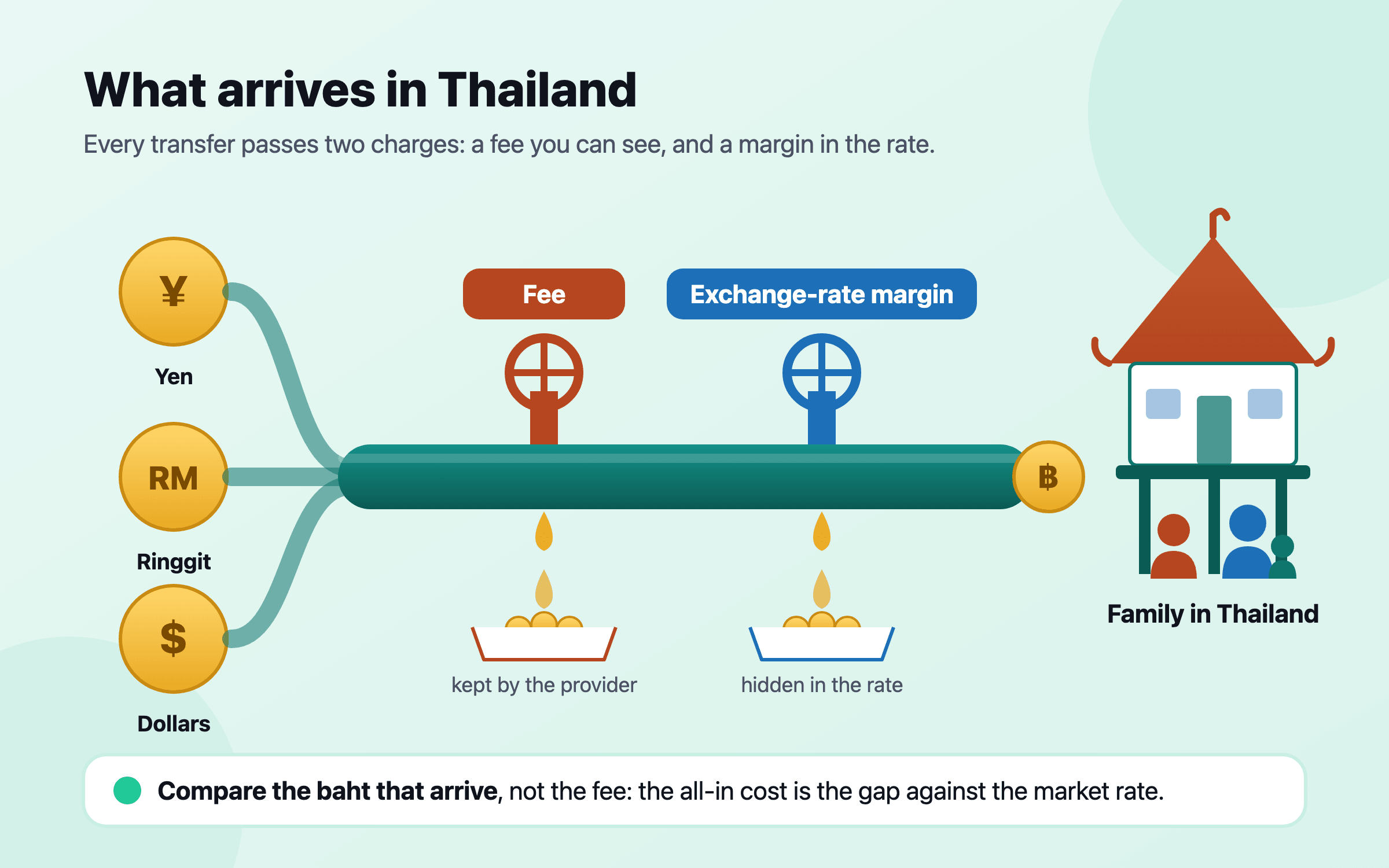
Every transfer has two charges. The fee is printed on the screen. The exchange-rate margin is the gap between the market rate and the rate the provider actually applies, and you see it only if you check. The World Bank counts both, and a service that does not tell a sender its rate is treated as not transparent and left out of its averages3.
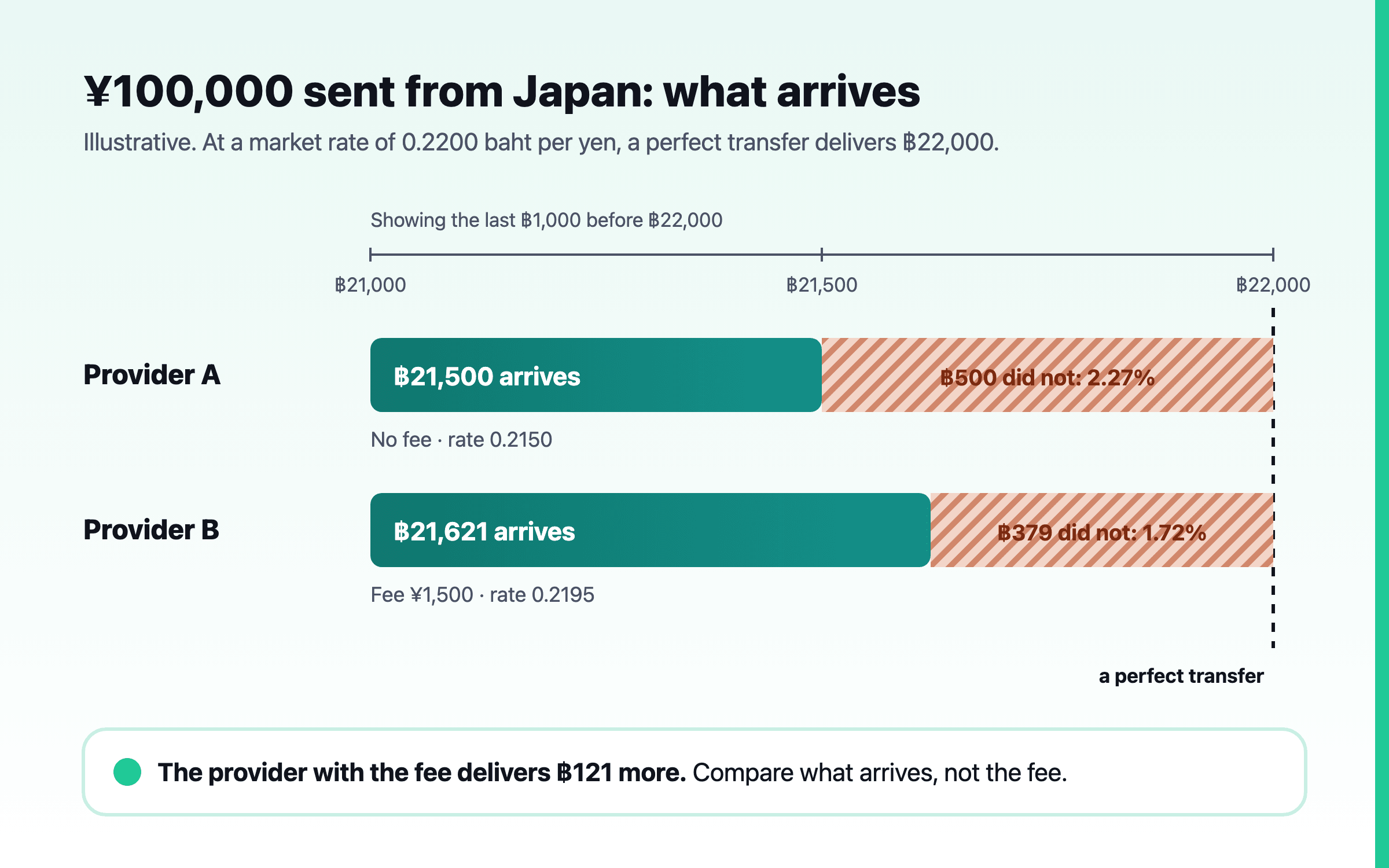
Illustrative: the same yen, two providers. The all-in cost is what did not arrive, measured against the market rate, whatever the provider calls its charges.
This is why “no fee” and “zero commission” say nothing about the price. A provider can charge nothing up front and take its whole price in the rate. The only number that settles it is how many baht arrive.
How to compare a transfer: the all-in cost
Note the market rate. Look up the rate for your two currencies at the moment you compare; a central bank’s published rate or a market data page will do.
Ask each provider what arrives. Enter the exact amount you will send and write down how many baht land in the account in Thailand after every charge.
Work out the all-in cost. Multiply the amount sent by the market rate to get what a perfect transfer would deliver. The shortfall between that and what arrives, as a share of it, is the all-in cost.
Ask about the Thai end. The World Bank’s total counts the sender’s fee and the margin, not what the receiving side may deduct3. Ask the bank in Thailand what it charges to credit a transfer from abroad.
Check speed and recourse. Note how long the transfer takes and how to cancel or complain before you send, not after.
Size, frequency and timing
Where part of the price is a flat fee, the same money sent in fewer, larger transfers costs less, because the fee is paid fewer times while the margin stays a share of the whole3. Take an illustrative provider charging a flat ¥1,500 plus a 0.6% margin, and a household sending ¥120,000 a month. Sent as four transfers of ¥30,000, the month costs ¥6,720, or 5.60%. Sent once, it costs ¥2,220, or 1.85%. Over a year that is ¥54,000 kept by the family rather than the provider.
There are limits to this. Support that has to arrive weekly should arrive weekly, and money waiting abroad for a larger transfer is exposed to the exchange rate for longer. Timing the rate is a different matter: nobody knows which way the baht will move next week, and a household that waits for a better rate is making a currency bet with its grocery money. A fixed schedule, sized to what the family needs, is easier to live with. Our article on a weaker dollar and global families shows how far exchange rates can move over a few years.
Thai rules when the money lands
Thailand does not cap what comes in. Under the Bank of Thailand’s exchange rules, foreign currency or baht can be brought into the country without limit, and a resident may deposit foreign currency received from abroad in a foreign currency deposit (FCD) account at an authorised bank, also without limit6. The rule that requires large receipts from abroad to be brought into Thailand and sold or deposited now applies only to USD 10 million or more per transaction, raised from USD 1 million in a change published in the Royal Gazette on 19 January 20267. In the same statement the Bank said it had tightened its oversight of incoming foreign-currency transactions, calling for documents on every one of USD 200,000 or more7.
Tax is a separate question from exchange control. The Revenue Department’s Order Paw. 161/2566, in force for income brought into Thailand from 1 January 2024, says that a Thai resident with income from work done or assets held abroad must add it to their taxable income in the tax year it is brought into Thailand, whichever year that is8. An amendment, Paw. 162/2566, excludes income that arose before 1 January 20248. Under section 41 of the Revenue Code, a resident is a person who stays in Thailand for 180 days or more in a tax year9. How the order applies to a particular household’s transfers is a question for the Revenue Department.
Support and savings are different money
Money sent home usually does two jobs. Part of it supports parents or other family, and that is spending, as real as rent. Part of it is saving, held in baht in a deposit or a fund in Thailand. Mixing them up hides both: the support never appears in the household’s budget, and the savings never appear beside the money still held abroad.
The savings half raises its own question: which currency will you finally spend in? That decides whether baht savings are a match or a risk, and it is the subject of our article on home bias and currency risk. Families sending money to India face the same arithmetic on different routes, set out in what sending money home really costs.
Questions people ask
How much does it cost to send money to Thailand?
The World Bank’s average cost of sending the equivalent of $200 to Thailand was 5.82% of the amount sent in the third quarter of 2025, below the world average of 6.36%4.
Which route into Thailand is cheapest?
Of the seven corridors the World Bank prices, the average quote was lowest from Australia, at 4.20%, and the three cheapest services averaged least from Singapore, at 1.31%4. Within any route, compare the baht that arrive rather than the fee.
What is an exchange rate margin?
It is the gap between the market rate and the rate a provider applies to your transfer, as a share of the amount. The World Bank adds it to the fee to get the total cost3.
Is there a limit on money sent to Thailand?
No. The Bank of Thailand allows foreign currency or baht to be brought in without limit6. Receipts of USD 10 million or more per transaction must be brought into Thailand and sold or deposited, a threshold raised from USD 1 million in January 20267.
Is money brought into Thailand from abroad taxed?
Under Revenue Department Order Paw. 161/2566, a Thai resident’s income from work or assets abroad is added to taxable income in the year it is brought into Thailand, for income arising from 1 January 20248. A resident is someone in Thailand for 180 days or more in the tax year9.
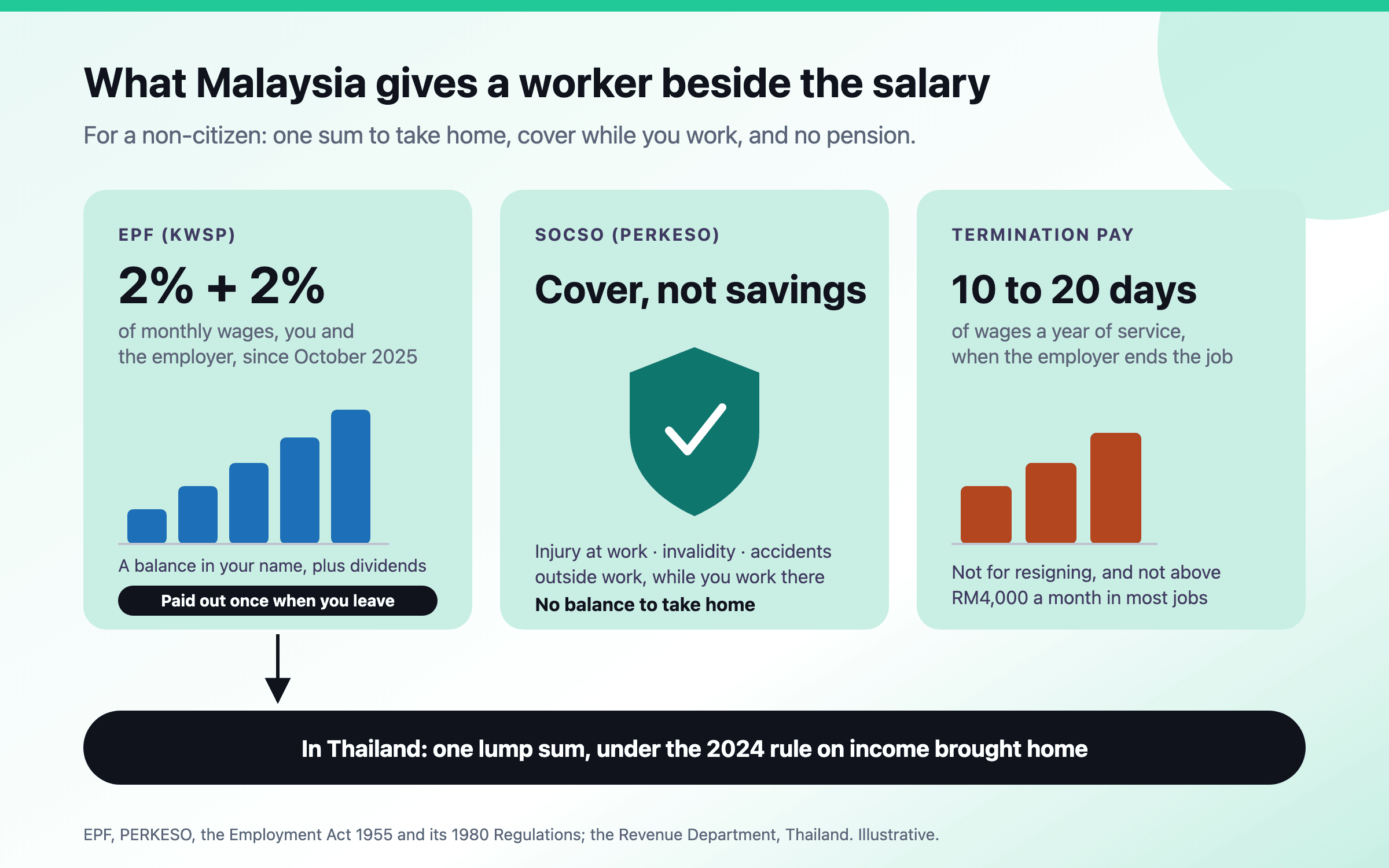
Since October 2025 every non-citizen employee in Malaysia pays 2% of wages into the EPF and the employer adds 2%, and the whole balance can be withdrawn on leaving the country for good. SOCSO covers injury and invalidity while you work but builds no balance, and the statutory termination benefit does not reach most professionals. What arrives in Thailand is a lump sum that Thailand’s 2024 rule on foreign income may tax.
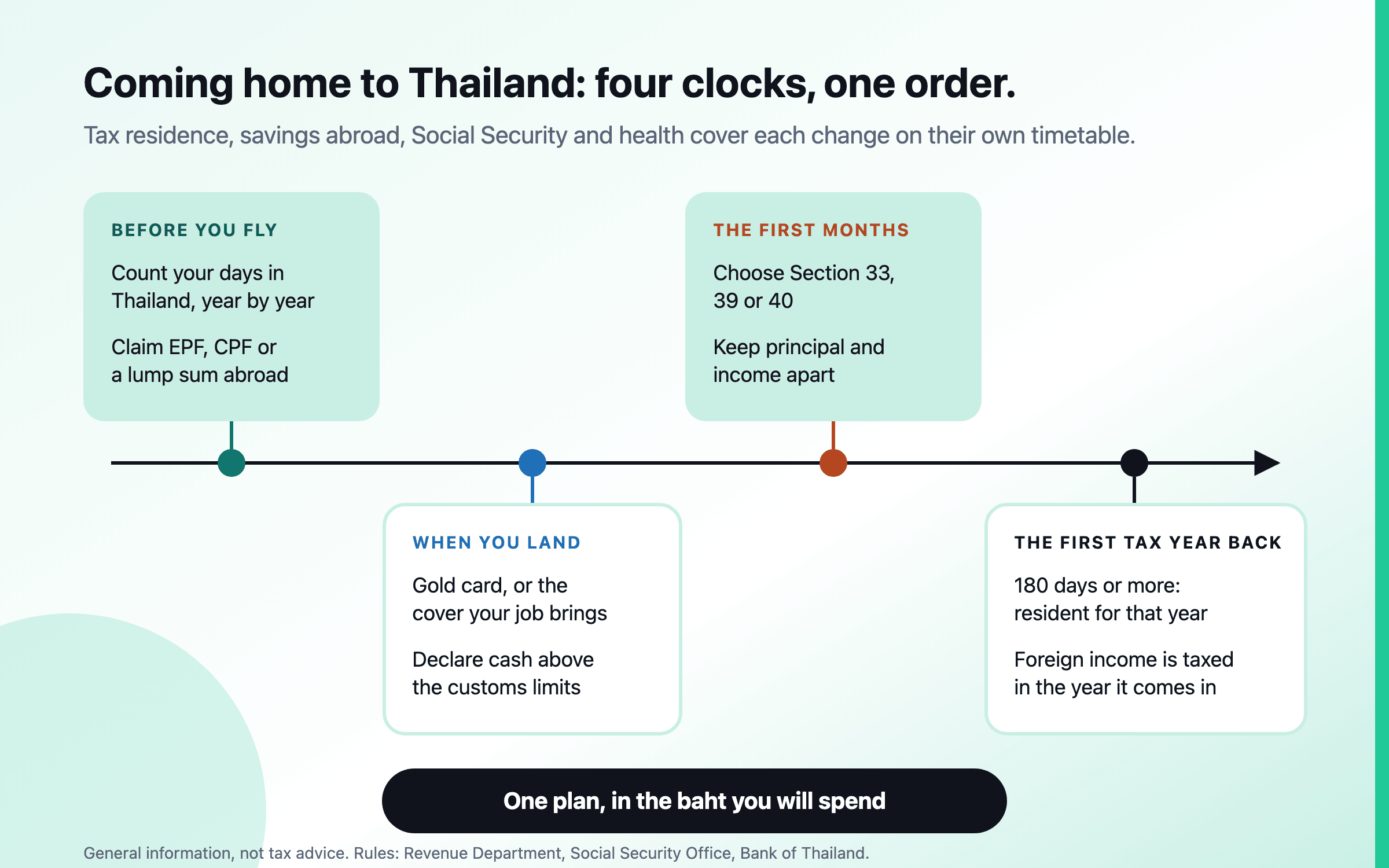
Moving home is several changes on different timetables. Tax residence follows a 180-day count in each calendar year, and since 2024 foreign income you bring in can be taxed, though savings from years you lived abroad are not. Schemes abroad, Thai Social Security and health cover each need their own step. This checklist sets out the rules from official sources; how they apply to you depends on your circumstances.
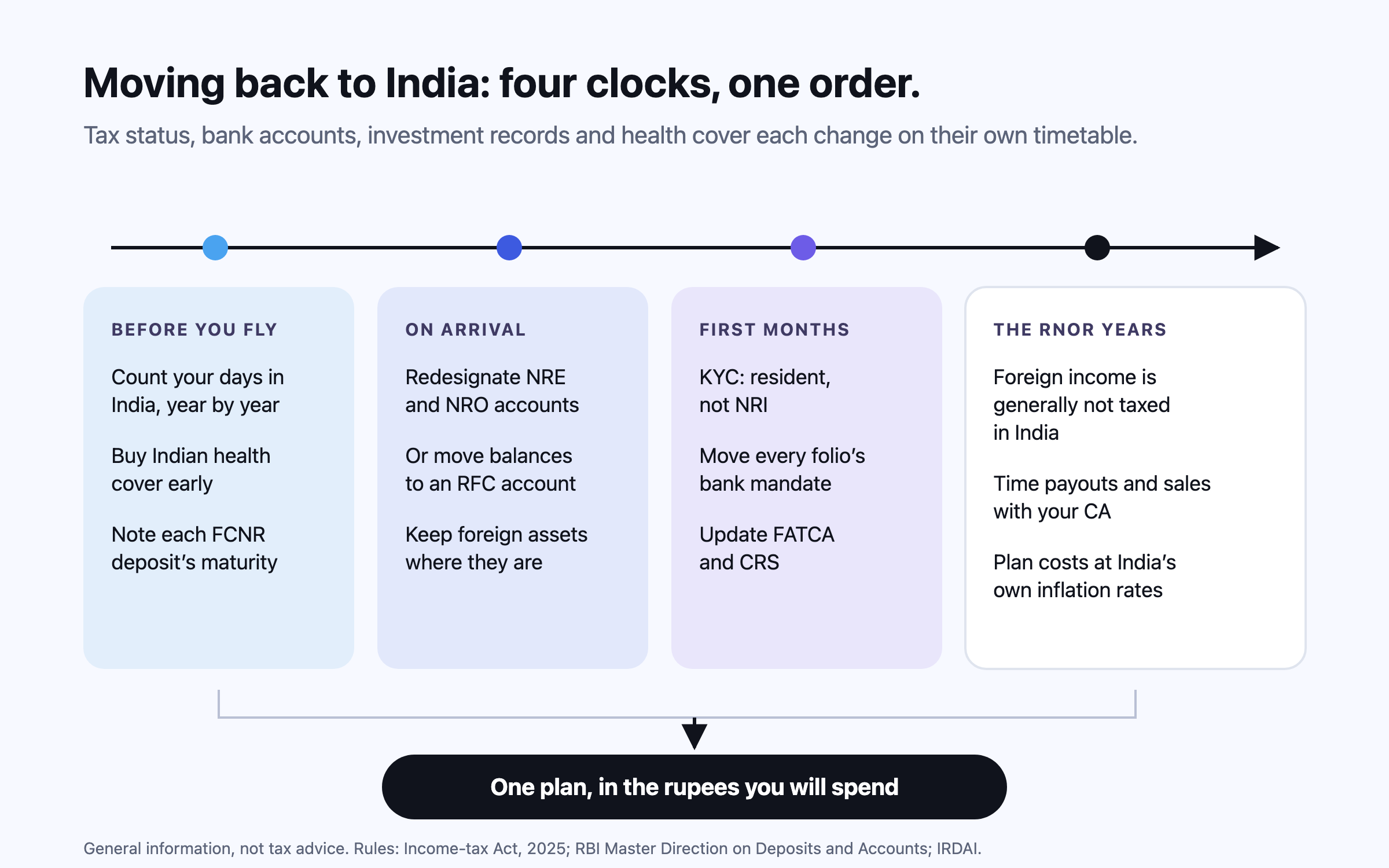
Coming home is several changes on different timetables. Your tax status follows day counts under the Income-tax Act, your bank accounts follow RBI rules under FEMA, and your investments, insurance and living costs each need their own step. This checklist explains each one in plain terms, with official sources — confirm the tax parts with a chartered accountant.
This is general information, not financial, tax or legal advice for your circumstances. Rules and figures change; check the official source for your country, and consult a licensed professional before making financial decisions. Projections are estimates, not predictions.