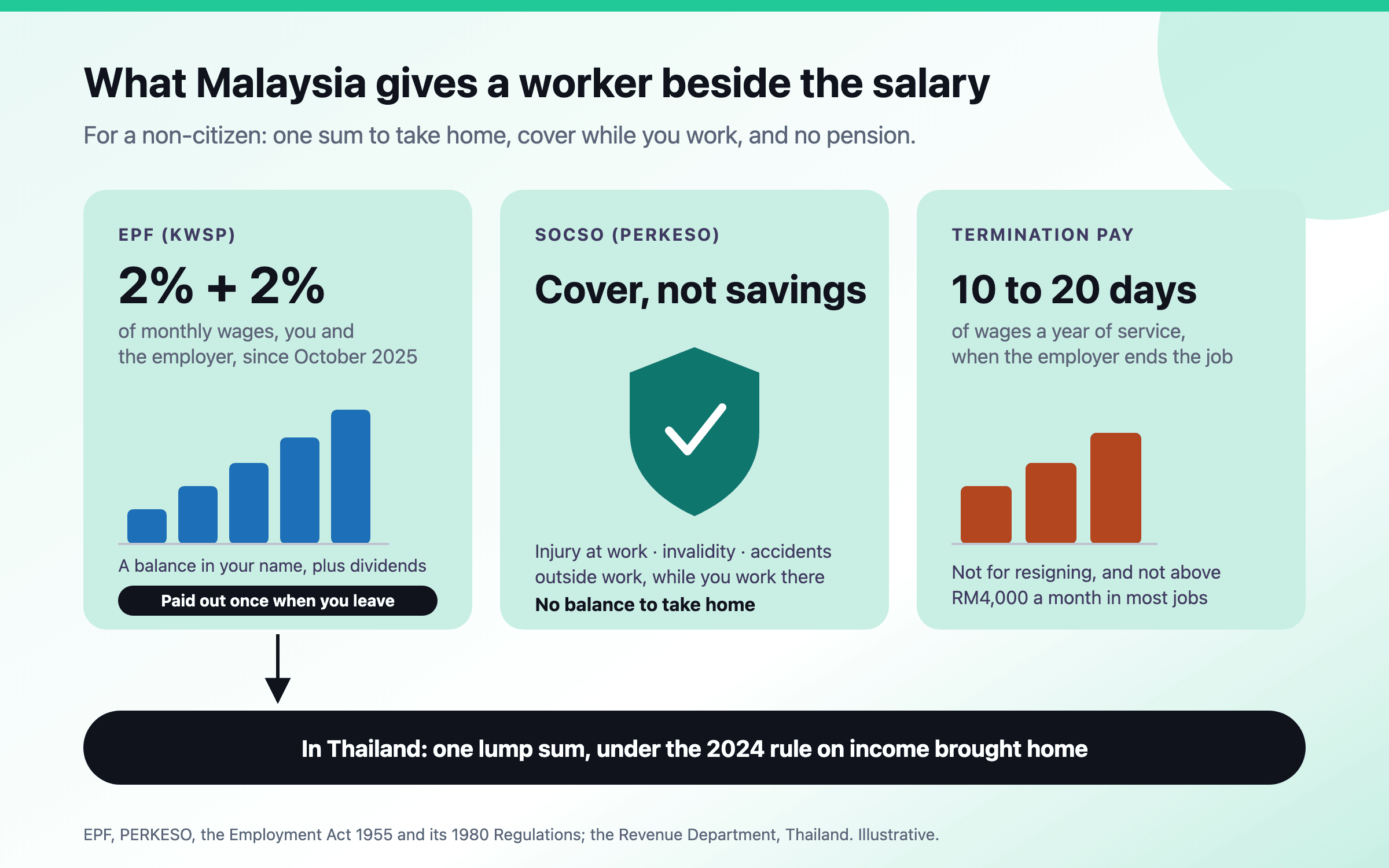
A Thai working in Malaysia now saves 2% of pay in the EPF, matched by 2% from the employer, and can take it all on leaving for good — a lump sum, not a pension, so your own savings have to carry the years after
Since October 2025 every non-citizen employee in Malaysia pays 2% of wages into the EPF and the employer adds 2%, and the whole balance can be withdrawn on leaving the country for good. SOCSO covers injury and invalidity while you work but builds no balance, and the statutory termination benefit does not reach most professionals. What arrives in Thailand is a lump sum that Thailand’s 2024 rule on foreign income may tax.
Nivritee Research · 27 October 2026 · updated 29 October 2026 · 8 min read
For a Thai engineer, nurse or manager working in Kuala Lumpur, the money that builds up beside the salary comes from three Malaysian systems: the Employees Provident Fund (EPF, called KWSP in Malay), the Social Security Organisation (SOCSO, or PERKESO), and the labour law on what an employer owes when a job ends. The money that finally reaches Chiang Mai or Bangkok then passes through two tax systems. This article sets out what each one does for a non-citizen, as the agencies themselves publish it, and follows one illustrative worker through it. It is information, not legal or tax advice: your contract, the Malaysian agencies and Thailand’s Revenue Department have the final word.
The EPF for non-citizens: 2% and 2% since October 2025
Malaysia’s Parliament passed the Employees Provident Fund (Amendment) Bill 2025, which makes EPF contributions compulsory for employees who are not Malaysian citizens1. From October 2025 wages, the employee and the employer each pay 2% of monthly wages2. The EPF announced the start on 1 October 20253.
Who is covered. A non-citizen who is not a permanent resident, holds a valid passport and work pass, works under a contract of service or apprenticeship, is paid wages in money and is under 75, for an employer registered or incorporated in Malaysia2. Domestic servants are excluded3.
Permanent residents are not in this group: they stay on the rates Malaysians pay2.
Registration. Holders of an Employment Pass or a Visitor’s Pass (Temporary Employment) are registered as EPF members automatically, and the employer pays both shares by the 15th of the following month4.
No top-ups. Voluntary self-contributions are for Malaysian citizens only, so a non-citizen’s balance is the 2% and 2% and the dividends on them2.
The savings earn the dividend the EPF declares each year. For 2025 it declared 6.15% on conventional savings (Simpanan Konvensional), after 6.30% for 2024, and the EPF sets out a minimum dividend of 2.50%5. Over the eleven years to 2025 the conventional rate ran between 5.20% and 6.90%5.
The dividend the EPF declared on conventional savings, 2015 to 2025.
Each point is the dividend rate the EPF declared for that year on conventional savings, credited after the year ends. The highest in these years was 6.90% for 2017 and the lowest 5.20% for 2020. A past dividend says nothing certain about a future one. 5The figures in this chart
Simpanan Konvensional dividend, % a year
2015
6.40%
2016
5.70%
2017
6.90%
2018
6.15%
2019
5.45%
2020
5.20%
2021
6.10%
2022
5.35%
2023
5.50%
2024
6.30%
2025
6.15%
Taking the EPF with you when you leave
A non-citizen who is no longer employed in Malaysia and is going home applies for the Leaving Country Withdrawal6. It ends the membership as well: once the payment is credited to the member’s bank account, the EPF account is closed2.
When to apply. The EPF asks expatriates to apply two months before the work permit expires, before the employer ends the contract, or before the date of resignation6.
Proof that the job has ended. One of three: the Immigration Department’s cancellation of the work pass, a resignation letter or the employer’s termination of the contract, or an income tax clearance letter — with a copy of the passport showing the name and passport number, and the old passport too if the number has changed6.
The bank account. The passport details the EPF holds must match those on the bank account the money is paid into, and the account has to stay open until the payment arrives; from 1 November 2026 the application also needs a bank document confirming the account holder’s details7.
SOCSO: cover while you work, not savings
PERKESO’s schemes for foreign workers are insurance. They pay out when something happens, for an injury, an invalidity or a death, and unlike the EPF they build no balance in your name.
Employment Injury Scheme. Paid by the employer alone, at 1.25% of the worker’s wages8.
Invalidity Scheme. Extended to foreign workers from 1 July 2024, for invalidity or death whatever the cause, provided it happens while the worker is in Malaysia on a valid work pass. It applies to a worker who first contributes before the age of 55; the employer and the worker each pay 0.5%9,8.
LINDUNG 24 Jam, cover for accidents outside work, applies to foreign employees too from 1 June 2026. The employee alone pays it, starting at 0.75% in its first phase, on wages up to the RM6,000 ceiling10.
Not the Employment Insurance System. The job-loss insurance PERKESO has run since 1 January 2018 covers Malaysian citizens and permanent residents; legal foreign workers fall under the Employment Injury Scheme instead11.
What a non-citizen employee under 55 and the employer pay each month, as a share of wages.
Employer, %
Employee, %
The EPF shares apply to the whole monthly wage. PERKESO’s are worked out on wages up to a ceiling of RM6,000 a month and set out in wage bands, so the ringgit amounts differ slightly from these percentages. LINDUNG 24 Jam starts from 1 June 2026 at its first-phase rate. 2,8,10The figures in this chart
Employer, %
Employee, %
EPF
2.00%
2.00%
Employment Injury Scheme
1.25%
0.00%
Invalidity Scheme
0.50%
0.50%
LINDUNG 24 Jam
0.00%
0.75%
Termination pay: what the Employment Act gives, and to whom
Malaysian law does not give every leaver a lump sum the way a Gulf gratuity does. What the Employment Act 1955 provides, in Peninsular Malaysia and Labuan, is a termination benefit when the employer ends the contract12. Under the Employment (Termination and Lay-Off Benefits) Regulations 1980 an employee with at least 12 months of continuous service is owed a termination benefit, except where the contract ends by retirement under its terms, by dismissal for misconduct after due inquiry, or by the employee’s own voluntary resignation13.
The minimum is 10 days’ wages for each year of service for someone with under two years, 15 days a year for two to under five years, and 20 days a year for five years or more, with an incomplete year counted in proportion, and it is due within 7 days of the termination14.
The minimum termination benefit, in days of wages, by years of continuous service.
The rate per year depends on the total length of service and then applies to every year: 10 days a year under two years, 15 from two to under five, 20 from five. It applies only to employees the regulations cover, and under the Act’s First Schedule not to anyone earning more than RM4,000 a month unless the Schedule names their work. 14,12The figures in this chart
Days of wages
1 year
10
2 years
30
3 years
45
4 years
60
5 years
100
7 years
140
10 years
200
The catch for most professionals is in the Act’s First Schedule: the section on termination benefits does not apply to a person whose wages exceed RM4,000 a month, unless their work falls in the groups the Schedule lists whatever they earn, such as manual labour12. Nok, on RM12,000 a month, is outside it: whatever she receives when her job ends comes from her contract, not from the regulations.
Malaysian income tax: the 182-day line
Malaysia decides your tax rate by residence, not citizenship. You are resident for a year if you are in Malaysia for 182 days or more in it; a shorter stay can still count if it is linked to a run of 182 or more consecutive days in the year before or after, and there are rules for people who have been in Malaysia for 90 days or more in several years15.
Residents are taxed on a progressive scale after reliefs: for the years of assessment 2023 to 2025, nothing on the first RM5,000 of chargeable income, rising through 11% on RM50,001 to RM70,000, 19% on RM70,001 to RM100,000 and 25% on RM100,001 to RM400,000, to 30% above RM2,000,00016.
Non-residents are taxed at a flat 30% and cannot claim any reliefs17.
Withheld every month. Your employer deducts the tax from each month’s pay (Monthly Tax Deduction, PCB), and for an employee who is not resident, or not known to be resident, the deduction is 30% of remuneration18.
Malaysian tax on the same chargeable income, as a resident and as a non-resident.
Resident, RM
Non-resident, RM
The resident figures apply the scale for the years of assessment 2023 to 2025 band by band; the non-resident figures are 30% of the same amount. A non-resident also loses every relief, so their chargeable income is higher to begin with. 16,17The figures in this chart
Resident, RM
Non-resident, RM
RM50,000
RM1,500
RM15,000
RM100,000
RM9,400
RM30,000
RM150,000
RM21,900
RM45,000
RM200,000
RM34,400
RM60,000
On RM100,000 of chargeable income a resident pays RM9,400, a non-resident RM30,00016,17. For Nok the line matters in her last year: from 1 January to 30 September 2029 she is in Malaysia for 273 days, past the 182 that make her resident for that year15.
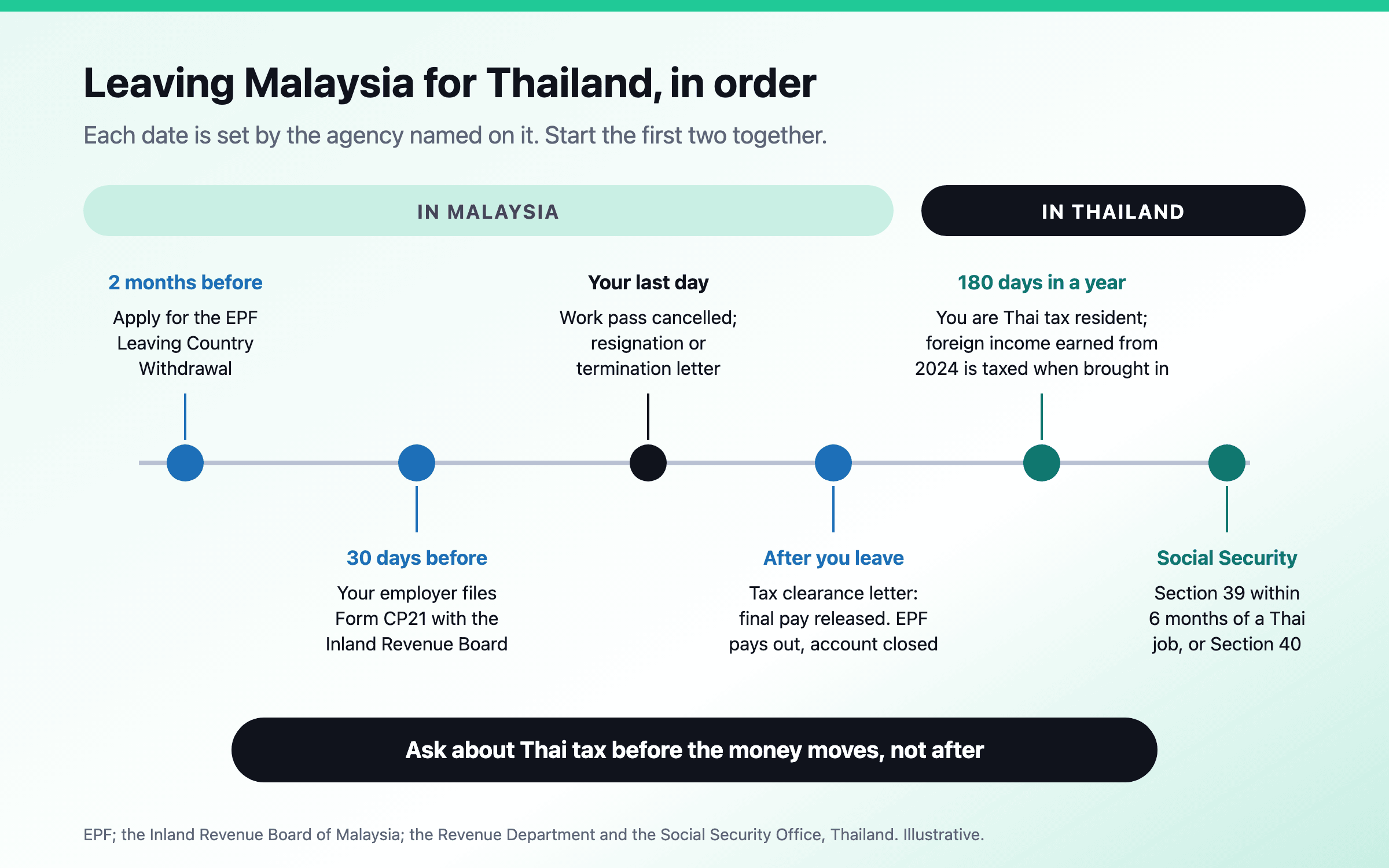
Leaving Malaysia for good has one more step. Your employer must notify the Inland Revenue Board at least 30 days before your employment ends, on Form CP21, and must hold back money payable to you until the board’s tax clearance letter arrives19. That letter is also one of the documents the EPF accepts for the Leaving Country Withdrawal6, so the two are worth starting together.
Illustrative: the order of the steps when a job in Malaysia ends and the family moves to Thailand. Each date is set by the agency named on it.
Bringing the money into Thailand
Thailand taxes its residents on foreign income they bring into the country. You are resident for a tax year, which is the calendar year, if you are in Thailand for 180 days or more in it20. Since 1 January 2024, the Revenue Department’s rule is that a resident’s income from abroad is taxable if it is earned in any tax year from 2024 onwards and brought into Thailand, in whole or in part, in that year or a later one; income earned before 2024 and brought in later is not taxed20.
Tax already paid in Malaysia is not simply lost. Under the agreement between Thailand and Malaysia on double taxation, Malaysian tax on income from Malaysia is allowed as a credit against the Thai tax on that income, but the credit cannot exceed the Thai tax on it21. The Thai scale the income joins runs from nothing on the first ฿150,000 of net income to 35% above ฿5,000,00020.
Thailand’s personal income tax scale, applied band by band to net income after expenses and allowances. 20
Net income in a year
Thai tax rate
Up to ฿150,000
Exempt
฿150,001 to ฿300,000
5%
฿300,001 to ฿500,000
10%
฿500,001 to ฿750,000
15%
฿750,001 to ฿1,000,000
20%
฿1,000,001 to ฿2,000,000
25%
฿2,000,001 to ฿5,000,000
30%
Over ฿5,000,000
35%
For a household like Nok’s, the dates are the whole question. She arrives in Chiang Mai on 1 October 2029 and is in Thailand for 92 days that year, under the 180 that would make her resident for 2029; from 2030 she is resident20. Which of her savings were earned from 2024 onwards, in which year each sum lands in Thailand, and how much Malaysian tax it carries are exactly what the rule turns on. Put those facts to the Revenue Department, or a tax professional, before the money moves; this article does not tell you how to arrange them.
Thai Social Security when you come back
Years worked in Malaysia add nothing to a Thai Social Security record: it counts only what was paid into the Thai fund. What you can join on return depends on your last Thai job.
Section 39, the voluntary scheme, is open to someone who paid into Section 33 as an employee for at least 12 months and applies within 6 months of leaving that job. Everyone pays 9% of a fixed ฿4,800 a month, ฿432, for six kinds of benefit including old age22.
Section 40 is for anyone aged 15 to 65 who is not insured under Section 33 or 39. It offers three options: ฿70 a month for sickness or injury, invalidity and death; ฿100 a month adding old age; and ฿300 a month adding child support23.
A new Thai job puts you back into Section 33 through your employer.
Nok left her last Thai job for Kuala Lumpur in 2021, years outside Section 39’s six-month window22, so on her return her options are Section 40 or a new Thai employer23. Whatever she joins pays according to what it receives from then on; her Malaysian years are carried by her own savings.
Planning the corpus in baht
None of what Malaysia provides is a pension. The EPF pays out once, PERKESO insures you while you work, and termination pay, where it applies at all, is a one-off sum. So the years after you stop working have to be paid for by the corpus the family builds, in the currency it will spend.
Write down the EPF balance from your statement, not an estimate, and the date you expect to leave.
Count it once. Hold it as a balance today, or as money arriving on the day you leave — not both.
Plan in baht. A ringgit sum is worth what the exchange rate gives on the day it is converted; see what sending money home costs for the price of the transfer itself.
Ask about tax before the money moves. Thailand’s 2024 rule turns on when income was earned and when it is brought in; the Malaysian tax you paid may count as a credit.
Settle your Thai Social Security within six months of your last Thai job if Section 39 is still open to you, or look at Section 40.
Do foreign workers have to contribute to the EPF in Malaysia?
Yes, from October 2025 wages. A non-citizen employee who is not a permanent resident, holds a valid passport and work pass and is under 75 pays 2% of monthly wages, and the employer pays another 2%; domestic servants are excluded2,3.
Can I withdraw my EPF when I leave Malaysia?
Yes. A non-citizen who is no longer employed and is going home applies for the Leaving Country Withdrawal, ideally two months before the work permit expires or the job ends, with proof such as the work pass cancellation, a resignation or termination letter, or a tax clearance letter; the account closes once the money is paid6,2.
What does SOCSO cover for foreign workers?
The Employment Injury Scheme, paid by the employer at 1.25% of wages, and since 1 July 2024 the Invalidity Scheme for workers who first contribute before 55. Foreign workers are not covered by the Employment Insurance System for job loss8,9,11.
Is money brought into Thailand from abroad taxed?
For a Thai tax resident, foreign income earned from 2024 onwards is taxable when it is brought into Thailand, in that year or a later one; income earned before 2024 is not. Malaysian tax on the same income can be credited against the Thai tax, up to the Thai tax on it20,21.
Can I rejoin Thai Social Security after working in Malaysia?
Section 39 is open only if you paid into Section 33 for at least 12 months and apply within 6 months of leaving that job22. Otherwise Section 40 accepts anyone aged 15 to 65 who is not under Section 33 or 3923.
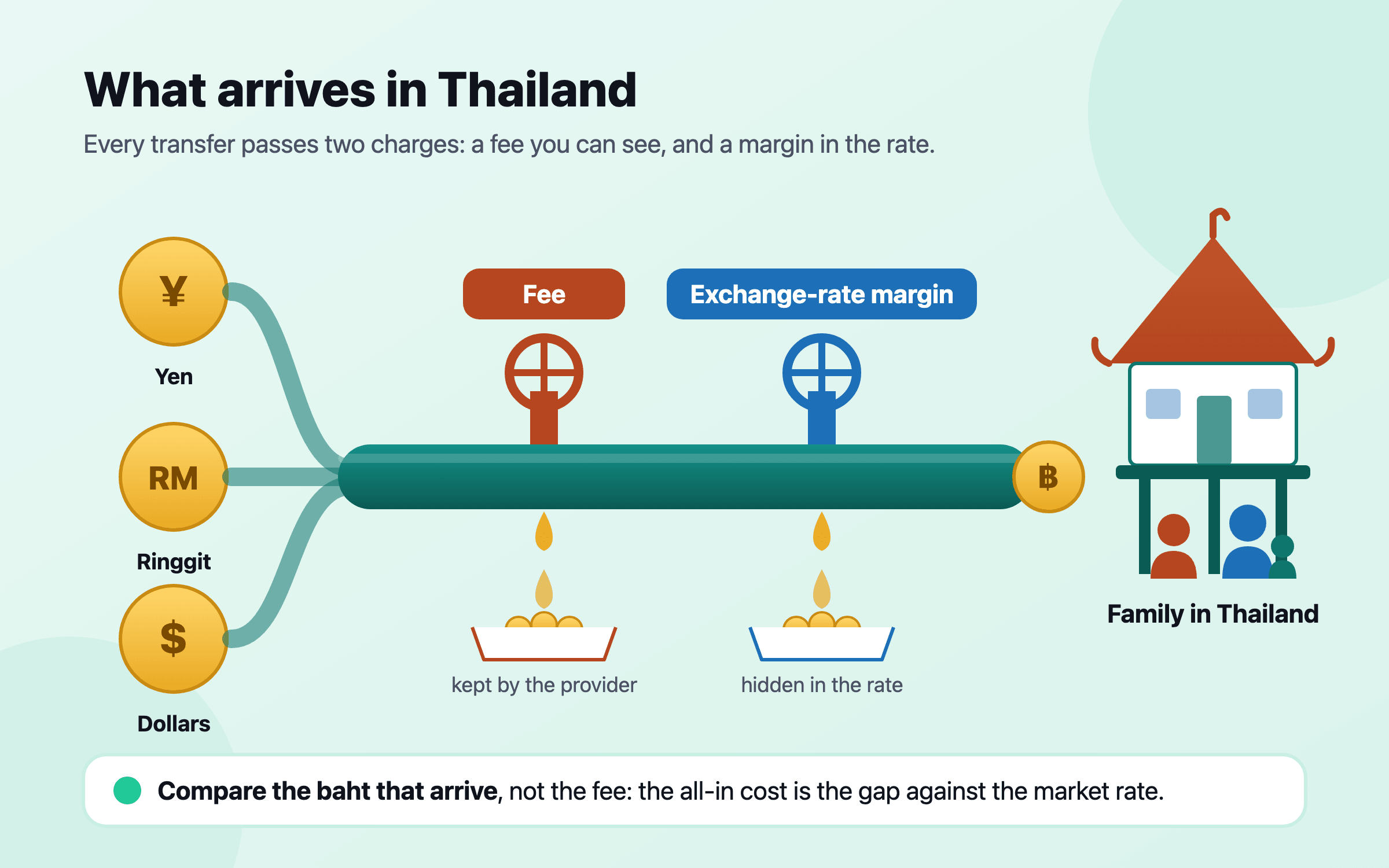
Sending the equivalent of $200 to Thailand cost 5.82% on average in the third quarter of 2025, down from 9.17% in 2017 and now below the world average of 6.36%. The seven corridors the World Bank prices run from 4.20% from Australia to 8.33% from Japan, while the three cheapest services in each cost between 1.31% and 4.68%. Compare the baht that arrive, not the fee.
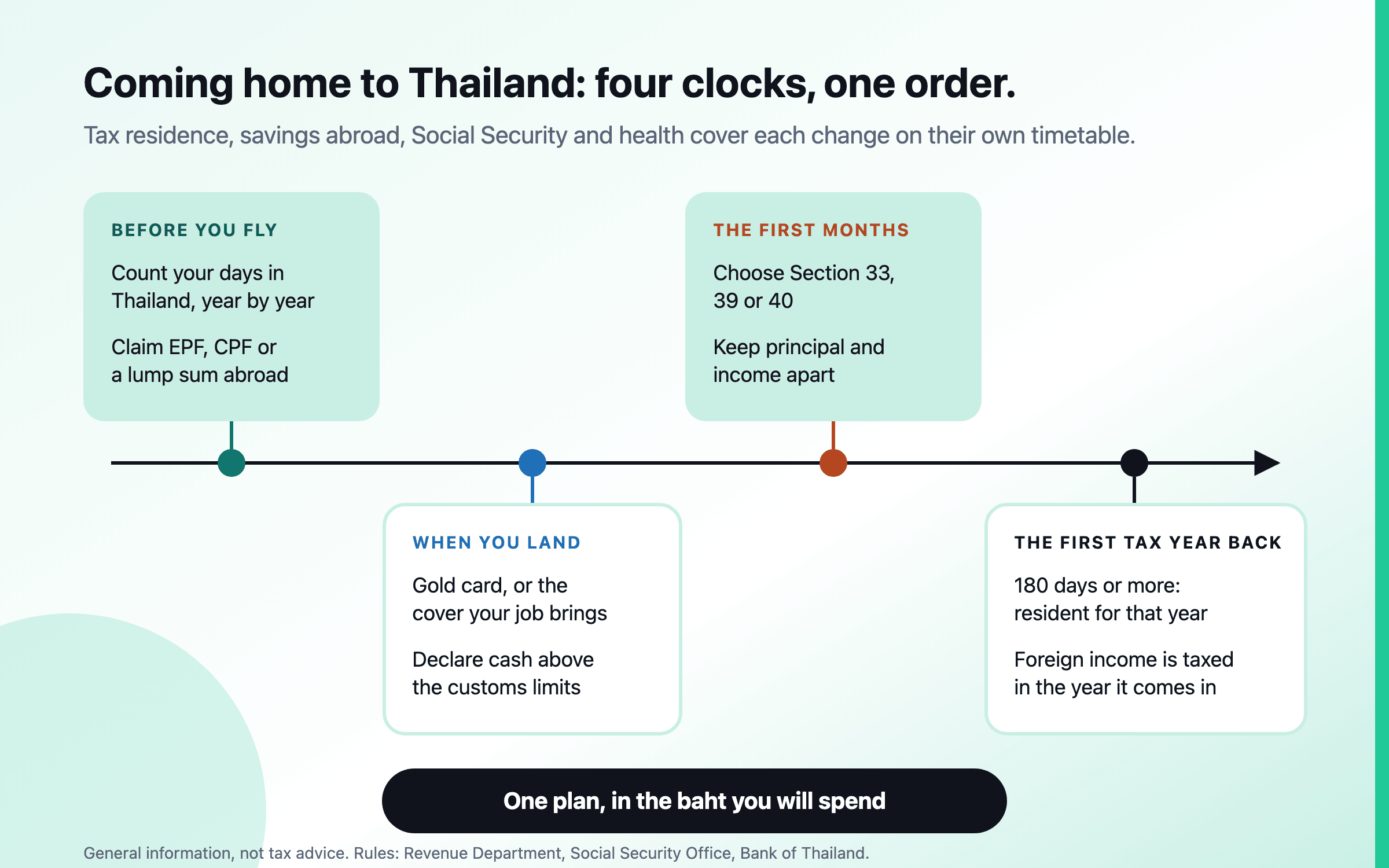
Moving home is several changes on different timetables. Tax residence follows a 180-day count in each calendar year, and since 2024 foreign income you bring in can be taxed, though savings from years you lived abroad are not. Schemes abroad, Thai Social Security and health cover each need their own step. This checklist sets out the rules from official sources; how they apply to you depends on your circumstances.
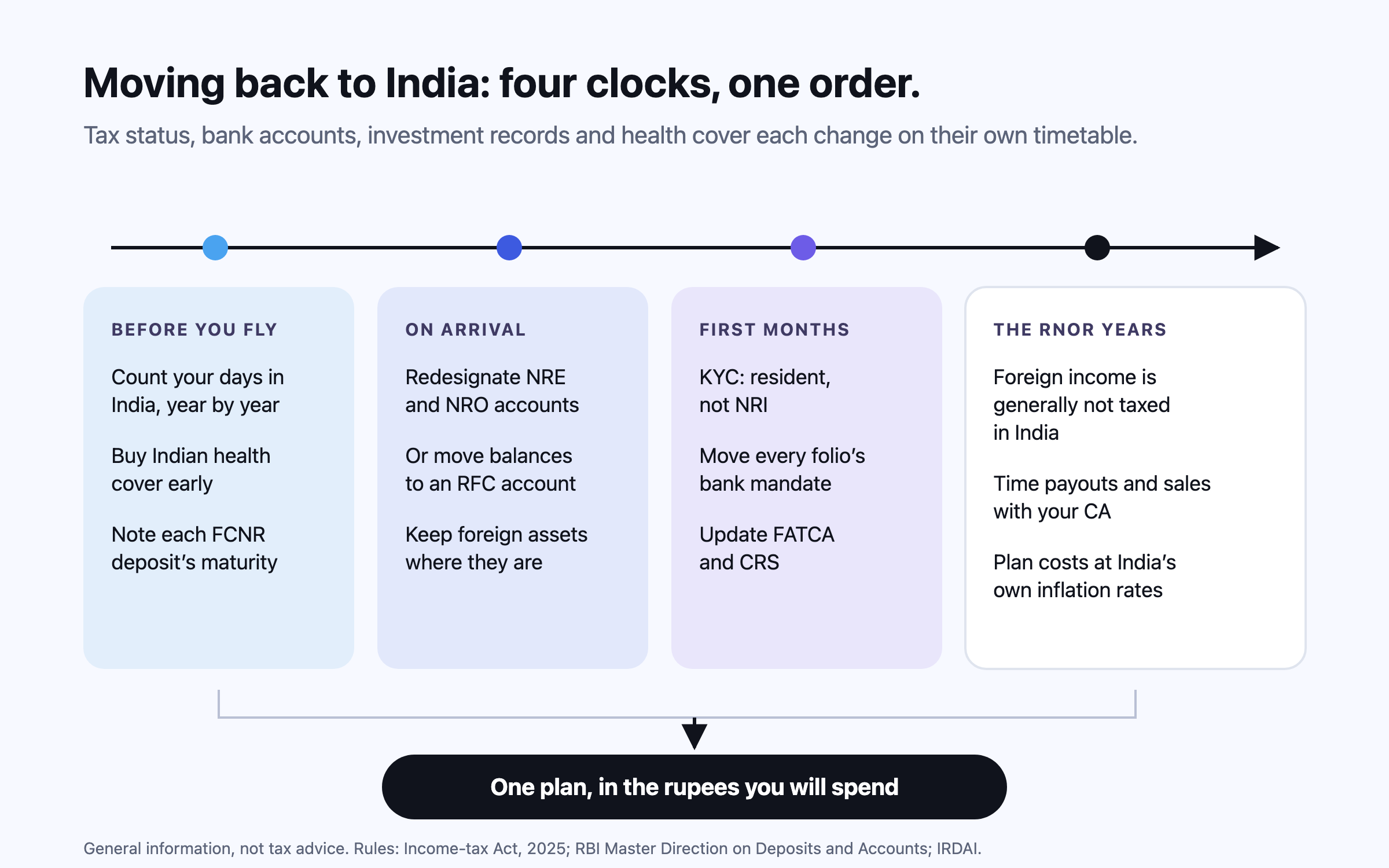
Coming home is several changes on different timetables. Your tax status follows day counts under the Income-tax Act, your bank accounts follow RBI rules under FEMA, and your investments, insurance and living costs each need their own step. This checklist explains each one in plain terms, with official sources — confirm the tax parts with a chartered accountant.
This is general information, not financial, tax or legal advice for your circumstances. Rules and figures change; check the official source for your country, and consult a licensed professional before making financial decisions. Projections are estimates, not predictions.