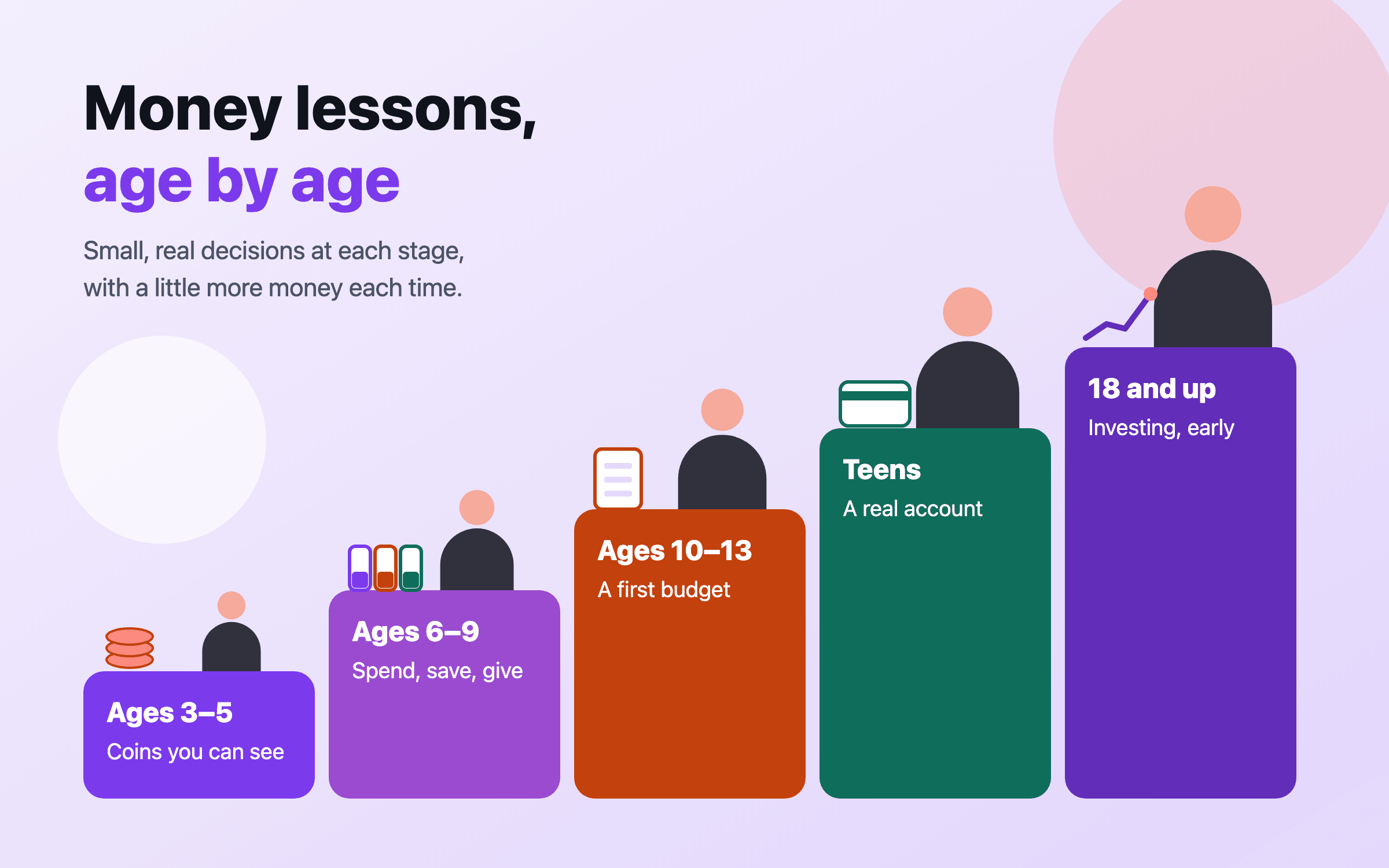
Children learn money from what they watch and the small choices they are allowed to make, long before they are taught it. Start with coins at three and real accounts in the teens.
Research for the UK’s Money Advice Service found the building blocks of later money behaviour are usually in place by about age seven, and the OECD finds teenagers who talk about money with their parents score higher on financial literacy. The useful lessons are small and practical: visible coins for the youngest, jars and pocket money in primary school, a budget and a bank account in the teens, and an honest view of the family’s own money.
Nivritee Research · 13 July 2026 · updated 15 October 2026 · 8 min read
Most parents mean to teach their children about money and put it off until the children are old enough to understand interest rates. The research suggests that is the wrong way round. By the time a child can follow a lesson about compounding, a lot of what they will do with money has already been learnt — from watching the adults around them, and from the small decisions they were or were not allowed to make. This guide sets out what the evidence says and what to do at each age, from coins on the kitchen table to a first investment account.
Habits start earlier than lessons
In 2013 the UK’s Money Advice Service asked David Whitebread and Sue Bingham of the University of Cambridge what is known about how young children form the habits that later shape their money behaviour. Their review concluded that by the age of seven, several basic concepts that relate to later financial behaviour will typically have developed — the ability to plan, to wait for something, and to understand that things are exchanged for value.1 The often-quoted line that “money habits are formed by seven” is a simplification of that finding, but the direction is right.
The same review was blunt about what does not work: teaching young children explicit financial facts on their own is likely to have little effect. What helps is money behaviour that adults model, discuss and demonstrate, and practice at waiting for things.1 A later, larger study points the same way. Re-running the famous marshmallow test with more than 900 children, Tyler Watts, Greg Duncan and Haonan Quan found the link between waiting as a four-year-old and later outcomes was small and largely disappeared once family background was taken into account — and concluded that drilling young children to delay gratification on its own is unlikely to help much.2 The lesson for parents is that the environment does the teaching: what children see, and what they are trusted to try.
Parents matter more than anything else on the list. In a study of 2,098 first-year university students, Soyeon Shim and colleagues found that parents, work experience and school financial education all predicted how well students handled money — with the parents’ role substantially larger than work and school combined.3
higher scores for those students than for those who never do
The OECD’s PISA assessment tests 15-year-olds’ financial literacy alongside reading, maths and science. Its 2022 round, published in June 2024, covered 20 countries and economies. Across the OECD systems the average score was 498, about 18% of students fell below the baseline level, and about 11% were top performers.4 The gap between countries is wide — more than 100 points separate the Flemish Community of Belgium from Malaysia — and the gap between advantaged and disadvantaged students within the OECD averaged 87 points.4
Average financial literacy score of 15-year-olds, PISA 2022, selected countries and economies
Twelve of the 20 systems assessed. The UK, Australia, New Zealand, Singapore, Hong Kong, Japan and India did not take part in the financial literacy test. Results for Denmark, the Canadian provinces, the Netherlands and the US did not meet every PISA sampling standard and need care. Canada means eight provinces. 4The figures in this chart
Mean score
Flemish Community of Belgium
527
Denmark
521
Canadian provinces
519
Netherlands
517
Poland
506
United States
505
OECD average
498
Spain
486
Italy
484
United Arab Emirates
441
Brazil
416
Malaysia
406
Two findings in the same report bear directly on parenting. About 64% of students said they talk with their parents about their own spending decisions weekly or monthly, and they scored 12 points higher than students who never do, after accounting for their background. And the 83% who said they could decide for themselves what to spend their money on scored around 30 points higher.4 Conversation and real choices, in other words — the same two things the Cambridge review pointed to for much younger children.
Parents often hold back anyway. In T. Rowe Price’s survey of 2,030 US parents of children aged 8 to 14, 41% said they were reluctant to discuss financial topics with their children and only 22% talked about money at least weekly, even though 85% agreed it was important to talk with their children about saving and spending.5
An age-by-age guide
The stages below are a guide, not a timetable; children move at their own pace. What changes from one stage to the next is the size of the decisions a child is trusted with and how long they have to wait for the result.
Ages 3 to 5: money you can see
Use coins and notes, not cards. A tap on a phone teaches nothing about how much something cost. Let them hand money over at a shop counter and take the change.
Name the choice out loud. “We could buy this today, or save for the bigger one on Saturday.” Small, real waits — a day, a week — are the practice the Cambridge review describes.
Play shop. Pricing toys and paying for them with play money teaches exchange before arithmetic.
Ages 6 to 9: pocket money and jars
This is the age to start regular pocket money: a fixed amount on a fixed day, so the child can plan. In the UK, NatWest’s Rooster Money index puts regular pocket money at an average of £2.69 a week at age six and £3.27 at age ten, and found 27.4% of families on the app have a regular allowance set up.6 In Australia, a Westpac survey of 1,007 parents found 74% give pocket money, an average of A$25 a week, and 63% of those said the point was to teach the value of money.7 Children whose parents gave an allowance were twice as likely to describe themselves as knowledgeable about managing money in T. Rowe Price’s 2015 survey, 32% against 16%.8
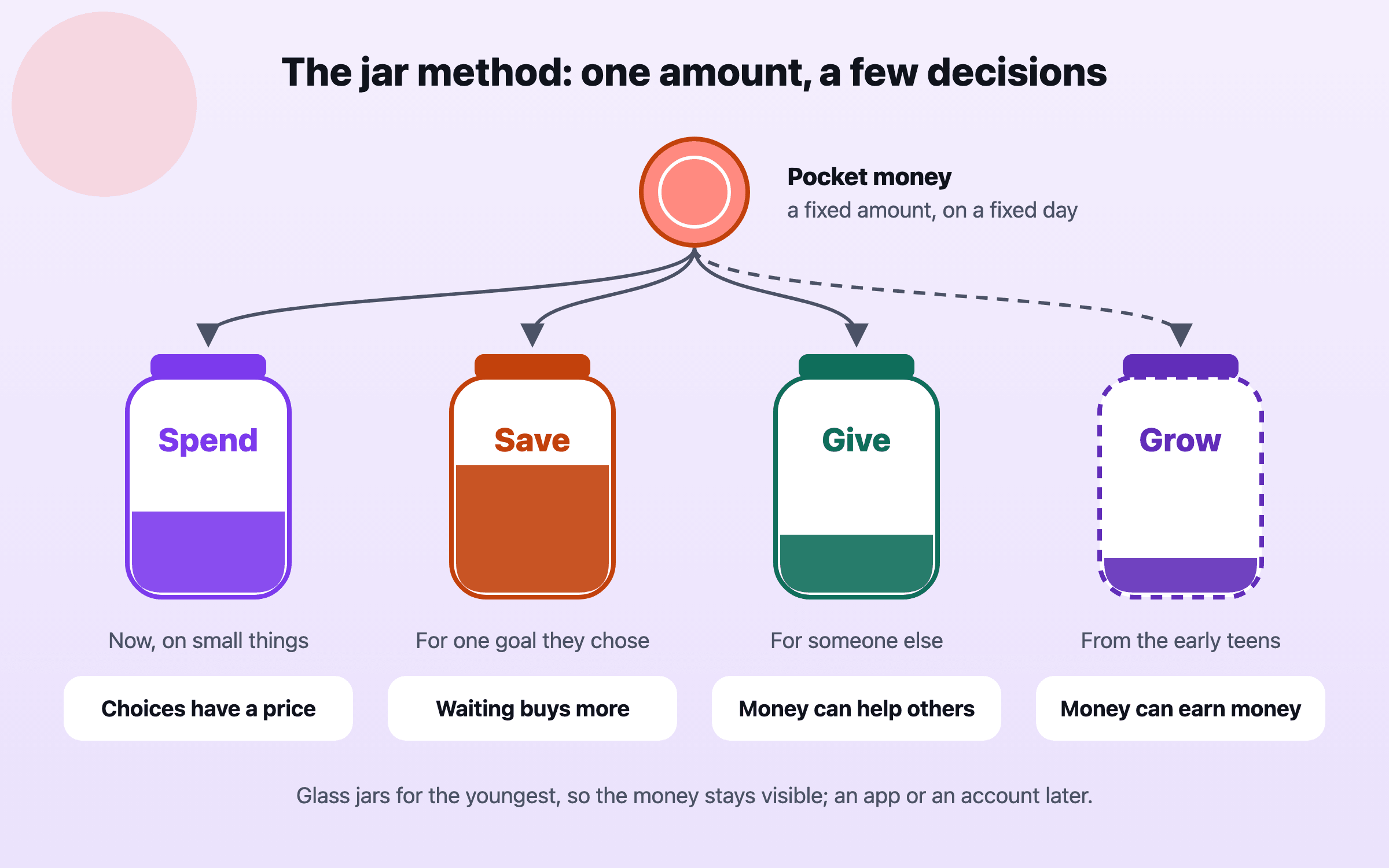
The jar method turns one amount into a few decisions. Each jar teaches something different; the fourth arrives once a child can open an account of their own.
Split it into jars. Spend, save and give is the classic set. Glass jars keep the money visible, which matters at this age.
Let them choose the saving goal, and let them make the mistake of spending the lot on something disappointing. A bad purchase with their own money teaches more than any lecture.
Chores: decide what you are paying for. NatWest found 30% of UK children do chores for their pocket money.9 Some families pay for extra jobs and keep everyday help unpaid, so contributing at home is not a transaction.
Ages 10 to 13: a first budget
Hand over a budget, not just an allowance. Fold in something you already pay for — a school lunch budget, a phone top-up, clothes for a season — so they plan across weeks.
Open a savings account in their name. In India, the Reserve Bank told banks from July 2025 to let minors aged ten and above open and operate savings and term deposit accounts on their own, within limits each bank sets.10 Elsewhere, a parent can usually open one for a child and run it until they are older.
Show interest arriving. Watching a small sum earn even a little interest is the first lesson in compounding.
Teens: real accounts and real stakes
By the mid-teens most children can handle a debit card, a part-time wage and a longer goal. This is also the age to show compounding properly, because time is the one advantage they have. Take two illustrative savers who each put 100 a month into an investment growing at an assumed 6% a year (any currency; a compound interest calculator such as the SEC’s does the same arithmetic).11 One starts at 15 and stops at 25, having put in 12,000. The other starts at 25 and keeps going to 60, putting in 42,000. At 60, the early starter has about 133,000 and the later one about 142,000 — barely more, for three and a half times the money.11
Two savers, 100 a month at an assumed 6% a year: one from 15 to 25, one from 25 to 60
Saves from 15 to 25, then stops
Saves from 25 to 60
Balance at each age, contributions made monthly and compounded monthly. Illustrative only: the 6% is an assumption, not a forecast, and real returns vary year to year. 11The figures in this chart
Saves from 15 to 25, then stops
Saves from 25 to 60
15
0
0
20
6,977
0
25
16,388
0
30
22,105
6,977
35
29,816
16,388
40
40,218
29,082
45
54,247
46,204
50
73,172
69,299
55
98,698
100,452
60
133,128
142,471
Let them earn and keep. A first wage, however small, is a chance to split it the jar way: some to spend, some to save, some to invest.
Talk about the price of borrowing before they are offered a card or a buy-now-pay-later plan: what a balance carried for a year costs in their own money.
Make the long goal concrete. A course, a car, a gap year — dated, priced and saved for, with a monthly figure.
18 and up: independence, gradually
Young adults learn most from running their own budget with a safety net still under it. Agree in advance what you will and will not pay for, and for how long — support with a known end is easier for everyone than an open tab. It is also the right moment to show them a whole household plan: what came in, what went out, what was saved, and what it is for.
Accounts a child can hold, by country
Most countries now offer something in a child’s own name. A few of the main ones, as each government publishes them:
United Kingdom — Junior ISA. Up to £9,000 a year in the 2026–27 tax year. The money belongs to the child, who can take control of the account at 16 but cannot withdraw until 18.12
United States — custodial and Trump Accounts. Under UTMA and UGMA custodial accounts, the money becomes the child’s at the moment of the gift and must be handed over at the age of majority.13 New Trump Accounts, an IRA for children under 18, carry a one-time $1,000 government payment for US citizens born from 2025 to 2028, and for now can hold only low-cost funds that track broad US share indexes.14
India — a minor’s own bank account. Children of any age can hold an account through a guardian, and from ten many banks now let them operate one independently.10
Singapore — the Child Development Account. Every Singapore citizen child receives a S$5,000 First Step Grant, and the government matches what parents save, dollar for dollar, up to a cap that depends on birth order and date of birth.15,16
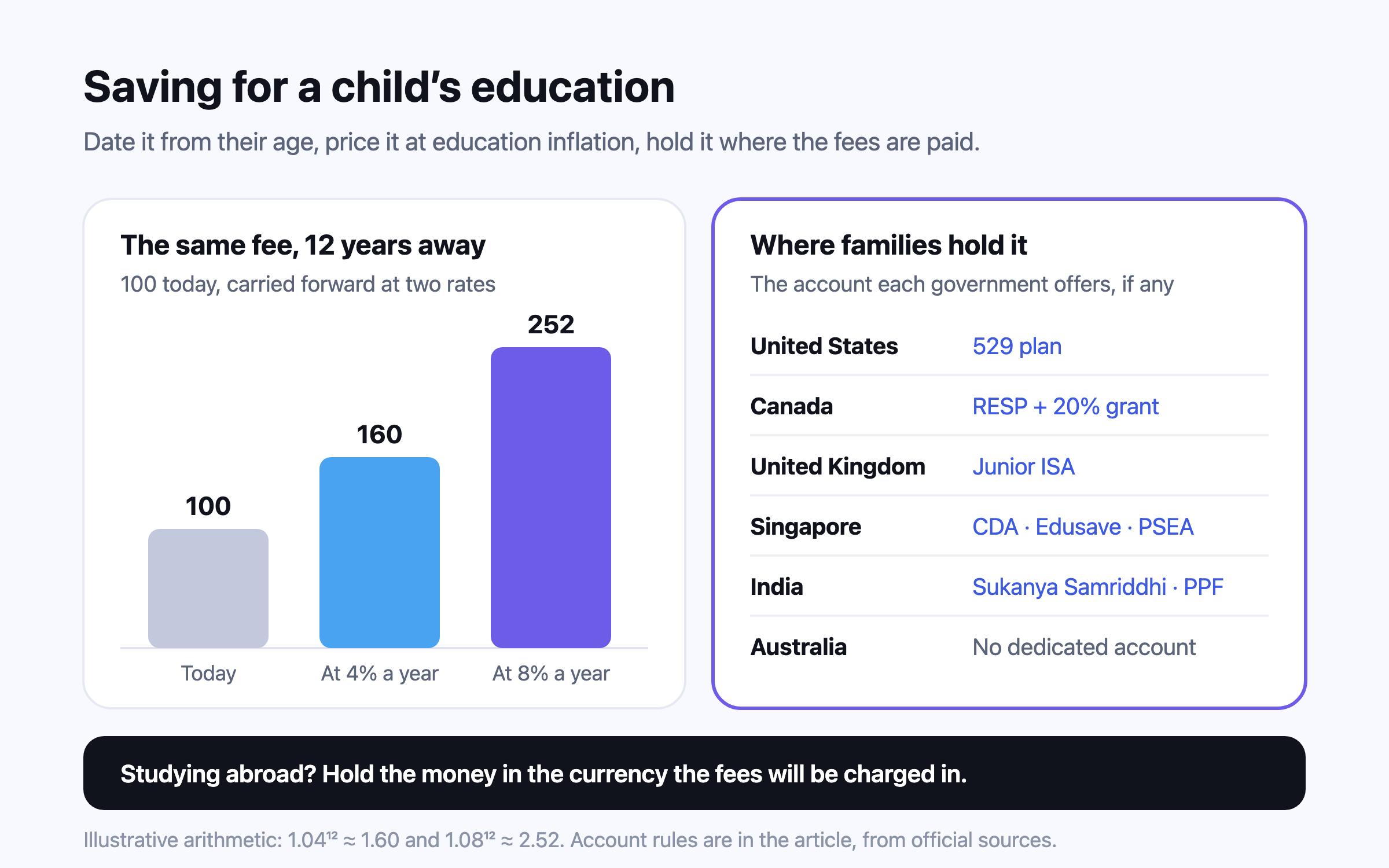
These are tools for saving for a child, and several double as teaching tools — a teenager who can see a Junior ISA or a custodial account grow is watching compounding with their own name on it. Saving for education specifically, with each country’s schemes compared, is covered in saving for a child’s education.
Talking honestly about the family’s money
Children notice more than parents think: a new car, a cancelled holiday, an argument at the kitchen table. Silence does not protect them from money worries; it leaves them to fill in the gaps. Honesty does not mean sharing every figure. It means age-sized truths:
For young children: “We are choosing not to buy that because we are saving for something more important to us.” It explains a no without making money frightening.
For older children: roughly what things cost — the rent or mortgage, the food bill, school fees — so the household budget is real rather than abstract.
For teenagers: the plan itself. What the family saves for, why, and the trade-offs between their education and their parents’ own independence.
In a hard year: what has changed, what the family is doing about it, and what is not their job to worry about.
At what age should you start teaching children about money?
From about three, with coins and small choices. A Cambridge review for the UK’s Money Advice Service found several building blocks of later money behaviour are typically in place by around age seven.1
How much pocket money should a child get?
There is no right figure; what matters is that it is regular and the child decides how to use some of it. In the UK, regular pocket money averages £2.69 a week at six and £3.27 at ten on NatWest’s Rooster Money app.6
Does talking about money with children make a difference?
The OECD found 15-year-olds who talk with their parents about their spending weekly or monthly scored 12 points higher in financial literacy than those who never do, after accounting for their background.4
Can a minor open a bank account in India?
Yes. A child of any age can hold one through a guardian, and the Reserve Bank lets banks allow minors aged ten and above to open and operate savings and term deposit accounts independently, within limits each bank sets.10
How do you explain compound interest to a teenager?
Show two savers: one who puts 100 a month away from 15 to 25 and stops, and one who starts at 25 and carries on to 60. At an assumed 6% a year the early starter ends with nearly as much while putting in far less.11
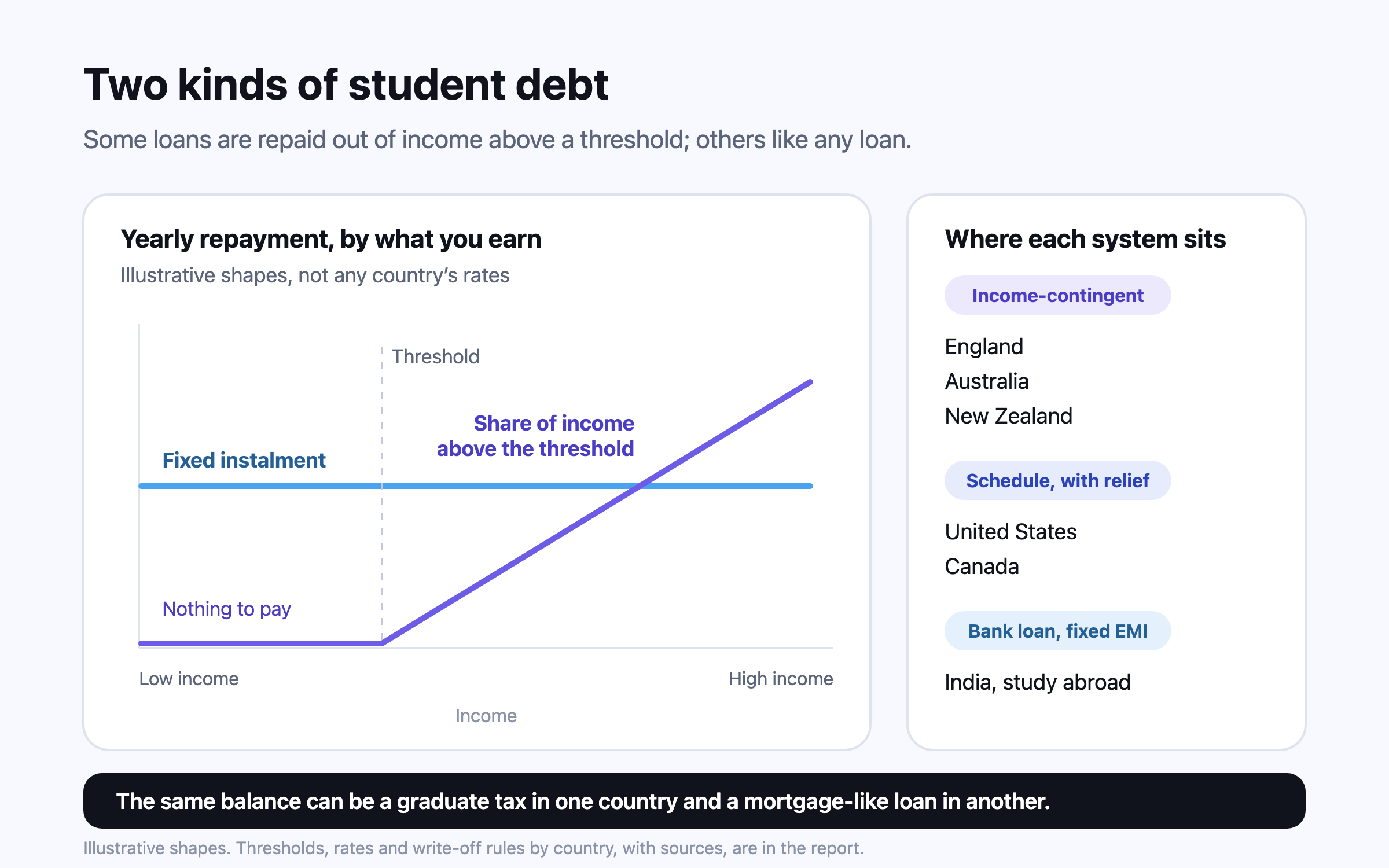
Student debt comes in two shapes. Income-contingent systems — England, Australia, New Zealand — take a share of income above a threshold and, in England, write off what is left after 30 or 40 years. Loans in the US, Canada and India have a schedule, with income-based relief in the first two and a fixed EMI in the third. The shape decides what the debt does to a household’s saving far more than the balance does.
Count the years from your child’s age to about eighteen, price the course today, and carry it forward at education inflation rather than general inflation — in Nivritee’s defaults, 3.0–8.0% a year against 2.0–4.0%. Then use the account your government offers where one exists, and hold the money in the currency the fees will be charged in.
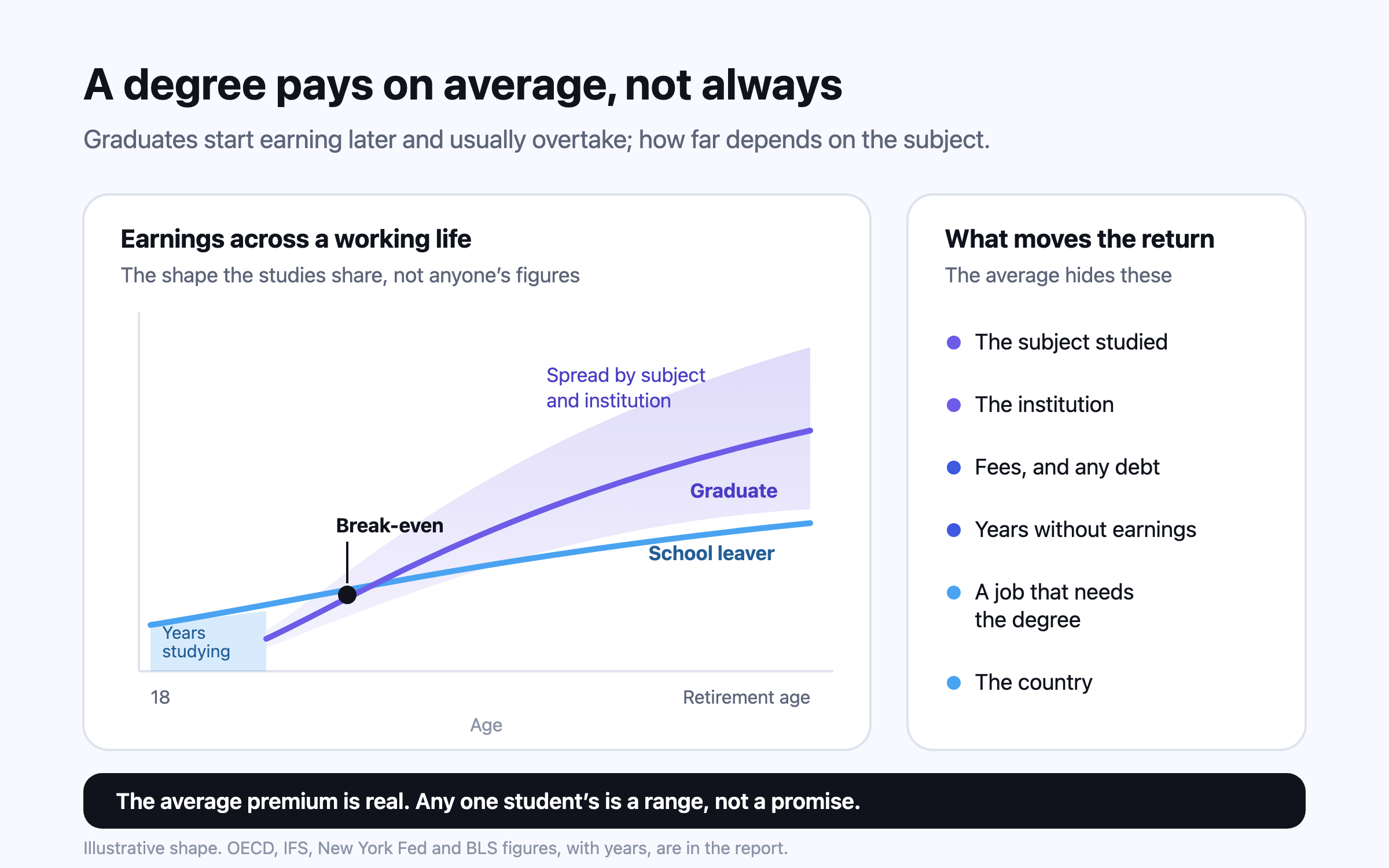
Across the OECD, adults with a tertiary degree earn 54% more than those who stopped at upper secondary school, and are more likely to be in work. The average hides a wide spread: in England about 20% of women and 30% of men can expect a negative lifetime return, and the subject studied makes a very large difference. A degree is usually worth it; whether a particular one is depends on the subject, the cost and the country.
This is general information, not financial, tax or legal advice for your circumstances. Rules and figures change; check the official source for your country, and consult a licensed professional before making financial decisions. Projections are estimates, not predictions.