Money worry is high this autumn and prices are part of the reason. A one-page month, a 20-minute weekly look and a pot for every irregular cost take most of the sting out.
In the APA’s 2026 survey 77% of US adults called the cost of living a significant source of stress, and September prices rose 3.7% in the US and 5.54% in India. A Mumbai family shows the fix: one page for the month, a pot for every irregular cost, payday automation and twenty minutes a week.
Nivritee Research · 3 November 2026 · 11 min read
The short answer: money stress is widespread this autumn, and real prices are feeding it. In the American Psychological Association’s 2026 survey, 77% of US adults named the cost of living as a significant source of stress1, and in the twelve months to September prices rose 3.7% in the US and 5.54% in India2,3. Nobody reading this can change those prices. What takes most of the stress out is smaller and duller: one page that shows where the month’s pay goes, twenty minutes a week to look at it, bills and savings moved automatically on payday, and a separate pot for every cost that does not arrive monthly — school fees, festivals, insurance premiums — so that none of them lands as a shock.
the finance charge on one Indian bank card: 3.6% a month
What the surveys say about money stress now
The APA released its 2026 Stress in America report on 22 October. The Harris Poll surveyed 3,132 adults online between 29 July and 24 August6, and the cost of living — rent, groceries, child care and transportation — was named as a significant source of stress by 77%1. In the same survey 59% said they felt they were doing everything right and still falling behind7. That second figure is the one worth sitting with. It describes people who are not being careless, and who still feel the ground moving.
India has less survey data on this, but what there is points the same way. ManipalCigna’s first India Health Quotient, reported in June, asked 2,600 people in 16 cities about five kinds of health; financial health scored 62 out of 100, the weakest of the five, and 41% said the pressure of pursuing financial goals caused them stress8. Its sample is urban only, so it says nothing about villages and small towns, but it describes the salaried families most likely to be reading this.
Anyone who has lived with money worry knows its shape. The banking app opened at two in the morning to check a balance that has not changed since the evening. The statement left unopened for a week. The argument at home that starts about a takeaway and is really about the school fees. Most of that worry is not about how much money there is. It is about not knowing — not knowing whether this month will close, or which bill is coming next. That part can be fixed this week, whatever prices do.
The month’s news that feeds it
In the US, the Bureau of Labor Statistics reported on 14 October that consumer prices rose 3.7% in the twelve months to September, up from 3.4% in August. Fuel did most of it: energy prices were up 20.4% and gasoline 34.2% over the year, while food rose 2.5% and prices excluding food and energy 2.6%2. On 28 October the Federal Reserve held its policy rate at 3.75% to 4.00%; two members dissented because they wanted a quarter-point rise9.
In India, the statistics ministry reported on 12 October that retail inflation rose to 5.54% in September from 4.83% in August, with food inflation at 7.74% and onion prices up 108.09% on a year earlier10,3. Days before that, on 7 October, the Reserve Bank’s monetary policy committee voted unanimously to raise the repo rate by 25 basis points to 5.50%, and by majority changed its stance to calibrated tightening11. A floating-rate home loan tied to the repo rate follows it up. And it is festival season: the traders’ body CAIT projected in mid-October that trade between Navratri and Diwali would cross ₹7 lakh crore, against about ₹6.05 lakh crore last year12. Diwali itself falls on 8 November this year, so for many families the biggest spending week of the year is still ahead.
In the UK, the Office for National Statistics reported on 21 October that prices rose 3.5% in the year to September, up from 3.1%, with motor fuels up 29.8% and petrol at 169.5 pence a litre, the highest since August 202213. The same story — fuel pushing the headline up — is running in all three countries. How an oil shock reaches a household budget traces the path from the pump to the grocery bill.
How much prices rose in the twelve months to September 2026, in the US, the UK and India.
The headline rate is an average over everything a typical household buys; a family that drives a lot, or spends a large share on food, feels more than the headline. India’s figures are rounded here to one decimal (5.54% and 7.74% as published). 2,13,3The figures in this chart
Rise over 12 months
US, all items
3.7%
US, gasoline
34.2%
UK, all items
3.5%
UK, motor fuels
29.8%
India, all items
5.5%
India, food
7.7%
The debt side of the news is quieter and matters as much. Americans owed $1.26 trillion on credit cards at the end of June, up $21 billion in the quarter, according to the New York Fed4. The Federal Reserve’s own survey of banks put the average interest rate on card accounts that were charged interest at 22.36% in August14. In India card interest is quoted by the month, which makes it look small: one HDFC Bank card’s key fact statement prints 3.6% a month, which it states as 43.2% a year5.
Average interest rate on US credit card accounts charged interest, commercial banks, 2021 to August 2026.
Yearly figures are annual averages; the last point is August 2026, marked preliminary by the Federal Reserve. The rate rose with policy rates in 2022 and 2023 and has stayed near its high since. 14The figures in this chart
Accounts assessed interest
2021
16.45%
2022
17.91%
2023
22.15%
2024
22.89%
2025
22.32%
Aug 2026
22.36%
Meet Farah and Imran
Farah and Imran live in a rented flat in Mumbai with their children, Aarav, who is eleven, and Mira, who is seven. Both work and both are paid on the first of the month. They are not in trouble. They are tired of the feeling that the money disappears, and of three months that always ambush them: the second half of the school fees in October, Diwali straight after, and the health and term insurance renewals in March. Their figures below are illustrative and round, chosen to make the arithmetic easy to follow, not to describe any real family.
One page for the month
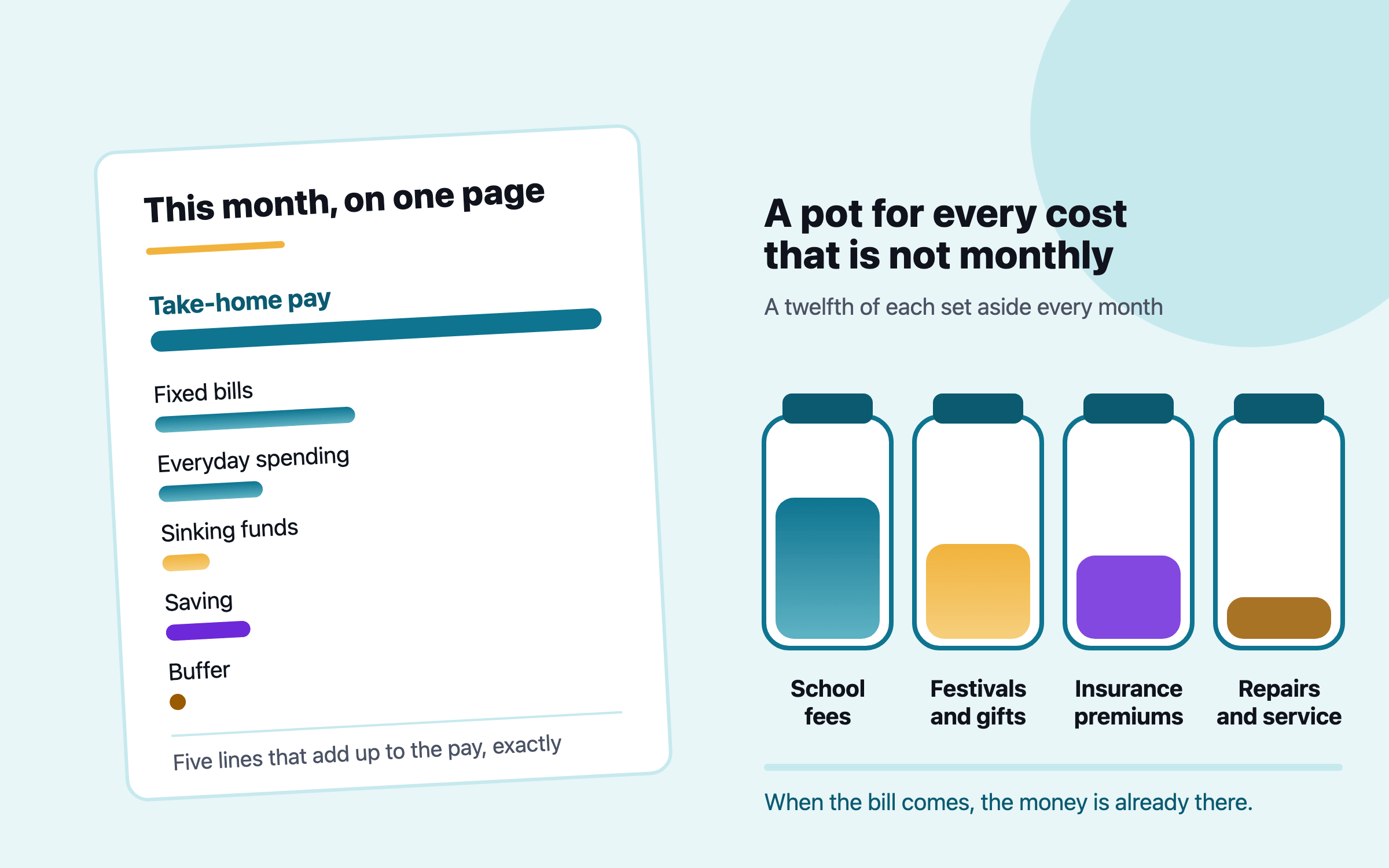
The first thing they do is write the month on one page, in the order money ought to leave the account: the bills that cannot move, the everyday spending, the pots for irregular costs, the saving, and whatever is left. Five lines. Not a budget with forty categories that nobody keeps after the second week — a page they can read in a minute and that adds up to their pay exactly.
Illustrative. Farah and Imran’s month on one page. The five lines below the first add up to the take-home pay exactly, so every rupee has a job before the month starts.
Line
Each month
Share of take-home pay
Take-home pay, both of them
₹1,60,000
100.0%
Fixed bills: rent, car loan EMI, electricity, phone and internet, domestic help
₹71,000
44.4%
Everyday spending: groceries, fuel and travel, eating out
₹37,000
23.1%
Sinking funds for irregular costs (the next table)
₹17,000
10.6%
Saving: SIPs and the emergency fund
₹30,000
18.8%
Buffer, deliberately left unassigned
₹5,000
3.1%
The buffer matters more than it looks. A month always has something nobody planned — a birthday party, a taxi in the rain — and without a line for it, the first surprise reads as failure. With one, a small overspend is just the buffer doing its job. The page also gives them a single signal: if the buffer is gone before the twentieth, something on the page is wrong, and they look at the everyday line first, because that is the one that moves. Budgeting methods compared sets out the other ways to draw the page; the method matters less than having one.
Sinking funds: the cure for the month that ambushes you
Most money stress in a salaried household comes from costs that are perfectly predictable and simply not monthly. School fees, festivals, insurance premiums, the car service, a wedding in the family: every one of them is known in January, and every one of them still arrives as a crisis because it is paid out of a single month’s pay. A sinking fund turns that around. Add up what each irregular cost comes to in a year, divide by twelve, and move that amount every month into a separate account that is not for spending. When the bill comes, the money is already sitting there.
Illustrative. Each monthly amount is the yearly cost divided by twelve; the four together are the sinking-fund line on the one-page month.
Irregular cost
Over a year
When it lands
Set aside each month
School fees, both children
₹96,000
April and October, in two halves
₹8,000
Festivals and gifts: Diwali, birthdays, family weddings
₹48,000
Mostly October and November
₹4,000
Health and term insurance premiums
₹42,000
March
₹3,500
Car service and home repairs
₹18,000
Any month
₹1,500
All four pots
₹2,04,000
₹17,000
Look at what the festival pot does to one month. Without it, the whole of Diwali is paid out of November’s salary, and it takes close to a third of the month — which is exactly when people reach for the credit card. With it, November’s pay carries only that month’s share, the same as every other month, and the rest is already in the pot from the eleven months before.
Illustrative. The same Diwali, the same spending, paid two ways.
The festival month
Paid from that month’s pay
Share of take-home pay
Without a festival pot
₹48,000
30.0%
With a festival pot
₹4,000
2.5%
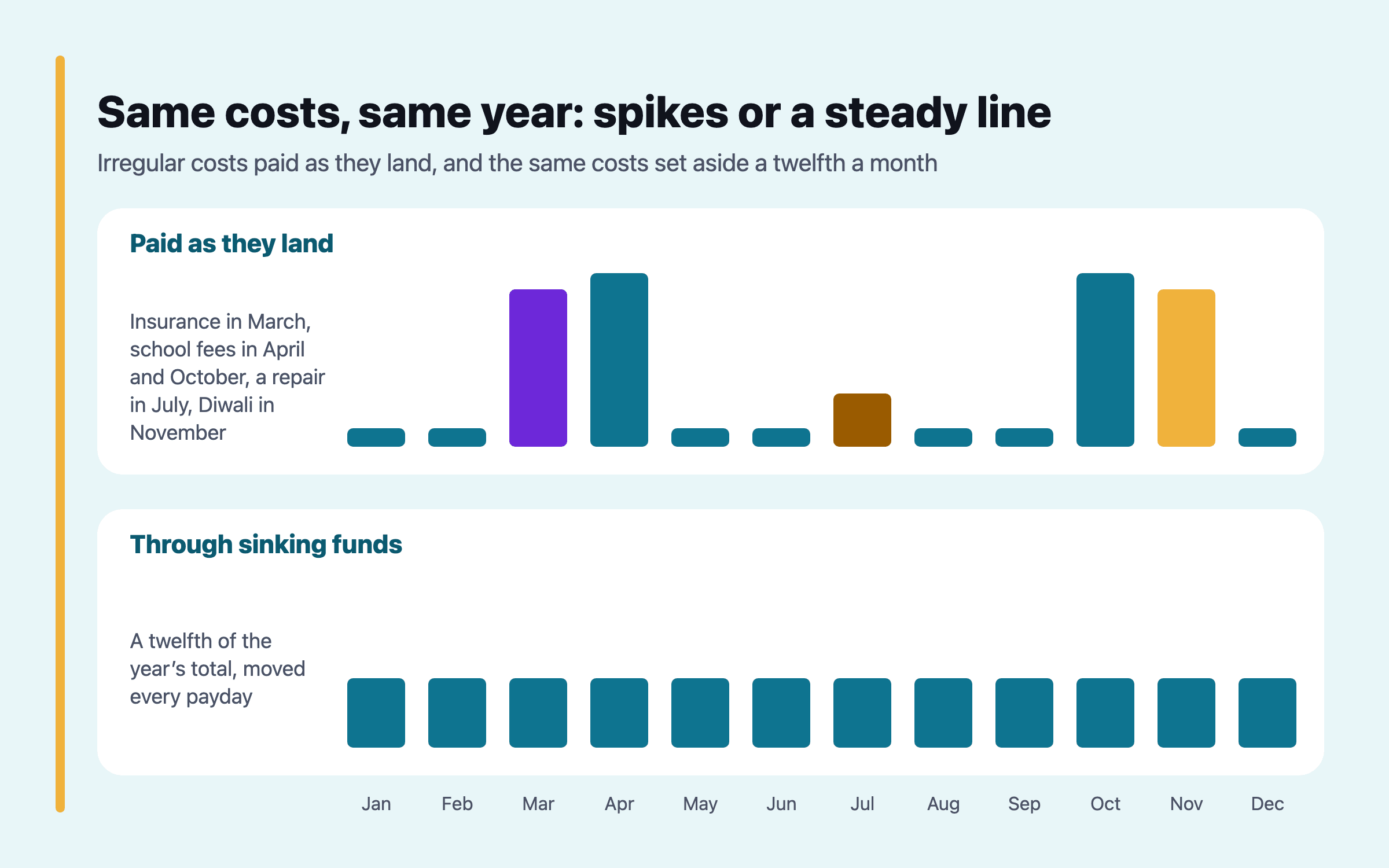
The same year of irregular costs, paid as they land and paid through sinking funds. The total is identical; only the spikes go.
Where the pots live matters less than that they are separate from the spending account. A second savings account, a recurring deposit timed to mature before the fees fall due, or one account with the four pots tracked on the page all work. What does not work is keeping them in the account the debit card draws on, because money that is visible on the balance gets spent. If this year’s festival pot is short because it was started late, the honest move is to spend what is in it and start next year’s in December — not to make up the gap on a card.
What to automate on payday
The page tells Farah and Imran what should happen. Automation makes sure it does, without either of them deciding again each month. The rule is that everything that leaves for a job — bills, pots, saving — leaves in the first two days, and whatever stays in the main account is genuinely free to spend.
Payday, day one: both salaries land in the account the bills are paid from.
The same day: a standing instruction moves the sinking-fund amount to the separate pots account.
Day two: the SIPs are dated the day after payday, so they never compete with a bill.
Day two: a second standing instruction moves the emergency-fund amount until the fund reaches its target, then stops — or switches to a SIP.
Through the month: rent, the car loan, electricity, phone and the insurance premiums run on auto-debit, and the credit card is set to pay the full statement balance, never the minimum.
What remains is the everyday line and the buffer, and the balance on the screen is now a true answer to the question “can we afford this?”
The emergency fund is the one automatic transfer with an end. Farah and Imran count their essentials — fixed bills, groceries, fuel — and aim for three months of them as a first target, the bottom of the usual three-to-six-month rule that how big an emergency fund should be works through. They already have some saved; the table shows how long the monthly transfer takes to close the gap, and the chart shows the same thing as months of cover, which is the number that actually lets a person sleep. A money system that runs itself has the evidence on why automatic saving sticks when good intentions do not.
Illustrative. The last row rounds up: fifteen transfers fall just short, so the sixteenth finishes it.
Emergency fund
Amount
Essentials each month: fixed bills, groceries, fuel and travel
₹1,01,000
Target: three months of essentials
₹3,03,000
Already saved
₹1,50,000
Still to save
₹1,53,000
Monthly transfer
₹10,000
Months to reach the target
16
Illustrative: Farah and Imran’s emergency fund, in months of essential spending it would cover.
Illustrative. What they hold divided by a month of essentials, with the same transfer every month. Three months is passed in the sixteenth month; the line is drawn to eighteen. The figures in this chart
Months of essentials covered
Now
1.5 months
Month 3
1.8 months
Month 6
2.1 months
Month 9
2.4 months
Month 12
2.7 months
Month 15
3.0 months
Month 18
3.3 months
A 20-minute weekly money routine
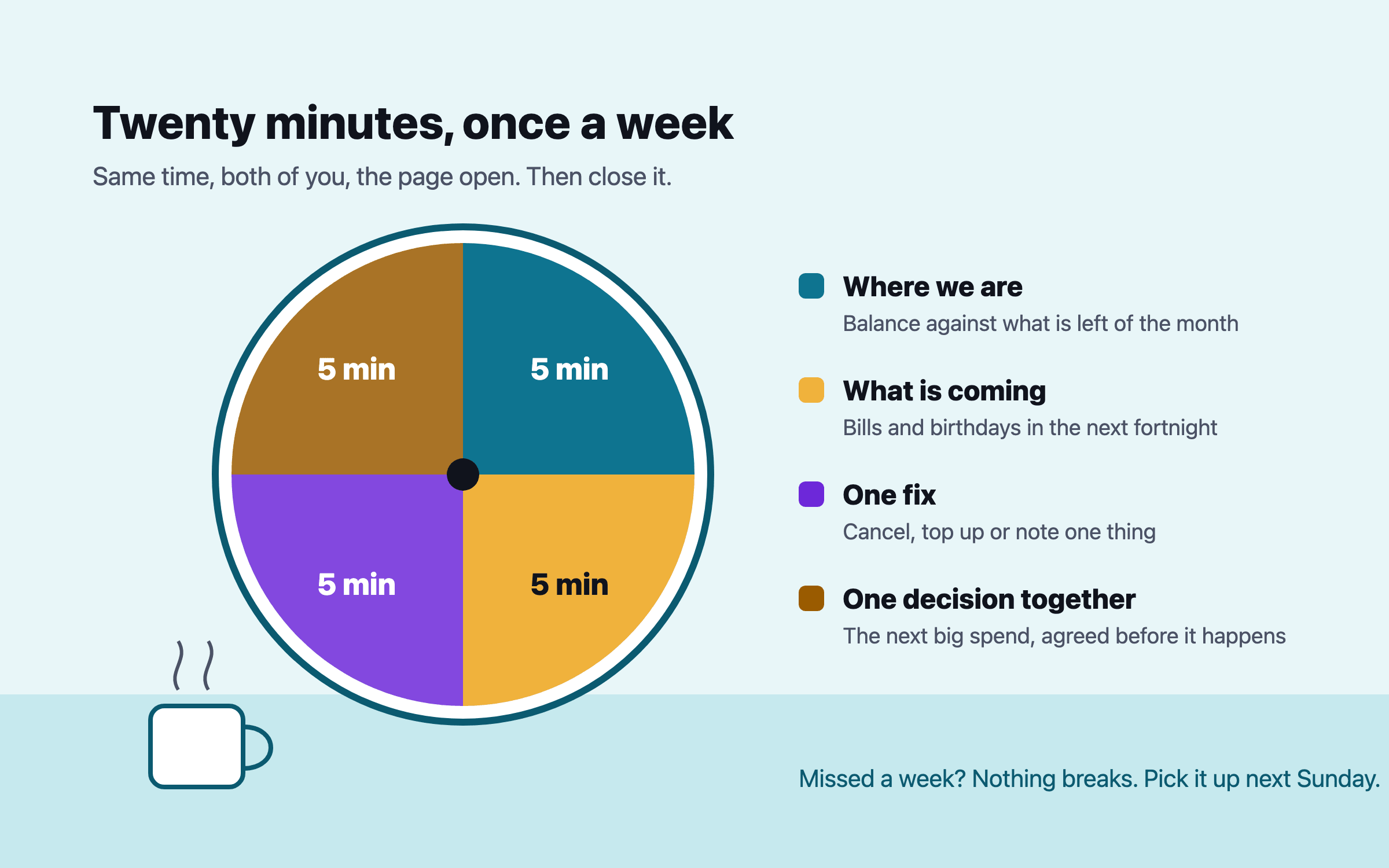
A monthly reckoning is where stress gathers: four weeks of small drifts, discovered all at once, usually by the person who did not cause them. Farah and Imran replace it with twenty minutes on Sunday morning, with tea, both of them, the page open. The two o’clock check of the app becomes unnecessary because there is a time when the looking happens.
Five minutes — where we are. The balance in the spending account against what is left of the everyday line and the buffer for the month.
Five minutes — what is coming. Any bill, renewal or birthday in the next fortnight, and whether its pot holds enough.
Five minutes — one fix. One thing: cancel a subscription nobody uses, move a little from the buffer to the festival pot, or note a line that is running high.
Five minutes — one decision together. The next spend above the amount they agreed to discuss first, or the plan for the coming weekend. Then close the page.
Twenty minutes, once a week, at the same time. Small drifts are caught while they are small.
The routine works because it is short and because it ends. It is not a review of everything the household has ever spent. If one Sunday is missed, nothing breaks; the next one picks up where it was. And it is the right time for the slower questions too, once a quarter or so: whether the SIPs still match what the children’s education will need, or whether the emergency fund has reached its target and the transfer should switch.
Talking about money as a couple without a fight
Money arguments are rarely about the item that started them. They are about one person carrying the worry alone, or one person feeling watched. The page helps because it moves the conversation from “you spent” to “the everyday line is running high”, which is a fact about a number rather than a verdict on a person. A few habits make the rest easier. Talk at the agreed time, not in the middle of a bill. Give each person a small personal allowance that the other never asks about. Agree an amount above which either of you checks with the other before buying, and keep it the same for both. Decide the festival budget together before anybody goes shopping, not afterwards over the card statement.
Whether the money is pooled, split or partly both is a choice each couple makes differently, and joint or separate finances sets out what each arrangement does well. What matters for stress is that both people can see the same page. Talking about money as a couple has more on starting the conversation if it has never really happened.
What the card costs if Diwali goes on it
The card is where an ambush month turns into a lasting cost. At 3.6% a month — the finance charge printed on one HDFC Bank card, before GST5 — a festival put on the card and not cleared is expensive quickly, and the table below shows how expensive. In the US the arithmetic is gentler but the same in kind: a $3,000 balance carried at the Fed’s August average of 22.36% costs about $56 in interest for one month14.
Illustrative amount, at the monthly rate in one HDFC Bank card’s key fact statement. Six equal payments are worked as a loan at 3.6% a month; GST is charged on interest on top. Your own card’s key fact statement gives its rate. 5
A ₹60,000 festival on the card, at 3.6% a month
Paid each month
Interest, before GST
Statement paid in full by the due date
₹60,000, once
₹0
Carried for one month, then paid in full
₹62,160, once
₹2,160
Cleared in six equal monthly payments
₹11,297
₹7,783
The lesson is not that cards are bad. Paid in full, a card costs nothing and its statement is a useful record of the month. The cost is in carrying a balance, and the sinking fund is what removes the reason to. If a balance is already there, clearing it usually comes before investing more, because almost nothing a household can invest in reliably earns what the card charges; paying off debt or investing works through the order.
When a month goes wrong
Some months go wrong however good the page is: a hospital visit, a car repair, a gap between jobs. The worst thing to do is not to look. These are the steps Farah and Imran agree in advance, on a calm Sunday, so that they do not have to invent them in a bad week.
Look at the page first. Write the shortfall down as a number. A number is a problem to solve; a feeling is not.
Cover the essentials and every minimum payment. Rent, food, medicine and at least the minimum on each loan and card, so that nothing adds late fees or a mark on a credit report.
Use the right pot. A repair comes from the repairs pot; a real emergency comes from the emergency fund. That is what they are for, and using them is the plan working.
Pause rather than stop. If the month cannot carry the SIPs, many fund houses let a SIP be paused for a few months; pausing keeps the habit, where cancelling tends to end it.
Call the lender early. A bank asked before a missed payment has more options than one asked after it.
Refill before resuming. When the month recovers, the buffer and then the emptied pot are topped up first, and the next pay rise goes there before it goes anywhere else.
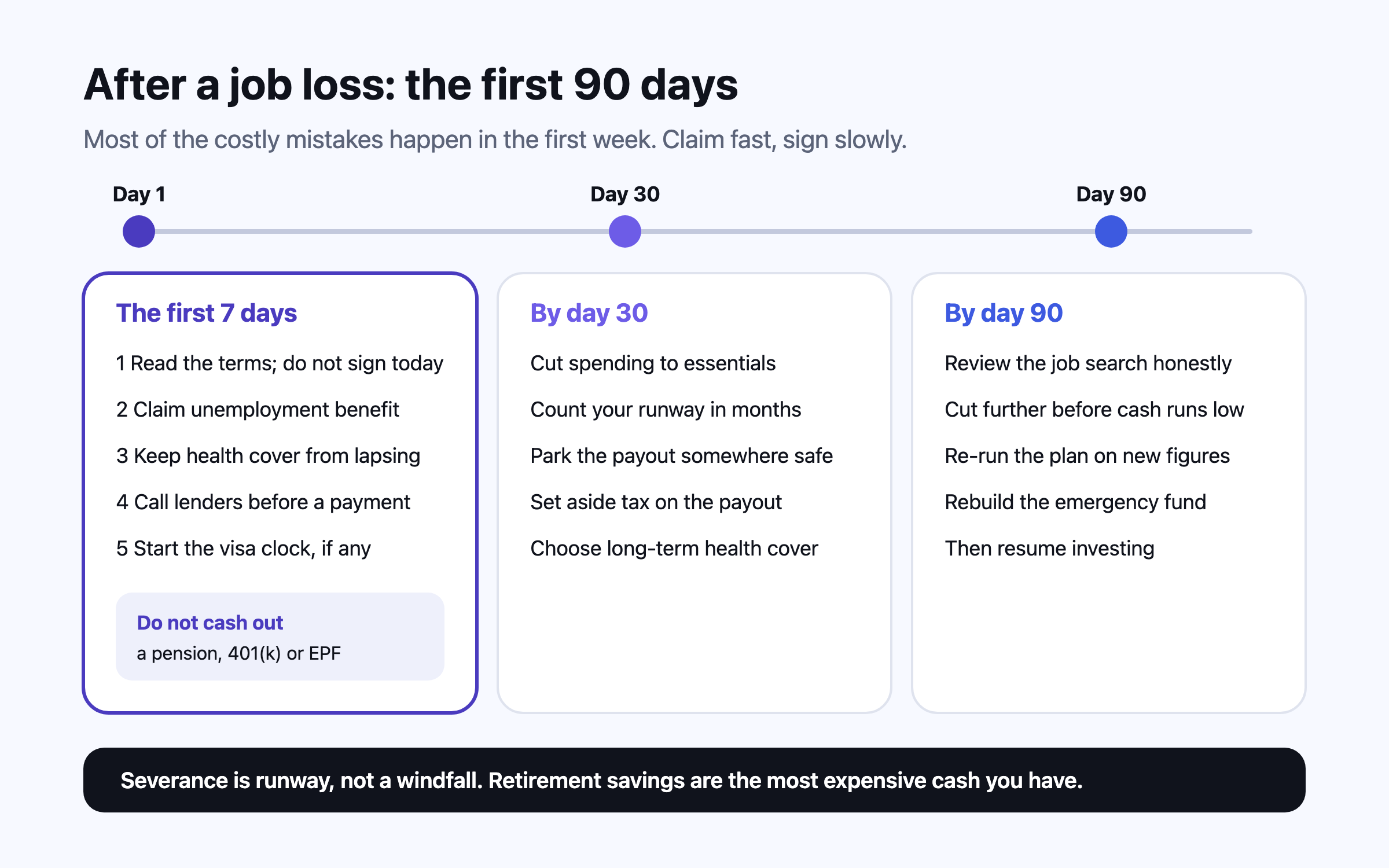
If the problem is bigger than a month — a lost job, an income that has fallen for good — the page still helps, but the order of what to do changes; what to do after a job loss takes it in sequence. And if the worry itself has become hard to carry, it is worth saying so to someone, a partner, a friend or a doctor. Money stress is common, and the surveys this autumn show how common, which also means nobody feeling it is unusual.
Questions people ask
How do I stop stressing about money every month?
Most monthly money stress comes from not knowing whether the month will close. Write the month on one page that adds up to your pay, move bills and savings automatically on payday, keep a small buffer, and look at it for twenty minutes once a week, so the looking happens at a set time instead of at two in the morning.
What is a sinking fund and how do I calculate it?
A sinking fund is money set aside every month for a cost that is predictable but not monthly, such as school fees, festivals or an insurance premium. Add up what the cost comes to over a year and divide by twelve; that is the monthly amount to move into a separate account, so the bill is already covered when it arrives.
How much interest does a credit card charge in India?
Indian cards quote interest by the month, and it is high once annualised: one HDFC Bank card’s key fact statement prints 3.6% a month, which it states as 43.2% a year, with GST charged on the interest on top5. Your own card’s rate is in its key fact statement.
What should I automate on payday?
Everything that leaves the account for a job: a transfer to your sinking funds, your SIPs dated the day after pay, a transfer to the emergency fund until it is full, and the bills on auto-debit, with the credit card set to pay the full statement balance. Whatever is left is the money you can spend.
How do couples talk about money without fighting?
Talk at an agreed time rather than in the middle of a bill, look at the same page of figures so the conversation is about a number and not a person, give each partner a small allowance nobody asks about, and agree one amount above which either of you checks before buying.
What do I do if I overspend in a month?
Write the shortfall down as a number, cover essentials and every minimum payment, take the money from the right pot or the emergency fund, pause rather than cancel any SIP if you must, and refill the buffer and the pot first when the next month allows.
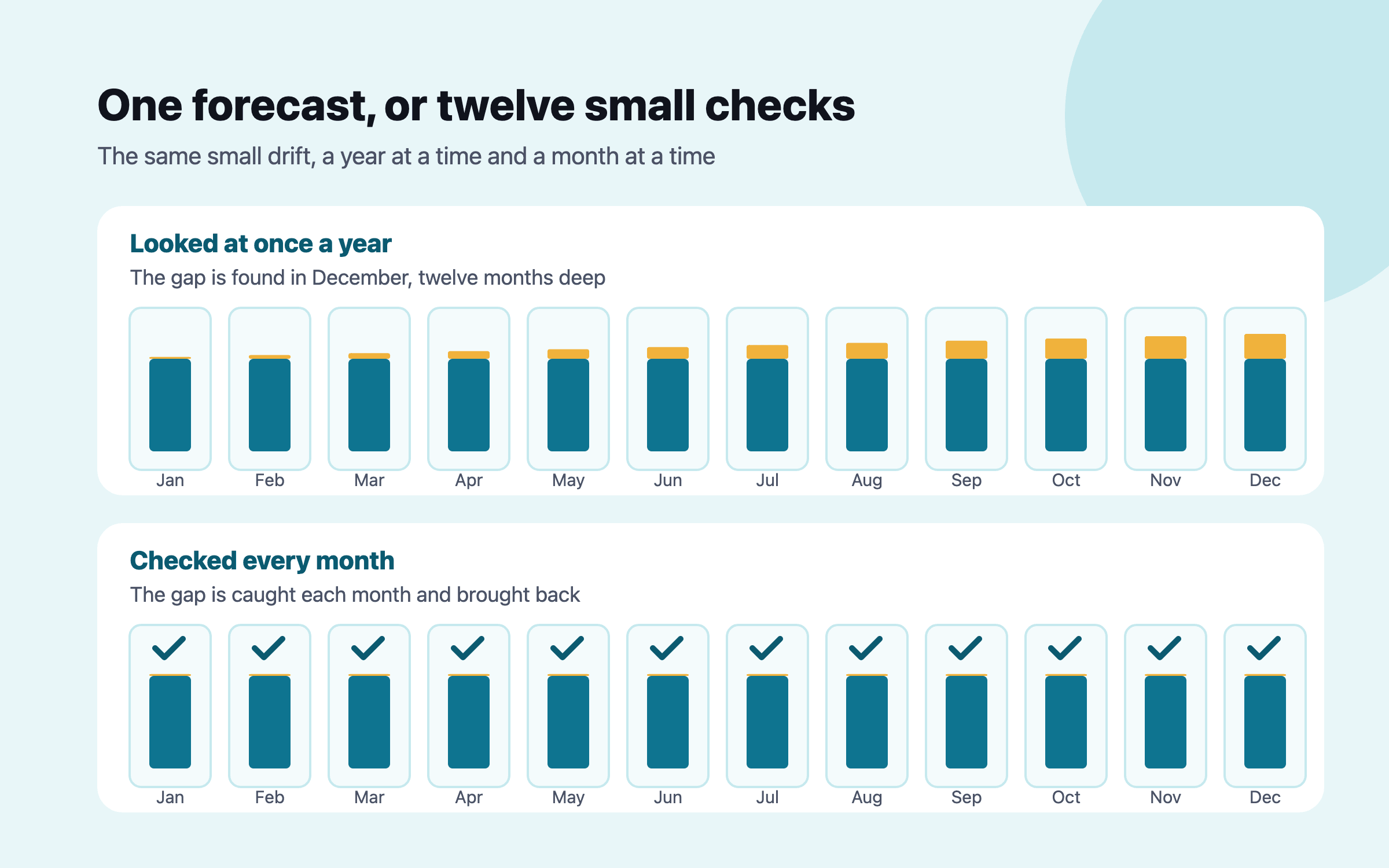
People underestimate what lies ahead even when asked for a worst case: students in a classic study took 55.5 days over theses they expected to finish in 33.9. A yearly budget is that kind of forecast. A short check at the end of each month catches drifts while they are small, sees the irregular month coming and keeps every month on the record.
US employers announced 43,281 job cuts in September 2026 and technology led every sector, while India’s big IT firms moved in opposite directions. If your job is the one people are whispering about, the useful work is done before any notice arrives: count your runway in months, plan your cuts in order, check your contract and cover, and talk it through at home.
Most of the expensive mistakes after a layoff happen in the first fortnight: signing a severance agreement unread, claiming benefits late, letting health cover lapse, missing a loan payment without calling the lender, and cashing out retirement savings. This is the order to do things in, with the 2026 rules for the US, UK, India, Canada, Australia, Singapore and the UAE.
This is general information, not financial, tax or legal advice for your circumstances. Rules and figures change; check the official source for your country, and consult a licensed professional before making financial decisions. Projections are estimates, not predictions.