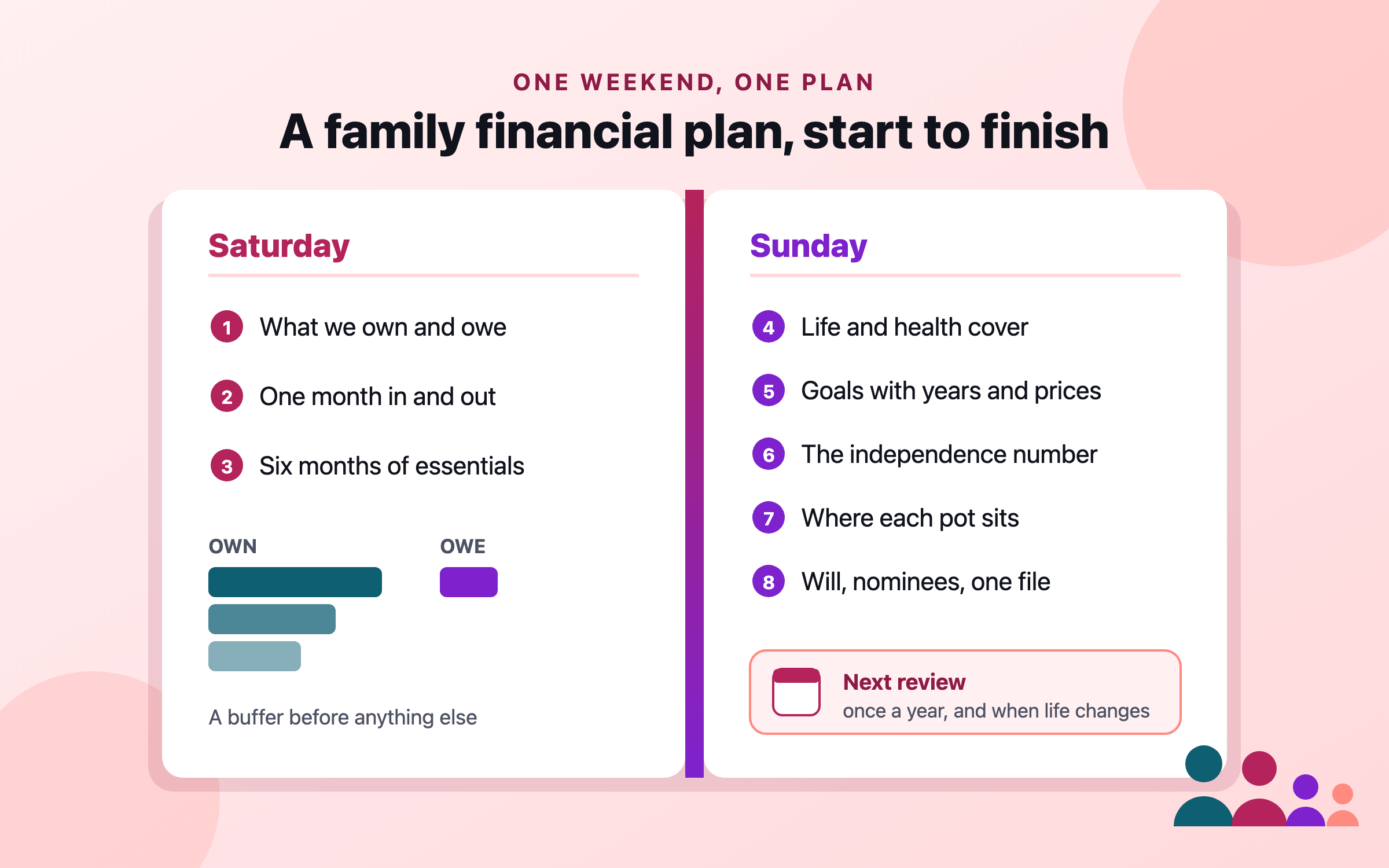
A family financial plan fits in one weekend: what you own and owe, a month’s cash flow, a buffer, cover, goals with years, an independence number, and a date to look again.
Sana and Arif, two earners with two children in Hyderabad, list what they own and owe, find a monthly surplus of ₹50,000, fill a six-month buffer, size term and health cover, price two degrees and a home in the years they fall due, and work out an independence number. The honest result is that the surplus covers the near goals and about a third of the far one, which tells them exactly which lever to pull.
Nivritee Research · 6 November 2026 · 10 min read
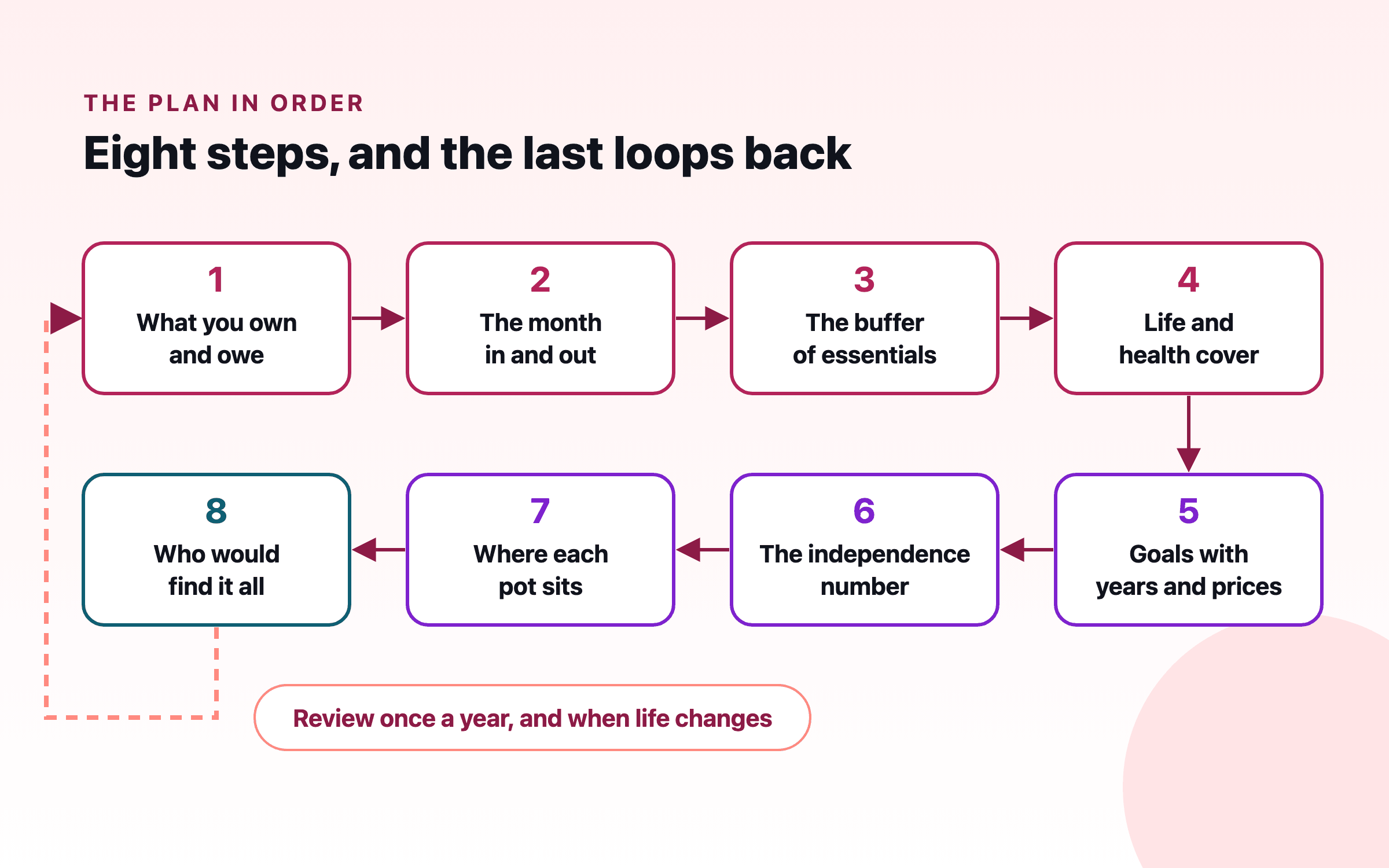
The short answer: a family financial plan is not a document a professional hands you. It is eight questions answered in order, with real figures, and most families can answer them in a weekend. What do we own and owe? What comes in and goes out each month? How long could we last without a salary? What happens if one of us dies or falls ill? What do the children’s education and a home cost in the year we pay for them? How much is enough to stop working? Where should each pot of money sit? Who would find it all? This article follows one household through every step, beside the news of a month when Indian inflation reached 5.54%1 and the Reserve Bank raised its policy rate2.
Urban unemployment in India in September 2026, from 6.8% in August
The household, and the month they started
Sana and Arif live in a rented flat in Hyderabad with Ananya, who is eight, and Vihaan, who is four. Arif is 36 and works in IT; Sana is 35 and works for a pharmaceutical company. Their pay and spending are in the tables below. They are an invented family with round numbers, but their position is a common one: two salaries, some savings in several places, no plan that joins them up, and a vague worry that surfaces at night after a bad week in the markets.
They picked a bad-looking month to start, which is exactly why it is a good one to follow. Retail inflation for September came out on 12 October at 5.54%, the highest so far in 2026 and above the Reserve Bank’s 4% target for a fourth month; food was up 7.74%1. On 7 October the RBI had already raised the repo rate by a quarter point to 5.50% and changed its stance to “calibrated tightening”, projecting 5.2% inflation for the year to March 20272. SBI raised its home loan benchmark rates by the same quarter point from 15 October, putting regular home loans at 7.50% to 8.80%5. The Nifty 50, which reached a record intraday high of 26,373 on 5 January, closed at 22,620 on 30 September, about 14% lower6; by 4 November it had recovered to 23,960.603.
The Nifty 50 at its 2026 intraday record, at the end of September and on 4 November.
A fall of about 14% from the intraday record by 30 September, and a partial recovery in October. None of this changes what a goal ten years away costs; it changes how the money for it feels this month. 6,3The figures in this chart
Nifty 50 level
5 Jan 2026 (intraday record)
26,373
30 Sep 2026
22,620
4 Nov 2026
23,961
None of this news tells Sana and Arif what to do. It changes some numbers in their plan, and it is better to see which ones than to carry all of it around as one general unease. If you are reading this in the middle of a falling market, why a long-term plan survives a short-term storm and managing money without the stress are the companions to this piece.
Saturday morning: what we own and what we owe
The first hour goes on a list. Every account, deposit, fund, provident fund balance and loan, at today’s value, with the gold valued at what it would fetch and the car left out because nobody plans to sell it to pay for a degree. The rules for valuing each line are in the family balance sheet.
Sana and Arif’s balance sheet, illustrative and in round rupees. Net worth is what they own less what they owe; the last line is what their goals can draw on.
Line
Value today
Can it fund a goal?
Savings account and fixed deposits
₹4,00,000
Yes, and it is the emergency fund
Equity mutual funds (monthly SIPs for four years)
₹12,00,000
Yes
EPF and PPF
₹10,00,000
Yes, mostly for independence
Gold jewellery
₹6,00,000
Counted in net worth, not planned on
Total owned
₹32,00,000
Car loan
₹3,00,000
Net worth
₹29,00,000
Money that can fund goals (everything but the gold)
₹26,00,000
Two things come out of the list straight away. Their money sits in five places that nobody had added up before, and the figure that can fund goals is smaller than the net worth, because family gold is not something they intend to sell. That gap is normal, and writing it down is what stops a family from counting the same jewellery as both an heirloom and a deposit.
Saturday afternoon: one month in and out
Next comes the month. They take three months of bank and card statements, sort the spending into a dozen lines, and divide by three. School fees, paid twice a year, are spread into a monthly figure so that the months they fall due do not look like emergencies.
An average month, from three months of statements. Illustrative figures.
Monthly line
Amount
Take-home pay (Arif ₹1,10,000, Sana ₹70,000)
₹1,80,000
Rent
₹30,000
Groceries and household
₹25,000
School fees, spread monthly
₹15,000
Fuel and transport
₹10,000
Electricity, phones, internet
₹6,000
Support for Arif’s parents
₹10,000
Insurance premiums
₹4,000
Car loan EMI
₹10,000
Eating out, holidays, shopping
₹20,000
Total spending
₹1,30,000
Surplus
₹50,000 (27.8% of take-home)
A surplus of ₹50,000 a month is a healthy start, but September’s inflation shows up here first. If their ₹25,000 grocery bill rose at September’s food rate of 7.74%, it would cost ₹1,935 more each month a year from now1, about ₹23,220 over a year, before anything else moves. The plan does not need them to forecast inflation. It needs each line to grow at a rate that makes sense for that line, which is why school fees and medical costs get rates of their own below rather than sharing one average.
The buffer: six months of the essentials
The emergency fund is sized on the spending that would continue if a salary stopped: everything in the month except eating out, holidays and shopping. Six months of that is their target, and the table shows how far they are from it and how they close the gap.
The buffer, worked out from the monthly table. Illustrative figures.
Emergency fund
Amount
Essential spending a month (₹1,30,000 less ₹20,000)
₹1,10,000
Six months of essentials
₹6,60,000
Savings and deposits now (about 3.6 months)
₹4,00,000
Gap
₹2,60,000
Added each month for ten months
₹26,000
Why six months for a two-earner family? Because both salaries come from industries that hire and cut together with the wider economy, and because finding a job takes time even in a steady market: urban unemployment in India was 6.9% in September4. The full reasoning, and what to do in the first month after a job goes, is in how big an emergency fund should be and a money plan for before the layoff.
Months of essential spending the buffer covers, as Sana and Arif add to it.
Illustrative: the household’s savings and deposits divided by its monthly essentials, with a fixed addition each month. The line reaches six months in month ten. The figures in this chart
Months covered
Now
3.6 months
Month 2
4.1 months
Month 4
4.6 months
Month 6
5.1 months
Month 8
5.5 months
Month 10
6.0 months
Sunday morning: cover for the two things a buffer cannot fix
A buffer covers months. A death or a long illness can take years of income away, and that is what insurance is for. They work the term cover out from needs rather than from a multiple of salary: fifteen years of the lost take-home pay (until Vihaan is 19), plus the car loan, plus both degrees at today’s cost, less the money they could already draw on. The calculation assumes the payout, once invested, roughly keeps pace with prices, which is a simplification; it is a starting figure to compare with quotes, not an answer to the rupee.
A needs-based estimate of term life cover for each earner. Illustrative figures; quotes and term lengths vary.
Term cover need
If Arif died
If Sana died
Take-home lost per year
₹13,20,000
₹8,40,000
× 15 years
₹1,98,00,000
₹1,26,00,000
+ car loan
₹3,00,000
₹3,00,000
+ two degrees at today’s cost
₹30,00,000
₹30,00,000
− money that can already fund goals
₹26,00,000
₹26,00,000
Cover needed
₹2,05,00,000
₹1,33,00,000
Health is the second gap. Their only cover is through Arif’s employer, at ₹5 lakh for the family, and it ends on the day the job does. Medical costs are the fastest-rising line in an Indian plan: Nivritee’s default for India is 12.9% a year, India’s own figure from WTW’s 2026 survey, against 4% for prices generally7. At that rate a ₹10 lakh hospital bill today becomes about ₹33.6 lakh in ten years. So they buy a family floater of their own, separate from any job, and put a note in the calendar to look at its size every three years. Which policies to buy first, and the ones to avoid, are in insurance basics.
Goals with years and prices
A goal without a year is a wish. Sana and Arif write three down, each with the year it falls due and what it would cost today, and carry each forward at its own rate: school and university costs at Nivritee’s India default of 4.74% a year, and the home at 4%, the general inflation default, as a stand-in for flat prices in their part of the city7. A flat could rise faster or slower than that; the point is to start from a figure they can revise.
Each goal carried forward at its own rate: cost today × (1 + rate) raised to the number of years. 7
Goal
Year
Cost today
Rate a year
Cost when due
Ananya’s degree
2036 (10 years)
₹15,00,000
4.74%
₹23.84 lakh
Vihaan’s degree
2040 (14 years)
₹15,00,000
4.74%
₹28.69 lakh
A flat of their own
2032 (6 years)
₹75,00,000
4.0%
₹94.90 lakh
Down payment on the flat (20%)
2032
₹18.98 lakh
What each cost becomes by the year it is paid, with today’s cost as 100.
At Nivritee’s India default rates: 4% for the flat, 4.74% for education and 12.9% for medical costs. The hospital bill is the reason health cover needs reviewing, not buying once. 7The figures in this chart
Cost when due (today = 100)
The flat, in 6 years
127
Ananya’s degree, in 10 years
159
Vihaan’s degree, in 14 years
191
A hospital bill, in 10 years
337
This month’s rate rise reaches the flat too. On a ₹75.92 lakh loan over 20 years, the 80% left after the down payment, the EMI is about ₹63,502 at 8% and ₹64,688 at 8.25%, a difference of ₹1,186 a month from one quarter-point move; BankBazaar’s table for a ₹50 lakh loan shows the same arithmetic, ₹41,822 rising to ₹42,6035. The EMI would replace the ₹30,000 rent, so the year they buy is also the year their monthly budget changes shape. That is a reason to test the purchase in a projection, year by year, rather than in a single sum.
The whole plan is eight steps in order, and the last one loops back to the first.
The independence number
The largest goal is the one with no invoice: the day work becomes optional. Arif would like that to be at 55, in 2045. They start from what life would cost then, in today’s money. The rent goes once they own the flat, school fees and the car loan end, and holidays and health premiums rise, so they settle on ₹1,00,000 a month, or ₹12 lakh a year. Morningstar’s forward-looking estimate for a 35-year withdrawal with a 90% chance of money remaining is 3.5% a year8, which puts their independence number at about ₹3.43 crore in today’s money. William Bengen’s original 4% from US history9 would give ₹3 crore. How the rate changes by country, and why a lower one suits a longer stretch, is in the 4% rule by country and how much you need to stop working.
Then a rough check, in today’s money so inflation drops out. At Nivritee’s India default return while working of 9.6% and 4% inflation, money grows about 5.38% a year in real terms7. Their ₹10 lakh in EPF and PPF would be worth about ₹27.09 lakh in today’s money by 55. If the ₹26,000 now going to the buffer moves to this goal from month eleven, it adds about ₹94.55 lakh. Together that is ₹1.22 crore, about 35% of the ₹3.43 crore target. Closing the gap from savings alone would take about ₹86,800 a month from now.
This is the moment many families stop, because the number looks unreachable. It is not the end of the calculation. The check leaves out the provident fund contributions both salaries add every month, and pay rises; Nivritee’s default for urban salaried earnings growth in India is 5.75% a year7. A SIP raised with each increment, a target age of 57 instead of 55, or a slightly smaller monthly figure at independence each move the answer, and a projection can show how far each one goes. What the rough check does is tell them which lever matters most. For this household it is raising the monthly saving as salaries rise, not fine-tuning which fund holds the education money.
Where each pot of money sits
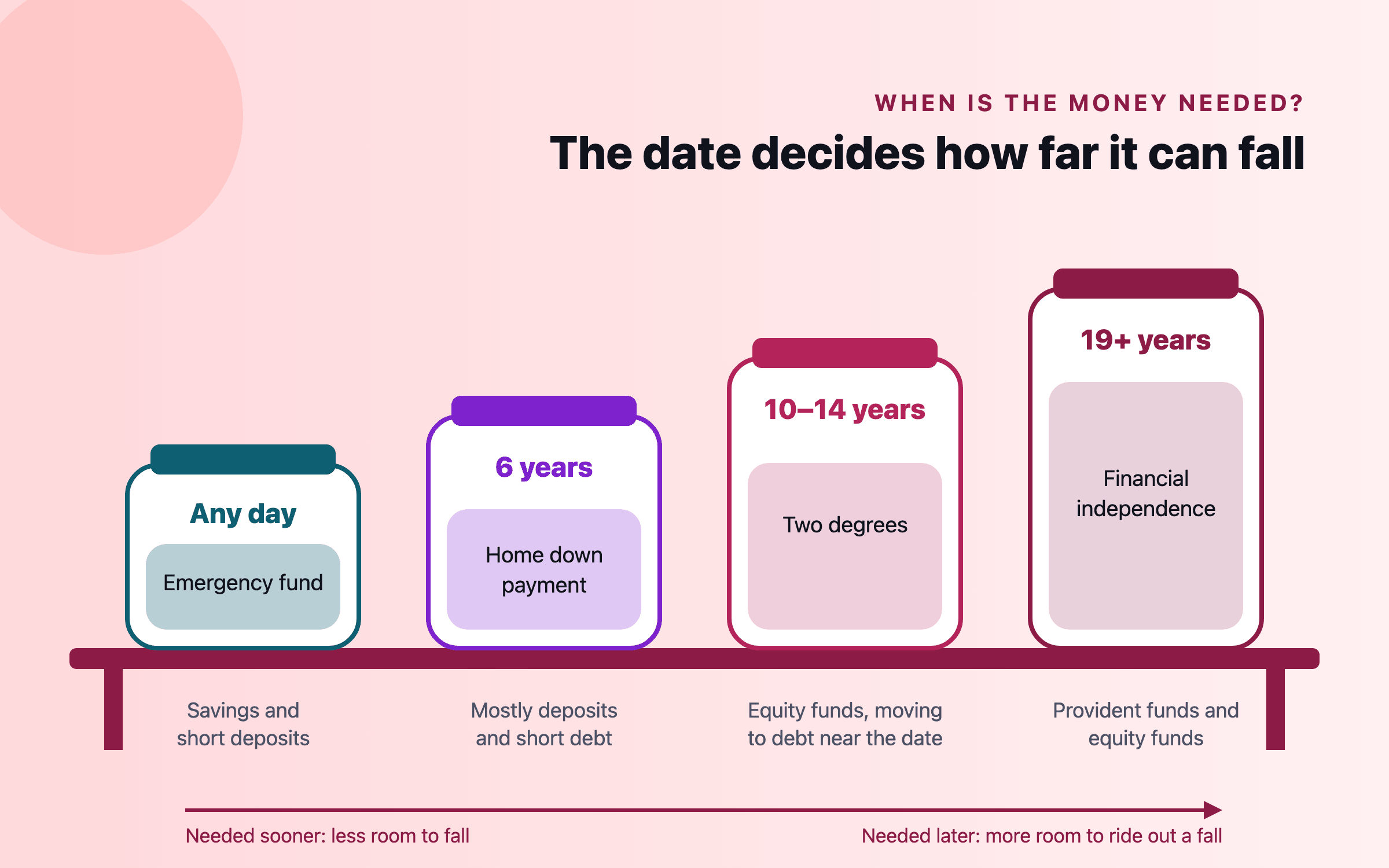
With every goal dated, the question of what to invest in mostly answers itself: money needed soon should not be able to fall far, and money needed in fifteen years can ride out the kind of fall the Nifty took this year. The table matches each of their goals to the kind of holding that usually fits its horizon. It is a description of a common approach, not a recommendation of a product.
The down payment SIP assumes 7.1% a year, what PPF pays for October–December 2026; the education SIPs assume 9.6%, Nivritee’s India default return while working. Illustrative figures. 10,7
Pot
When needed
What usually fits
Monthly amount
Emergency fund
Any day
Savings account, sweep or short fixed deposits
₹26,000 for 10 months
Flat down payment
6 years
Mostly deposits, PPF-like or short-term debt; little equity
₹21,220
Ananya’s degree
10 years
Equity funds now, moving to debt over the last three years
₹4,410 plus ₹6 lakh of existing funds
Vihaan’s degree
14 years
Mostly equity funds, moving later
₹2,000 plus ₹6 lakh of existing funds
Independence
19 years and beyond
EPF and PPF, plus diversified equity funds
₹26,000 from month 11
Total for the first ten months
₹53,630
The arithmetic behind the middle column is a standard SIP formula. To have ₹18.98 lakh in six years at 7.1% a year, roughly what PPF pays this quarter10, takes about ₹21,220 a month. For the degrees they put ₹6 lakh of their existing funds against each child; at 9.6% that grows to about ₹15.01 lakh by Ananya’s year and ₹21.65 lakh by Vihaan’s, leaving gaps that SIPs of about ₹4,410 and ₹2,000 close7.
The first ten months need ₹53,630 against a surplus of ₹50,000. They close the ₹3,630 by trimming eating out and shopping, and keep the trim afterwards so that the ₹26,000 can move to independence once the buffer is full7. This is the real work of a family plan: not finding the perfect fund, but deciding together what gives when the sums do not quite fit. How couples have that conversation without it becoming an argument is the subject of joint or separate finances.
Each pot of money is matched to when it is needed, which decides how far it can afford to fall.
If you are planning from the US this month
The same eight steps work anywhere; only the numbers that feed them change. In the US, consumer prices rose 3.7% in the year to September and 2.6% excluding food and energy, with gasoline up 34.2%, which makes fuel the line in the monthly budget most worth re-checking11. The Federal Reserve held its target range at 3.75% to 4% on 28 October, saying inflation remains elevated12. Payrolls grew by 165,000 in October and unemployment was 4.1%13. A buffer is still sized for the household’s own industry, not the national average.
Who would find it all: will, nominees and one file
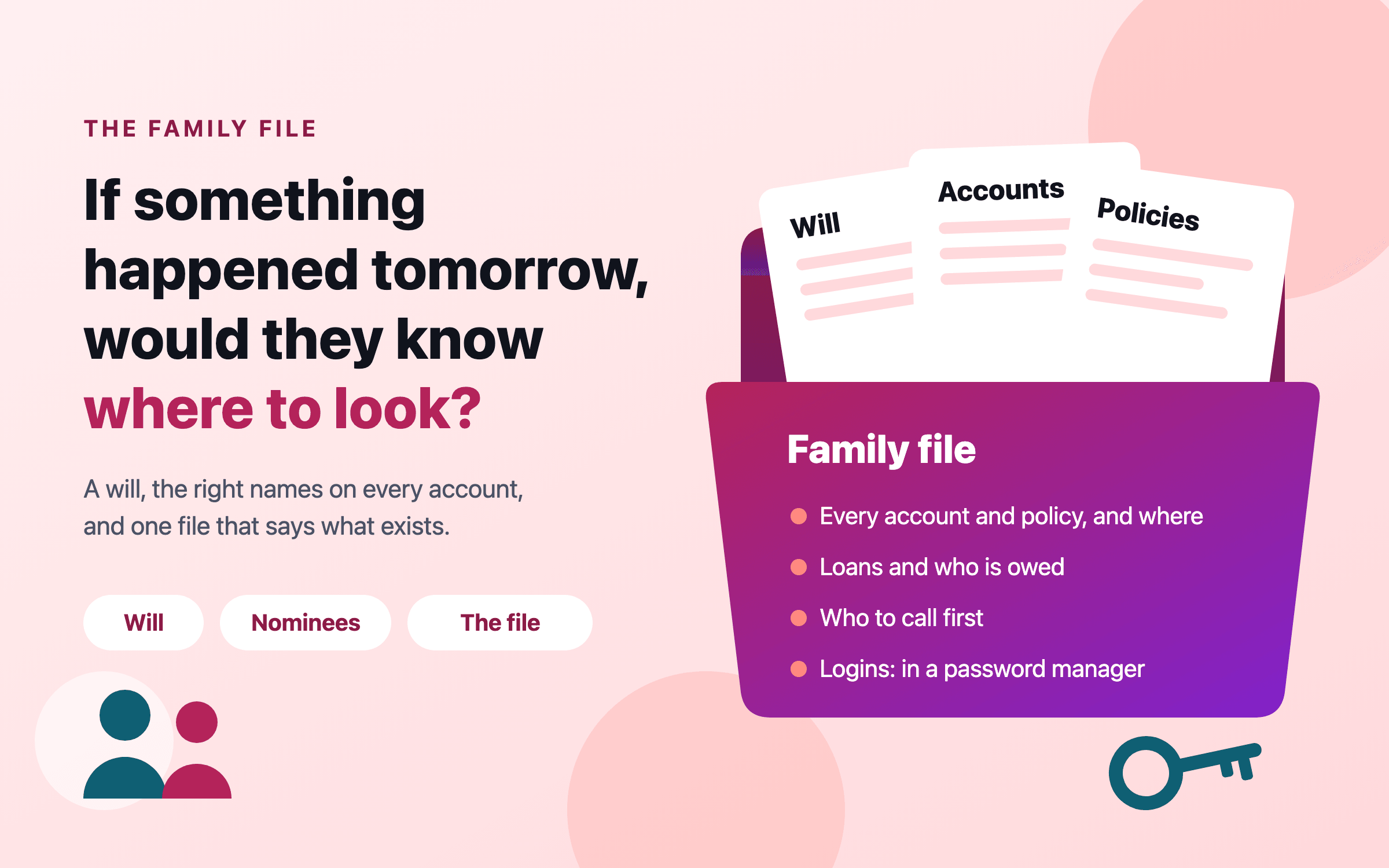
The last hour of the weekend is the least pleasant and the most important. If Arif were in hospital tomorrow, could Sana find every account on the list from Saturday morning? They check that every bank account, fund folio, demat account, provident fund and insurance policy has a nominee, they each write a simple will, and they keep one file that says what exists, where, and whom to call. The routes money takes after a death, and why a nominee and a will do different jobs, are in wills, nominees and the family file.
When to look again
A plan that is never opened again is a snapshot. Theirs gets three kinds of look, each short, and none triggered by a market headline.
Once a month, ten minutes: did the surplus reach each pot? Prices are worth checking at month-end, not at 2am; how to track a portfolio when markets swing has a routine for it.
Once a year, an afternoon: update the balance sheet, raise SIPs with pay rises, re-price each goal, check the size of the health cover.
Whenever life changes: a new job, a child, a move, a loan, or a rate change on a floating loan like this October’s5. Each one is a reason to re-run the plan, not to start a new one.
Questions people ask
How do I make a financial plan for my family?
Answer eight questions in order: what you own and owe, what comes in and goes out each month, how many months your savings cover, what cover you need if an earner dies or falls ill, what each goal costs in the year it is due, how much is enough to stop working, where each pot of money should sit, and who would find it all. Then set a date to review it.
How much term insurance does a family need?
A needs-based estimate adds the earner’s take-home pay for the years the family depends on it, the outstanding loans and the children’s education, then subtracts savings that could already pay for those. In this article’s illustrative family that came to about ₹2.05 crore for one earner and ₹1.33 crore for the other.
How big should a family emergency fund be?
Six months of essential spending is a common target for a household whose income depends on salaries; essentials leave out holidays, eating out and shopping. A household with very secure jobs may hold less, and one with a single earner or a volatile industry more.
How do I calculate the future cost of my child’s education?
Multiply today’s cost by one plus the education inflation rate, raised to the number of years until it is paid. At Nivritee’s India default of 4.74% a year, a ₹15 lakh degree today costs about ₹23.84 lakh in ten years7.
What is a financial independence number?
It is the amount that could pay for your yearly spending once you stop working, found by dividing that spending by a withdrawal rate. At ₹12 lakh a year and Morningstar’s 3.5% for a 35-year stretch, it is about ₹3.43 crore in today’s money8.
Should I change my financial plan when the market falls or rates rise?
Re-run it rather than rewrite it. A market fall changes how money for distant goals feels, not what those goals cost; a rate rise on a floating loan does change a figure, such as an EMI, and is worth putting into the plan5.
In the US, the UK, Canada, Singapore and Australia, roughly half of adults have no will. Money then moves by three routes: joint ownership, a name on the account, or a will — and where there is no will, a fixed legal order that may not match your wishes. Families with assets in more than one country need a plan for each, and everyone needs a family file that says what exists and where.
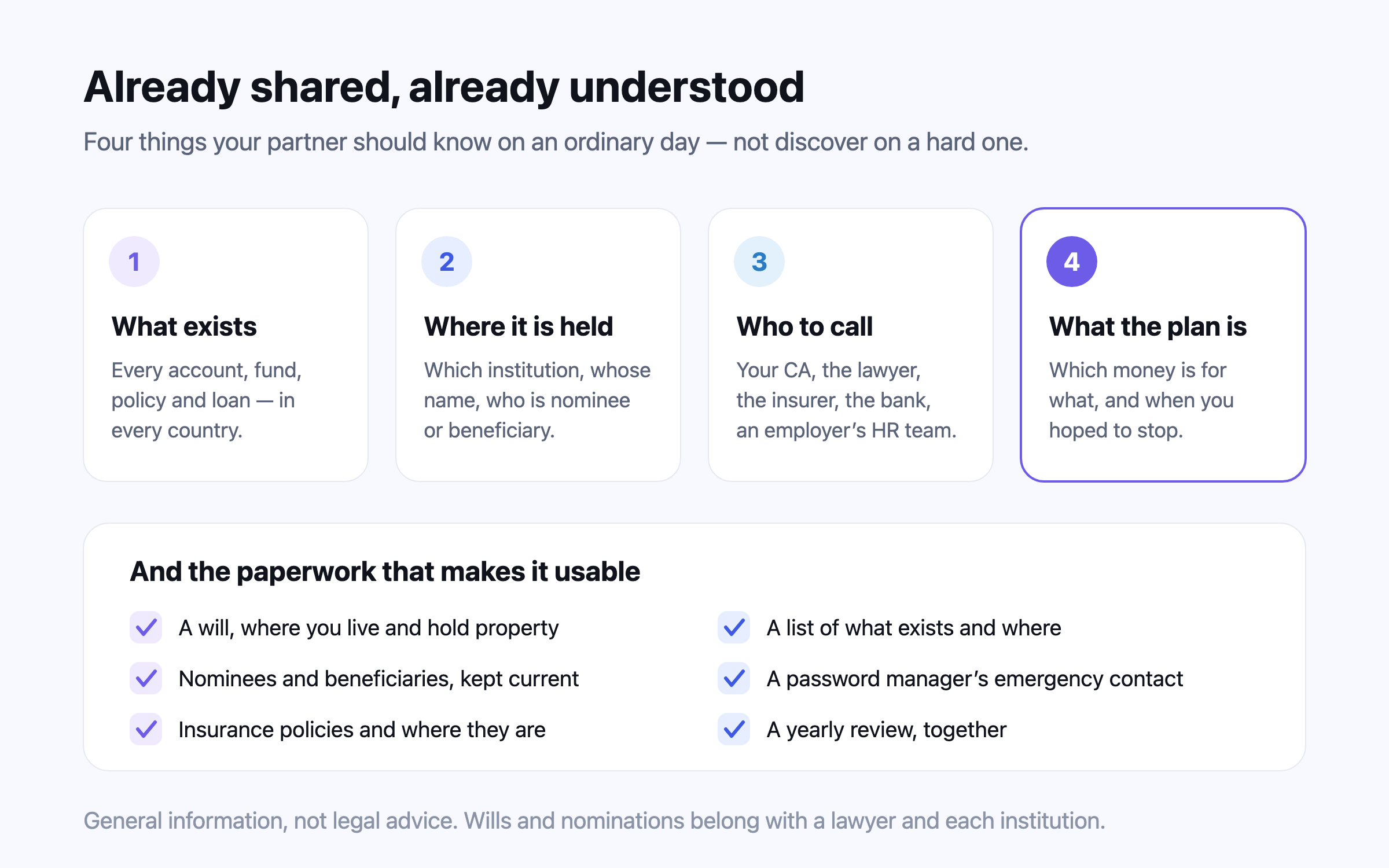
In most households one person knows where everything is. Readiness means your partner knows four things too — what you own and owe, where each is held, who to call, and what the plan is — plus the paperwork that makes it usable: a will, up-to-date nominations or beneficiaries, insurance details and a way into the accounts. The easiest time to share all of it is now, when nothing is wrong.
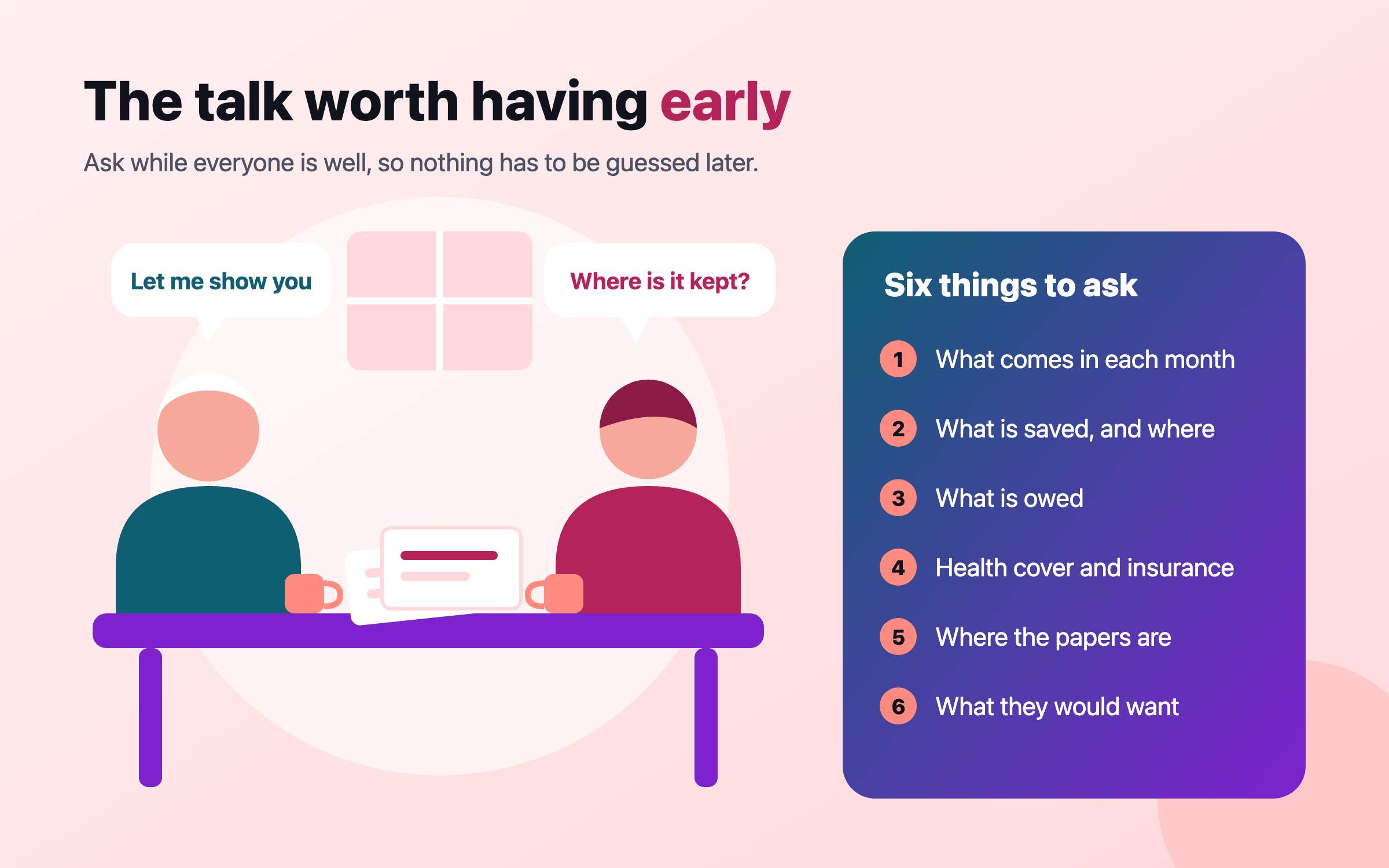
Most families have this conversation too late, in a hospital corridor. Asked early, it comes down to six things — what comes in, what is saved, what is owed, what cover exists, where the papers are and what your parents would want — plus a power of attorney signed while they are well, a watch for scams, and an agreed split of support between siblings that also fits inside your own plan.
This is general information, not financial, tax or legal advice for your circumstances. Rules and figures change; check the official source for your country, and consult a licensed professional before making financial decisions. Projections are estimates, not predictions.